


Vacuum chamber simulation test system for large-yield multi-point concentrated explosion cratering effects
-
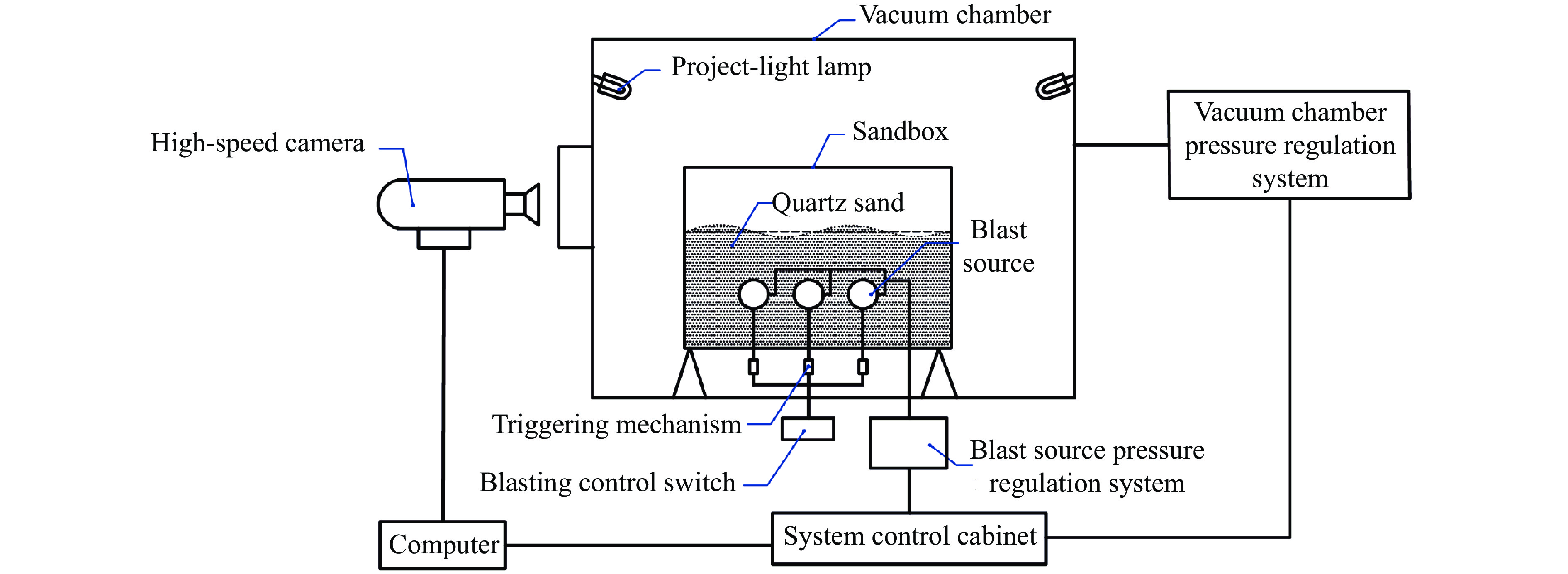
摘要: 针对传统单点模拟难以复现此类多点协同毁伤爆炸成坑效应的难题,创新性地设计并开发了基于真空室的大当量多点聚集爆炸成坑效应模拟试验系统。该系统的核心创新点在于利用真空室模拟试验技术可以高效、快捷的模拟大当量多点爆炸成坑效应,并且试验成本低,试验结果可重复。基于真空室爆炸模拟理论,建立了大当量多点聚集爆炸成坑效应的相似律,确定了真空室压力、多点模拟爆腔压力等关键参数,并通过同步性试验验证了多爆源之间的同步性。以“Palanquin”地下核爆炸成坑原型试验为参照,开展了深埋(4.3 kt,埋深85 m)与浅埋(5 kt,埋深20 m)两组不同工况下的三点爆源真空室爆炸成坑模拟试验,并与单点爆炸成坑原型试验统计结果及经验公式进行了对比。结果表明:相较于单点爆炸,多点爆炸显著提升了成坑半径、体积及自由面投影面积,极大扩展了毁伤区域;爆源埋深对毁伤效应影响显著。Abstract: The multi-point focused explosions of new low-yield earth-penetrating nuclear weapons pose a serious threat to deep underground engineering projects. Addressing the challenge that traditional single-point simulations struggle to replicate the cratering effects of such multi-point synergistic damage, and considering that current explosive testing, while efficient, faces significant limitations hindering normal operations, research innovatively designs and develops a vacuum chamber-based simulation test system for large-yield multi-point focused explosion cratering effects. The core innovation lies in applying similarity theory to convert prototype tests into simulated tests. The vacuum chamber simulation technology enables efficient and rapid simulation of large-yield multi-point explosion cratering effects, with low experimental costs and repeatable results. Based on vacuum chamber explosion simulation theory, the similarity laws governing large-yield multi-point focused explosion cratering were established, defining key parameters such as vacuum chamber pressure and multi-point simulated blast cavity pressure. Synchronization tests verified the simultaneity of multiple explosive sources. Referencing the underground nuclear test, we conducted vacuum chamber simulations for three-point sources under deep burial (4.3 kt, 85 m depth) and shallow burial (5 kt, 20 m depth) scenarios, comparing results with single-point explosion prototype data and empirical formulas. Through synchronization tests and three-point explosive source cratering tests, differences in cratering parameters under varying burial depths and yields were quantitatively analyzed. This revealed a significant advantage in damage range for multi-point sources compared to single-point sources when the total yield is identical. Key results indicate: A vacuum chamber simulation system is successfully developed, relying on a miniature explosive device based on the two-stage gas gun principle and the vacuum chamber. Synchronization tests confirmed good simultaneity among explosive sources using a common detonation control switch; Compared to single-point explosions, multi-point explosions significantly increased crater radius, volume, and free surface projection area, greatly expanding the damage zone; Explosive source burial depth significantly impacts the damage effect.
-
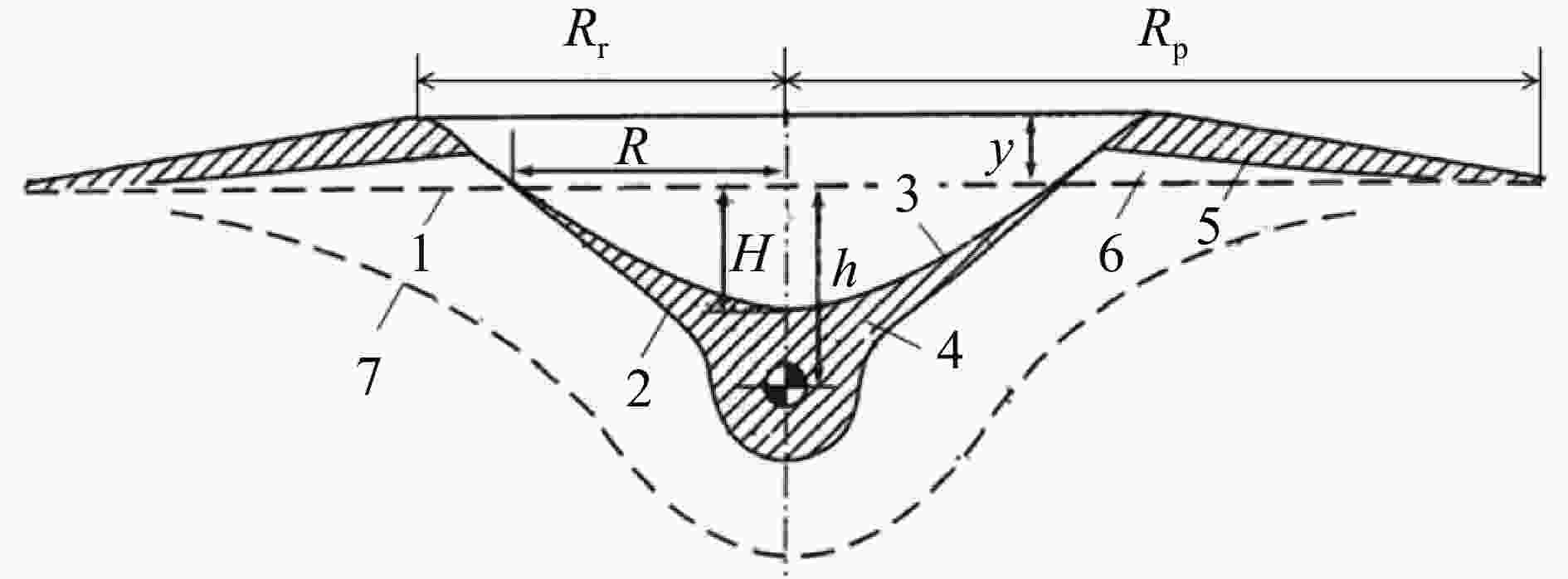
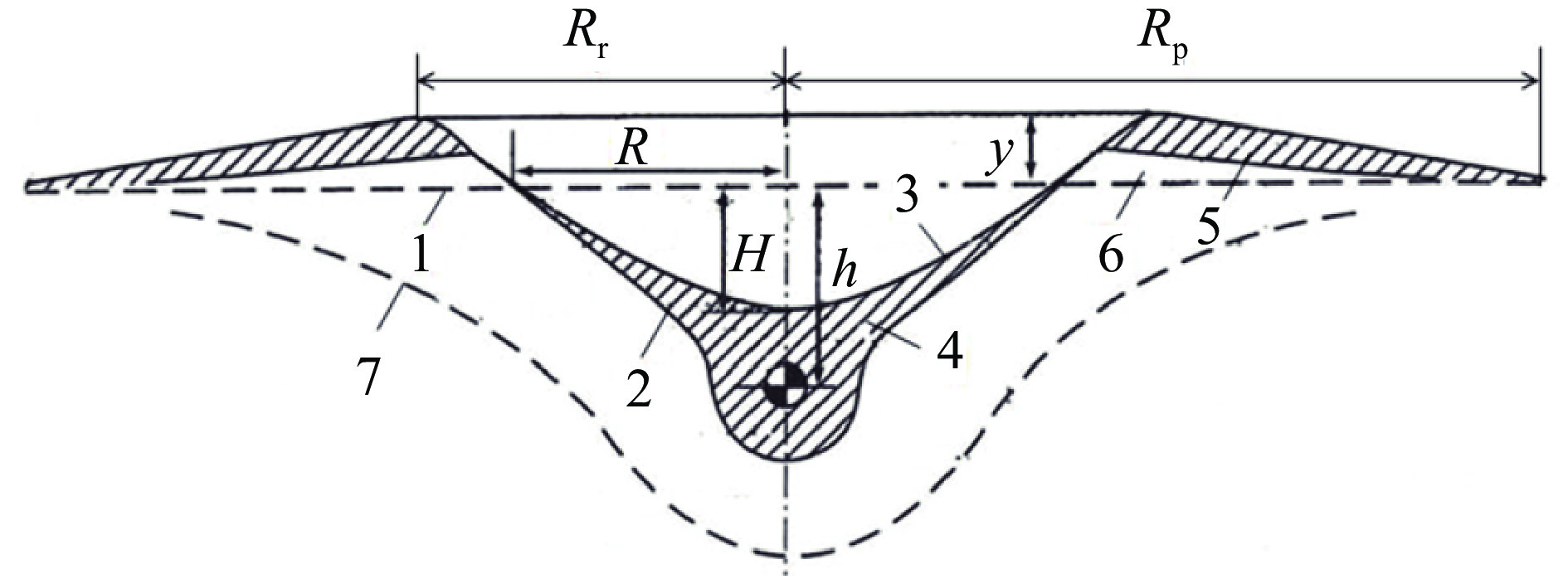
图 1 抛掷弹坑构造示意图
Figure 1. Ejecta crater schematic diagram
1. initial position of the ground surface;2. contour of the “true” crater;3. contour of the visible crater;4. inner ejecta blanket;5. outer mound (ejecta blanket);6. zone of residual deformations;7. boundary of the damaged rocks
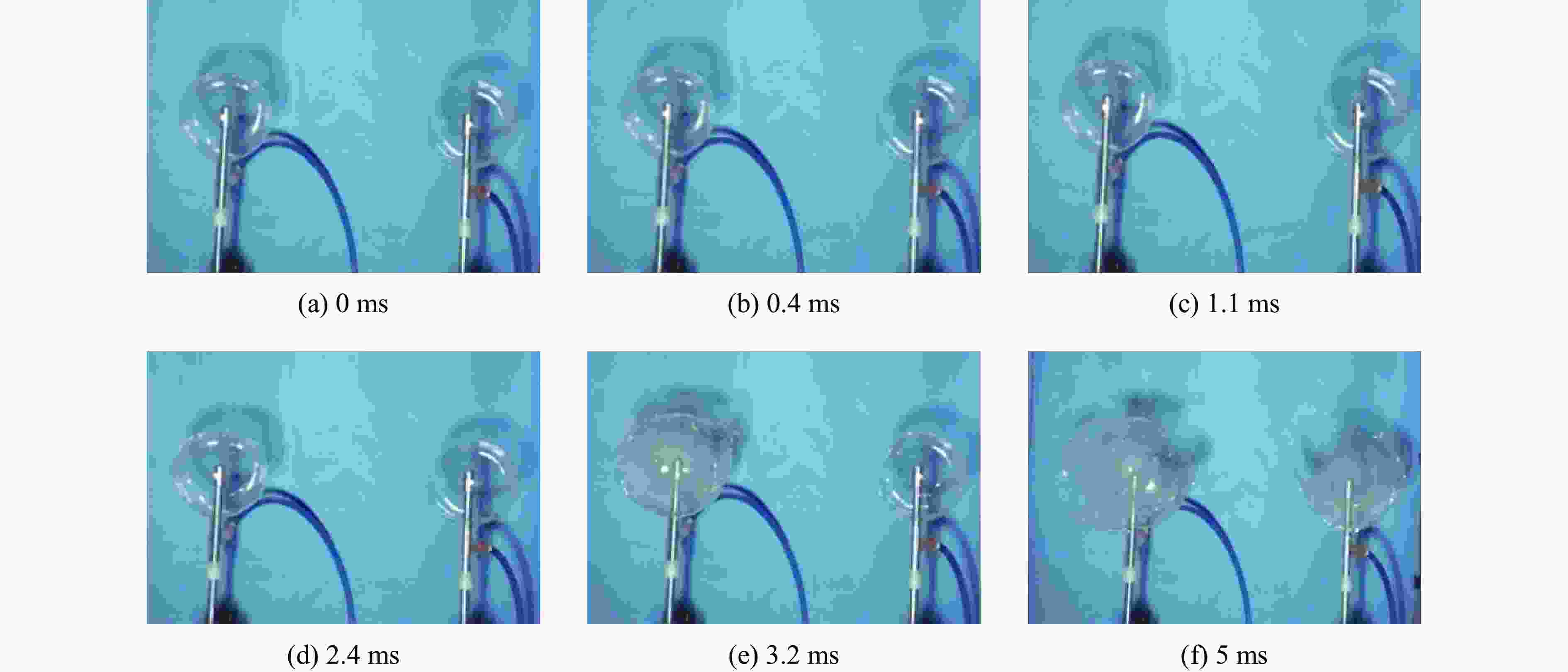
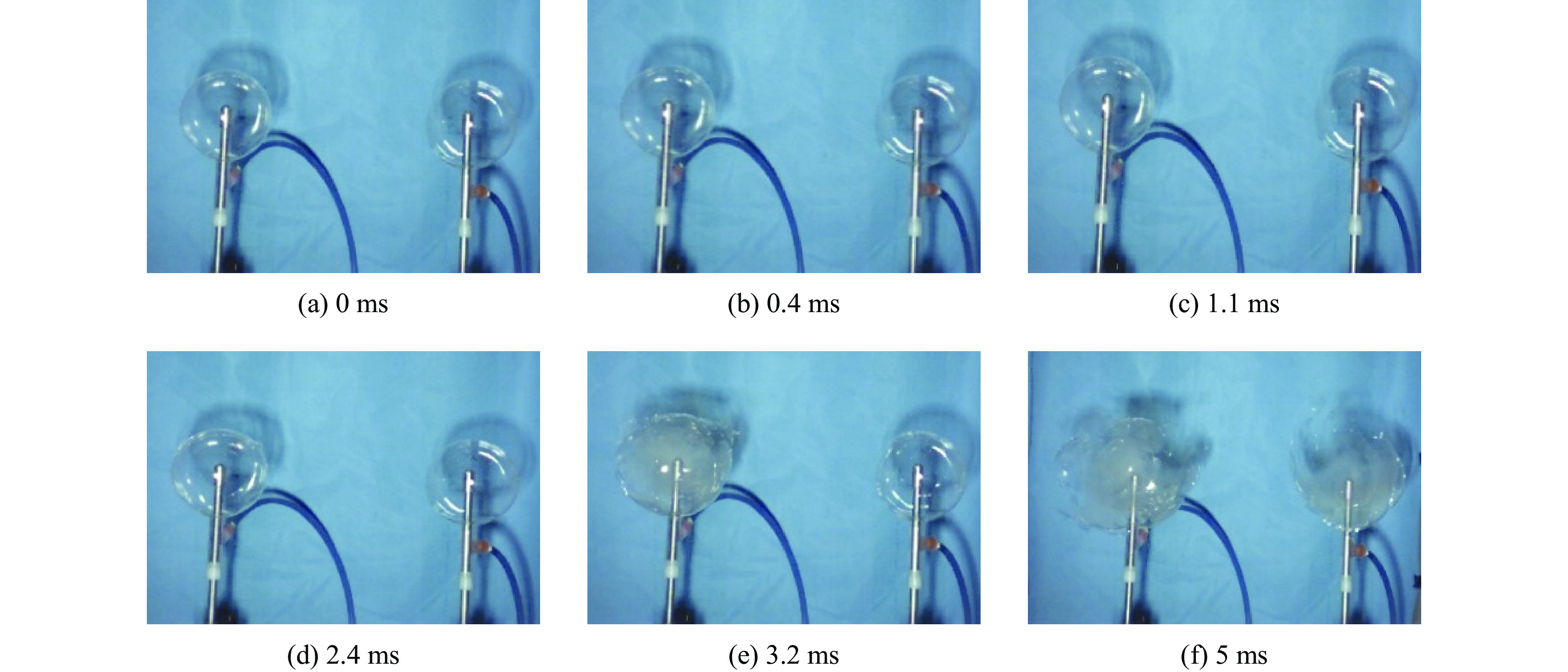
图 8 两点爆源空气中同步爆破试验镜头
Figure 8. Test footage of dual-point blast sources in simultaneous air detonation
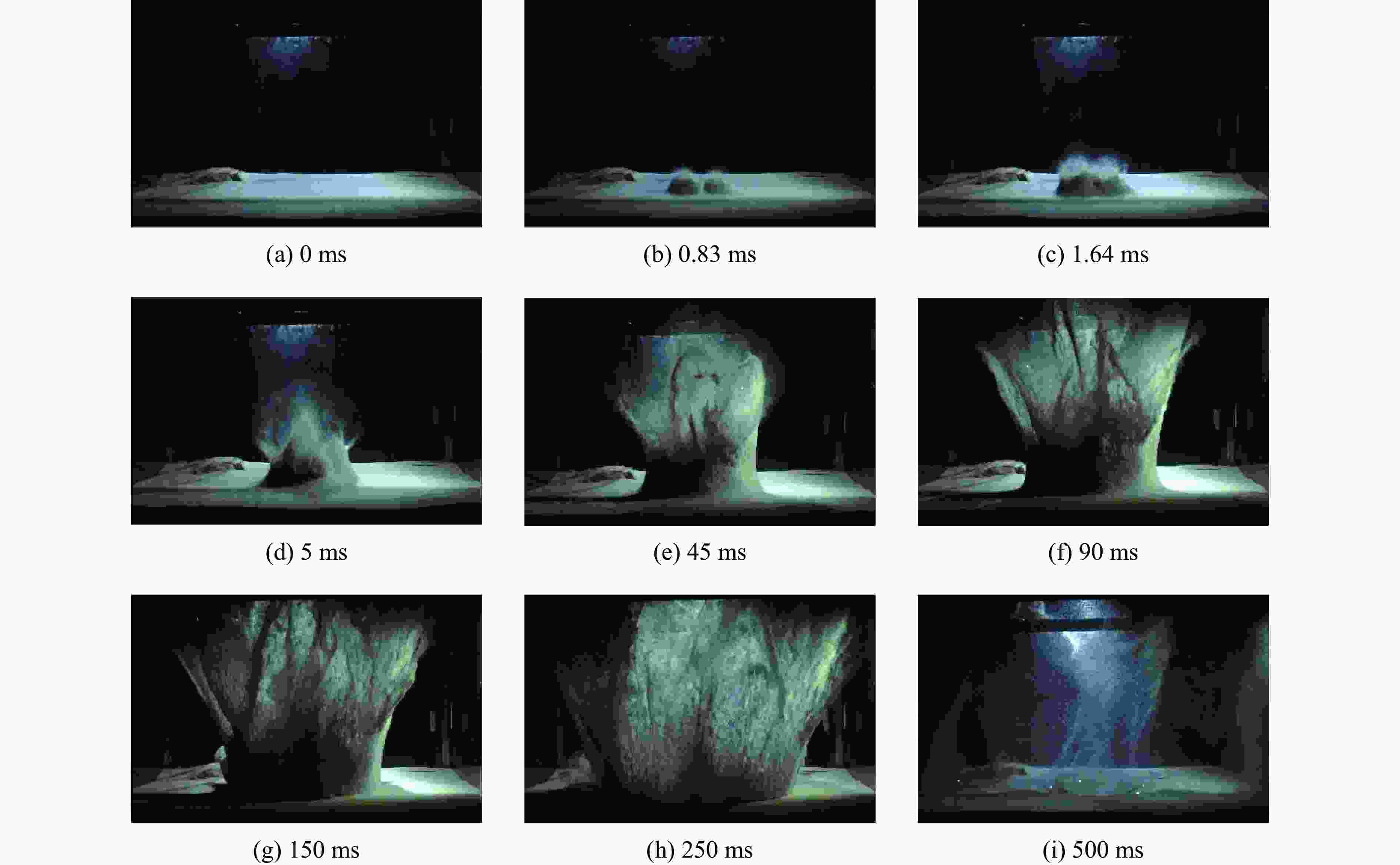
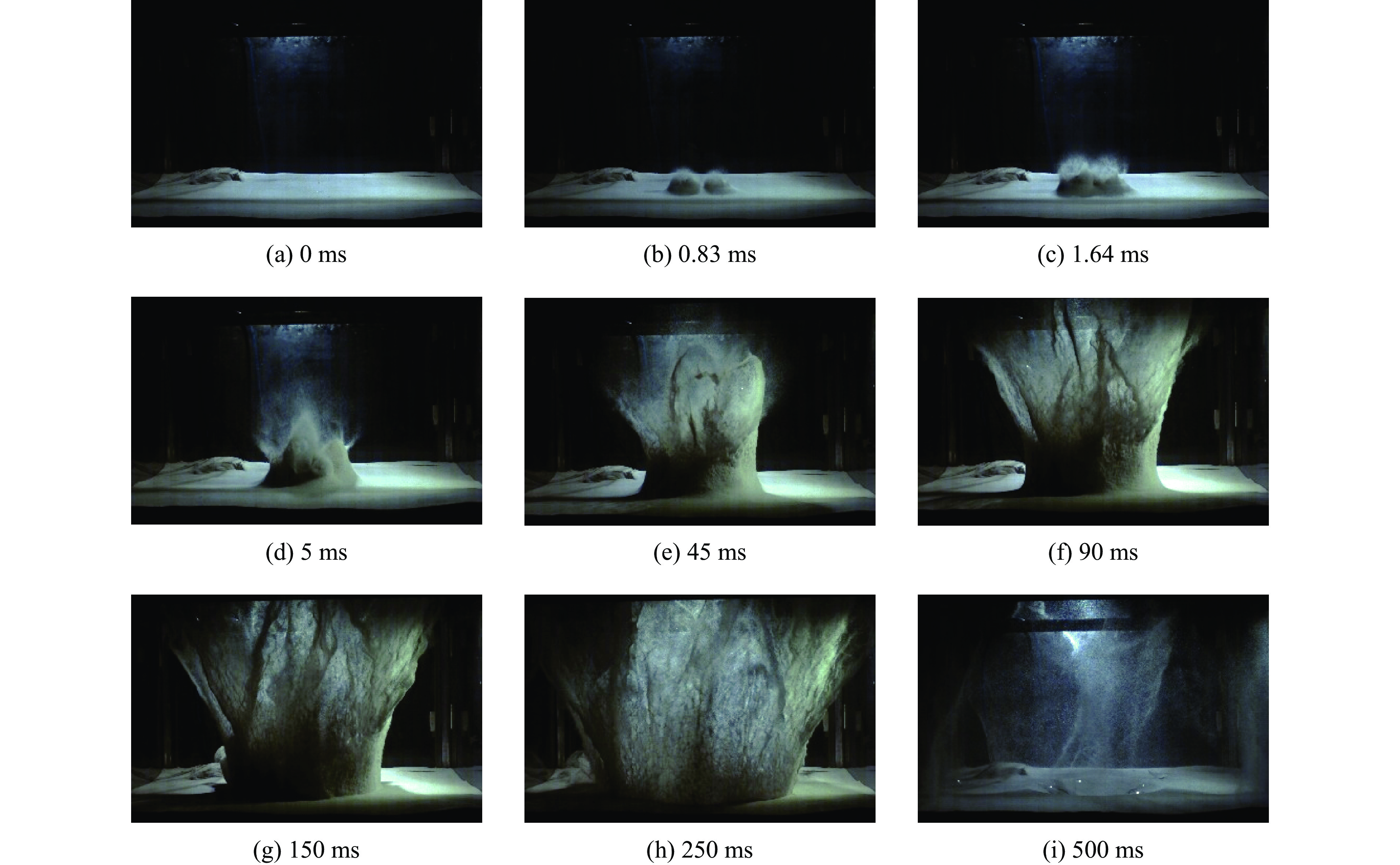
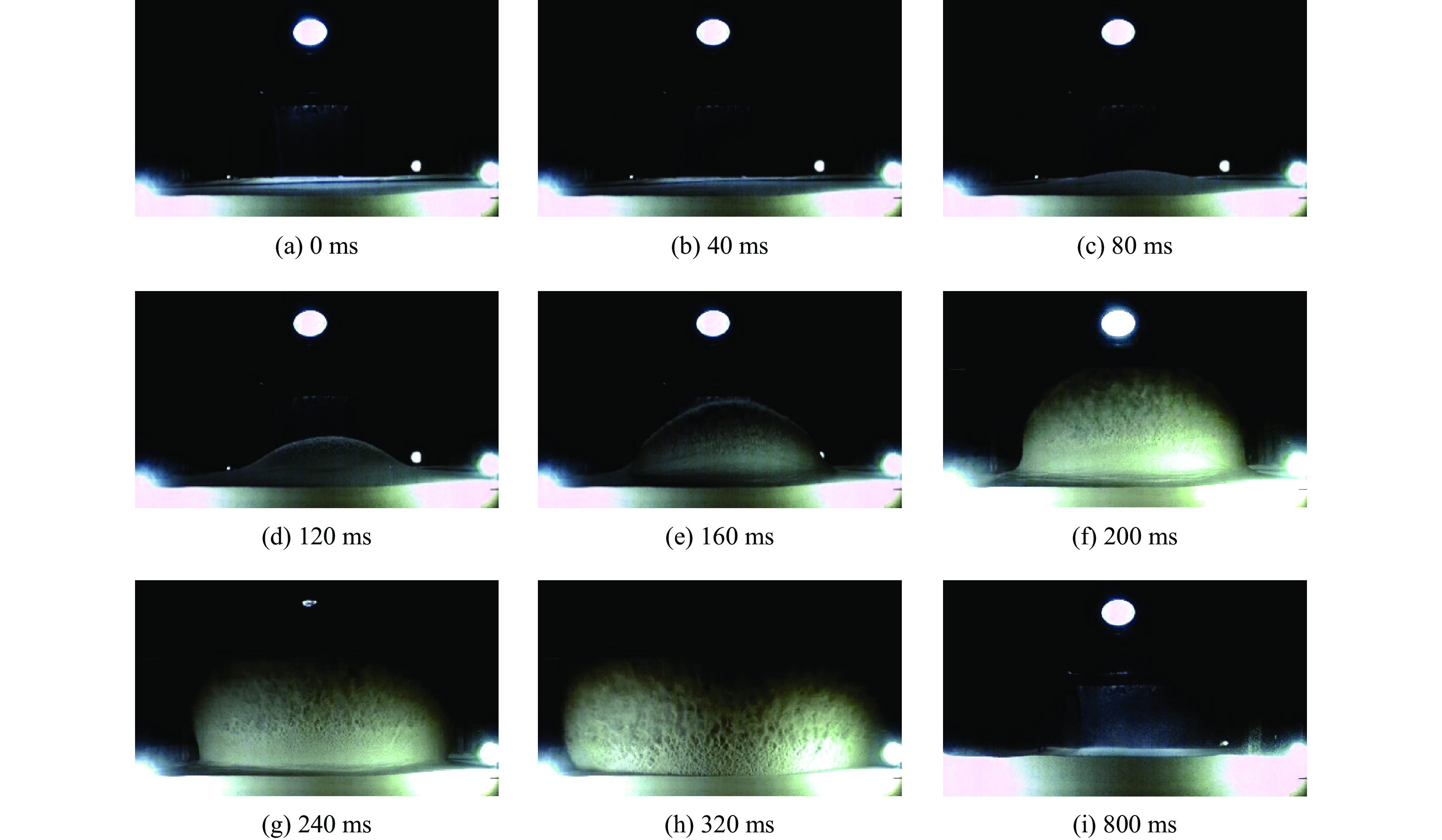
图 11 三点爆源浅埋模拟试验成坑抛掷过程
Figure 11. Cratering and ballistic ejecta process in shallow-buried triple-point blast simulation test
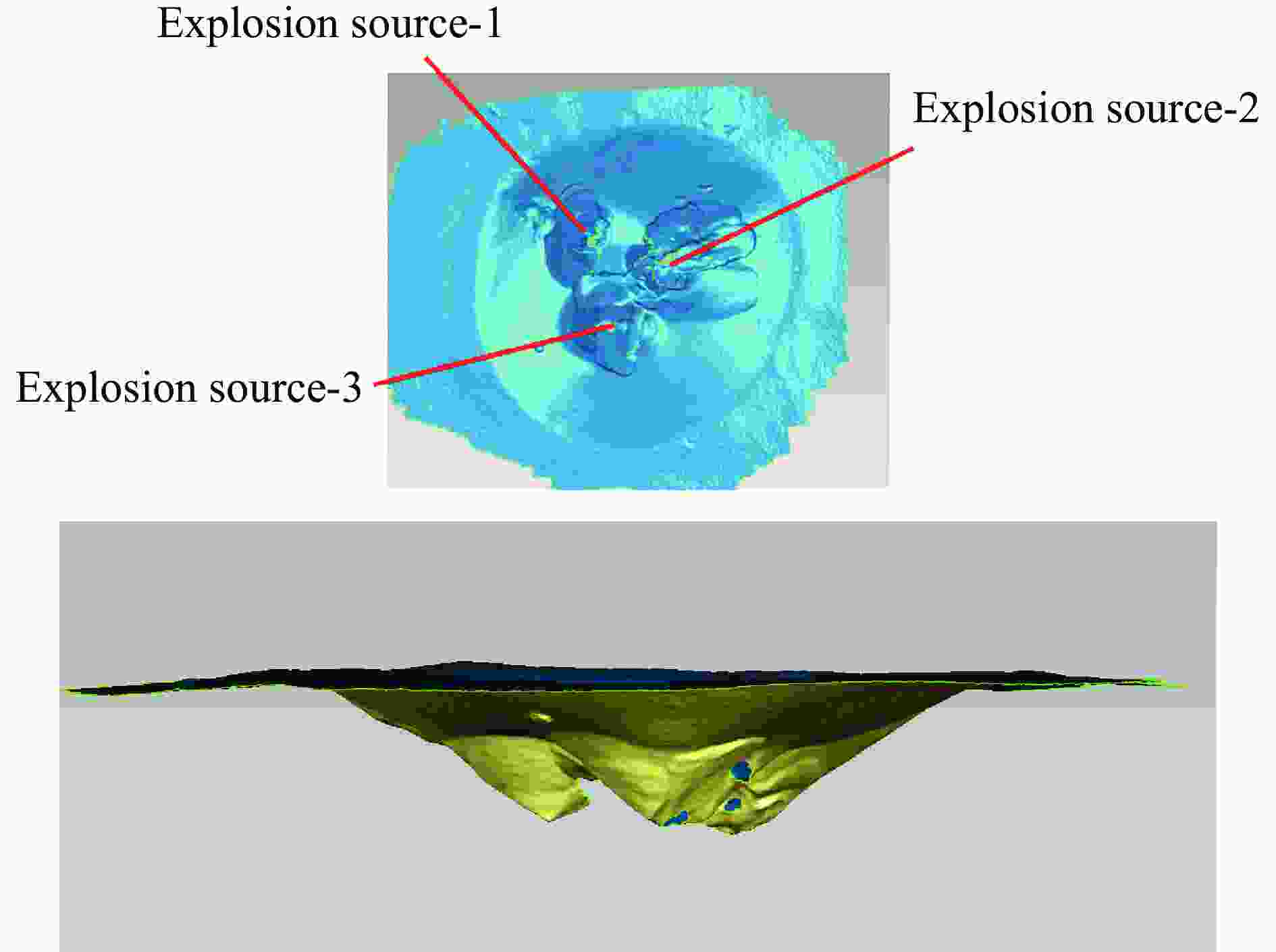
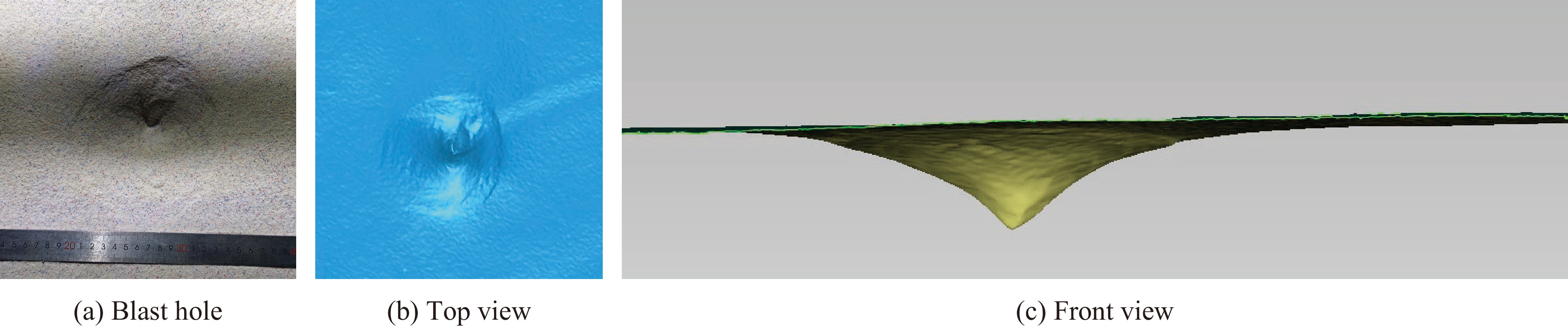
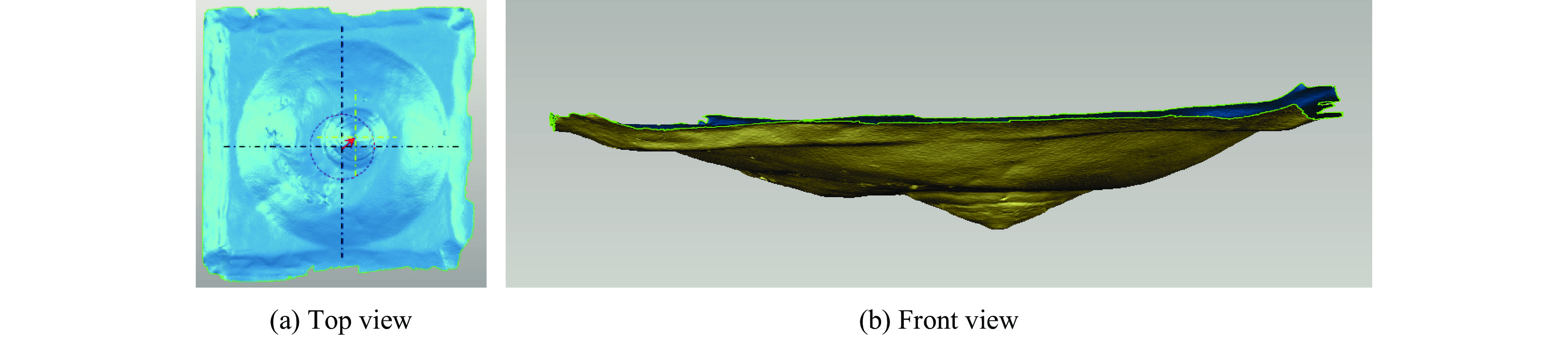
图 12 模拟试验爆坑形态3D扫描图
Figure 12. 3D scan reconstruction of blast crater morphology from simulation test
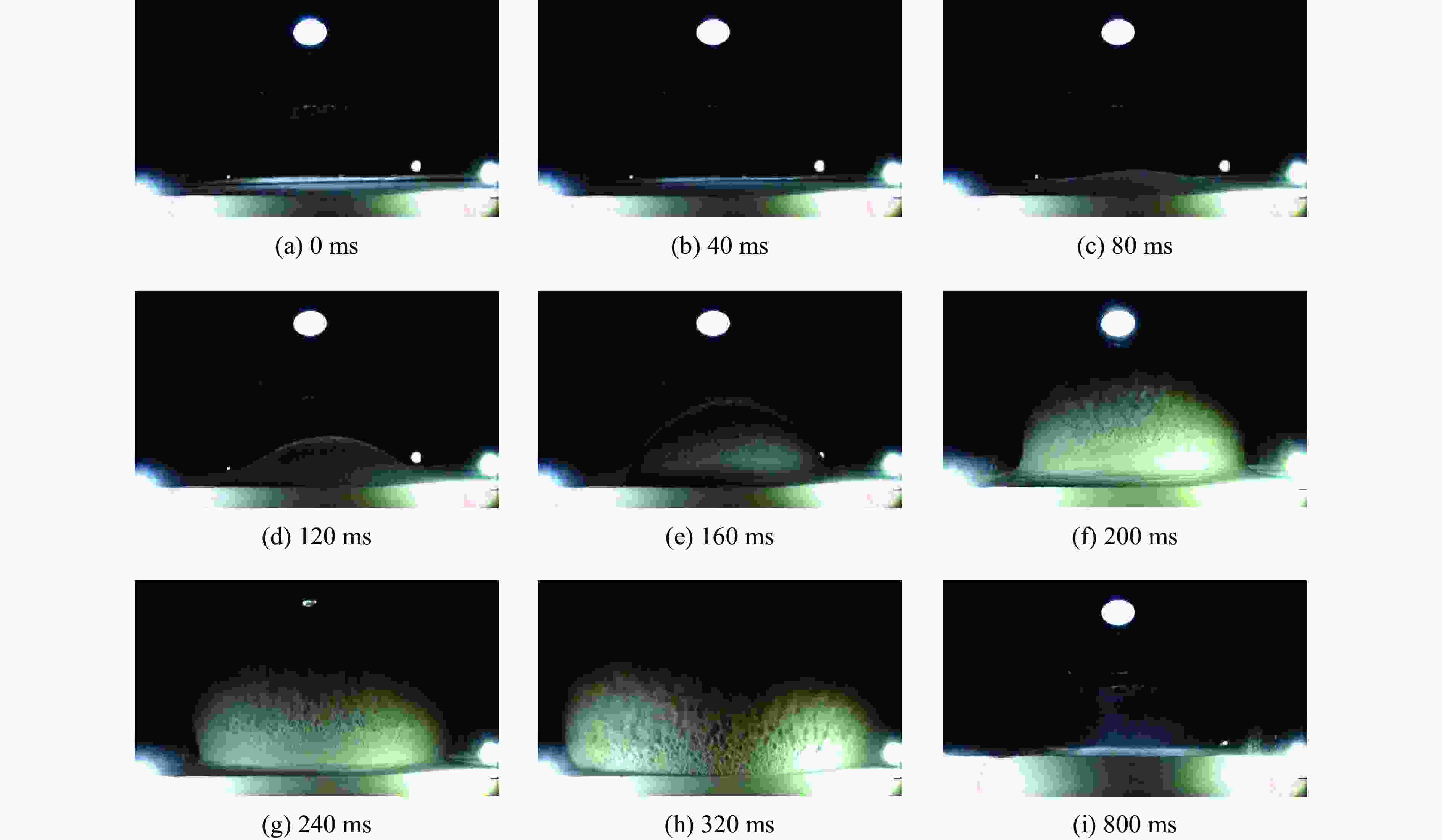
图 13 三点爆源深埋模拟试验成坑抛掷过程
Figure 13. Cratering and ballistic ejecta process in deep-buried triple-point blast simulation test
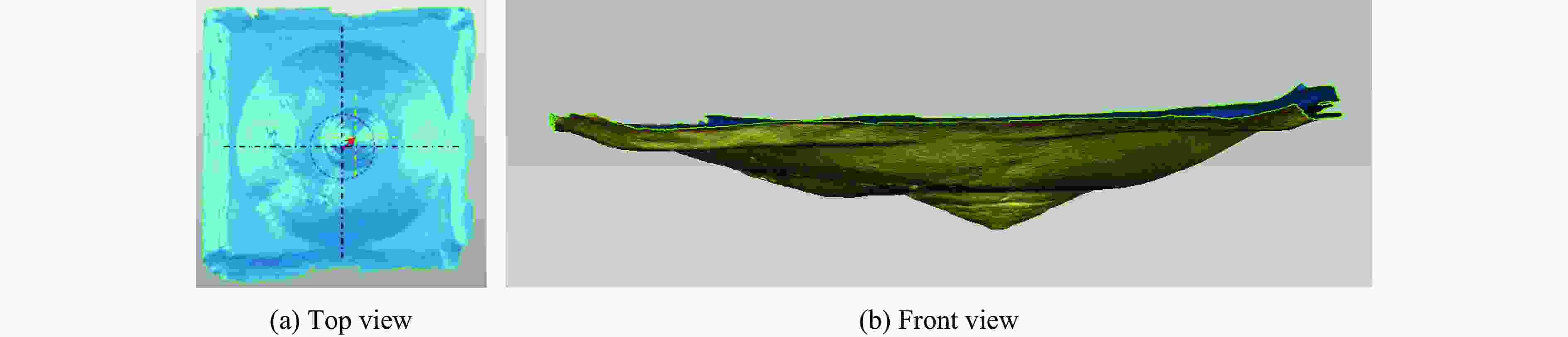
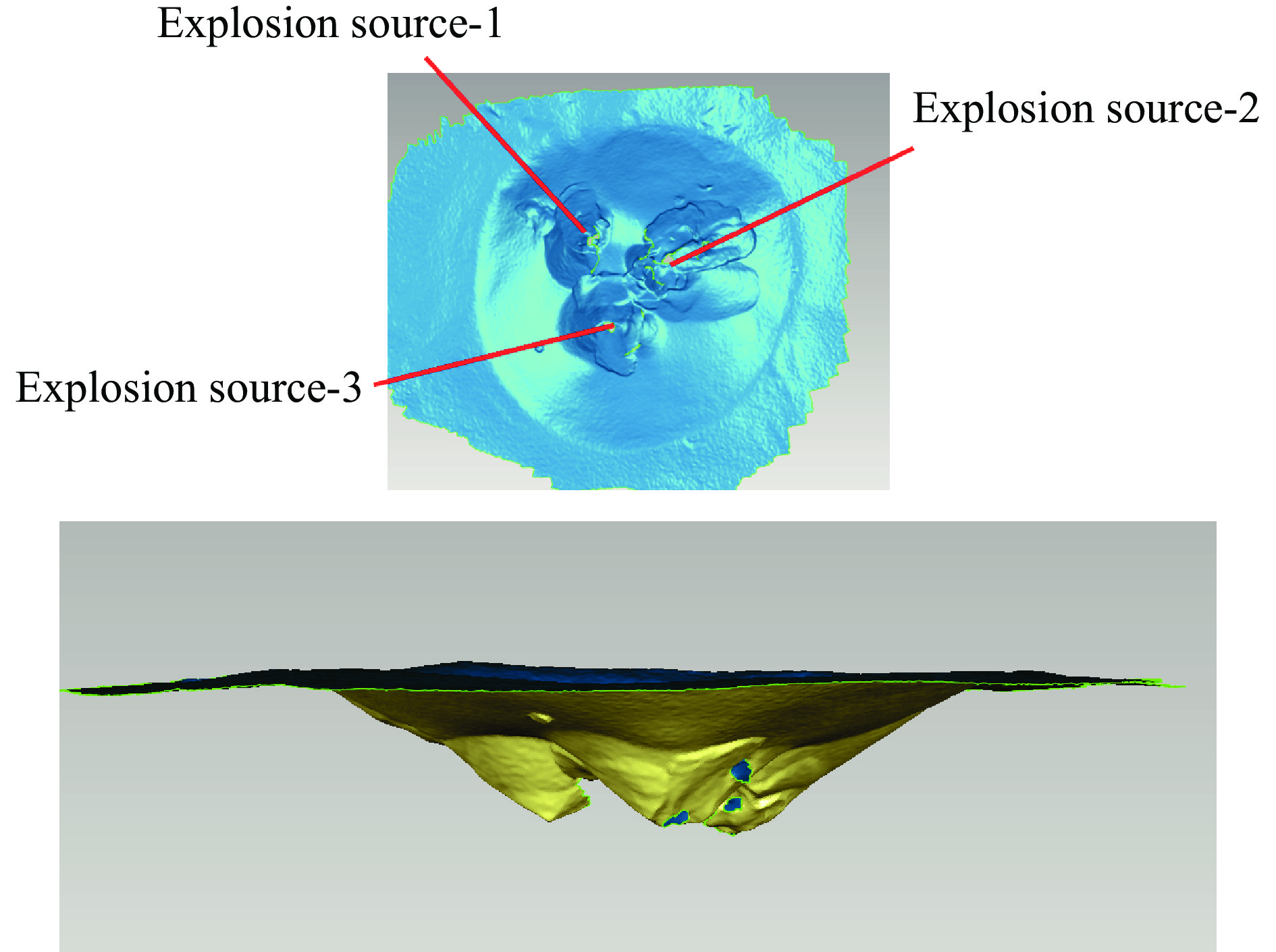
图 14 三点爆源深埋模拟试验爆坑形态3D扫描图
Figure 14. 3D Scan reconstruction of blast crater morphology from simulation test
表 1 多点爆炸成坑模拟试验参数
Table 1. Crater formation simulation parameters for multi-point blast testing
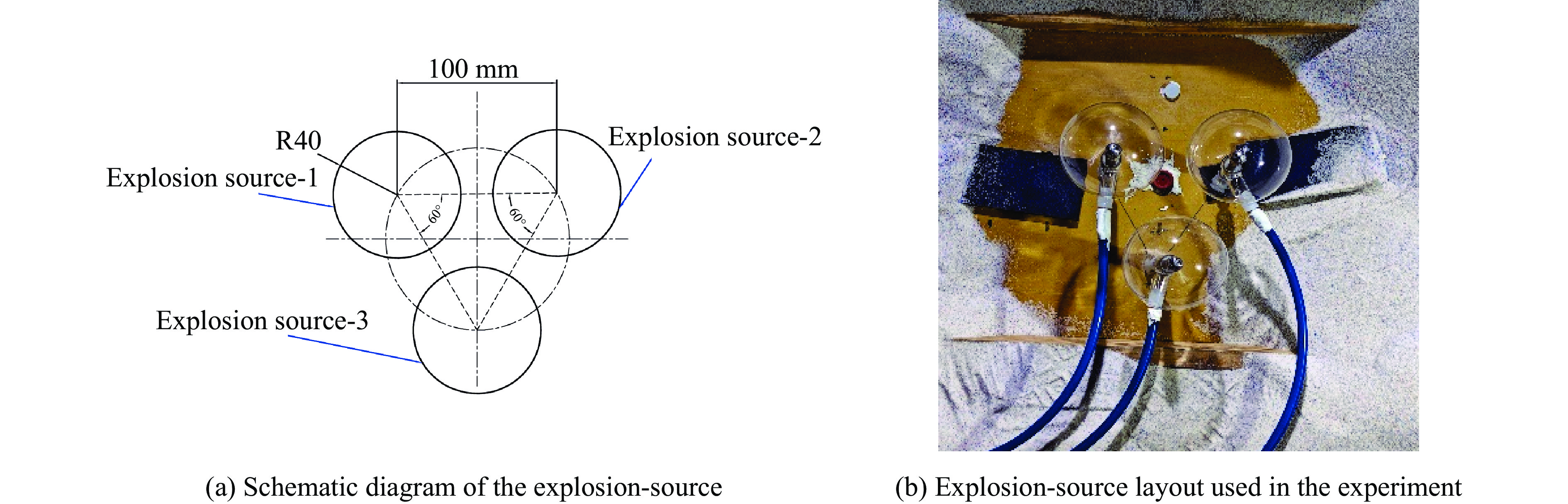
模型 qtotal/kt q/kt W/m $ {\overline{r}}_{\mathrm{n}} $ rn/m (A)R/J (pn)R/Pa (pa)R/Pa 1 4.3 1.43 85 11 12.4 8.48×10¹¹ 5.11×10⁷ 1.01×10⁵ 2 5 1.67 20 15 17.8 9.04×10¹¹ 1.97×10⁷ 1.01×10⁵ 模型 $ {\eta }_{\varepsilon } $ r/m N (p)M/kPa (pa)M/Pa D/m d/mm h/mm 1 0.01 0.04 310 164.9 325.77 44.5 100 45 2 0.153 0.04 445 44 227 31 100 274 注:qtotal为总当量,q为单个爆源当量,W为原型试验爆源埋深,$ {\overline{r}}_{\mathrm{n}} $为比例半径,rn为爆腔半径,(A)R为气体生成物势能,(pn)R为原型试验爆腔压力,(pa)R为原型试验自由面压力,r为玻璃球半径,N为模拟比尺,(p)M为玻璃球内气体压力,(pa)M为真空室压力,D为原型试验爆源间距,d为模型试验爆源间距,h为模型试验爆源埋深  下载: 导出CSV
表 2 同当量单点爆源弹坑数据
Table 2. Ballistic Crater Data for Equivalent-Yield Single-Point Blast Source
qtotal/kt W/m rn/m R/m H/m V/m3 S/m2 “Palanquin”原型试验 4.3 85 17.8 46 28 6.2×10⁴ 0.66×10⁴ 5kt单点浅埋爆炸试验 5 20 25.6 69.82 32.12 2.51×10⁵ 1.49×10⁴ 注:S为弹坑在自由面上的投影面积。
下载: 导出CSV
表 3 三点浅埋埋爆源成坑数据与5 kt单点浅埋爆炸试验经验公式结果对比
Table 3. Comparison between cratering data from triple shallow-buried blast sources and empirical formula results of 5 kt single-point shallow buried explosive test
qtotal/kt D/m W/m R/m H/m V/m3 S/m2 5kt单点浅埋爆炸试验 5 -- 20 69.82 32.12 2.51×10⁵ 1.49×10⁴ 三点浅埋真空室模拟试验 31 20 85.6 35.8 2.70×10⁵ 2.08×10⁴ 对比结果 -- 18.4% 10.2% 7.04% 28.4%
下载: 导出CSV
表 4 三点深埋爆源成坑数据与“Palanquin”原型试验对比
Table 4. Comparison of three-point deep-buried explosion sources crater formation data with the "Palanquin" prototype test
qtotal/kt D/m W/m R/m H/m V/m3 S/m2 “Palanquin”原型试验 4.3 85 46 28 6.2×10⁴ 0.66×10⁴ 真空室三点模型试验 31 85 114.1 35.6 5.52×10⁵ 8.09×10⁴ 对比结果 59.7% 21.3% 88.8% 91.8%
下载: 导出CSV
表 5 三点钻地核爆成坑相似原型推算数据
Table 5. Calculated Data for Hypothetical Crater Formation from Three-Point Earth-Penetrating Nuclear Explosions
qtotal/kt D/m W/m R/m H/m V/m3 S/m2 5kt三点浅埋真空室模拟试验 5 44.5 20 85.6 35.8 2.70×10⁵ 2.08×10⁴ “Palanquin”真空室三点模型试验 4.3 31 85 114.1 35.6 5.52×10⁵ 8.09×10⁴ 对比结果 24.9% 0.5% 51.1% 74.3%
下载: 导出CSV
-
[1] SADOVSKII M A, ADUSHKIN V V, RODIONOV V N, et al. A method of modeling large cratering explosions [J]. Combustion, Explosion and Shock Waves, 1967, 3(1): 73–79. DOI: 10.1007/BF00741616. [2] ADUSHKIN V V, PERNIK L M. Design of linear charges for caving a slope by a large-scale explosion [J]. Soviet Mining, 1989, 25(6): 505–509. DOI: 10.1007/BF02528298. [3] ADUSHKIN V V, KAMALYAN R Z, KOROLEV K D. Character of the interaction of concentrated excavation charges detonated at different times [J]. Combustion, Explosion and Shock Waves, 1989, 25(6): 782–785. DOI: 10.1007/BF00758751. [4] BLINOV I M, VAKHRAMEEV Y S. The method for modelling large-scale outburst explosions by microexplosions of explosive charges [J]. Fizika Goreniya I Vzryva, 1995, 31(2): 102–109. [5] VAKHRAMEEV Y S. Physical foundations for approximately modeling explosions with ejecta [J]. Combustion, Explosion and Shock Waves, 1995, 31(1): 120–125. DOI: 10.1007/BF00755969. [6] 徐小辉, 邱艳宇, 王明洋, 等. 大当量浅埋地下爆炸抛掷成坑效应的缩比模拟实验装置 [J]. 爆炸与冲击, 2018, 38(6): 1333–1343. DOI: 10.11883/bzycj-2017-0144.XU X H, QIU Y Y, WANG M Y, et al. Development of the testing apparatus for modeling large equivalent underground cratering explosions [J]. Explosion and Shock Waves, 2018, 38(6): 1333–1343. DOI: 10.11883/bzycj-2017-0144. [7] 徐小辉, 邱艳宇, 王明洋, 等. 大当量地下浅埋爆炸真空室模拟相似材料研究 [J]. 岩石力学与工程学报, 2018, 37(S1): 3550–3556. DOI: 10.13722/j.cnki.jrme.2016.1539.XU X H, QIU Y Y, WANG M Y, et al. Similar materials for vacuum chamber model test under large scale throw blasting [J]. Chinese Journal of Rock Mechanics and Engineering, 2018, 37(S1): 3550–3556. DOI: 10.13722/j.cnki.jrme.2016.1539. [8] 王明洋, 徐小辉, 邱艳宇, 等. 一种用于模拟爆炸效应的爆源装置: CN201710295250.6 [P]. 2017-04-28.WANG M Y, XU X H, QIU Y Y, et al. Explosion resource device for simulating explosion effect: CN201710295250.6 [P]. 2017-04-28. [9] ADUSHKIN V V, SPIVAK A. Underground explosions: WGC-2015-03 [R]. Lexington: Weston Geophysical Corp, 2015. [10] 郭纬, 徐小辉, 李干, 等. 二级高压驱动阵列弹珠同步弹射微型爆源的研制 [J]. 爆炸与冲击, 2022, 42(8): 084101. DOI: 10.11883/bzycj-2021-0343.GUO W, XU X H, LI G, et al. Development of a miniature explosion device initiated by a synchronous launcher of marbles driven by two-stage high-pressure gas [J]. Explosion and Shock Waves, 2022, 42(8): 084101. DOI: 10.11883/bzycj-2021-0343. -

计量
- 文章访问数: 1525
- HTML全文浏览量: 387
- PDF下载量: 140
- 被引次数: 0