


Research on new intelligent flyer-type electronic detonator
-
摘要: 针对工业电子雷管因使用敏感起爆药剂导致的意外爆炸风险,以及传统无起爆药雷管存在的安全与环保问题,为了通过飞片起爆技术提升炸药安全性和环保性能,提出一种新型智能飞片式电子雷管设计:通过理论分析确定飞片起爆临界参数,结合数值模拟优化飞片速度;采用高速摄影观测飞片运动特性,通过铅板穿孔试验评估轴向起爆能力;利用水下爆炸试验验证爆轰稳定性;并开展空气间隔殉爆试验测试安全距离。研究显示:主装药结构优化(一次药400 mg/1.56 g/cm3、二次药200 mg/1.41 g/cm3、三次药320 mg/散装)可实现稳定爆轰;飞片发生器收口直径5.6~5.7 mm时飞片速度达可靠起爆阈值,铅板试验显示轴向起爆能力优于传统无起爆药雷管;水下爆炸试验证实爆轰性能稳定,空气间隔殉爆距离不低于30 mm,满足40 mm生产工艺安全要求;创新性地取消四次药,简化生产工艺,兼具高安全性与绿色环保特性。研究结果表明:新型智能飞片式电子雷管通过飞片起爆技术彻底规避装填敏感起爆药剂,在起爆可靠性、安全距离及环保性能上显著优于传统结构,符合工业雷管安全化、绿色化发展趋势,为行业提供了创新解决方案。Abstract: To address the accidental explosion risks caused by sensitive primary explosives in industrial electronic detonators, as well as the safety and environmental issues associated with traditional no-primary detonators, a new intelligent flyer-type electronic detonator design was proposed to enhance the safety and environmental performance through flyer initiation technology. To achieve reliable initiation without sensitive primary explosives, a multi-dimensional approach combining experimental and numerical simulation methods is employed for the design and performance optimization of the new intelligent flyer-type electronic detonator. First, critical parameters for slapper initiation were determined through theoretical modeling of shock wave propagation and energy transfer. A finite element model of the flyer acceleration process was established to simulate the effects of different charge structures (e.g., confinement diameter, thickness) on flyer velocity, comprehensively considering material deformation, detonation wave interactions, and flyer fragmentation effects. Second, a high-speed camera (500 000 Hz) was used to synchronously record the detonation process, capturing the actual velocity, flight attitude, and deformation behavior of the flyer upon target impact. This data was used to validate the numerical model and optimize the structural design of the flyer generator. Third, the axial initiation capability was evaluated through standardized lead plate (5 mm thickness) penetration tests. The penetration depth and crater morphology were comparatively analyzed to quantify performance differences with traditional no-primary detonators. Fourth, an underwater explosion test system was utilized, with an array of pressure sensors measuring shock wave overpressure and bubble pulse energy to assess detonation stability and energy output efficiency. Fifth, donor/acceptor detonator arrays were set up at 10–50 mm intervals, and high-speed cameras were used to monitor sympathetic detonation phenomena, verifying compliance with the industrial safety standard of 40 mm minimum separation distance. Sixth, charge parameters were optimized through iterative testing: Primary charge (400 mg, compaction density 1.56 g/cm3) ,Secondary charge (200 mg, compaction density 1.41 g/cm3) , Tertiary charge (320 mg, loosely packed) ,The fourth charge layer was eliminated to simplify the production process while maintaining performance. This multi-scale methodology system provides systematic validation support for the reliability, safety, and environmental friendliness of the flyer initiation technology. The results were aquired as follows. Optimized main charge configuration (primary charge: 400 mg−1.56 g/cm3, secondary charge: 200 mg−1.41 g/cm3, tertiary charge: 320 mg-loosely packed) achieved stable detonation, achieve synergistic improvement of detonation performance and safety. When the slapper generator's necking diameter was 5.6-5.7 mm, the flyer velocity reached the reliable initiation threshold. Lead plate tests demonstrated superior axial initiation capability compared to traditional no-primary detonators. Underwater explosion tests confirmed stable detonation performance, with an air-gap sympathetic detonation distance ≥30 mm, meeting the 40 mm safety requirement for production processes. The innovative elimination of the fourth charge simplified the production process while maintaining high safety and environmental friendliness.The technical bottlenecks of traditional no-primary detonators has been broken. The results show that he new intelligent flyer-type electronic detonator completely avoids the use of sensitive primary explosives through flyer initiation technology. It significantly outperforms traditional designs in initiation reliability, safety distance, and environmental performance, aligning with the industry's trend toward safer and greener detonators. This study provides an innovative solution for the field.
-
Key words:
- electronic detonator /
- flyer /
- structural design /
- safety
-
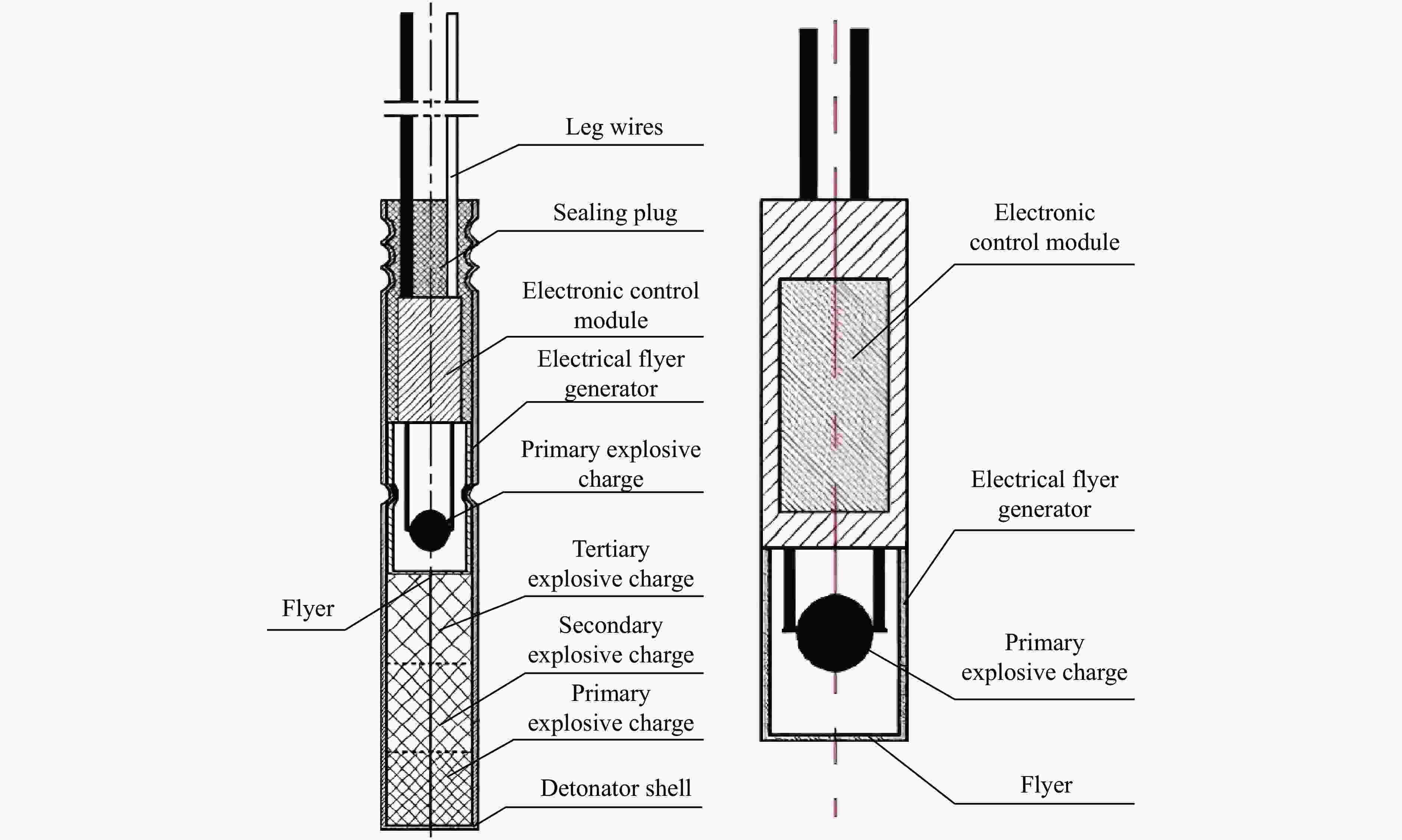
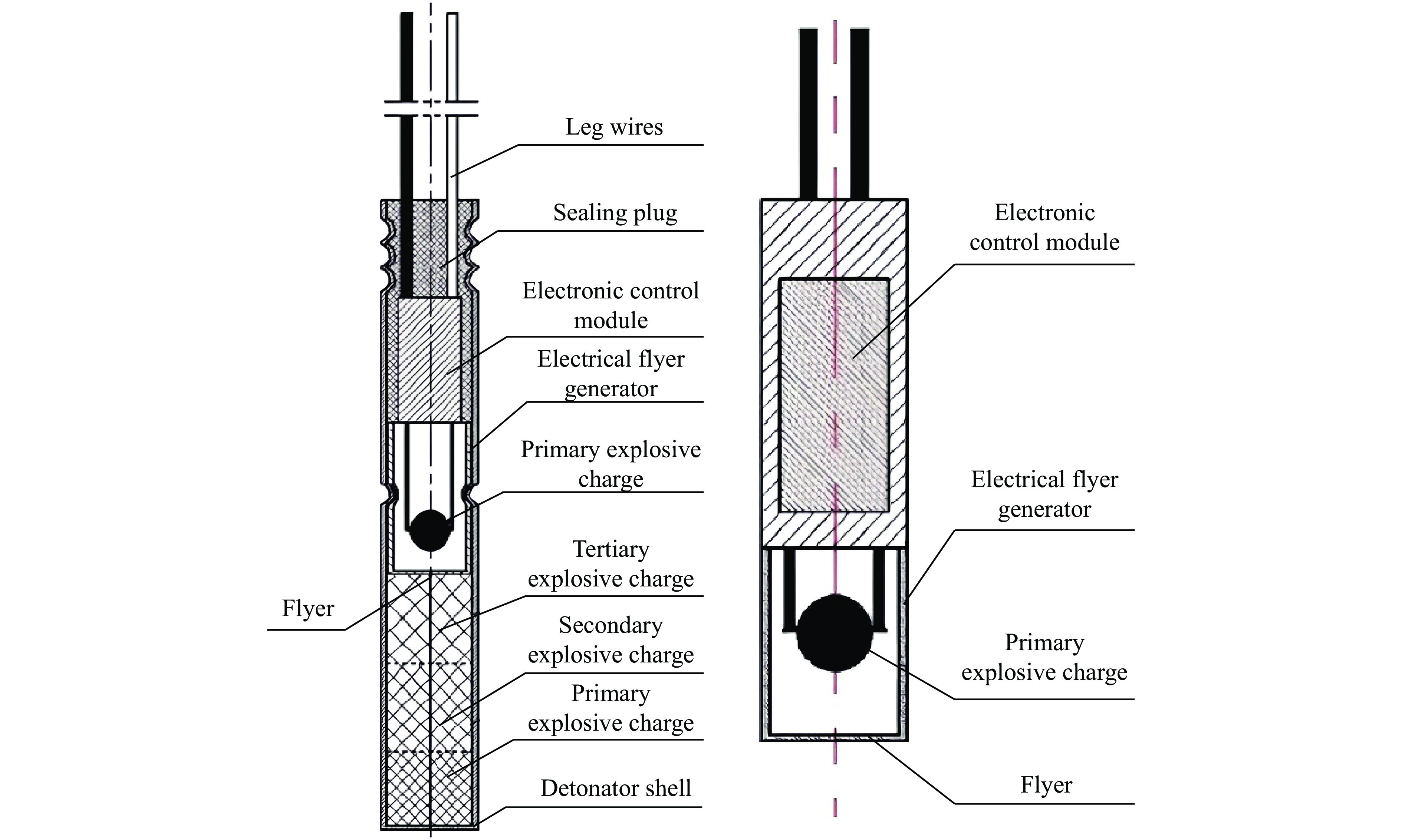
图 4 新型智能飞片式电子雷管结构图
Figure 4. Structure diagram of New intelligent flyer-type electronic detonator
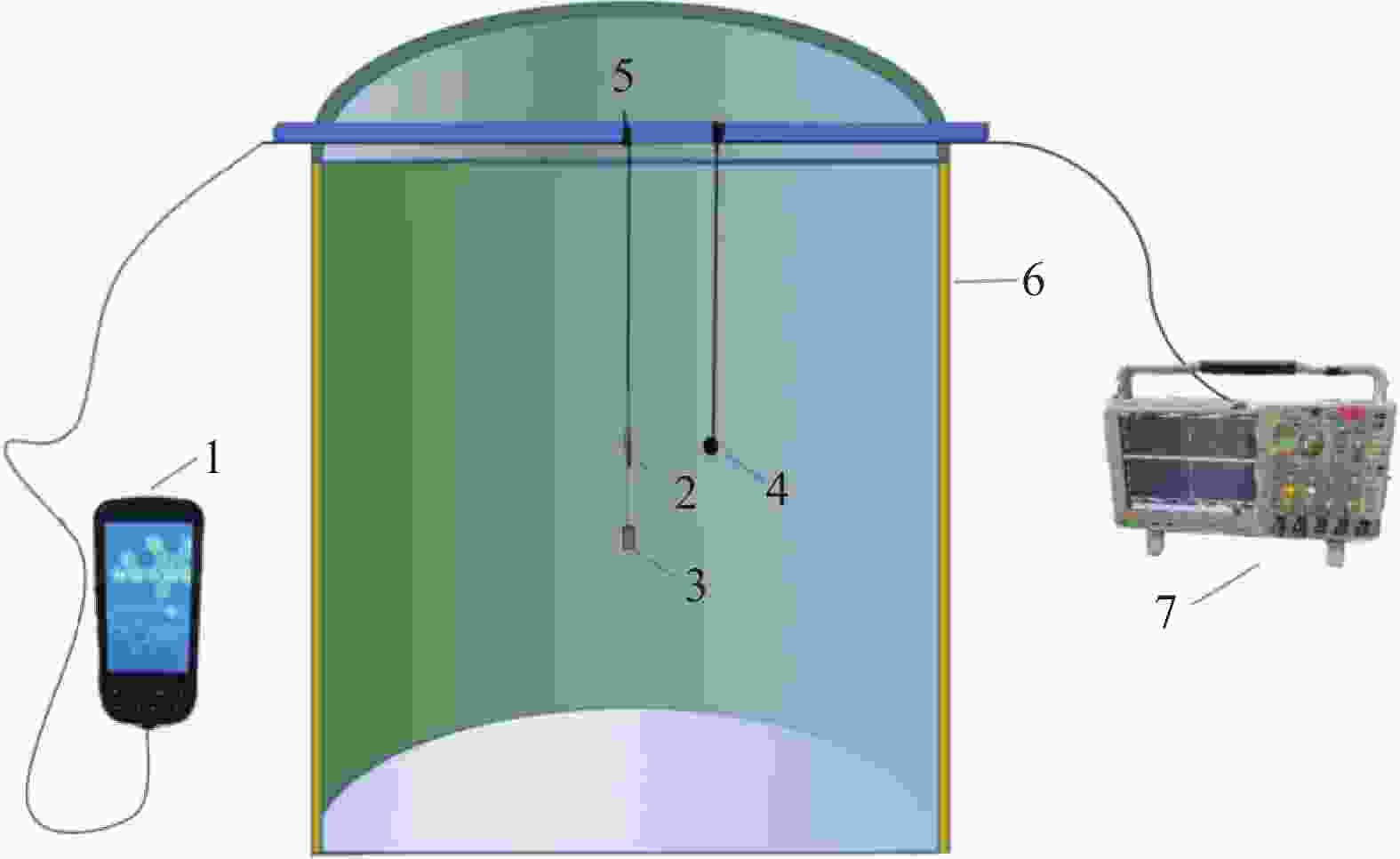
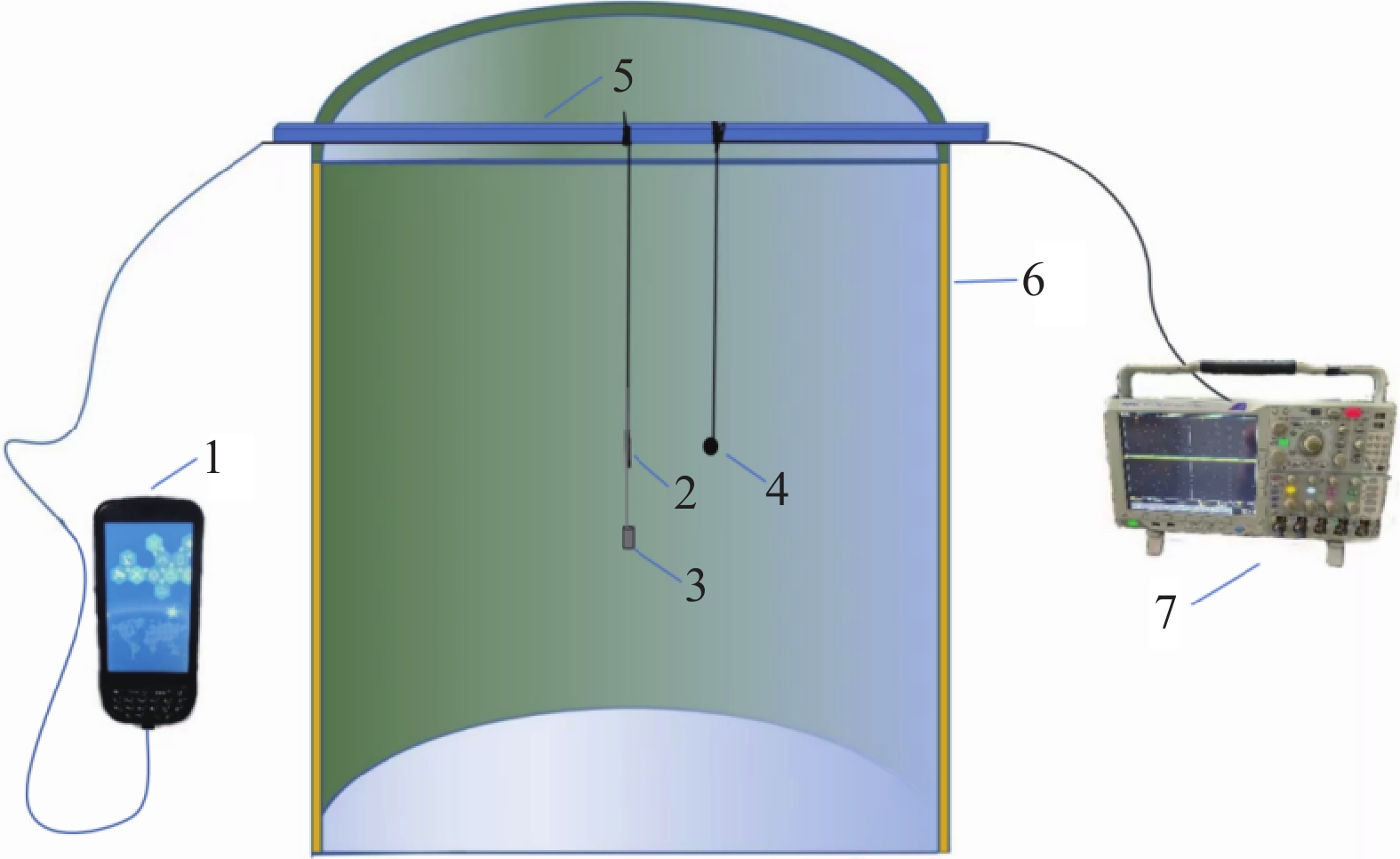
图 5 水下爆炸试验设备组成
Figure 5. Composition of underwater explosion test equipment
1. Initiation controller; 2. New intelligent flyer-type electronic detonator; 3. Plumb bob; 4. Sensor; 5. Steel frame; 6. Explosion cistern; 7. Oscilloscope
表 1 不同二次压药密度下的铅板穿孔试验
Table 1. Lead plate perforation test at different second primary pressure density
ρ2/(g·cm−3) 铅板穿孔直径/mm 最大值 最小值 平均值 标准偏差 1.50 11.8 11.1 11.25 0.27 1.41 12.1 11.5 11.72 0.25 1.30 11.1 10.2 10.82 0.30  下载: 导出CSV
表 2 不同收口直径下的铅板穿孔试验
Table 2. Lead plate perforation test with different bayonet diameters
收口直径/mm 铅板穿孔直径/mm 拒爆率 6.0~6.1 11.90, 11.42, 11.72, 11.56, ×,×,×,×,×,× 3/5 5.6~5.7 11.44, 11.68, 11.48, 11.90, 11.82, 11.24, 11.40, 11.62, 11.86, 11.28 0 注:“×”表示铅板未穿孔,说明雷管未完全爆轰。
下载: 导出CSV
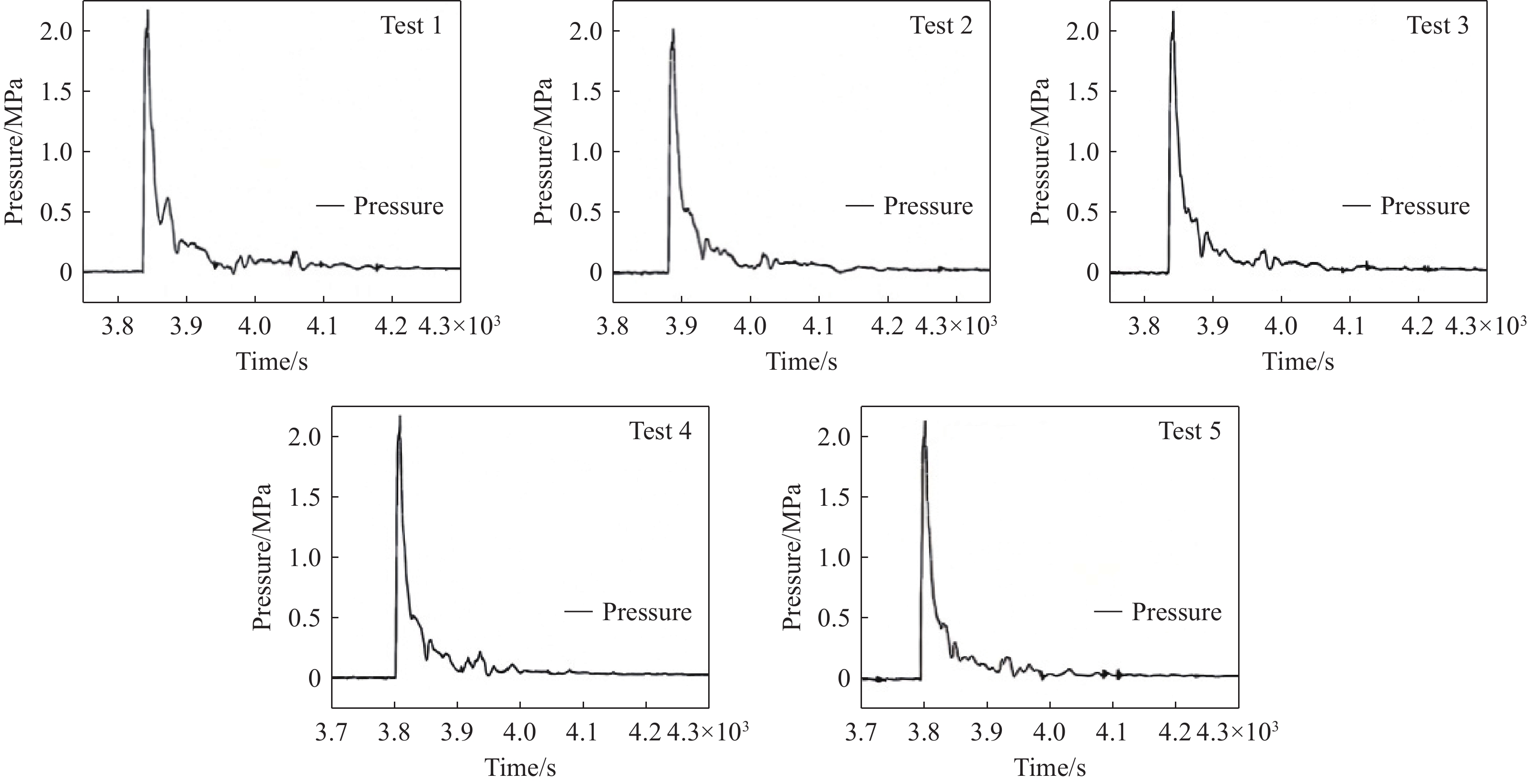
表 3 不同收口直径的冲击波峰值压力
Table 3. Shock wave peak pressure under different bayonet diameter
试验 一次装药量/mg 二次装药量/mg 三次装药量/mg 收口直径/mm 峰值压力/MPa 1 412 205 318 6.1 2.167 2 407 205 323 6.0 2.019 3 405 201 321 5.7 2.173 4 407 204 324 6.1 2.133 5 405 201 320 6.0 2.159
下载: 导出CSV
表 4 PETN状态方程参数表
Table 4. PETN state equation parameters table
密度/
(g·cm−3)E/GPa D/
(km·s−1)CJ爆轰
压力/GPaA/GPa B/GPa R1 R2 ω 1.5 8.56 7.45 22 625.3 23.29 5.25 1.6 0.28
下载: 导出CSV
表 5 空气介质状态方程参数表
Table 5. Air medium state equation parameter table
ρ0/
(g·cm−3)c/
(m·s−1)S1 S2 S3 γ0 a 1.29×10⁻³ 340 0 0 0 0.14 0
下载: 导出CSV
表 6 飞片Johnson-Cook本构方程计算参数
Table 6. Calculation parameters of Johnson-Cook constitutive equation for flying plates
密度/(g·cm−3) n m AJC/GPa BJC/GPa CJC Tm/K Troom/K 7.8 0.26 1.03 0.792 0.51 0.014 1793 294
下载: 导出CSV
-
[1] 沈兆武, 关慧娟. 空心无起爆药雷管: CN87101726 [P]. 1988-09-21.SHEN Z W, GUAN H J. Hollow detonator without initial explosive: CN87101726 [P]. 1988-09-21. [2] 孙伯文, 杨昌德, 陈月畅, 等. 活塞式导爆管雷管: CN03271267.7 [P]. 2005-03-23.SUN B W, YANG C D, CHEN Y C, et al. Piston primer detonator: CN03271267.7 [P]. 2005-03-23. [3] 马宏昊. 高安全雷管机理与应用的研究 [D]. 合肥: 中国科技技术大学, 2008.MA H H. Study on the mechanism and application of high safety detonator [D]. Hefei: University of Science and Technology of China, 2008. [4] 沈兆武. 冲击飞片式无起爆药雷管: CN87106394 [P]. 1994-09-21.SHEN Z W. Impact flying tablet type without explosive detonator: CN87106394 [P]. 1994-09-21. [5] 陈月畅, 沈兆武, 杜建国. 飞片式无起爆药雷管的结构和工作原理 [C]//中国力学学会工程爆破专业委员会2013年年度工作会议暨学术交流会论文集. 贵阳: 中国力学学会工程爆破专业委员会, 2013: 162–172.CHEN Y C, SHEN Z W, DU J G. Structure and working principle of flying plate detonator [C]//Proceedings of the 2013 Annual Working Conference and Academic Exchange Meeting of Engineering Blasting Professional Committee of Chinese Mechanics Society. Guiyang: Engineering Blasting Professional Committee of Chinese Mechanics Society, 2013: 162–172. [6] 胡企强, 沈兆武, 郑慧娟. 简易飞片无起爆药雷管研究 [J]. 爆破器材, 1994, 23(1): 14–16.HU Q Q, SHEN Z W, ZHENG H J. Study of non-primary explosive detonator with simper flyer [J]. Explosive Materials, 1994, 23(1): 14–16. [7] 杜建国, 马宏昊, 沈兆武. 激光驱动飞片式无起爆药雷管 [C]//民用爆破器材理论与实践——中国兵工学会民用爆破器材专业委员会第七届学术年会论文集. 广州: 中国兵工学会民用爆破器材专业委员会, 2012: 252–255.DU J G, MA H H, SHEN Z W. Flying plate detonator initiated by laser [C]//Theory and Practice of Civil Blasting Equipment - Proceedings of the 7th Annual Academic Conference of Civil Blasting Equipment Professional Committee of Chinese Military Engineering Society. Guangzhou: The Civil blasting Equipment Professional Committee of the Chinese Military Engineering Society, 2012: 252–255. [8] 王惠娥, 胡企强, 胡学先, 等. 装药条件对飞片雷管爆轰性能的影响 [J]. 火工品, 2005(4): 13–16. DOI: 10.3969/j.issn.1003-1480.2005.04.004.WANG H E, HU Q Q, HU X X, et al. Influence of charge conditions on detonation property of flying plate detonator [J]. Initiators & Pyrotechnics, 2005(4): 13–16. DOI: 10.3969/j.issn.1003-1480.2005.04.004. [9] 王俊杰, 黄寅生, 李锦涛, 等. 飞片式无起爆药雷管结构研究 [J]. 火工品, 2016(4): 13–16. DOI: 10.3969/j.issn.1003-1480.2016.04.005.WANG J J, HUANG Y S, LI J T, et al. Study on the structure of flying plate detonator [J]. Initiators & Pyrotechnics, 2016(4): 13–16. DOI: 10.3969/j.issn.1003-1480.2016.04.005. [10] 松全才, 杨崇惠, 金韶华. 炸药理论 [M]. 北京: 兵器工业出版社, 1997.SONG Q C, YANG C H, JIN S H. Explosive theory [M]. Beijing: Ordnance Industry Press, 1997. [11] 杨文, 岳彩新, 宋家良, 等. 数码电子雷管抗静电性能研究 [J]. 火工品, 2021(1): 9–11. DOI: 10.3969/j.issn.1003-1480.2021.01.003.YANG W, YUE C X, SONG J L, et al. Research on antistatic performance of digital electronic detonator [J]. Initiators & Pyrotechnics, 2021(1): 9–11. DOI: 10.3969/j.issn.1003-1480.2021.01.003. [12] 董聪慧. 一种燃烧转爆轰无起爆药雷管的研究 [D]. 淮南: 安徽理工大学, 2016.DONG C H. The research of non-primary detonator based on DDT theory [D]. Huainan: Anhui University of Science and Technology, 2016. [13] 宫翔飞, 刘文韬, 张树道, 等. 水下爆炸近场峰值压力的数值模拟 [J]. 爆炸与冲击, 2019, 39(4): 041409. DOI: 10.11883/bzycj-2017-0262.GONG X F, LIU W T, ZHANG S D, et al. Numerical simulation of peak pressure in near-field underwater explosion [J]. Explosion and Shock Waves, 2019, 39(4): 041409. DOI: 10.11883/bzycj-2017-0262. [14] COLE R H. Underwater explosions [M]. Princeton: Princeton University Press, 1948. [15] BRETT J M, KRELLE A. A study of bubble collapse pressure pulse waves from small scale underwater explosions near the water surface [J]. Journal of Sound and Vibration, 2018, 435: 91–103. DOI: 10.1016/j.jsv.2018.08.004. [16] 江向阳, 颜事龙, 刘伟, 等. 柱状药包爆炸波传播规律的试验分析 [J]. 重庆大学学报, 2015, 38(4): 121–127. DOI: 10.11835/j.issn.1000-582X.2015.04.017.JIANG X Y, YAN S L, LIU W, et al. Experimental analysis of the law of explosive wave of cylindrical charge [J]. Journal of Chongqing University, 2015, 38(4): 121–127. DOI: 10.11835/j.issn.1000-582X.2015.04.017. [17] MILNE A, LONGBOTTOM A, FROST D L, et al. Explosive fragmentation of liquids in spherical geometry [J]. Shock Waves, 2017, 27(3): 383–393. DOI: 10.1007/s00193-016-0671-y. [18] LIU L, GUO R, GAO K, et al. Full-field peak pressure prediction of shock waves from underwater explosion of cylindrical charges [J]. Propellants, Explosives, Pyrotechnics, 2017, 42(8): 912–920. DOI: 10.1002/prep.201700070. [19] 奥尔连科. 爆炸物理学 [M]. 孙承纬, 译. 3版. 北京: 科学出版社, 2011: 636–637.ΟΡЛЕНКО Л П. Explosion physics [M]. SUN C W, trans. 3rd ed. Beijing: Science Press, 2011: 636–637. [20] WIELAND M S. The desensitization and malfunction of coal-mine explosive [C]//Proceedings of the 13th Conference on Explosives and Blasting Practices. Miami: ISEE, 1987: 97–114. [21] 王尹军, 颜事留, 李玉景, 等. 延期雷管的殉爆和抗冲击波性能 [J]. 工程爆破, 2008, 14(3): 67–69,62. DOI: 10.3969/j.issn.1006-7051.2008.03.019.WANG Y J, YAN S L, LI Y J, et al. On sympathetic detonation and anti-shockwave performance of delay detonators [J]. Engineering Blasting, 2008, 14(3): 67–69,62. DOI: 10.3969/j.issn.1006-7051.2008.03.019. [22] 杨文, 岳彩新, 宋家良, 等. 工业电子雷管抗冲击性能试验研究 [J]. 火工品, 2022(2): 16–19. DOI: 10.3969/j.issn.1003-1480.2022.02.004.YANG W, YUE C X, SONG J L, et al. Experimental research on the impact resistance of industrial electronic detonators [J]. Initiators & Pyrotechnics, 2022(2): 16–19. DOI: 10.3969/j.issn.1003-1480.2022.02.004. -

计量
- 文章访问数: 895
- HTML全文浏览量: 164
- PDF下载量: 64
- 被引次数: 0