


Shock wave pressure modeling using long short-term memory network based on variational mode decomposition processing
-
摘要: 冲击波压力传感器采集系统兼具高低频动态特性,而传统的基于传递函数的建模方法难以实现整体精准建模,这一问题限制了系统补偿精度的提升。本文提出一种基于麻雀优化算法、变分模态分解与长短期记忆网络的动态特性融合建模方法,旨在解决整体建模难题并提高系统动态特性建模精度。该方法通过优化算法搜索变分模态分解的模态数和惩罚因子,自适应分解响应信号为多个模态分量并识别成分,实现高频与低频分量的有效分离;对低频分量进行动态特性补偿后,将其作为压力信号和原响应信号构建模型输入输出数据集,通过网络完成传感器系统动态特性建模。仿真与实爆试验结果表明,相较于传统的反滤波补偿方法,本方法补偿后信号与典型压力曲线的平均绝对百分比误差降低75%,振荡残余减小38%,满足作为输入压力信号的精度要求;与单一神经网络建模相比,该融合建模方法的误差降至13%,为解决传感器宽频带动态建模难题提供了一条有效途径。Abstract: Shock wave pressure sensor acquisition systems exhibit both high-frequency and low-frequency dynamic characteristics, while traditional transfer-function-based modeling and compensation methods were unable to achieve accurate full-band modeling, thereby limiting further improvement in compensation accuracy and reconstructed signal fidelity under complex dynamic conditions. To address this limitation, a fusion modeling method integrating the sparrow search algorithm (SSA), variational mode decomposition (VMD), and a long short-term memory (LSTM) network was developed to improve the dynamic characteristic modeling accuracy of shock wave pressure acquisition systems. In this method, SSA was employed to globally optimize the mode number and penalty factor of VMD using a comprehensive fitness function that combined sample entropy and the Pearson correlation coefficient, which enhanced the adaptability of decomposition for nonstationary response signals contaminated by oscillations and noise. With the optimized parameters, VMD decomposed the sensor response signal into multiple intrinsic modal components; the frequency-domain characteristics of each component were then analyzed, and correlation coefficients together with jump durations were calculated and compared according to the spectral distribution characteristics of shock waves to identify the signal types contained in each mode. Based on this identification, the high-frequency oscillatory modes and noise modes were discarded, thereby achieving the reconstruction of the effective shock wave signal. A sinusoidal signal generator was used to obtain pressure acquisition waveforms over 0.1–10 Hz, amplitudes were converted into decibels to form the low-frequency magnitude–frequency characteristic curve, and a frequency-domain rational function fitting procedure was applied to model the low-frequency transfer function. Using the transfer function, low-frequency dynamic compensation was performed on the reconstructed signal, and the compensated low-frequency signal was combined with the original sensor response signal to construct an input-output dataset that simultaneously preserved compensated dynamic information and original response characteristics. Based on this dataset, SSA was further used to search key LSTM hyperparameters, including the number of hidden units, the maximum training epochs, and the initial learning rate, and an LSTM network was trained to model the nonlinear, time-dependent, and memory-dependent behavior of the acquisition system, enabling fusion modeling of high- and low-frequency dynamic characteristics within a unified framework. Simulation analyses and live explosion test results demonstrated that, compared with the traditional inverse filtering compensation method, the proposed method reduced the mean absolute percentage error (MAPE) between the compensated signal and the reference pressure curve by approximately 75% and decreased oscillation residuals by about 38%, meeting the accuracy requirements for input pressure signals; compared with a single LSTM-based modeling approach, the VMD-LSTM fusion modeling method reduced the overall modeling error to 13%, indicating improved accuracy and robustness. These results show that the SSA-optimized VMD, transfer-function-based low-frequency compensation, and SSA-tuned LSTM fusion modeling jointly provide an effective full-band modeling route, and the proposed framework now offers a robust solution for accurate dynamic characteristic modeling and compensation in shock wave pressure sensor acquisition systems.
-
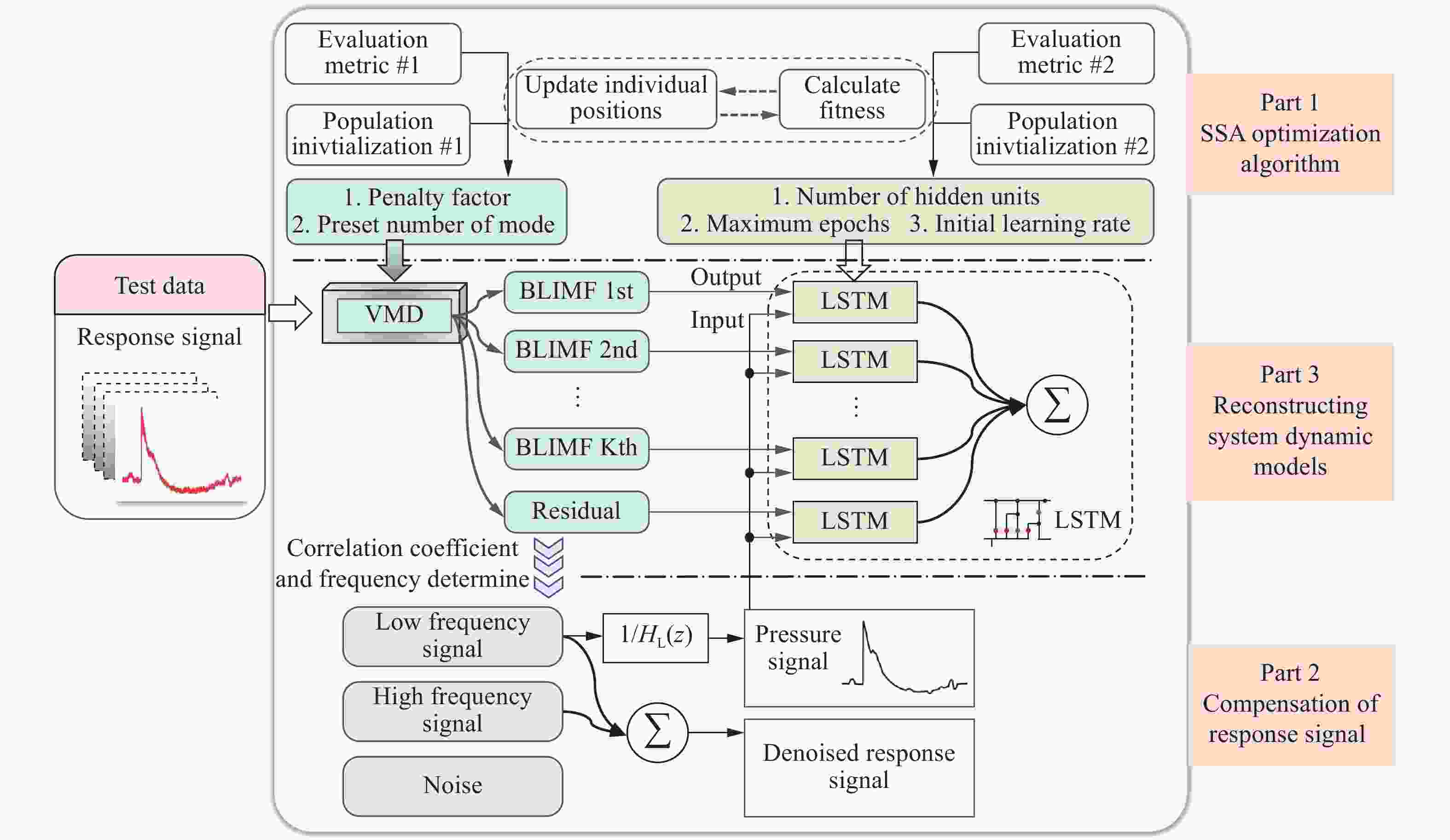
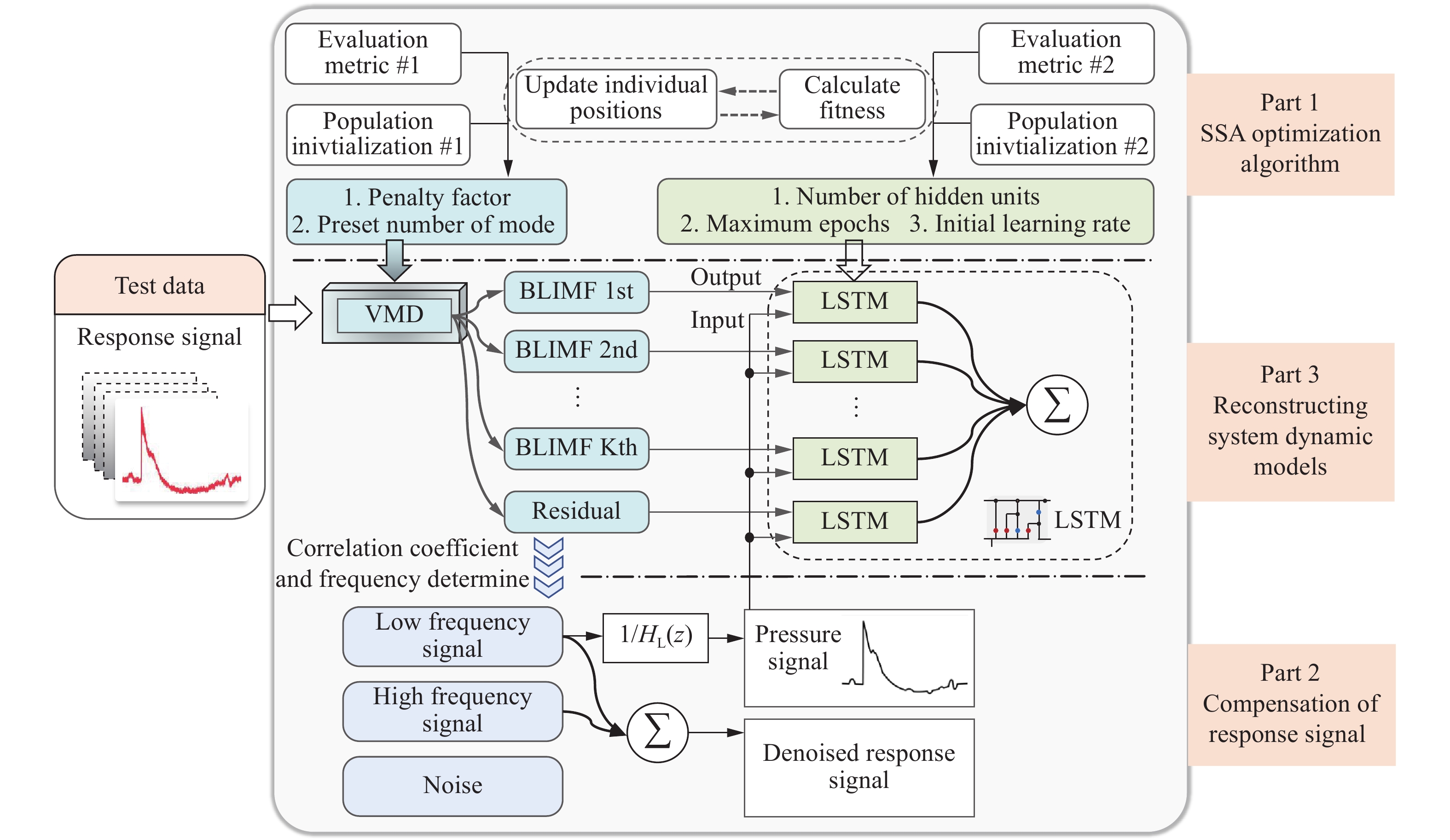
图 2 冲击波压力信号的变分模态分解与长短期记忆网络建模算法流程
Figure 2. Flowchart of the modeling algorithm using VMD-LSTM for shock wave pressure signals
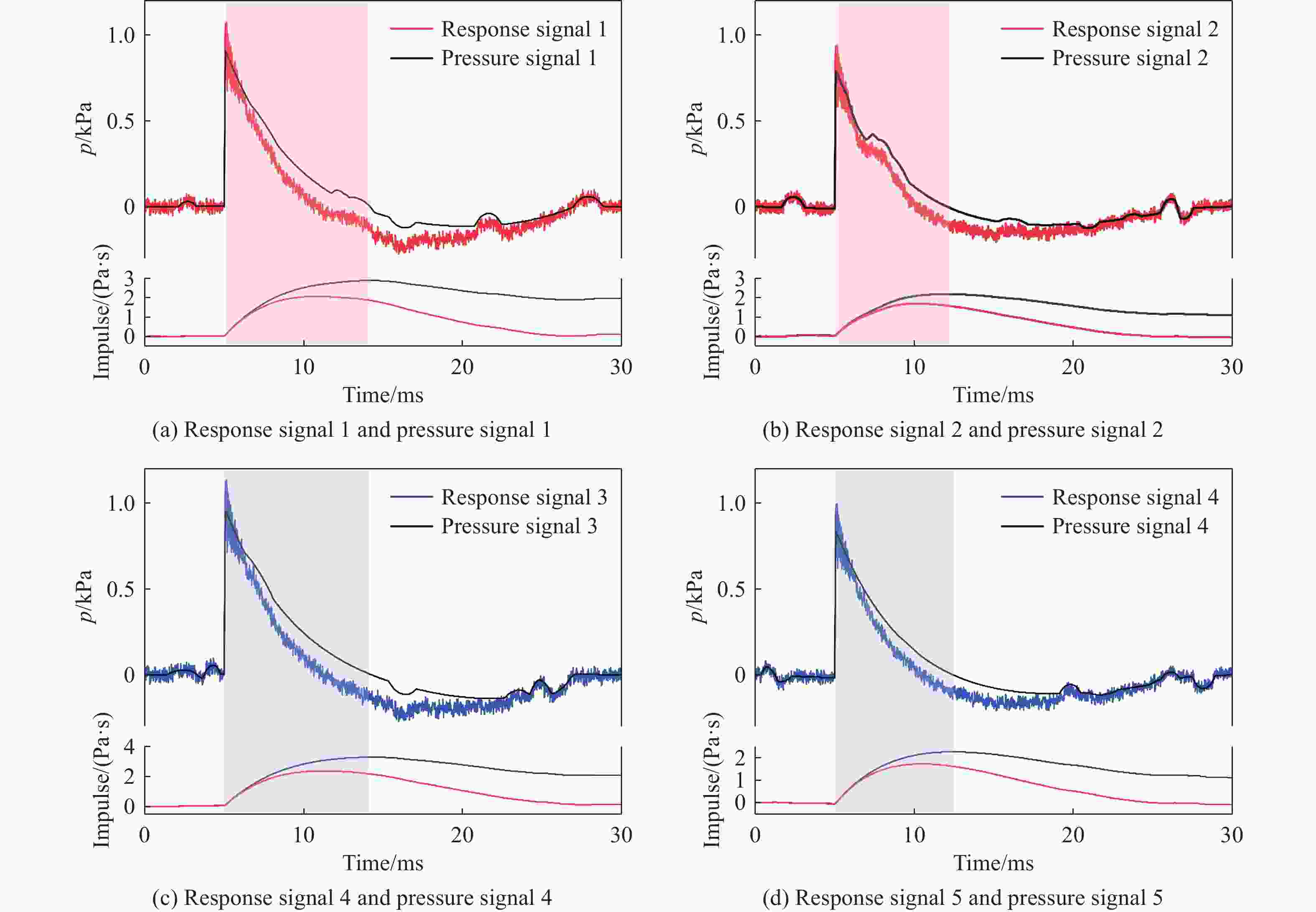
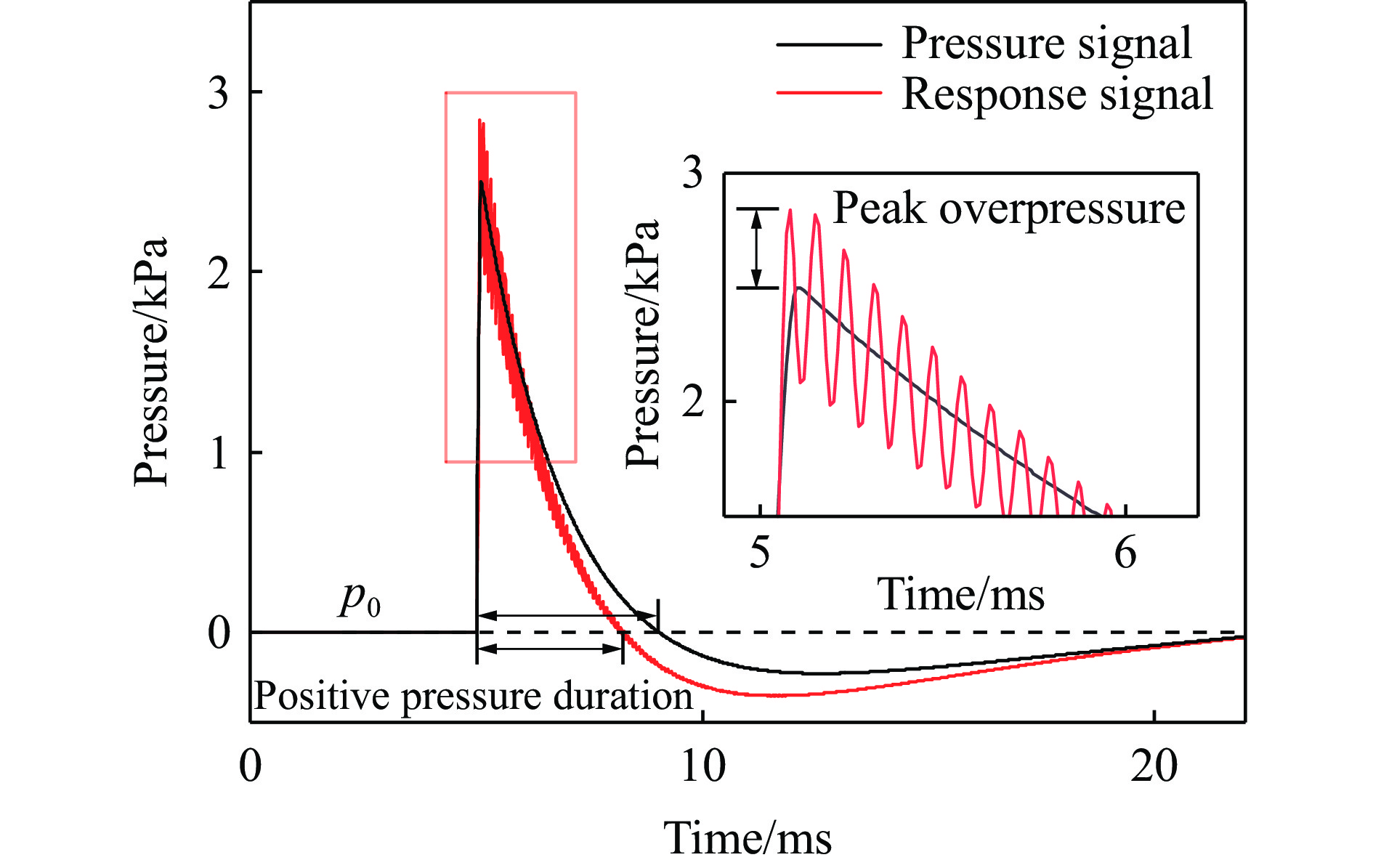
图 3 仿真冲击波压力信号与采集系统动态响应曲线
Figure 3. Simulation of shock wave pressure signal and dynamic response curve of acquisition system
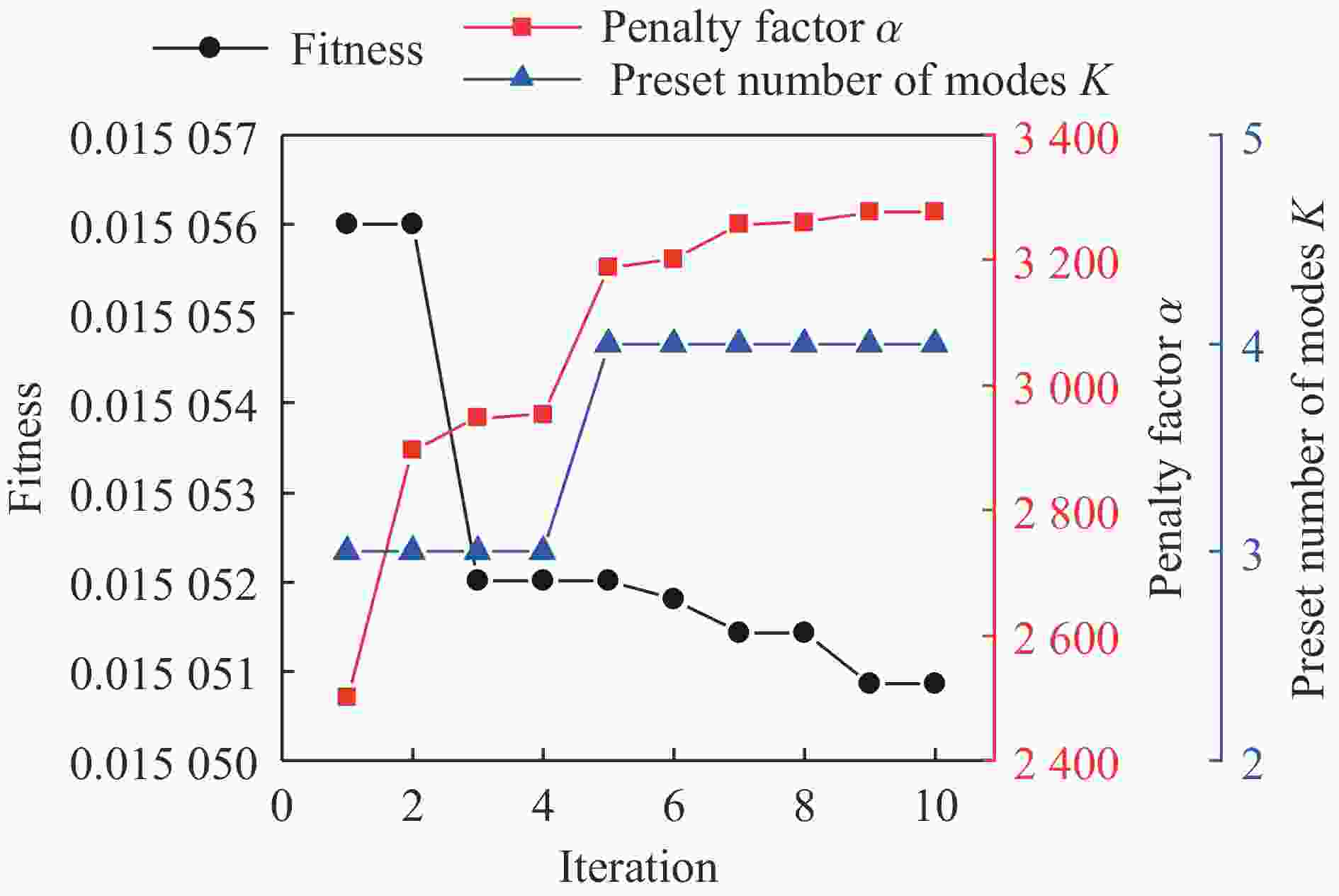
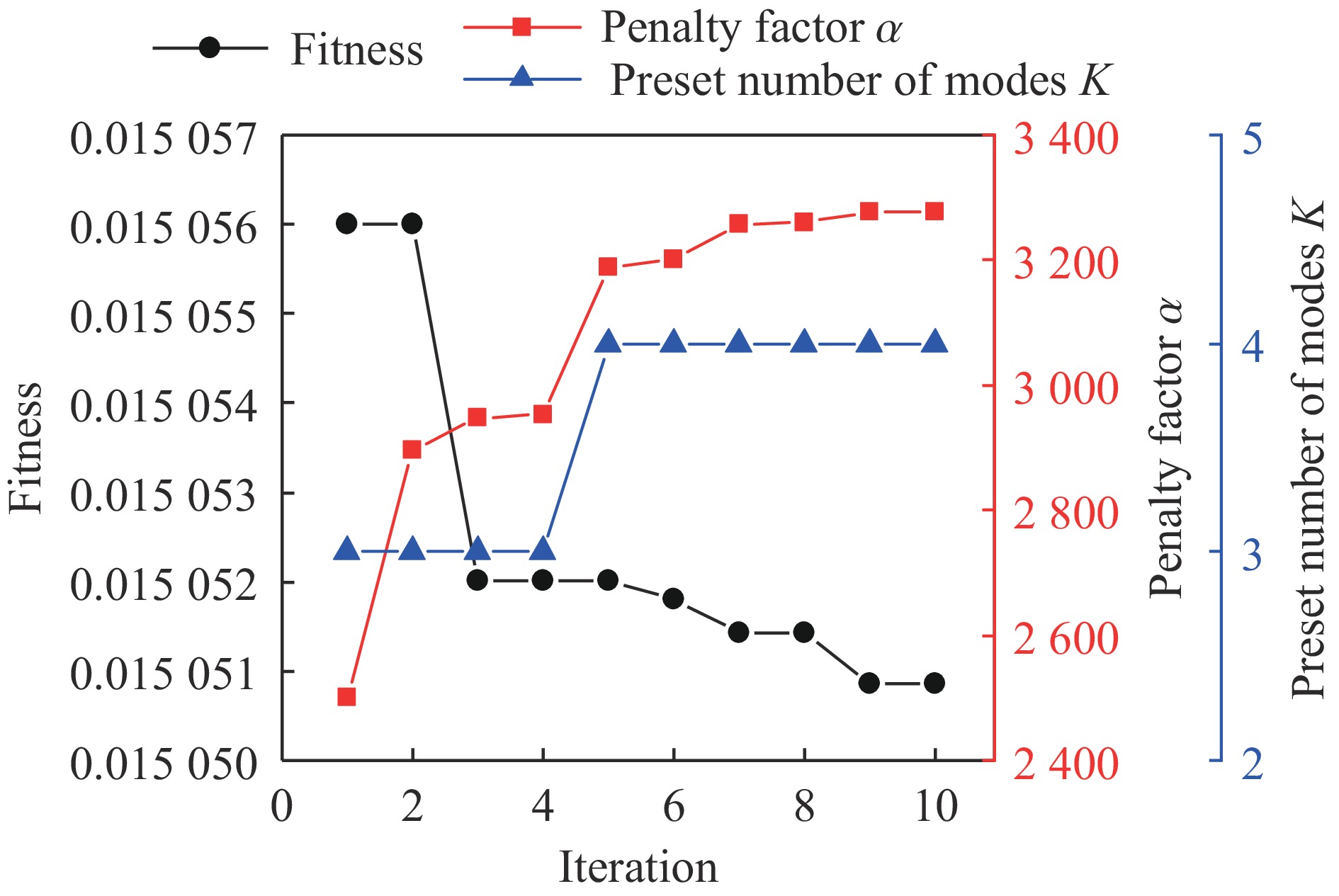
图 4 优化算法适应度随迭代过程的收敛趋势
Figure 4. Convergence trend of the optimizer’s fitness across iteration steps
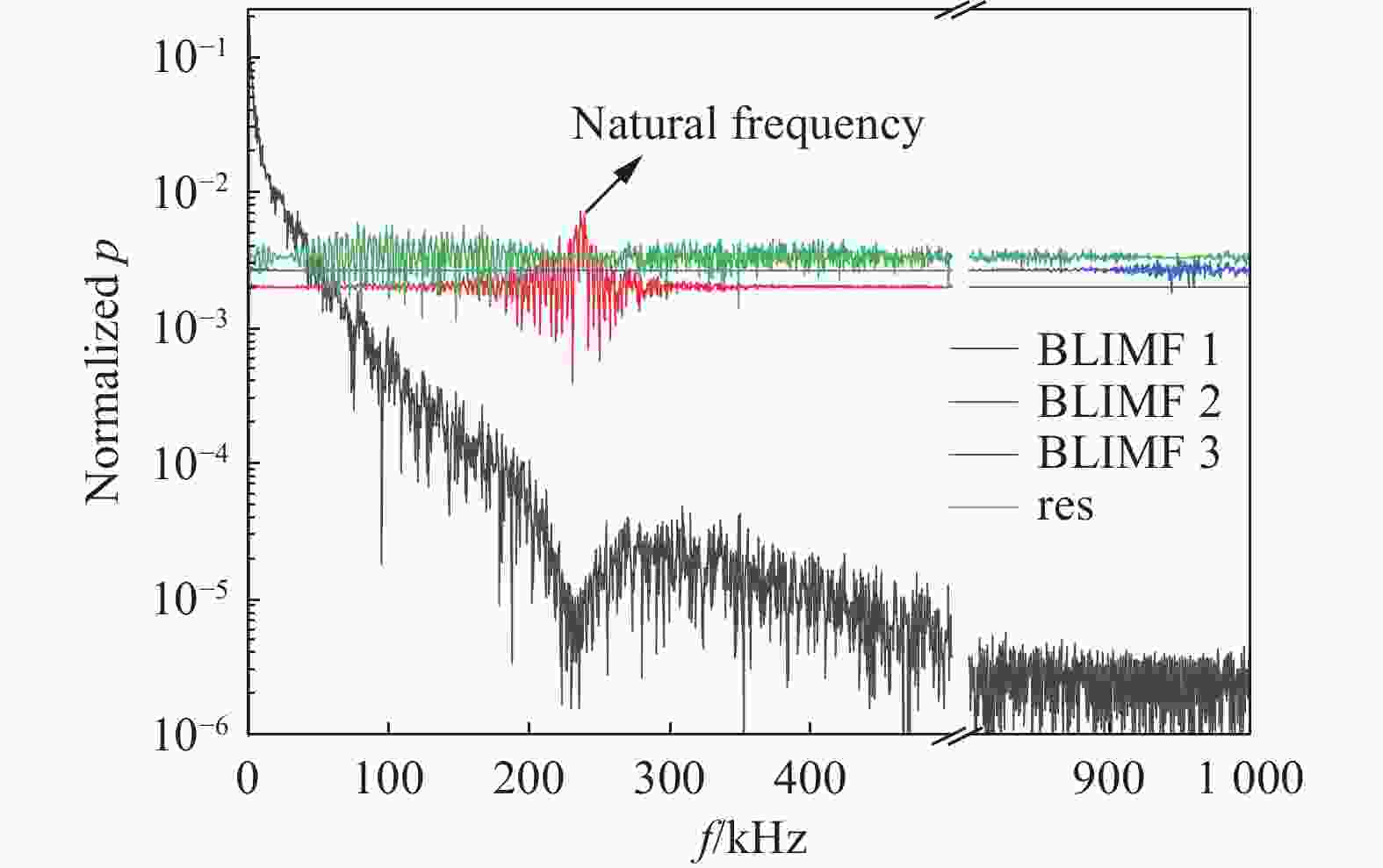
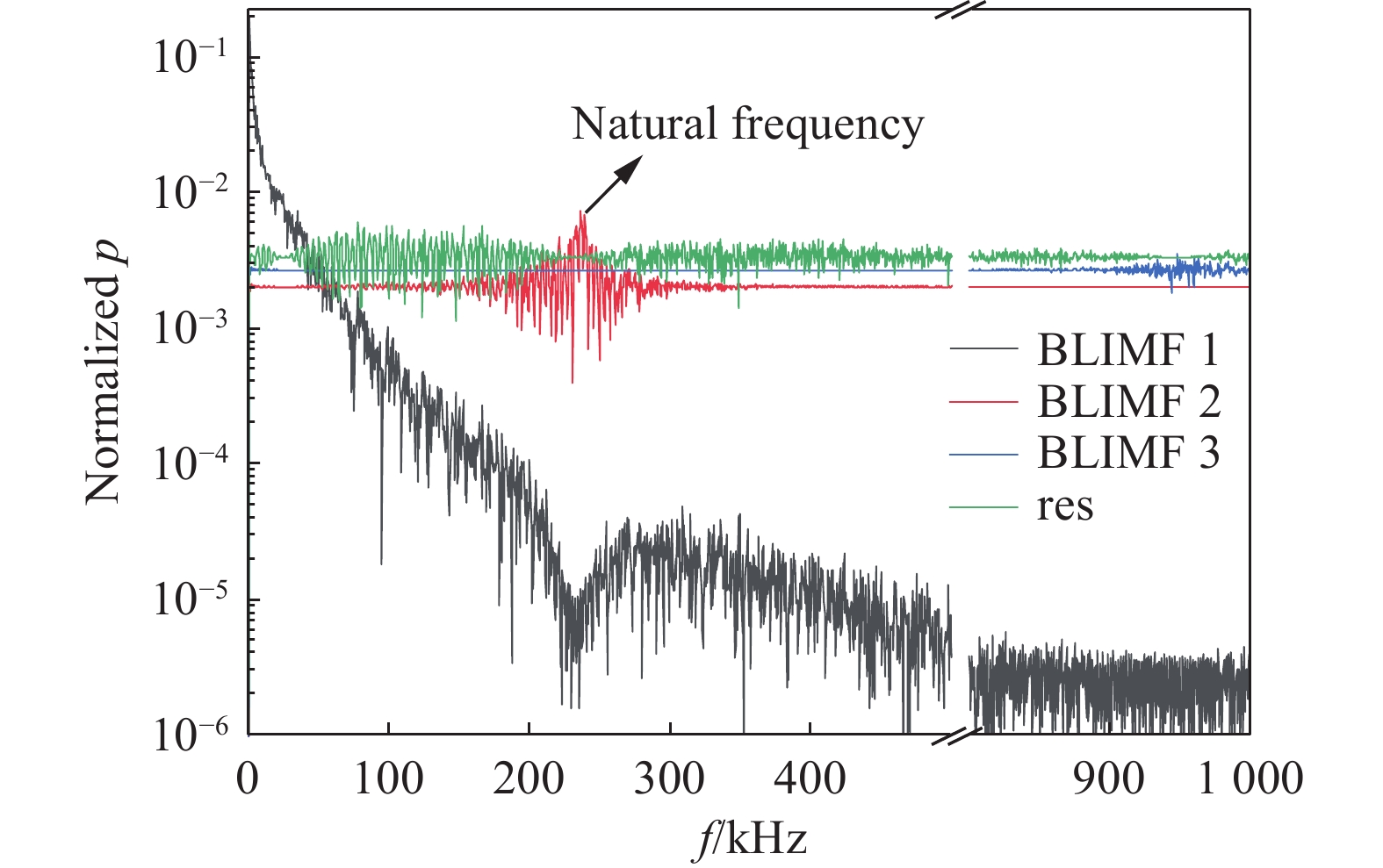
图 5 信号分解后各分量的幅频特性频谱
Figure 5. Amplitude-frequency characteristics spectra of the decomposed signal components
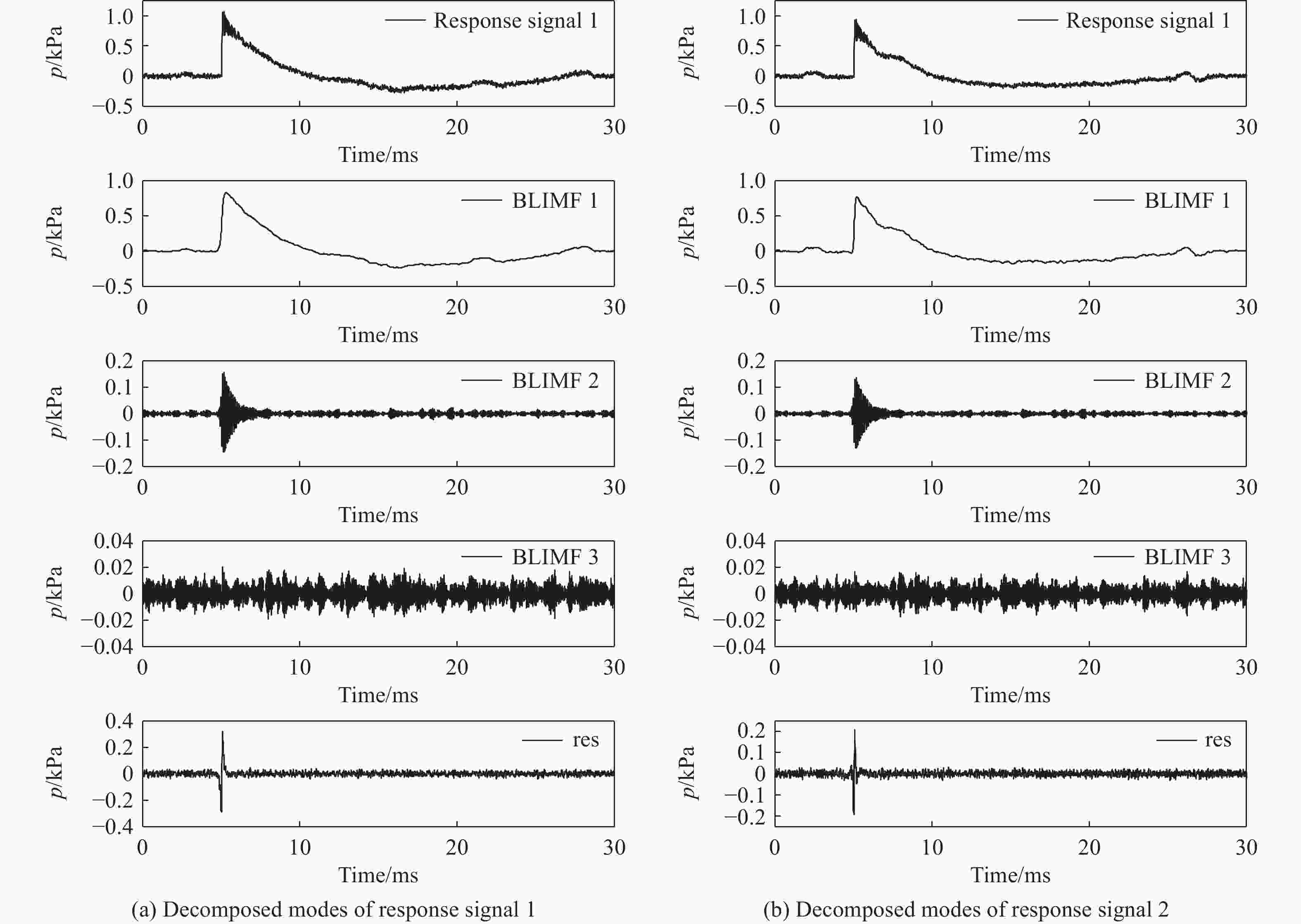
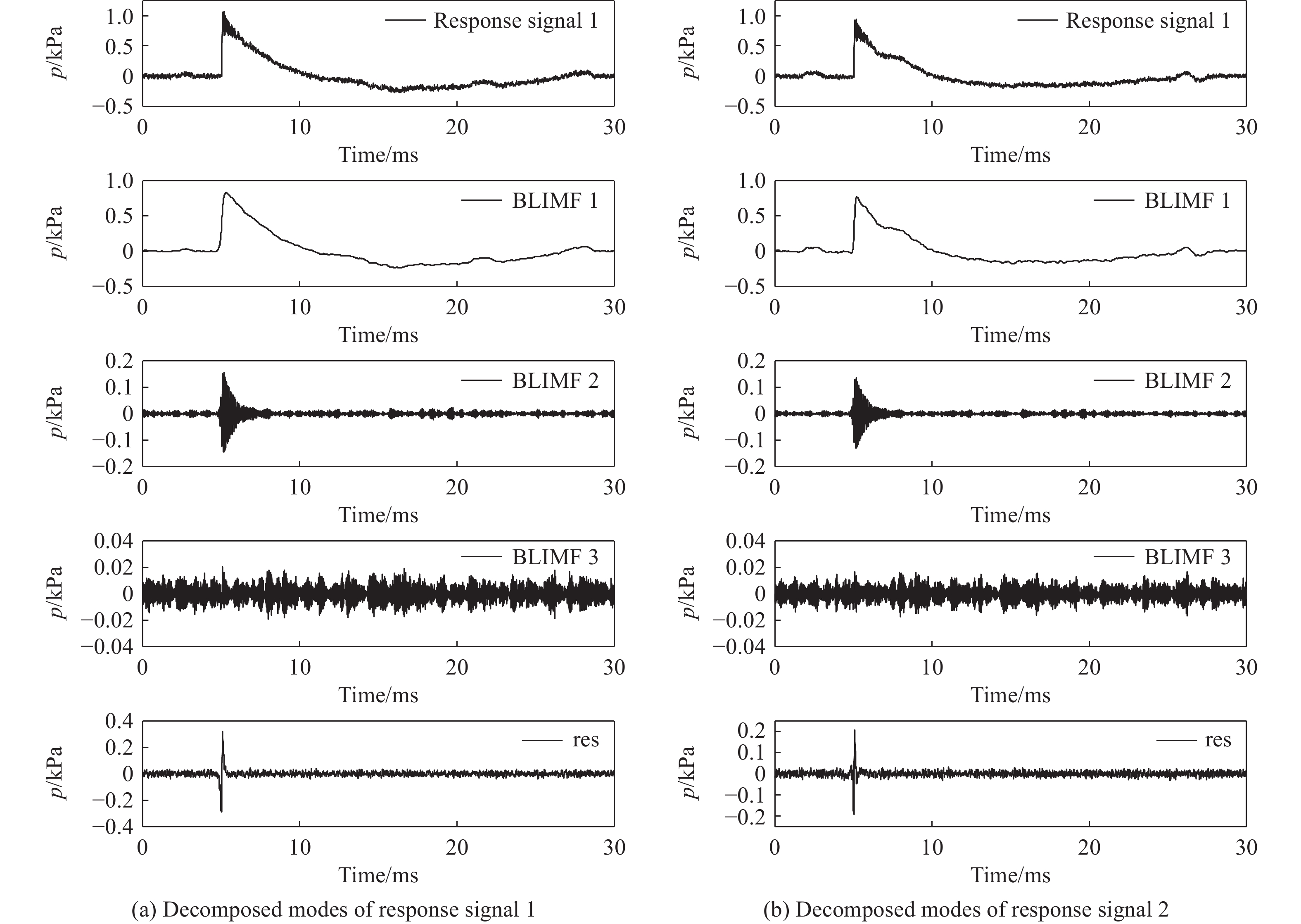
图 6 信号分解后各分量的时域特性
Figure 6. Time-domain characteristics of the decomposed signal components
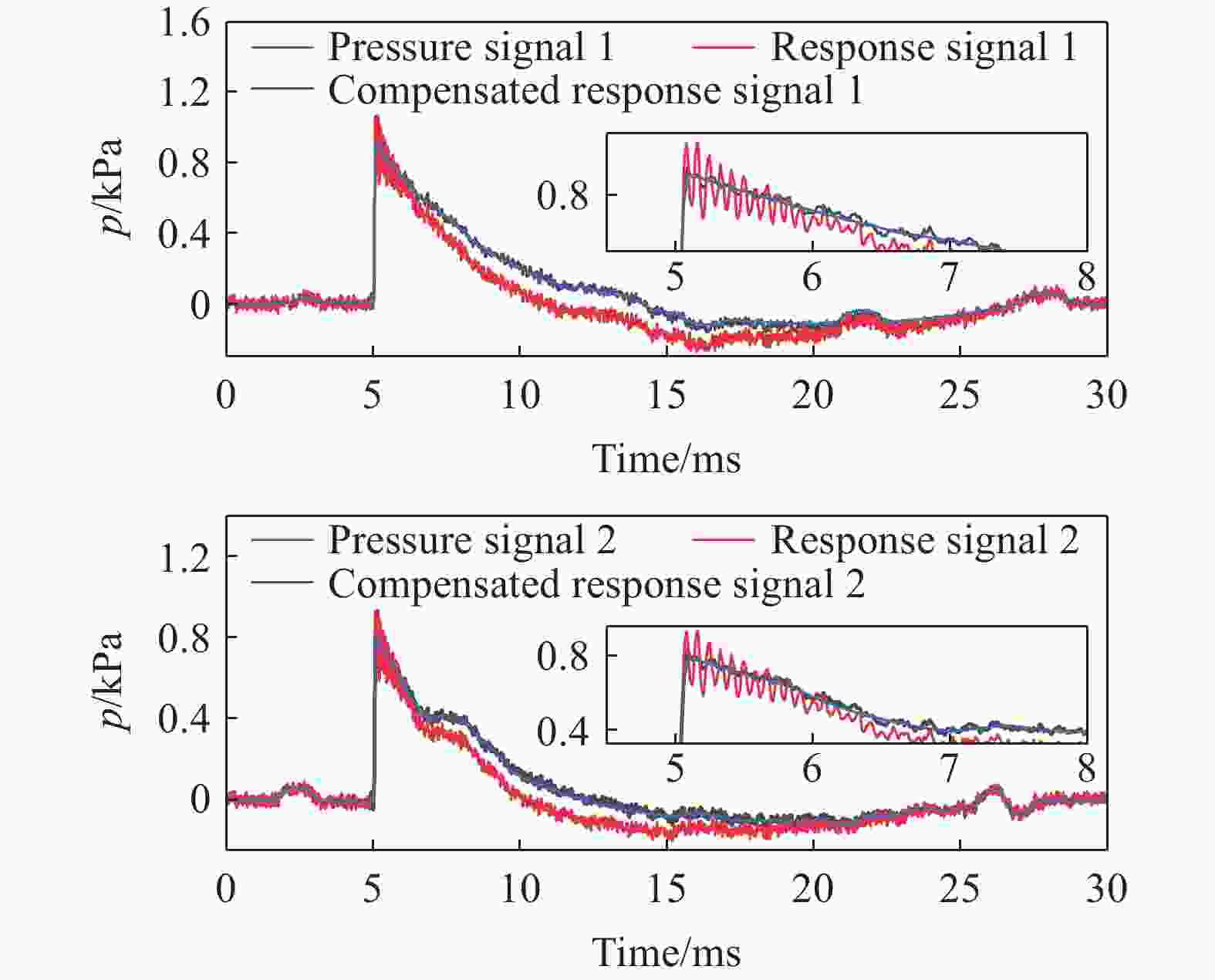
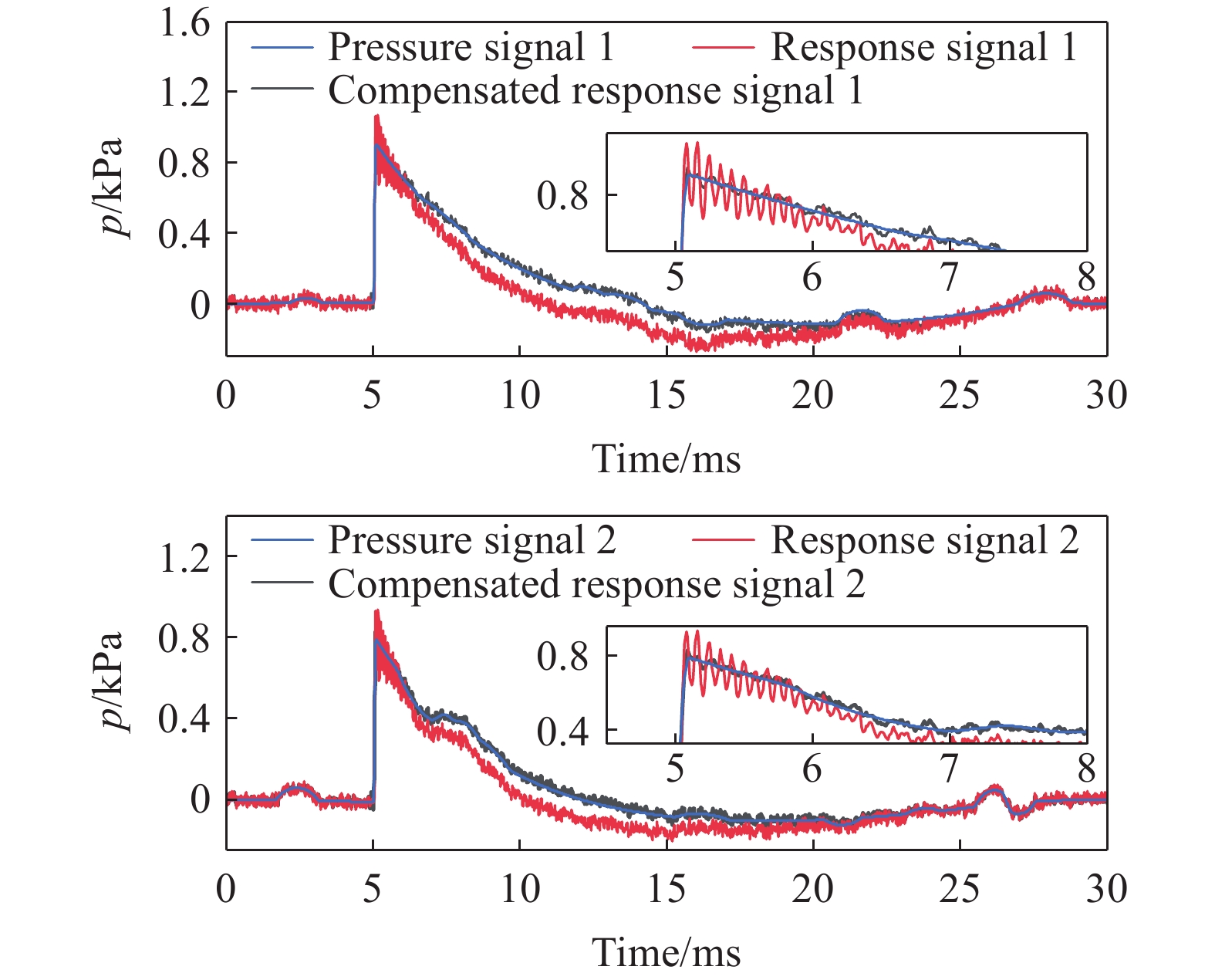
图 7 分解重构处理对冲击波响应信号补偿的效果
Figure 7. Effect of decomposition-reconstruction processing on compensation of shock wave response signals
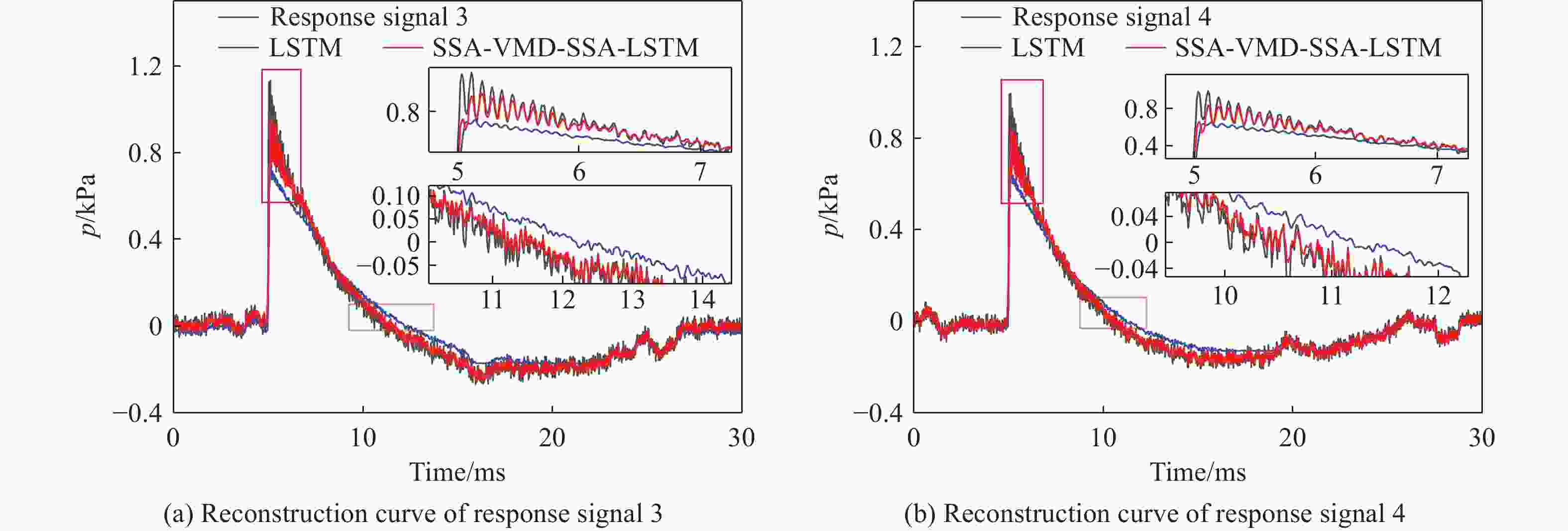
图 8 验证集冲击波压力信号的模型建模效果对比
Figure 8. Comparison of model recovery performance for shock wave pressure signals on the validation set
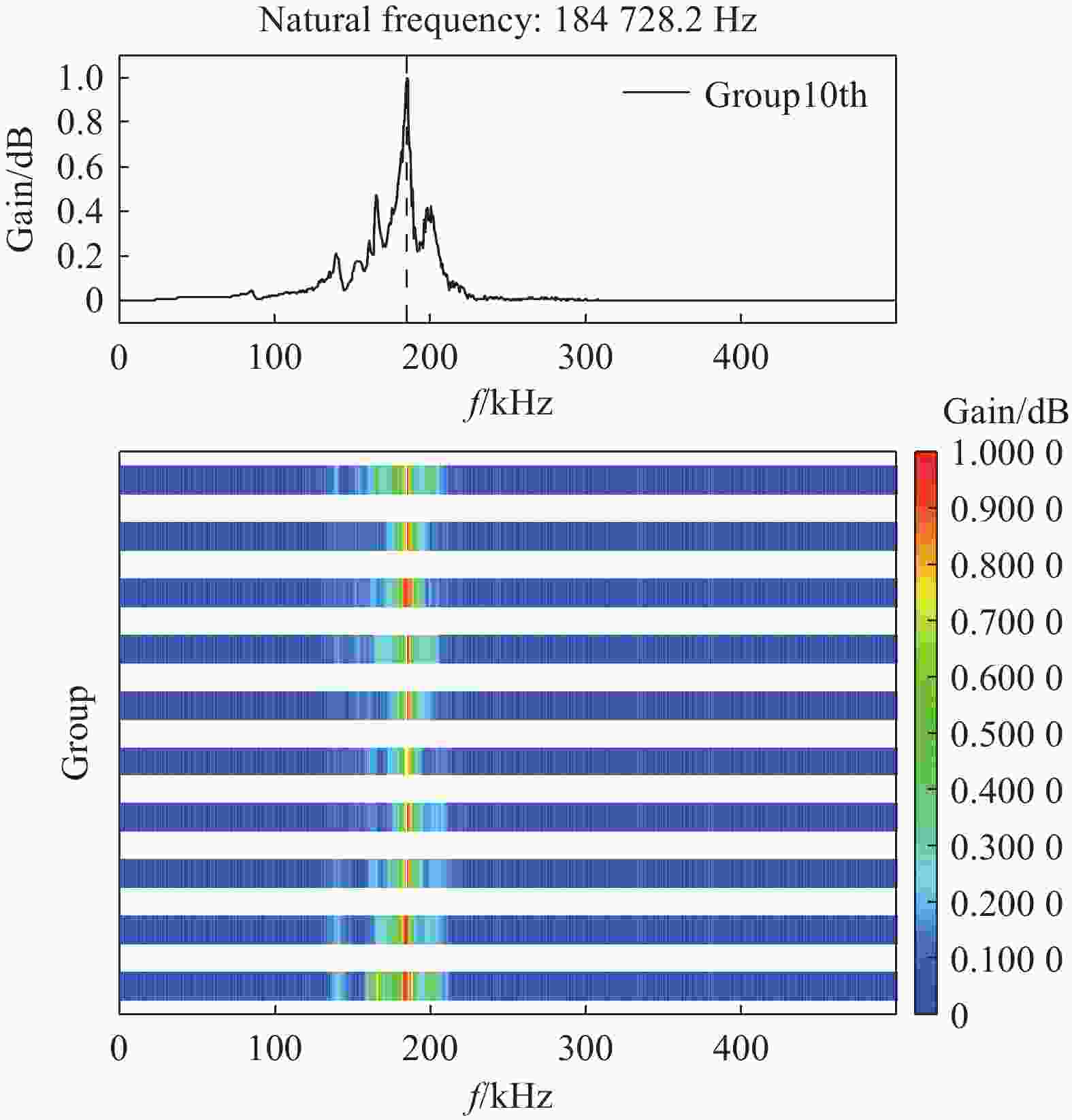
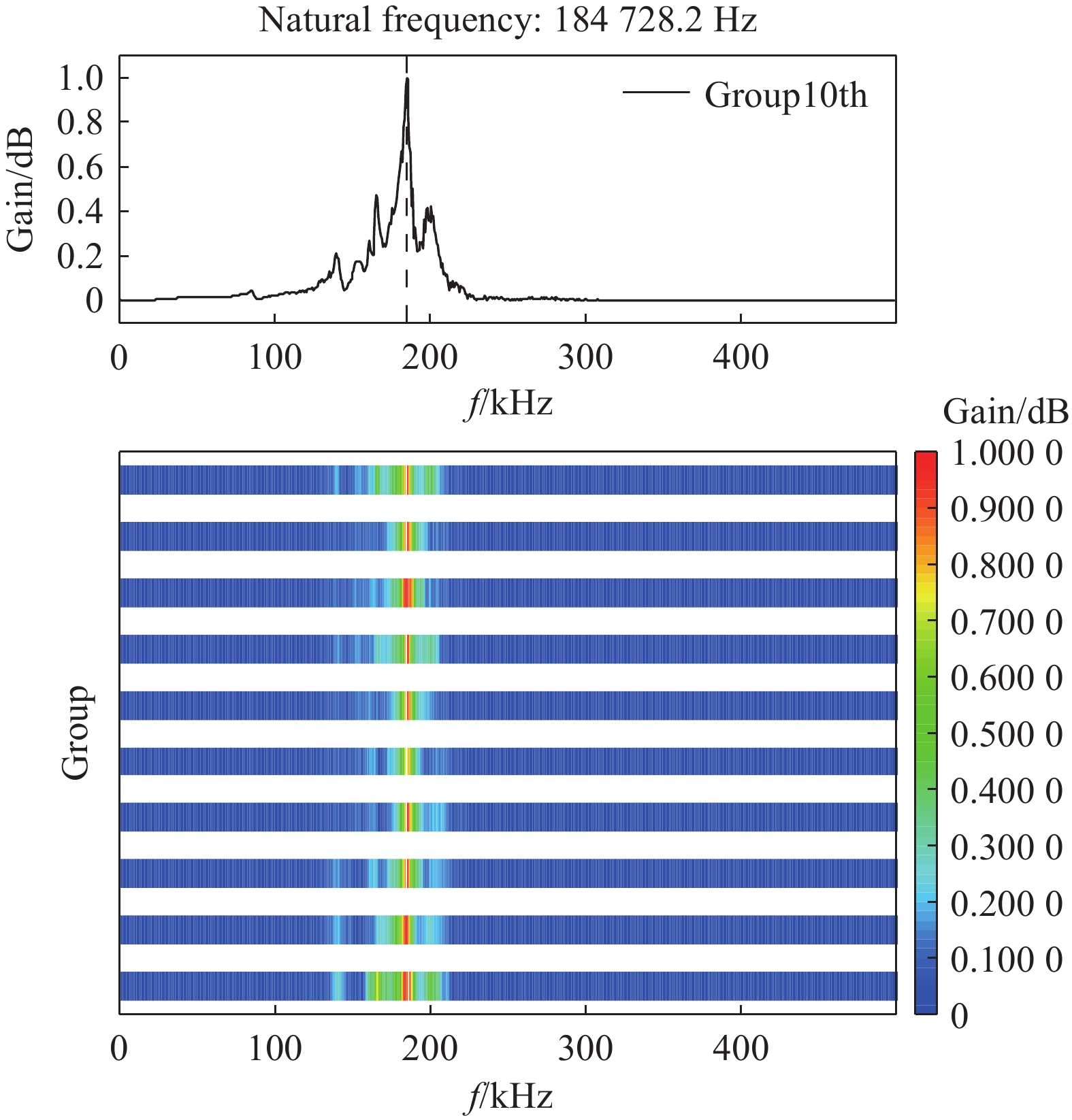
图 9 实测信号的高频分量幅频特性
Figure 9. The amplitude-frequency characteristics of high-frequency signal components
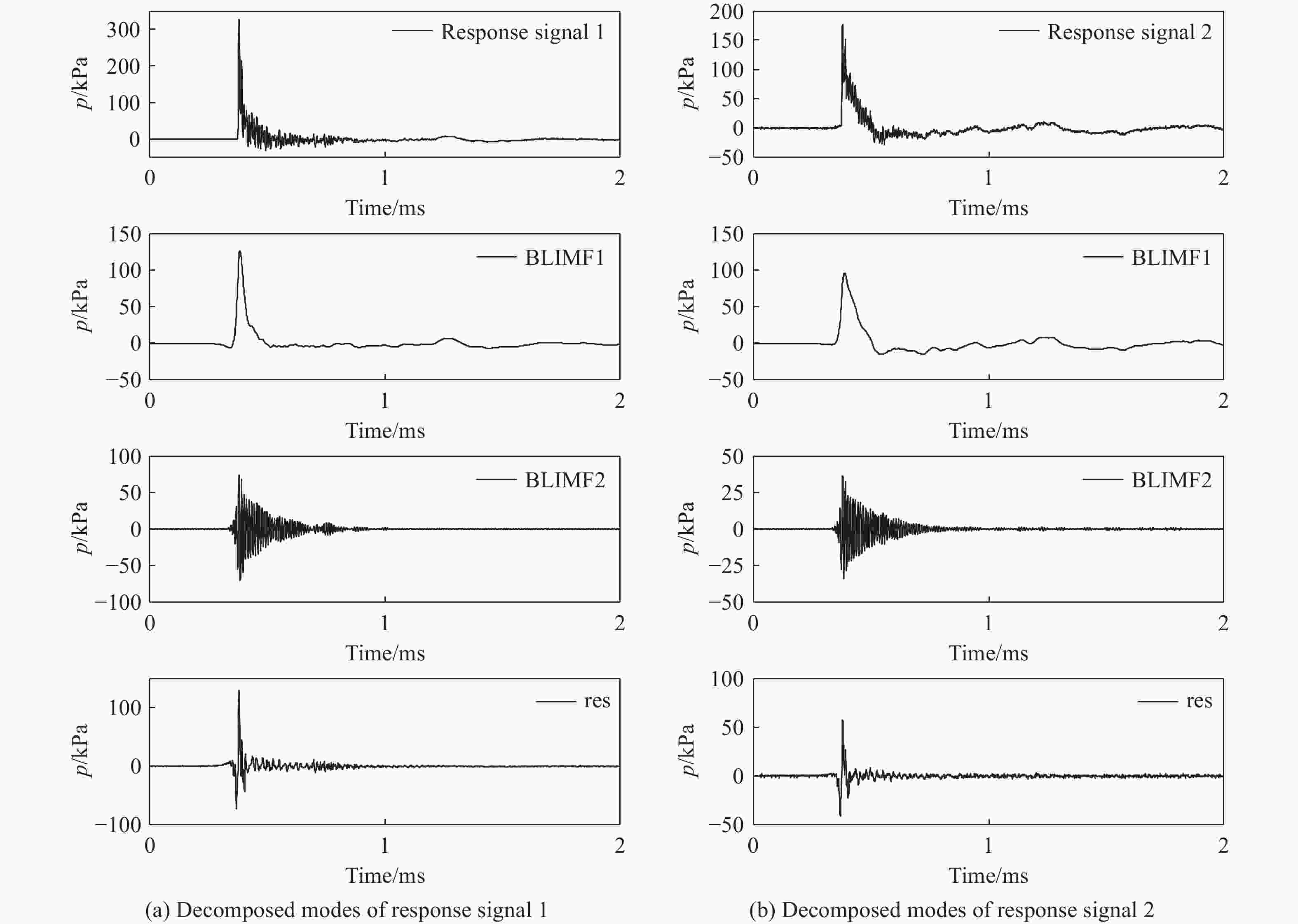
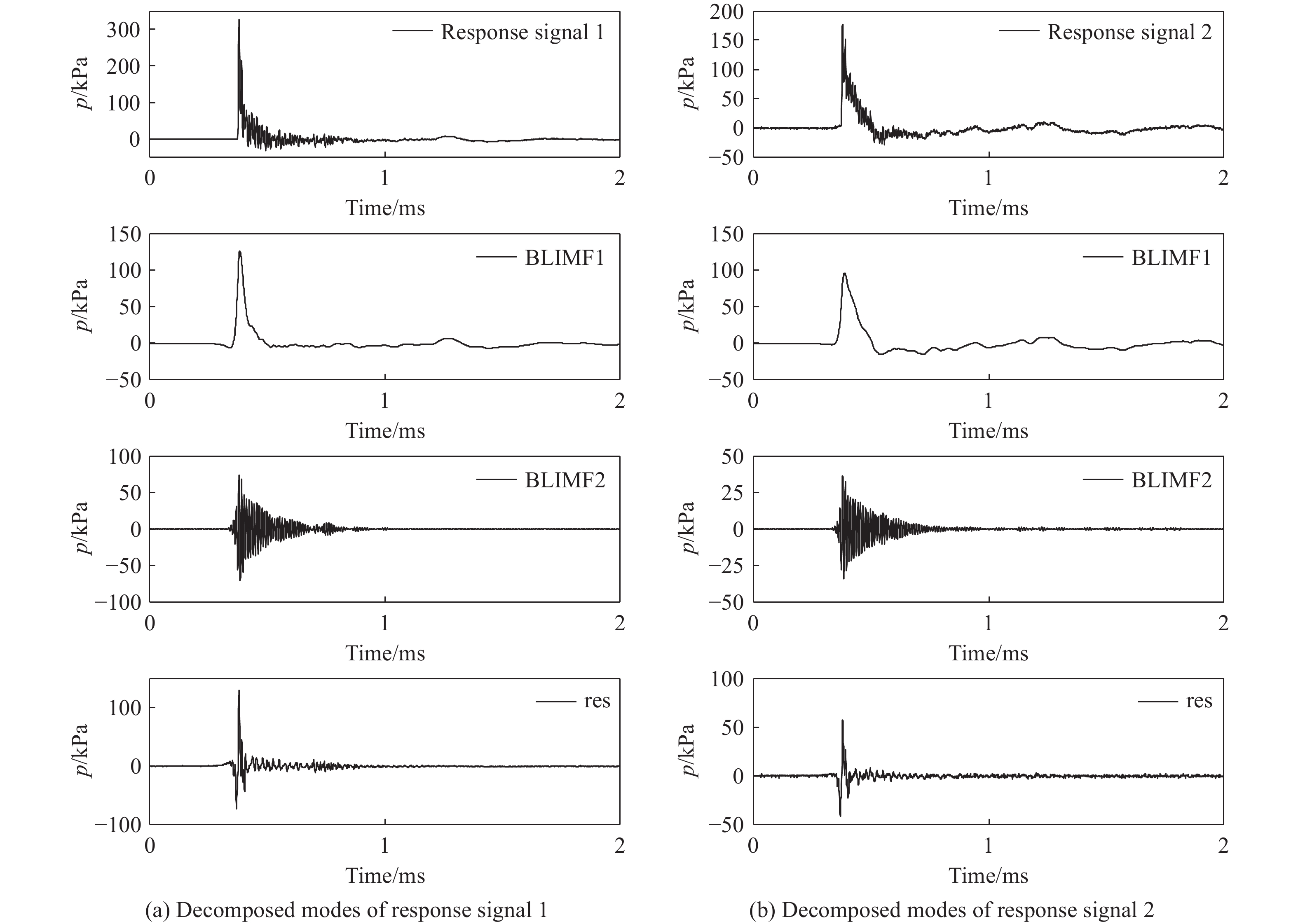
图 10 实测冲击波响应信号各分解模态的时域特性
Figure 10. Time-domain characteristics of decomposed components of the shock wave response signal
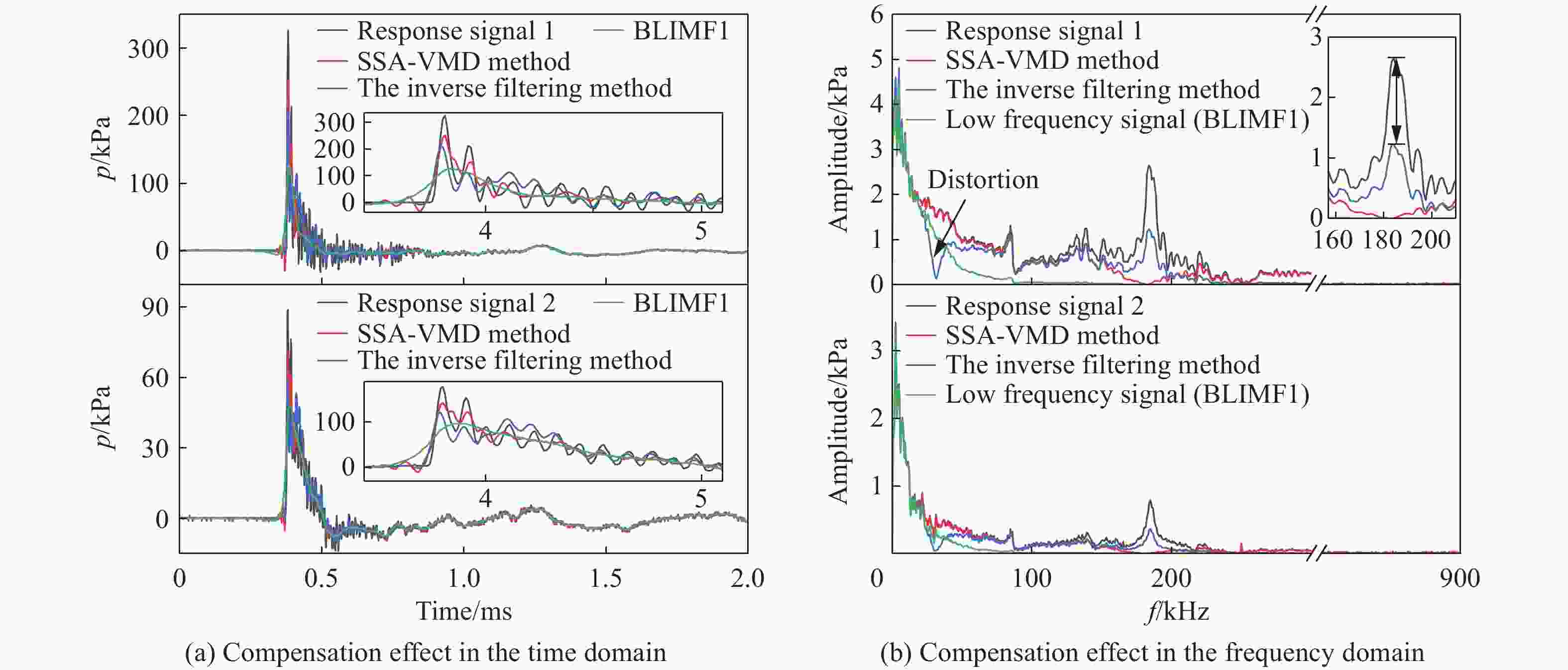
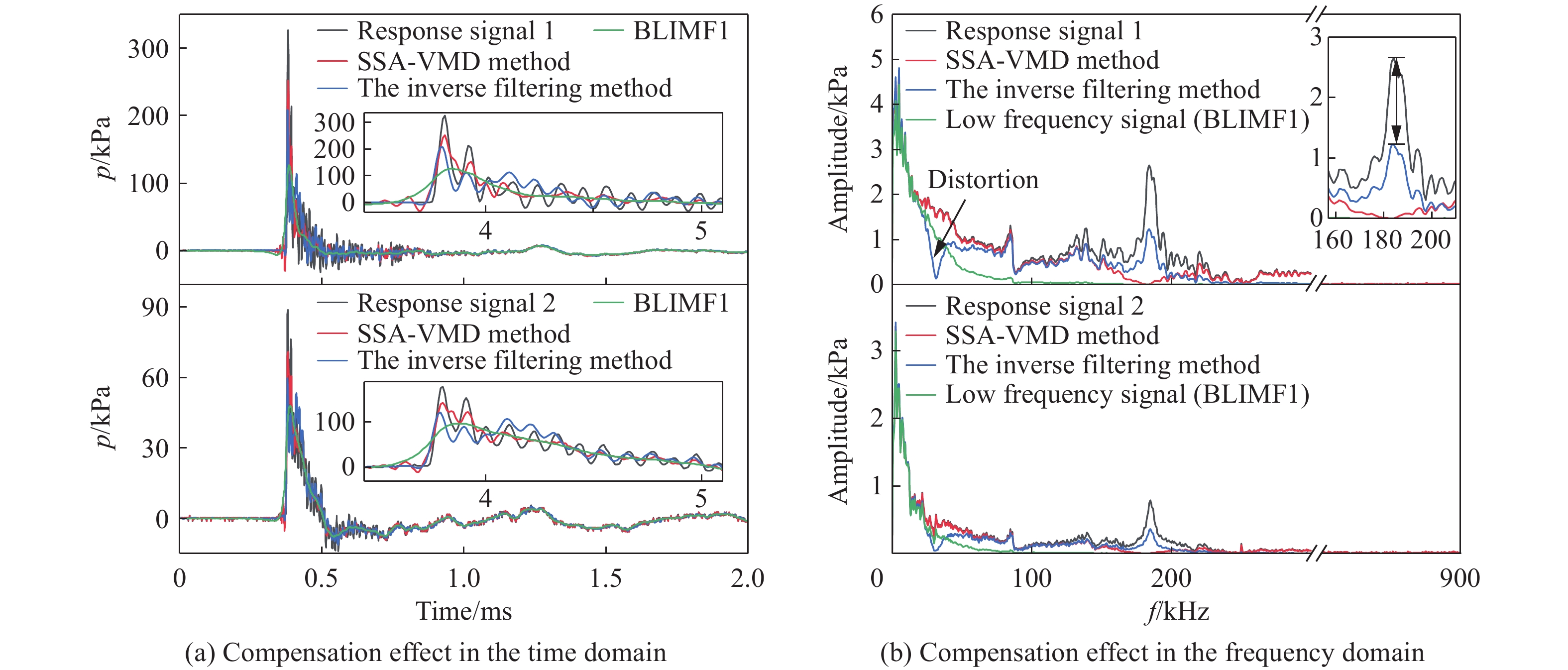
图 11 SSA-VMD与反滤波的补偿结果实测对比
Figure 11. Comparison of results between SSA-VMD and inverse filtering
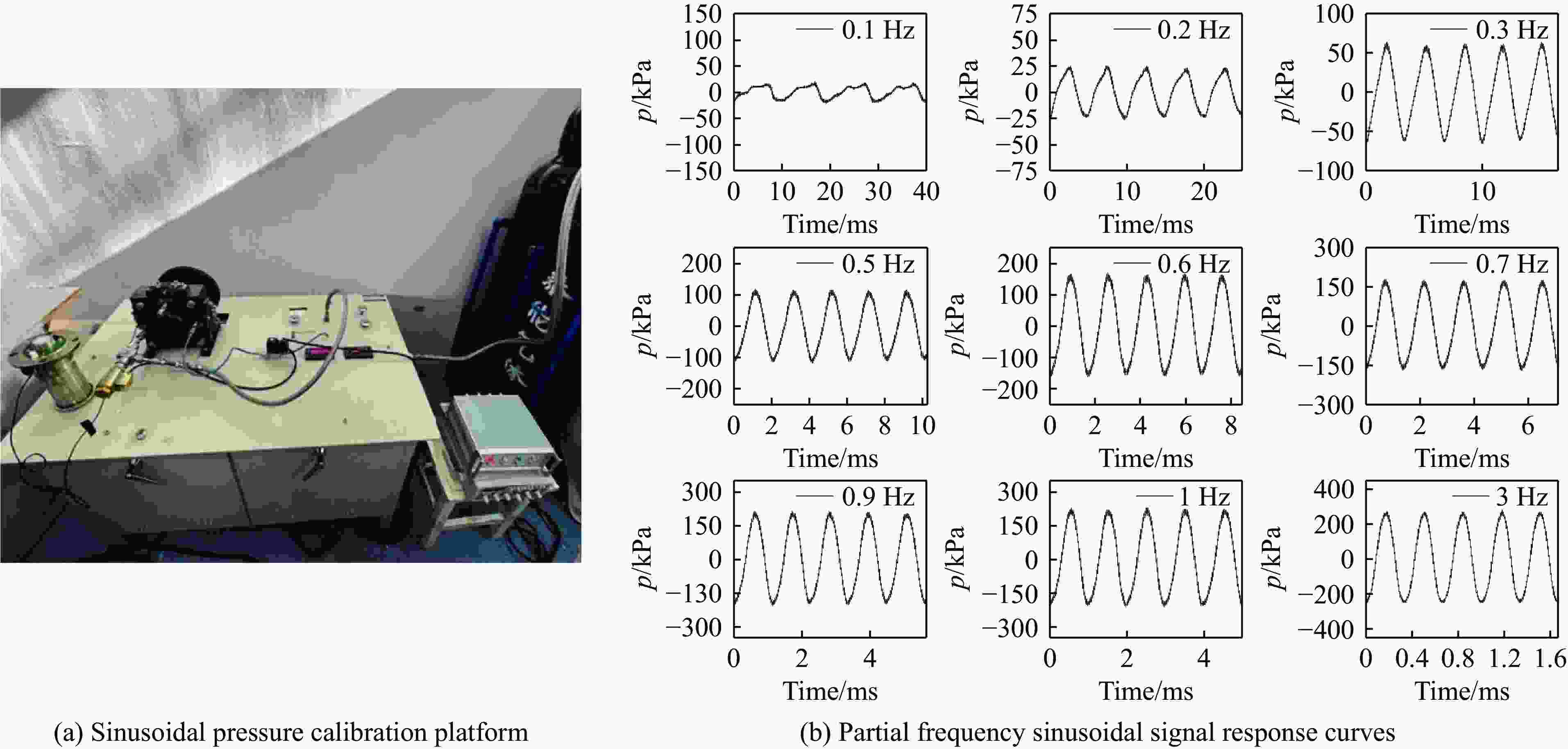
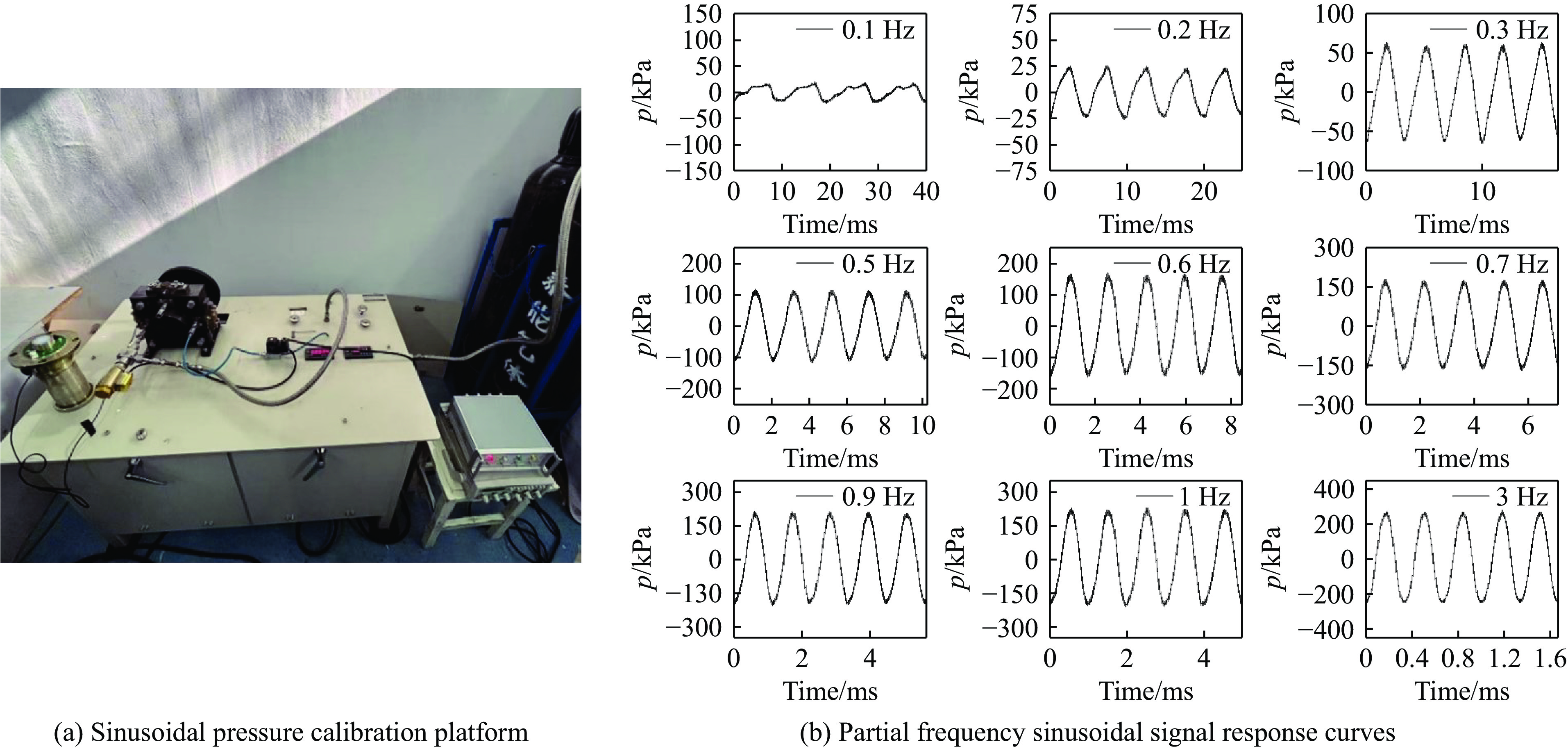
图 12 基于正弦发生器的传感器低频动态响应信号变化规律
Figure 12. Variation patterns in low-frequency response signals of the sensor tested with a sine generator
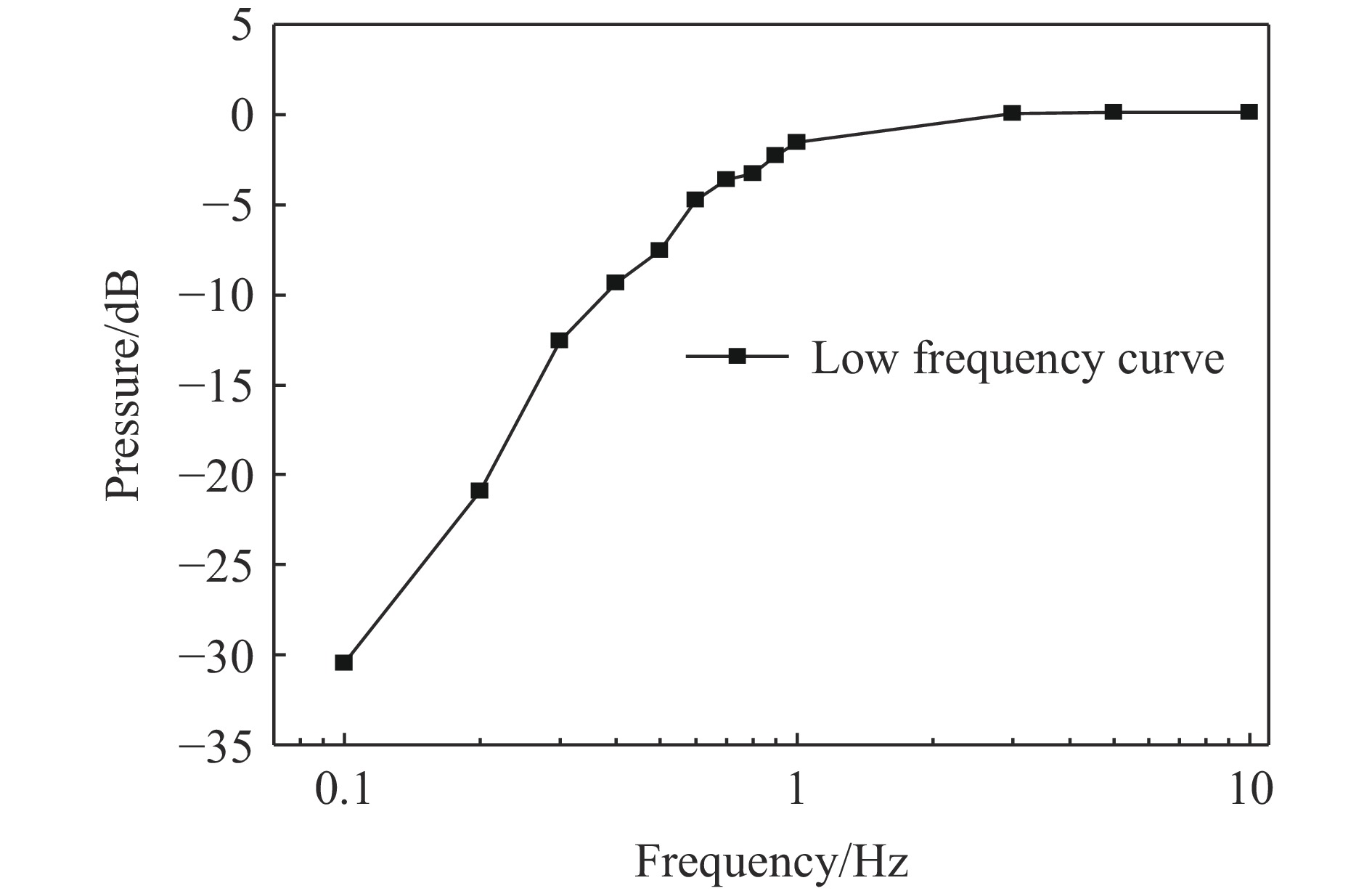
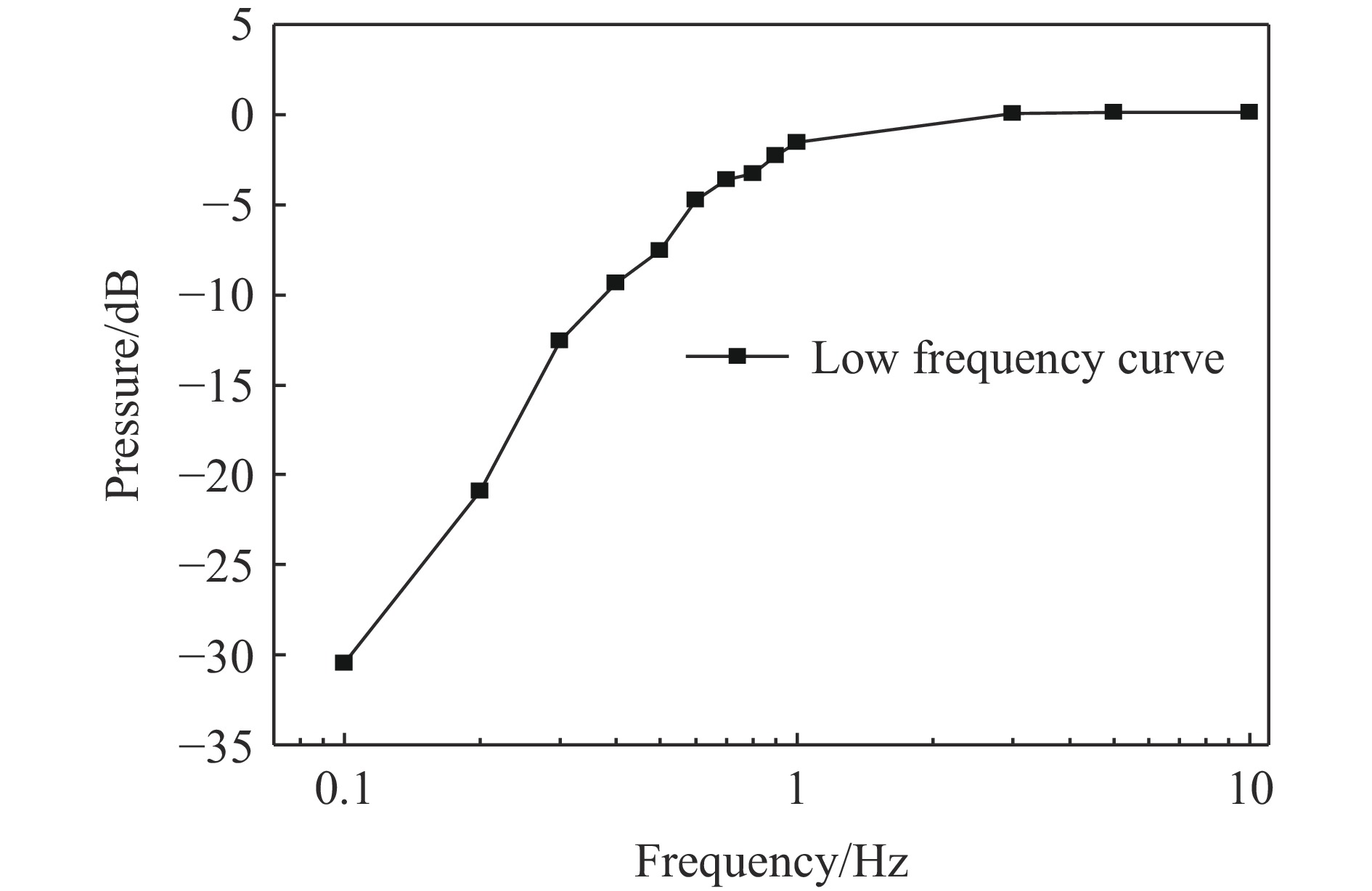
图 13 系统低频动态幅频特性曲线
Figure 13. System low-frequency dynamic amplitude-frequency characteristic curve
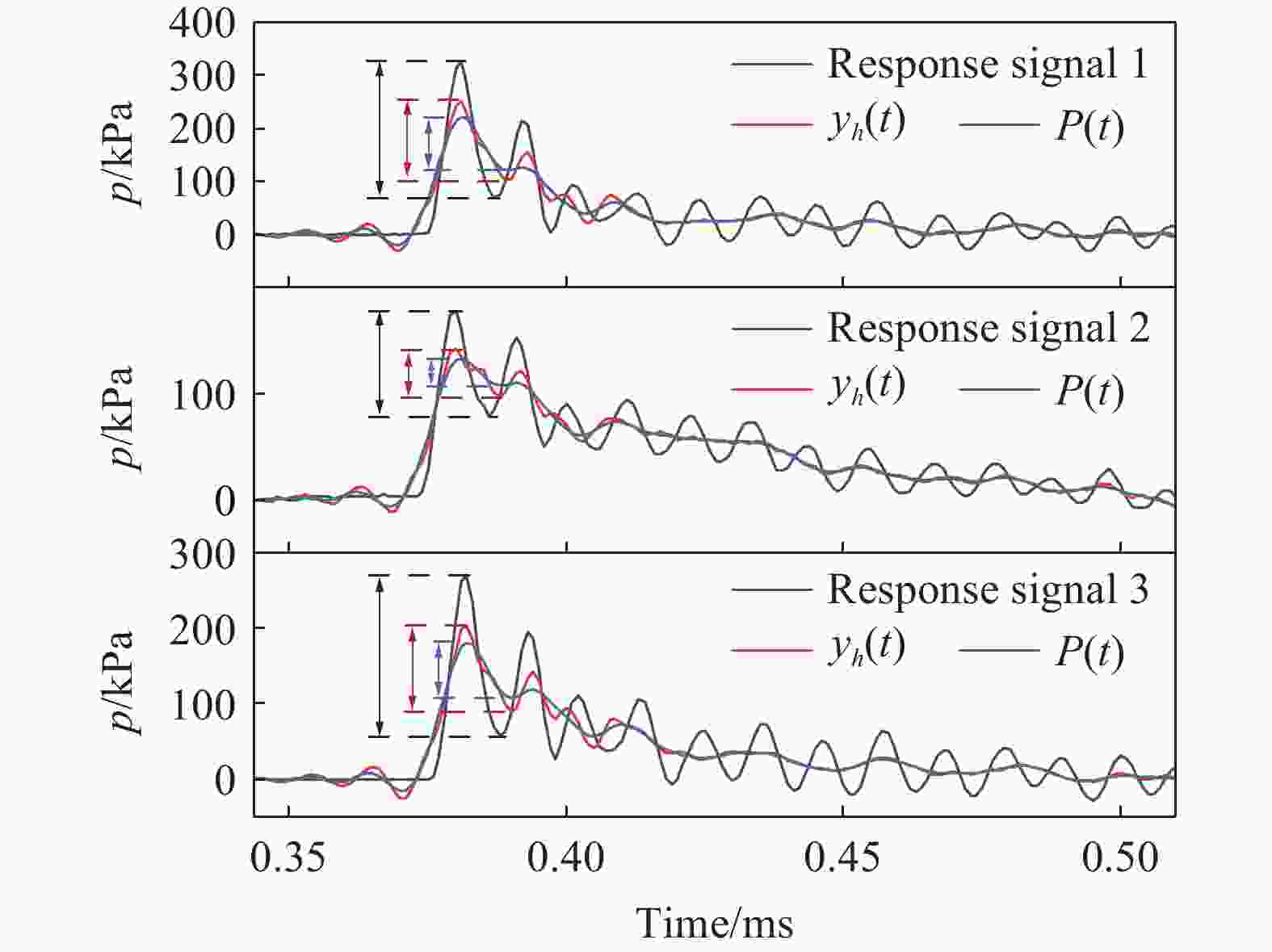
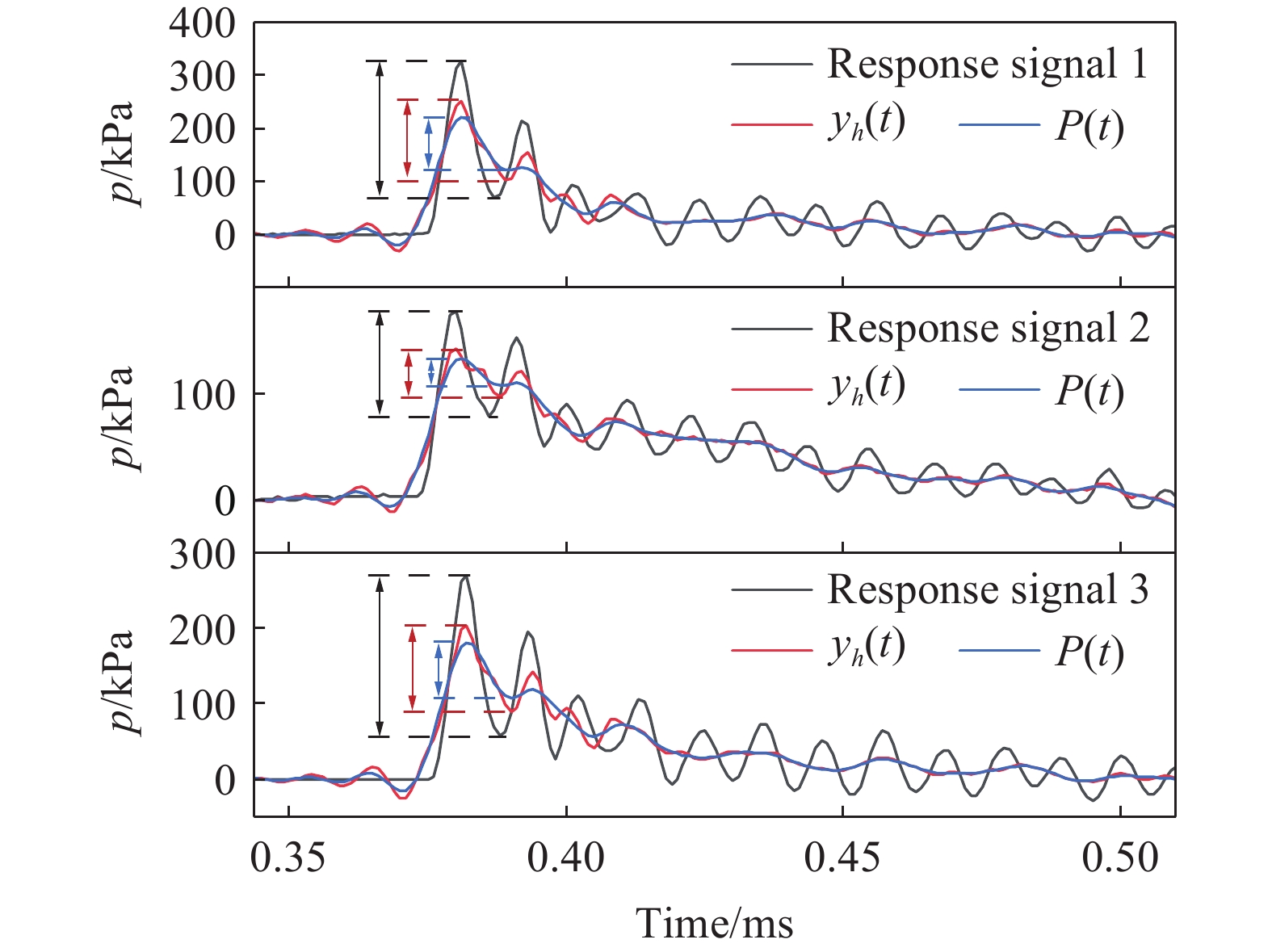
图 14 低频补偿的处理效果对比
Figure 14. Comparative processing effectiveness of low-frequency compensation
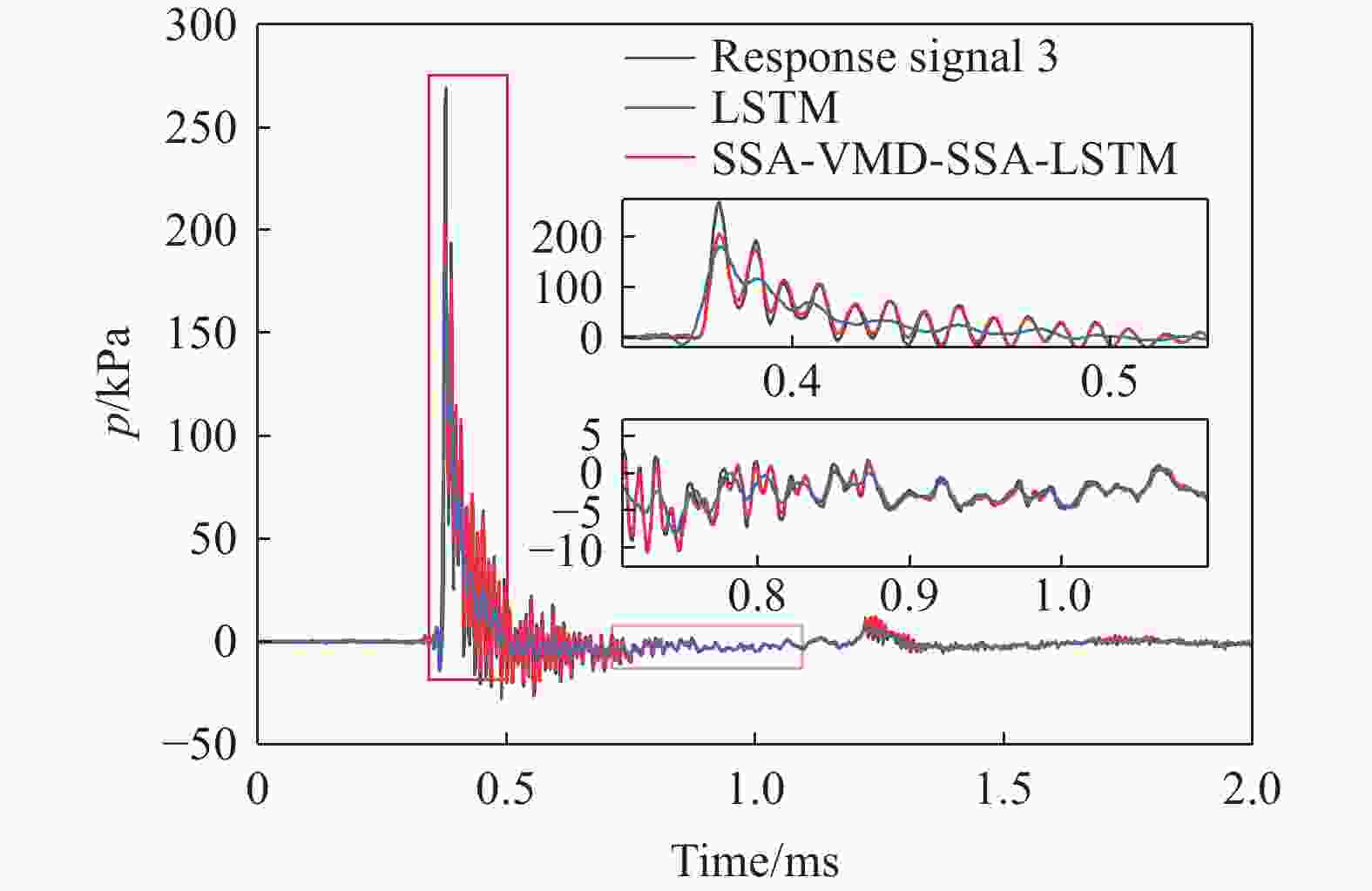
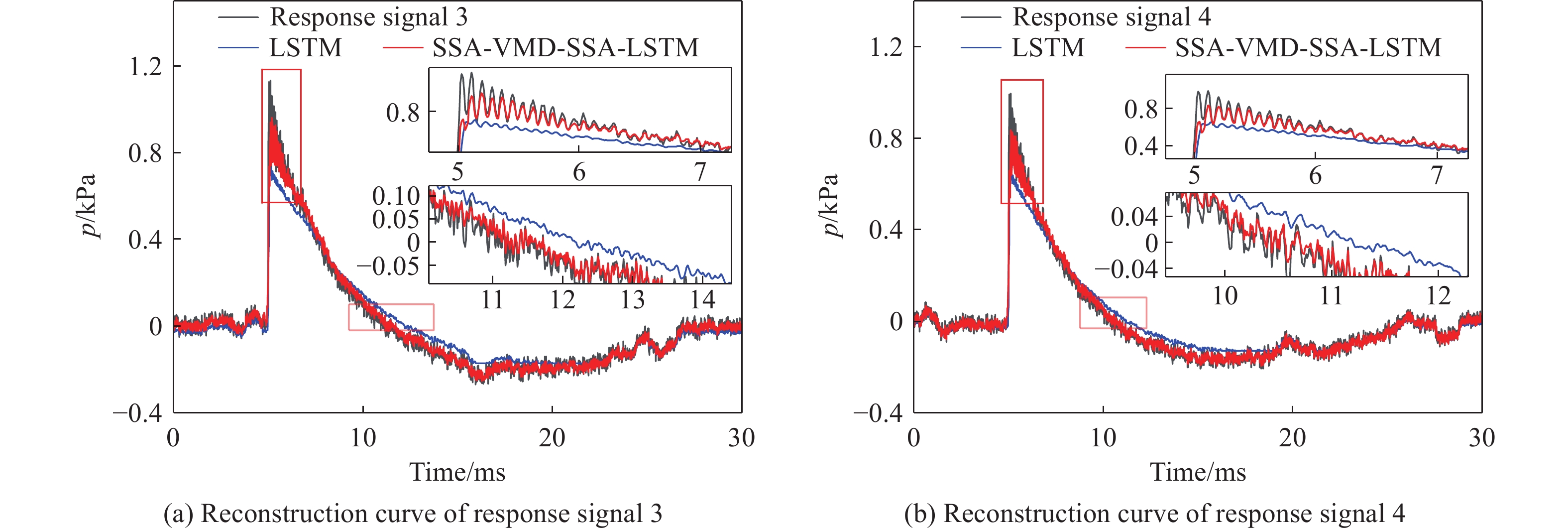
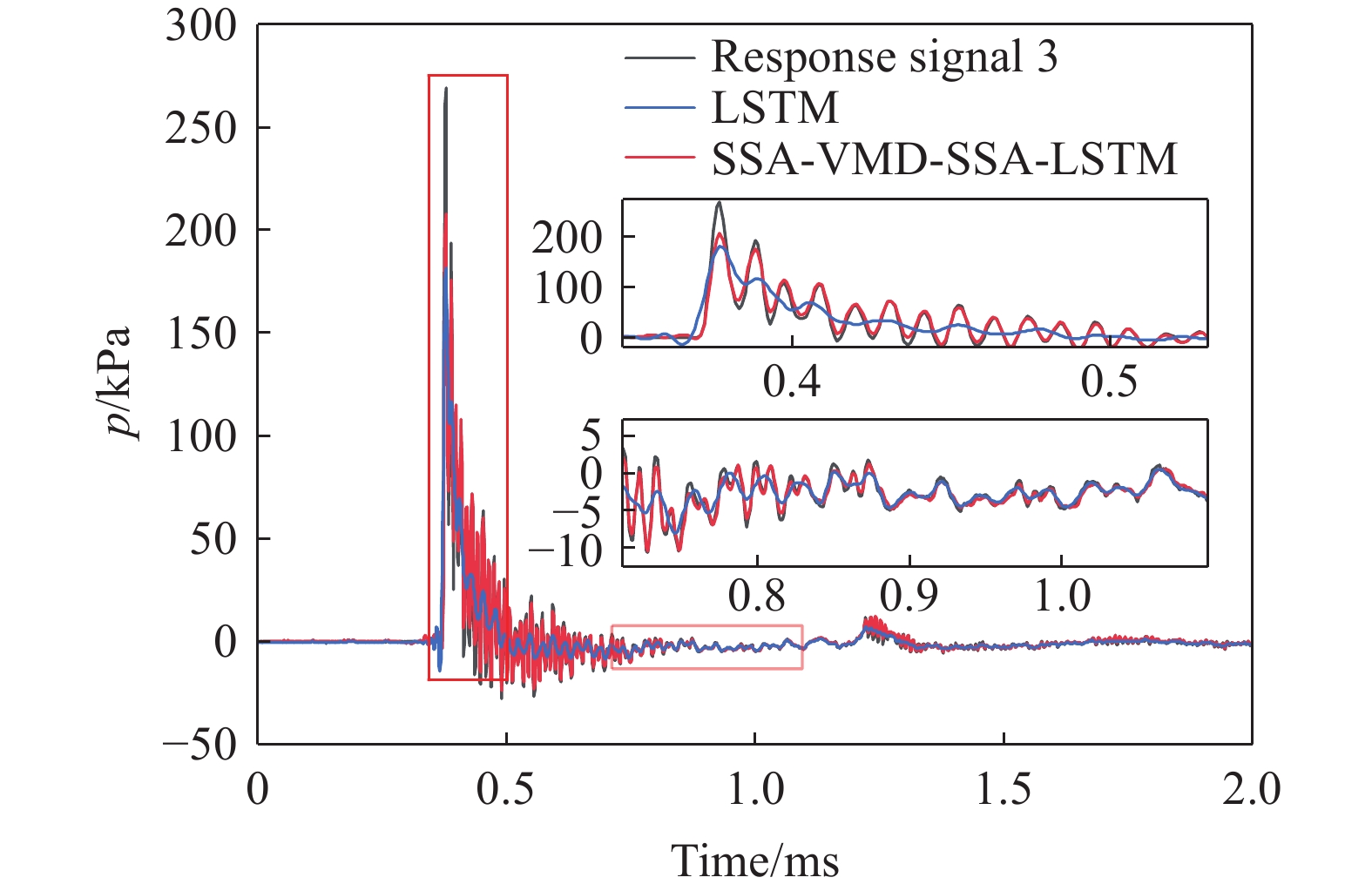
图 15 实测验证集信号重建曲线
Figure 15. Reconstruction curves for measured signals on the validation set
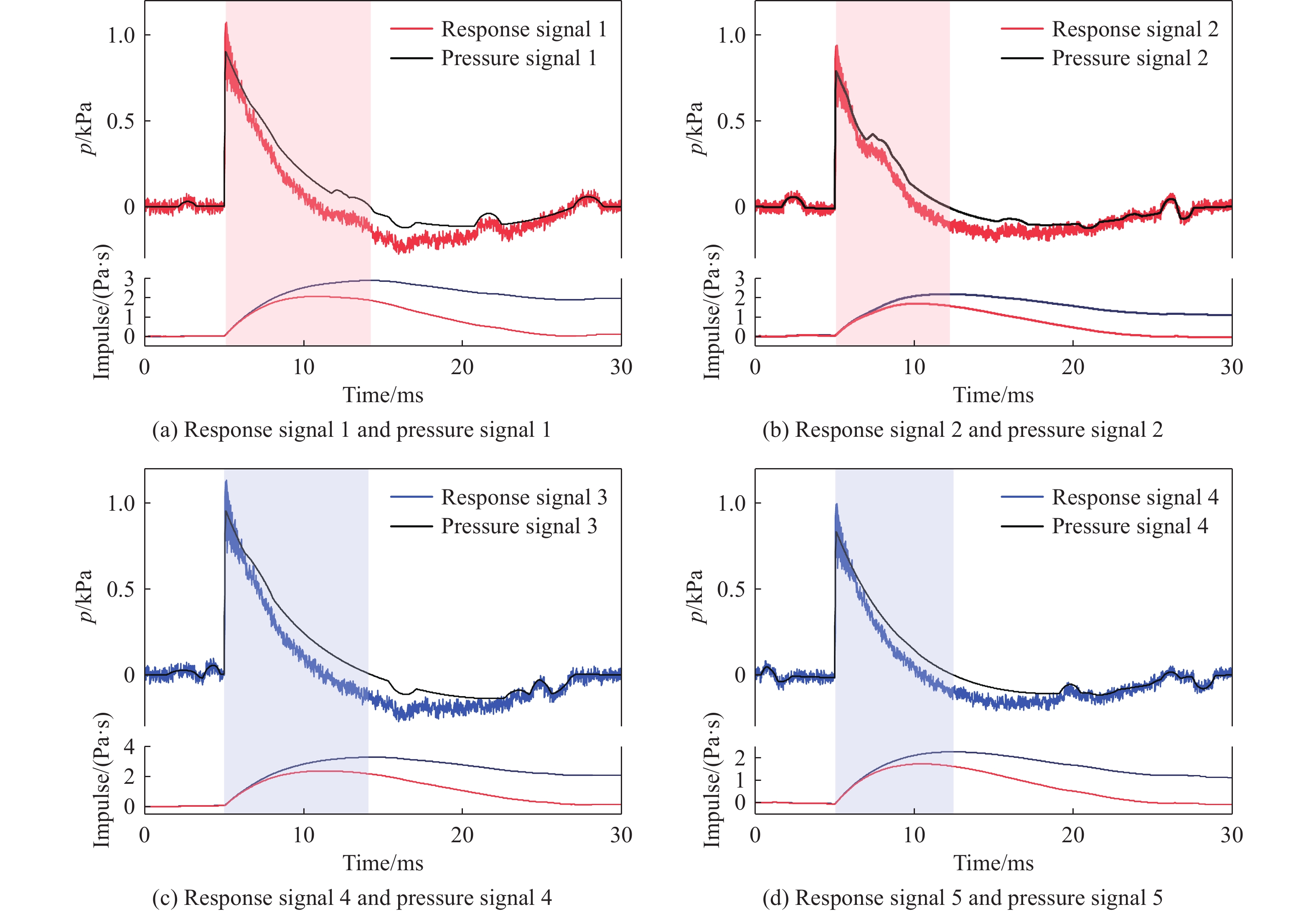
表 1 动态压力冲击信号及其响应特征参数
Table 1. Dynamic pressure impulse signal and its responses
组别 信号 响应 峰值超压/kPa 正压时间/ms 冲量/(Pa·s) 峰值超压/kPa 正压时间/ms 冲量/(Pa·s) 1 0.90 9.22 2.89 1.07 6.01 2.60 2 0.79 6.97 2.18 0.93 5.13 1.69 3 0.96 9.28 3.28 1.13 6.35 2.37 4 0.83 5.47 2.26 0.99 7.45 1.73  下载: 导出CSV
表 2 信号分解后各分量的相关系数、跳变时长
Table 2. Correlation coefficients and jump durations for decomposed signal components
模态 信号1 信号2 CC 跳变时长/ms CC 跳变时长/ms BLIMF1 0.989 6.20 0.991 5.54 BLIMF2 0.098 3.89 0.098 3.55 BLIMF3 0.064 0.10 0.061 0.10 Residual 0.223 1.44 0.192 0.32
下载: 导出CSV
表 3 模型的误差指标对比
Table 3. Comparison of error metrics for the models
算法 训练集 验证集 RMSE/Pa MAE/Pa MAPE/% RMSE/Pa MAE/Pa MAPE/% LSTM 55.545 38.828 7.4441 59.648 41.19 8.4934 SSA-VMD-SSA-LSTM 21.363 12.450 3.12 23.335 13.75 3.4385
下载: 导出CSV
表 4 优化算法对模型性能影响的消融实验分析
Table 4. Impact of optimization algorithms on model performance: an ablation analysis
隐藏单元
数目/个最大训练
周期/轮初始学习率 RMSE/Pa MAE/Pa MAPE/% 156 300 0.0067035 23 14 3.439 124 300 0.0067035 29 17 4.657 188 300 0.0067035 31 18 5.164
下载: 导出CSV
表 5 两种神经网络建模的误差性能指标
Table 5. A comparative evaluation of error metrics for the two neural network architectures
算法 隐藏单元数/个 初始学习率 RMSE/kPa MAE/kPa MAPE/% 峰值超压/kPa 振荡频率/kHz SSA-LSTM 66 0.0409 8.667 3.088 30.08 179.77 85.03 SSA-VMD-SSA-LSTM 124 0.091909 3.406 1.015 13.17 207.73 183.82
下载: 导出CSV
-
[1] 胡勇, 马天, 王俊龙, 等. 针对个体防护的冲击波检测评估技术 [J]. 爆炸与冲击, 2025, 45(4): 041101. DOI: 10.11883/bzycj-2024-0118.HU Y, MA T, WANG J L, et al. Shock wave detection and evaluation techniques for individual protection [J]. Explosion and Shock Waves, 2025, 45(4): 041101. DOI: 10.11883/bzycj-2024-0118. [2] 张志杰. 动态测试与校准技术 [M]. 北京: 机械工业出版社, 2021: 8–9.ZHANG Z J. Dynamic measurement and calibration technology [M]. Beijing: China Machine Press, 2021: 8–9. [3] 韦志慧. 基于MATLAB传感器动态误差频域修正方法 [J]. 机械, 2012, 39(S1): 17–20. DOI: 10.3969/j.issn.1006-0316.2012.S1.005.WEI Z H. A correcting method of frenquency domain for sensor's dynamic error based on MATLAB [J]. Machinery, 2012, 39(S1): 17–20. DOI: 10.3969/j.issn.1006-0316.2012.S1.005. [4] 徐浩, 杜红棉, 范锦彪, 等. 冲击波测试系统低频特性与补偿方法研究 [J]. 爆炸与冲击, 2019, 39(10): 104102. DOI: 10.11883/bzycj-2019-0233.XU H, DU H M, FAN J B, et al. Research on low frequency characteristics and compensation method of a shock wave test system [J]. Explosion and Shock Waves, 2019, 39(10): 104102. DOI: 10.11883/bzycj-2019-0233. [5] 张龙, 廖旭东, 张宝国, 等. 有限空间爆炸瞬态温度的动态补偿方法研究 [J]. 传感技术学报, 2020, 33(6): 861–866. DOI: 10.3969/j.issn.1004-1699.2020.06.012.ZHANG L, LIAO X D, ZHANG B G, et al. Research on dynamic compensation method for explosion transient temperature in finite space [J]. Chinese Journal of Sensors and Actuators, 2020, 33(6): 861–866. DOI: 10.3969/j.issn.1004-1699.2020.06.012. [6] 杨文杰, 张志杰, 赵晨阳, 等. 基于零极点配置理论的压力传感器动态特性补偿 [J]. 科学技术与工程, 2016, 16(2): 78–82,99. DOI: 10.3969/j.issn.1671-1815.2016.02.015.YANG W J, ZHANG Z J, ZHAO C Y, et al. The dynamic characteristics compensation of the pressure sensor based on the theory of configuring zero-poles [J]. Science Technology and Engineering, 2016, 16(2): 78–82,99. DOI: 10.3969/j.issn.1671-1815.2016.02.015. [7] 王志超, 张志杰, 赵晨阳. 压力传感器的模型不确定度研究 [J]. 测试技术学报, 2020, 34(1): 54–60. DOI: 10.3969/j.issn.1671-7449.2020.01.009.WANG Z C, ZHANG Z J, ZHAO C Y. Research on model uncertainty of pressure sensor [J]. Journal of Test and Measurement Technology, 2020, 34(1): 54–60. DOI: 10.3969/j.issn.1671-7449.2020.01.009. [8] 郑德智, 吴钧明, 樊尚春. 基于改进烟花算法的传感器动态特性补偿方法研究 [J]. 计测技术, 2020, 40(5): 25–30. DOI: 10.11823/j.issn.1674-5795.2020.05.05.ZHENG D Z, WU J M, FAN S C. Research on dynamic compensation of sensors based on improved fireworks algorithm [J]. Metrology and Measurement Technology, 2020, 40(5): 25–30. DOI: 10.11823/j.issn.1674-5795.2020.05.05. [9] 赵博, 李鹤. 结合EMD和LSF的振动信号降噪方法的研究 [J]. 振动、测试与诊断, 2022, 42(3): 606-610, 624. DOI: 10.16450/j.cnki.issn.1004-6801.2022.03.028.ZHAO B, LI H. Noise reduction method of vibration signal combining EMD and LSF [J]. Journal of Vibration, Measurement & Diagnosis, 2022, 42(3): 606-610, 624. DOI: 10.16450/j.cnki.issn.1004-6801.2022.03.028. [10] 孙传猛, 裴东兴, 陈嘉欣, 等. 基于深度学习的爆炸冲击波信号重构模型 [J]. 计测技术, 2022, 42(2): 57–67. DOI: 10.11823/j.issn.1674-5795.2022.02.07.SUN C M, PEI D X, CHEN J X, et al. Research on reconstruction model of explosion shock wave signal based on deep learning [J]. Metrology and Measurement Technology, 2022, 42(2): 57–67. DOI: 10.11823/j.issn.1674-5795.2022.02.07. [11] 于浩, 刘彦, 孙亚如, 等. 爆炸冲击波场参数数字重构技术研究 [J]. 北京理工大学学报, 2025, 45(3): 219–228. DOI: 10.15918/j.tbit1001-0645.2024.078.YU H, LIU Y, SUN Y R, et al. Research on digital reconstruction of explosion shock wave field parameters [J]. Transactions of Beijing Institute of Technology, 2025, 45(3): 219–228. DOI: 10.15918/j.tbit1001-0645.2024.078. [12] YAO Z J, LI Y S, SHI B, et al. An improved reconstruction method of the reflected dynamic pressure in shock tube system based on inverse sensing model identification [J]. Aerospace Science and Technology, 2024, 145: 108903. DOI: 10.1016/j.ast.2024.108903. [13] LU J X, ZHOU Y Z, GE Y L, et al. Research into prediction method for pressure pulsations in a centrifugal pump based on variational mode decomposition-particle swarm optimization and hybrid deep learning models [J]. Sensors, 2024, 24(13): 4196. DOI: 10.3390/s24134196. [14] FRIEDLANDER F G. The diffraction of sound pulses: Ⅰ. diffraction by a semi-infinite plane [J]. Proceedings of the Royal Society A: Mathematical, Physical and Engineering Sciences, 1946, 186(1006): 322–344. DOI: 10.1098/rspa.1946.0046. [15] DRAGOMIRETSKIY K, ZOSSO D. Variational mode decomposition [J]. IEEE Transactions on Signal Processing, 2014, 62(3): 531–544. DOI: 10.1109/TSP.2013.2288675. [16] ZHANG X, MIAO Q, ZHANG H, et al. A parameter-adaptive VMD method based on grasshopper optimization algorithm to analyze vibration signals from rotating machinery [J]. Mechanical Systems and Signal Processing, 2018, 108: 58–72. DOI: 10.1016/j.ymssp.2017.11.029. [17] 李向荣, 马翊闻, 李帅, 等. 爆炸冲击波峰值区域频率分布特性研究 [J]. 北京理工大学学报, 2019, 39(2): 125–130. DOI: 10.15918/j.tbit1001-0645.2019.02.003.LI X R, MA Y W, LI S, et al. Research on frequency distribution of peak area of blast shock wave [J]. Transactions of Beijing Institute of Technology, 2019, 39(2): 125–130. DOI: 10.15918/j.tbit1001-0645.2019.02.003. [18] ZHAI Y P, ZHANG Z J, ZHANG H. Analysis and compensation of low frequency characteristics of sensors for vibration testing [J]. Journal of Measurement Science and Instrumentation, 2019, 10(2): 176–181. DOI: 10.3969/j.issn.1674-8042.2019.02.010. [19] 赖富文, 王文廉, 张志杰. 大当量战斗部爆炸冲击波测试系统设计及应用 [J]. 弹箭与制导学报, 2009, 29(3): 133–135,138. DOI: 10.3969/j.issn.1673-9728.2009.03.039.LAI F W, WANG W L, ZHANG Z J. Design and application of test system for blast wave [J]. Journal of Projectiles, Rockets, Missiles and Guidance, 2009, 29(3): 133–135,138. DOI: 10.3969/j.issn.1673-9728.2009.03.039. [20] HASTIE T, TIBSHIRANI R, FRIEDMAN J. The elements of statistical learning: data mining, inference, and prediction [M]. 2nd ed. New York: Springer, 2009. DOI: 10.1007/978-0-387-84858-7. -

计量
- 文章访问数: 184
- HTML全文浏览量: 44
- PDF下载量: 90
- 被引次数: 0