


Dynamic response and failure mechanism for urban continuous beam bridges under far-field blast loads
-
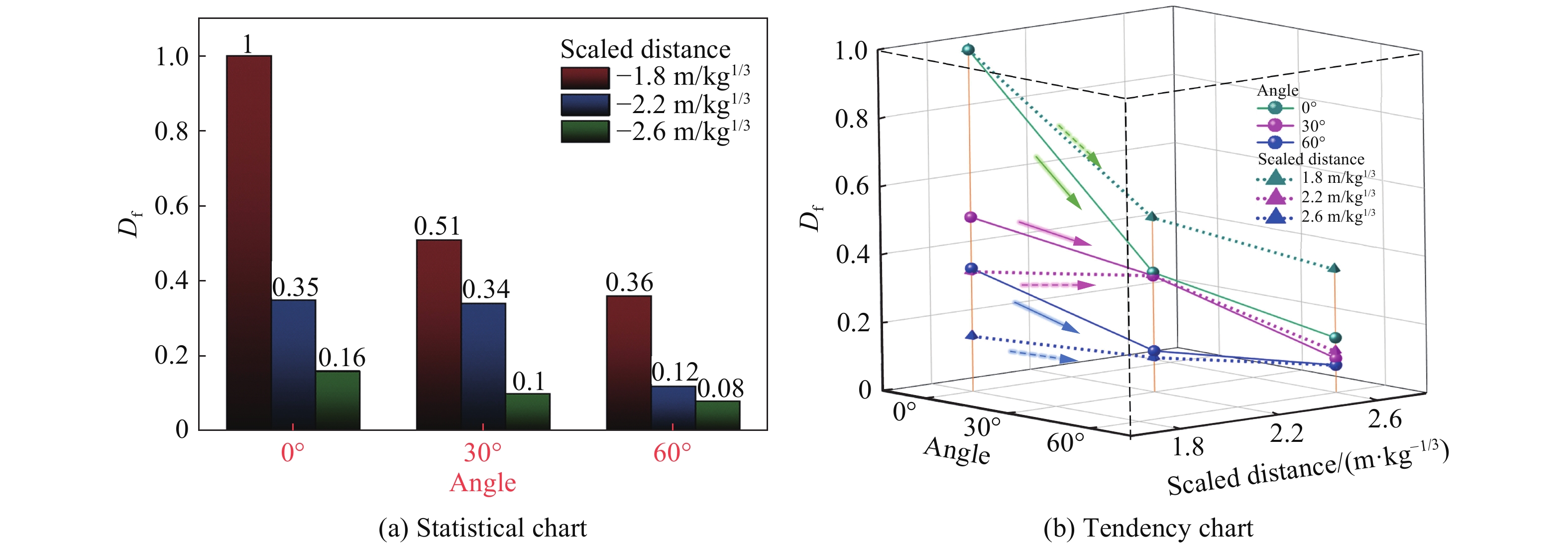
摘要: 为探究远距离爆炸荷载作用下城市连续梁桥的动力响应和破坏机理,首先采用LS-DYNA实现了远距离爆炸荷载的高效加载和爆炸流固耦合数值计算。基于典型连续梁桥结构,建立精细化数值计算模型,分析了不同爆炸场景下桥梁的响应过程和典型破坏模式,并进一步研究了爆炸距离、爆炸当量、冲击角度对结构响应和破坏的影响。结果表明:远距离爆炸荷载下连续梁桥呈现整体性的响应,上部结构抬升和桥墩倾斜是响应过程中的典型特征,上部结构抬升受爆炸荷载及桥梁空间几何特性影响,而桥墩倾斜则与冲击波直接作用和上部结构移位相关;正冲击下,连续梁桥发生湿接头破坏、箱梁弯曲变形、墩顶和墩底压溃以及盖梁弯曲开裂等典型破坏模式,并且斜冲击下,下部结构还发生墩柱扭转现象;冲击角度和比例距离减小,均将加剧桥梁结构的整体损伤程度。根据提出的加权损伤因子评价可知,相比于冲击角度变化,连续梁桥整体损伤程度对比例距离变化更敏感。Abstract: Urban bridges are frequently exposed to blast threats arising from accidental explosions and terrorist attacks. However, existing studies on bridge responses under blast loading remain limited, particularly for far-field blast conditions. To investigate the dynamic response and damage mechanisms of urban continuous beam bridges subjected to far-field blast loading, LS-DYNA was employed to efficiently apply blast loads and perform numerical simulations accounting for blast-induced fluid–structure interaction. Based on a typical continuous beam bridge, a refined numerical model was developed to analyze the response process and representative damage modes of the bridge under different blast scenarios. Furthermore, the effects of blast distance, explosive charge weight, and impact angle on structural response and damage were systematically examined. The results indicate that, under far-field blast loading, the continuous beam bridge exhibits a global structural response, with uplift of the superstructure and tilting of the bridge piers being the dominant characteristics. The uplift of the superstructure is primarily influenced by the blast load and the spatial geometric characteristics of the bridge, whereas the tilting of the piers is associated with the direct action of the blast wave and the displacement of the superstructure. Under perpendicular impact, typical damage modes include wet joint failure, flexural deformation of box girders, crushing damage at the tops and bases of piers, and bending cracks in bent caps. Under oblique blast loading, torsional deformation of pier columns is additionally observed in the substructure. A decrease in the impact angle or the scaled distance results in an increase in the overall damage of the bridge structure. Evaluation based on the proposed weighted damage factor indicates that, compared with the impact angle, the overall damage of the continuous beam bridge is more sensitive to variations in the scaled distance. The findings of this study provide useful analytical approaches and mechanistic insights for understanding blast responses and guiding the blast-resistant design of bridge structures.
-
Key words:
- far-field blast /
- continuous beam bridge /
- dynamic response /
- failure mechanism
-
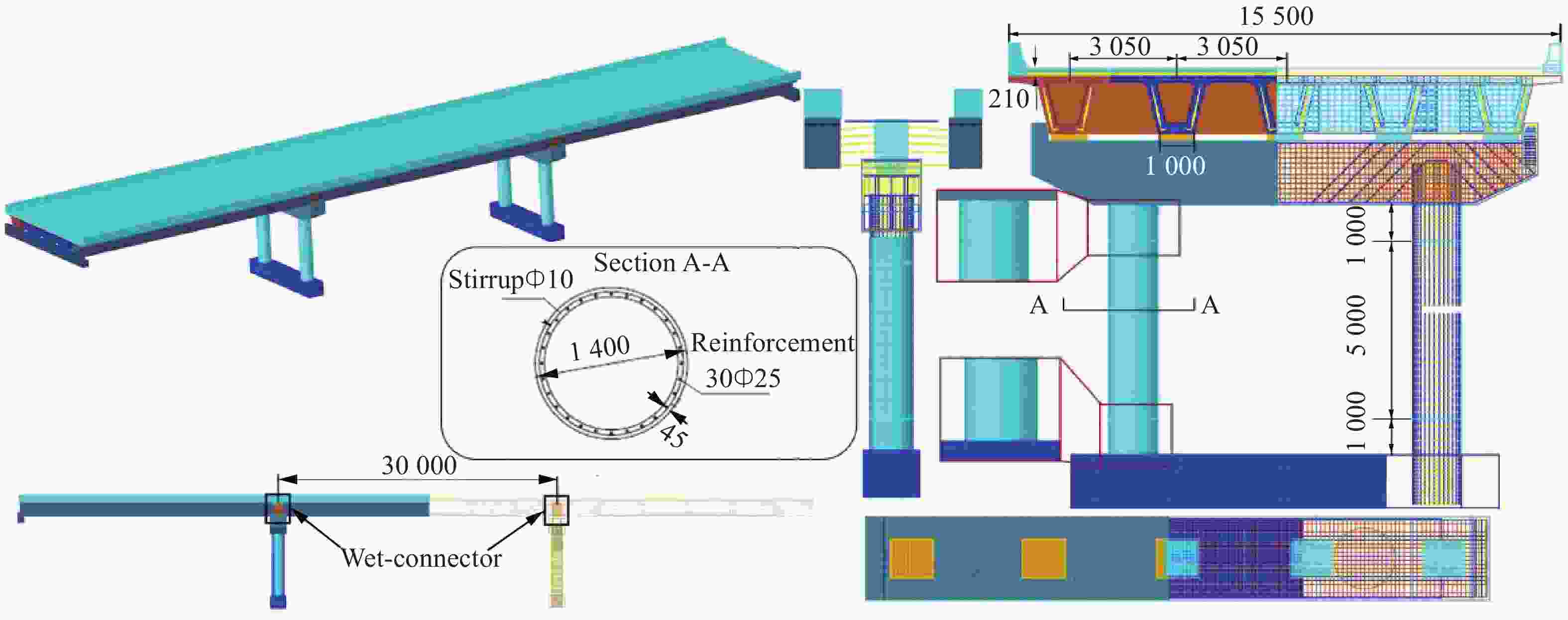
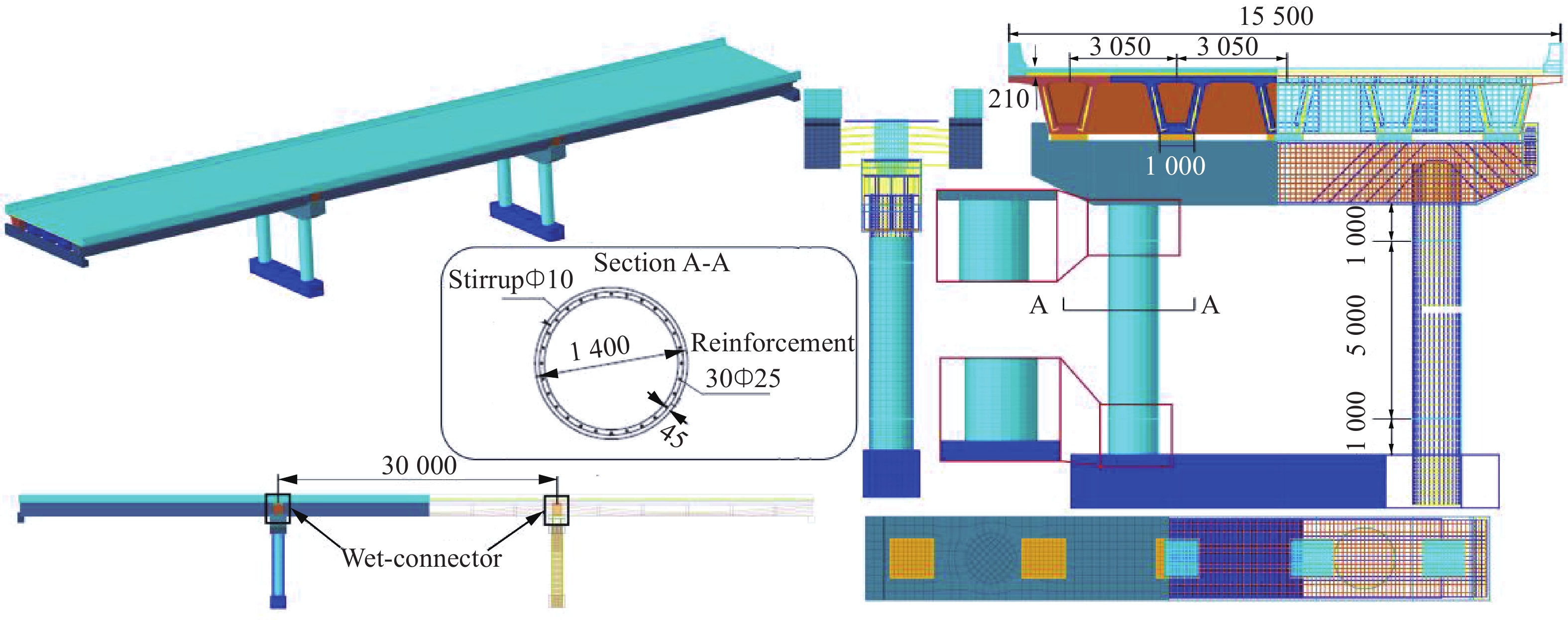
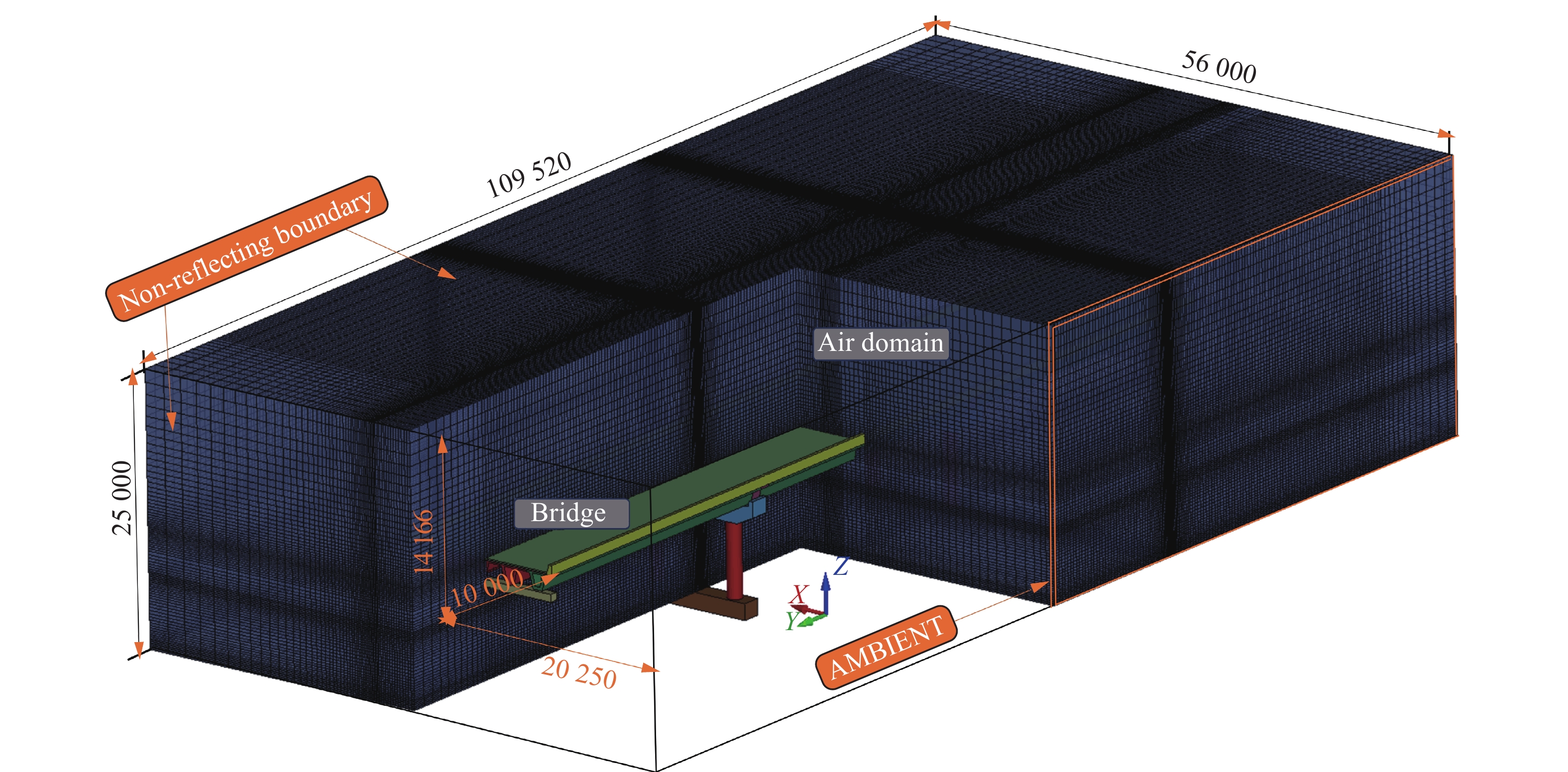
图 5 连续梁桥有限元模型(单位:mm)
Figure 5. Finite element model of continuous beam bridge (unit: mm)
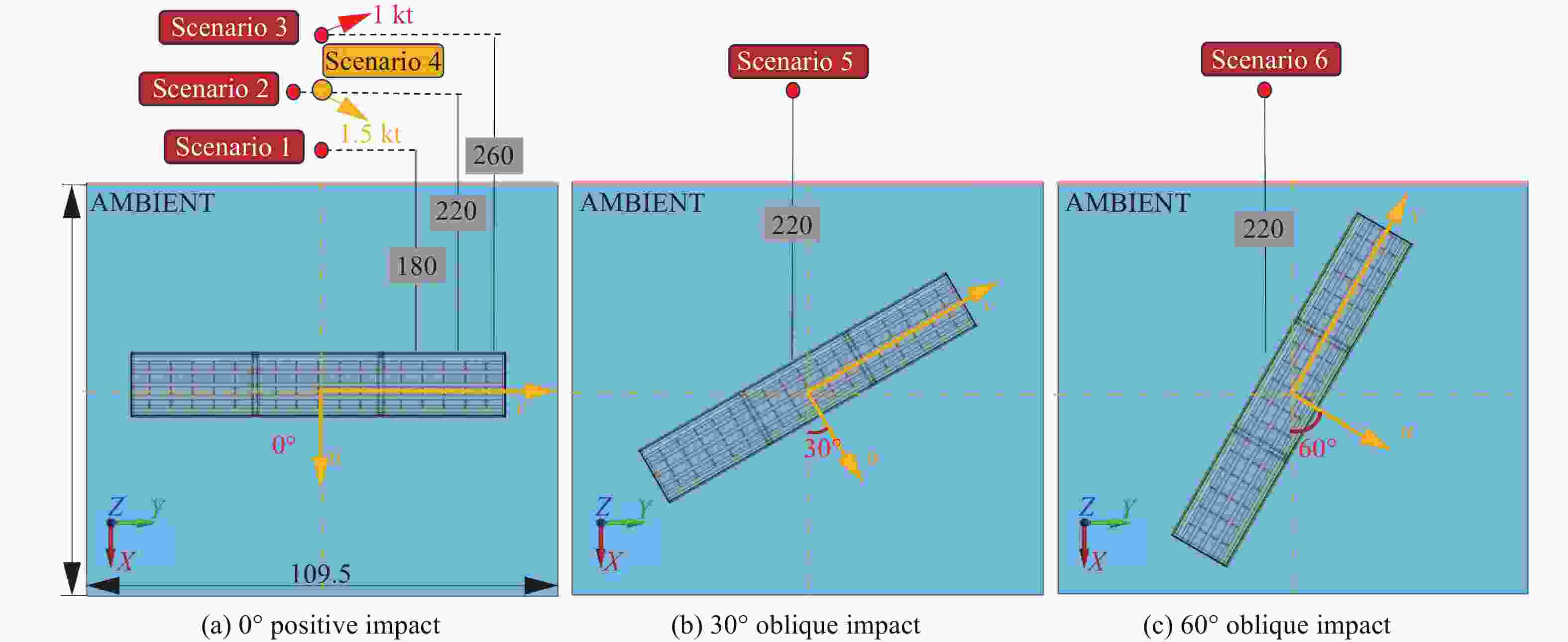
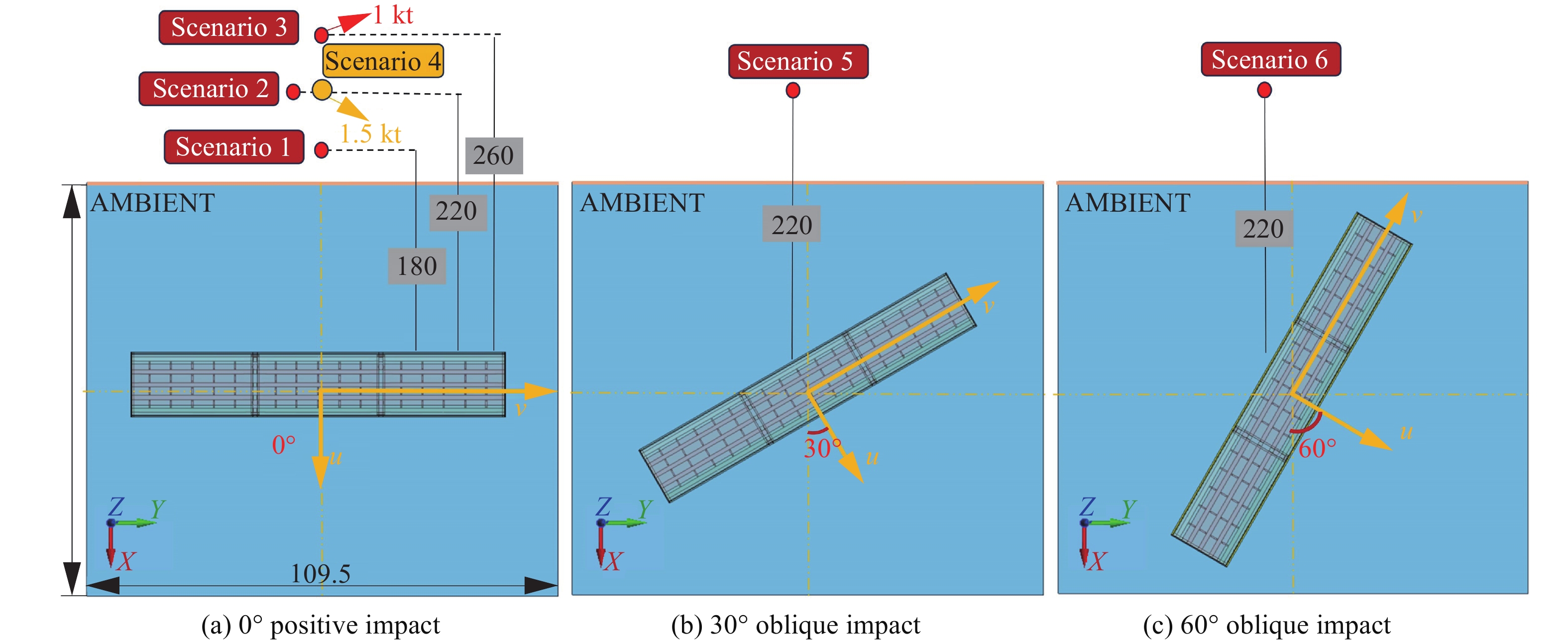
图 8 远距离爆炸场景示意图(单位:m)
Figure 8. Schematic diagram of the far-field blast scenarios (unit: m)
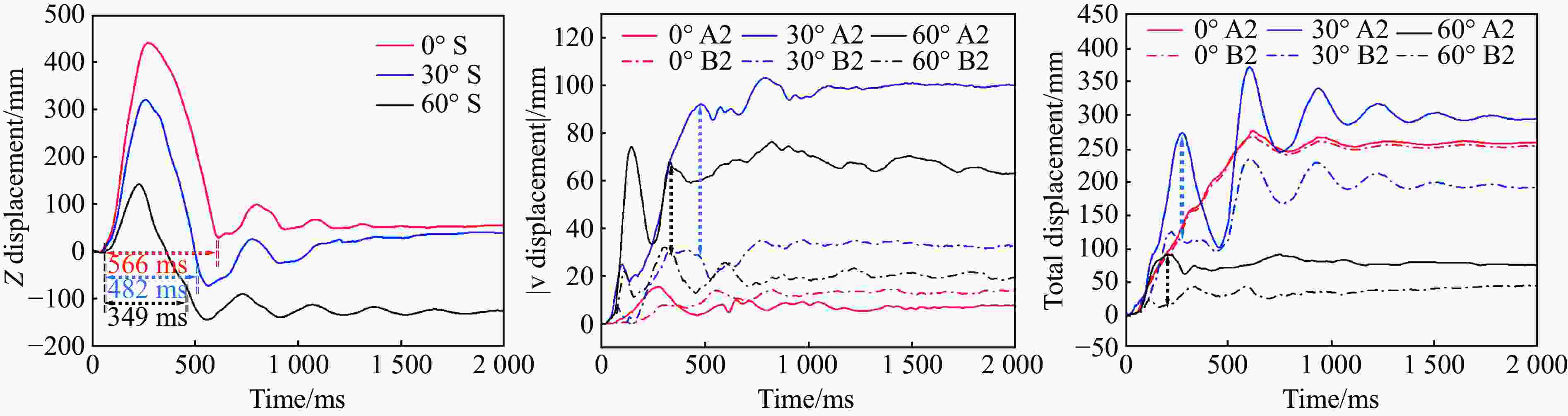
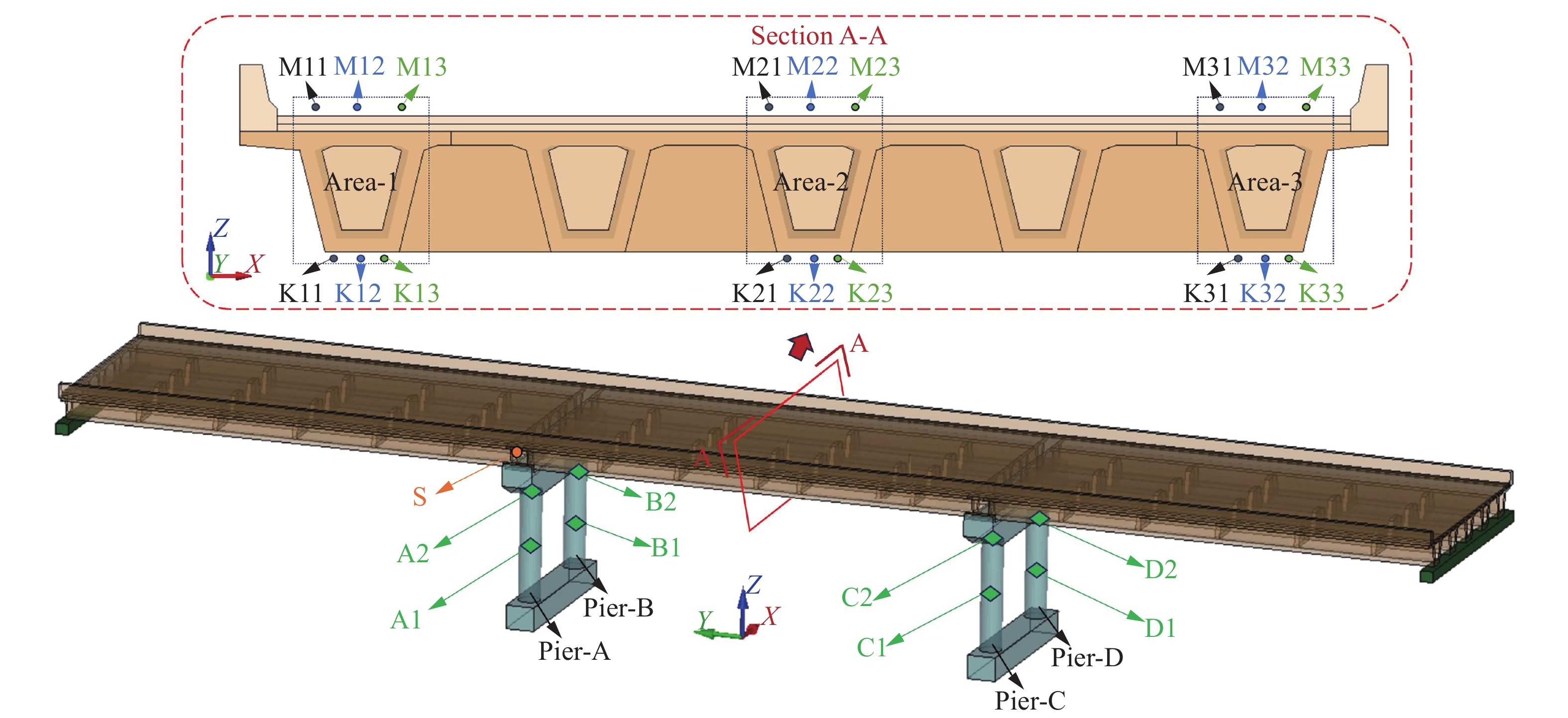
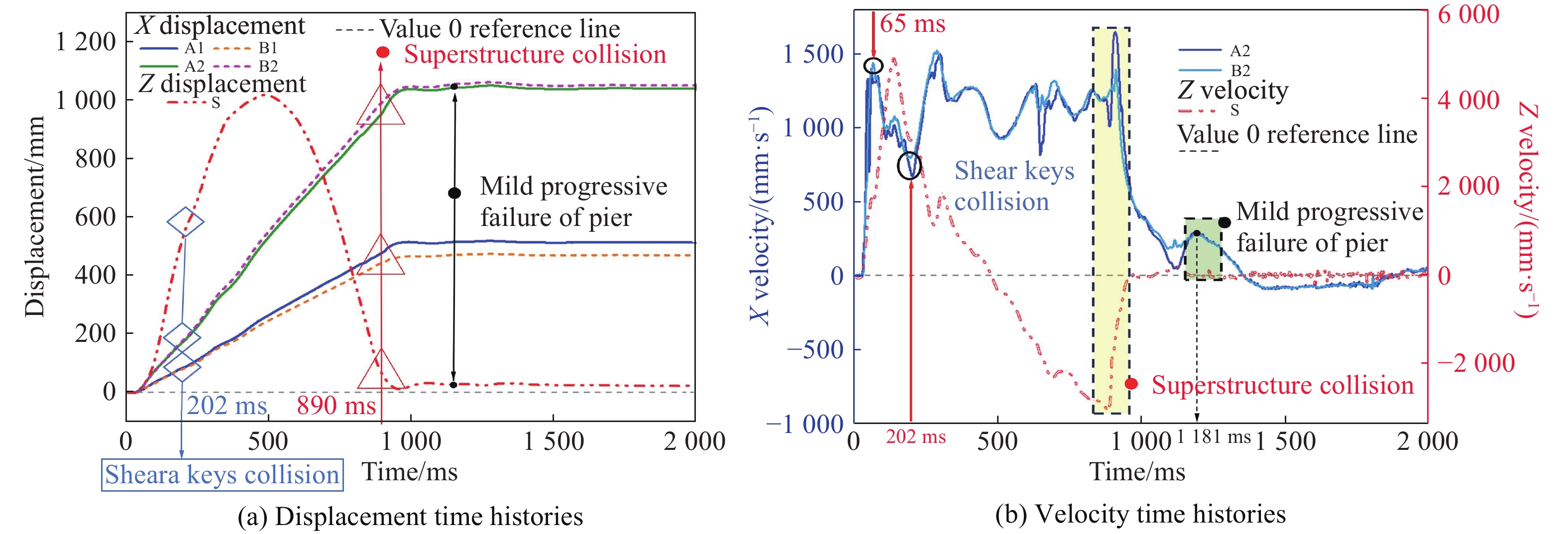
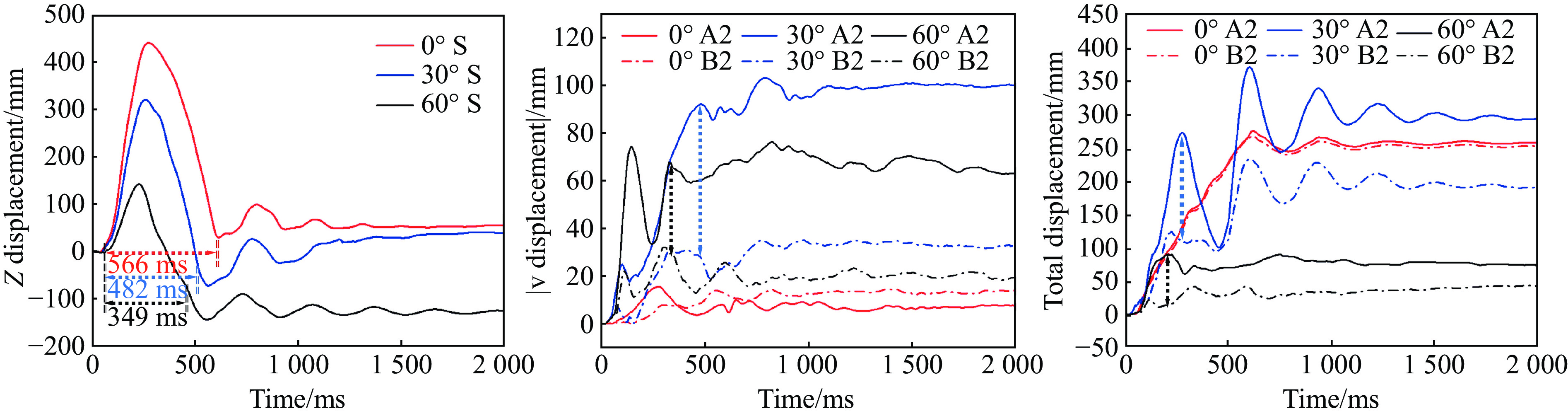
图 17 桥墩和桥面测点位移时程曲线
Figure 17. Displacement histories of measurement points on piers and bridge deck
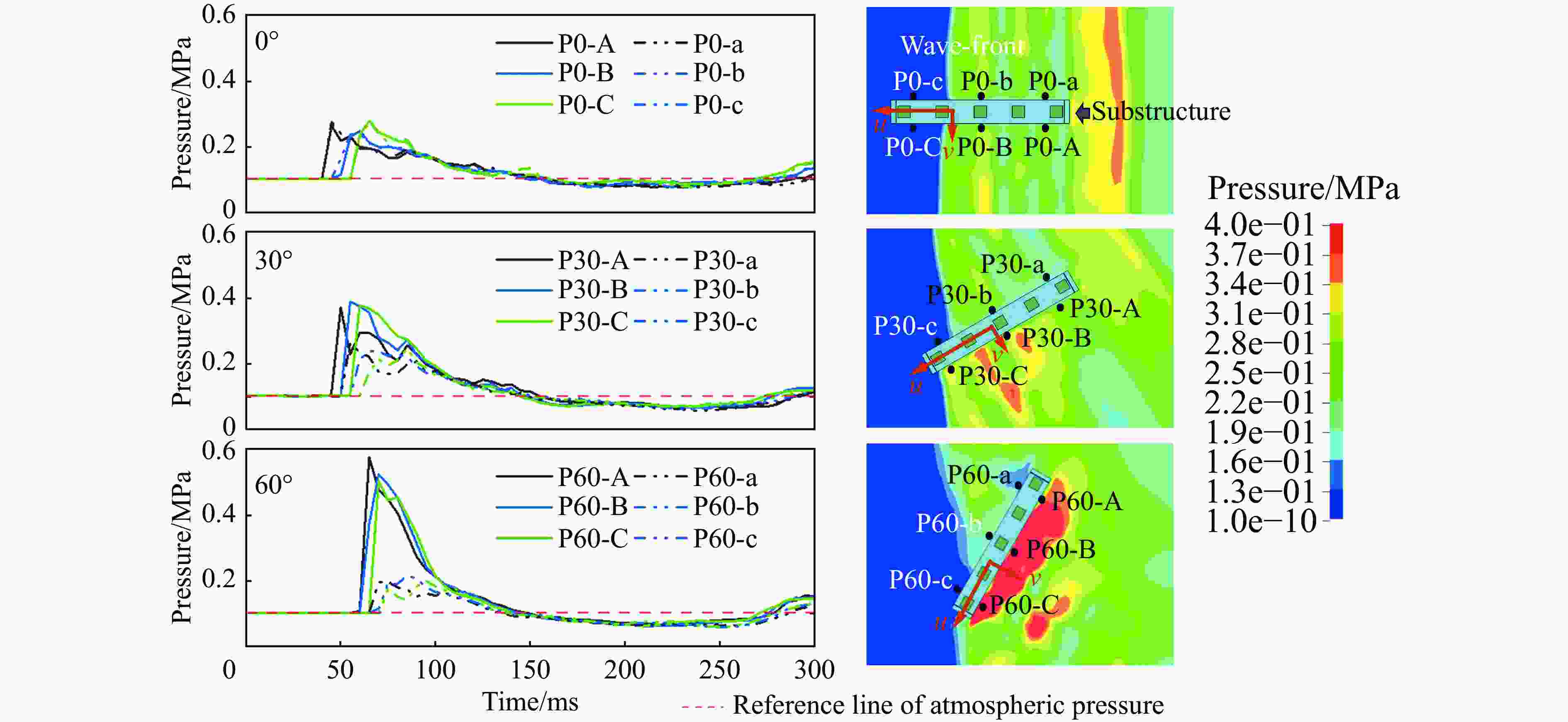
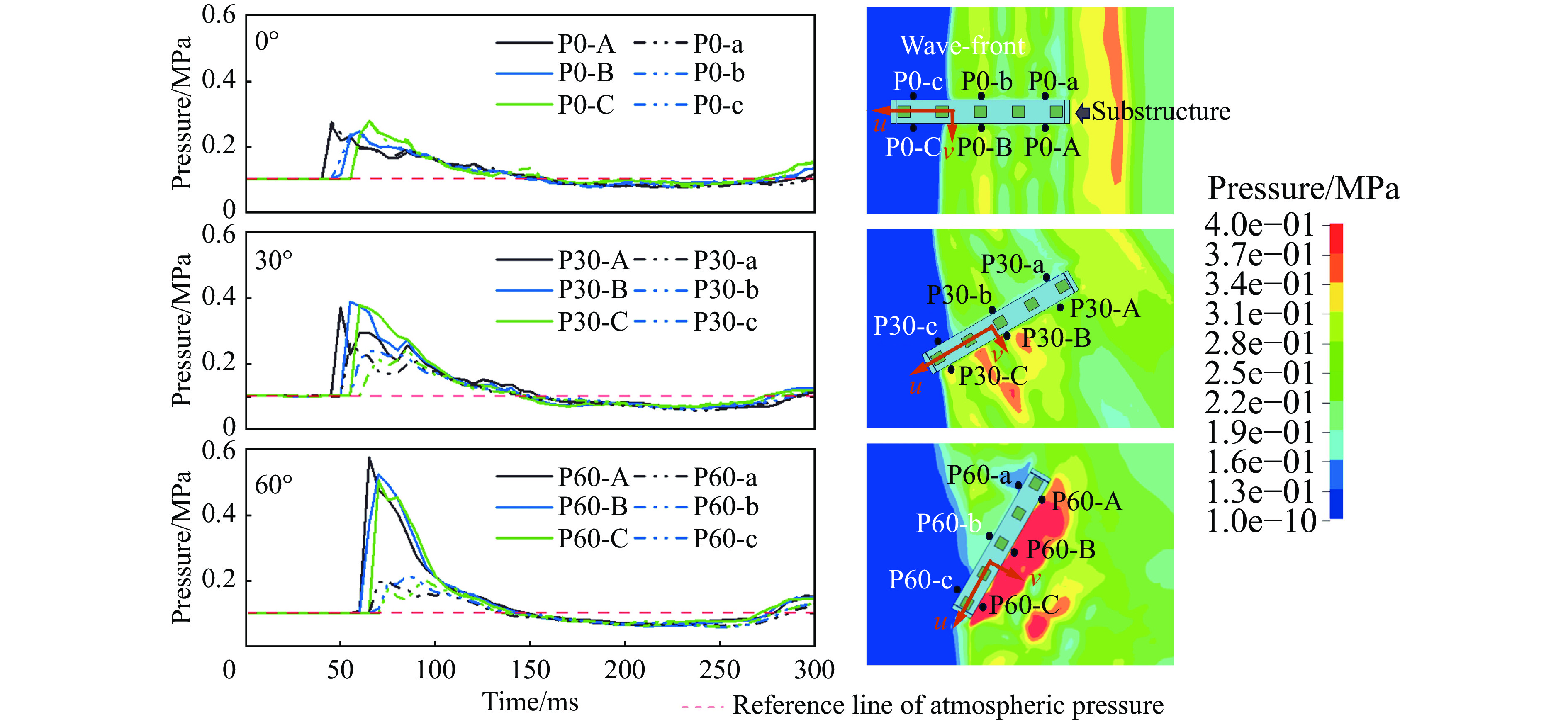
图 18 不同角度下盖梁侧面压力分布
Figure 18. Pressure distribution on the sides of bent caps under different impact angles
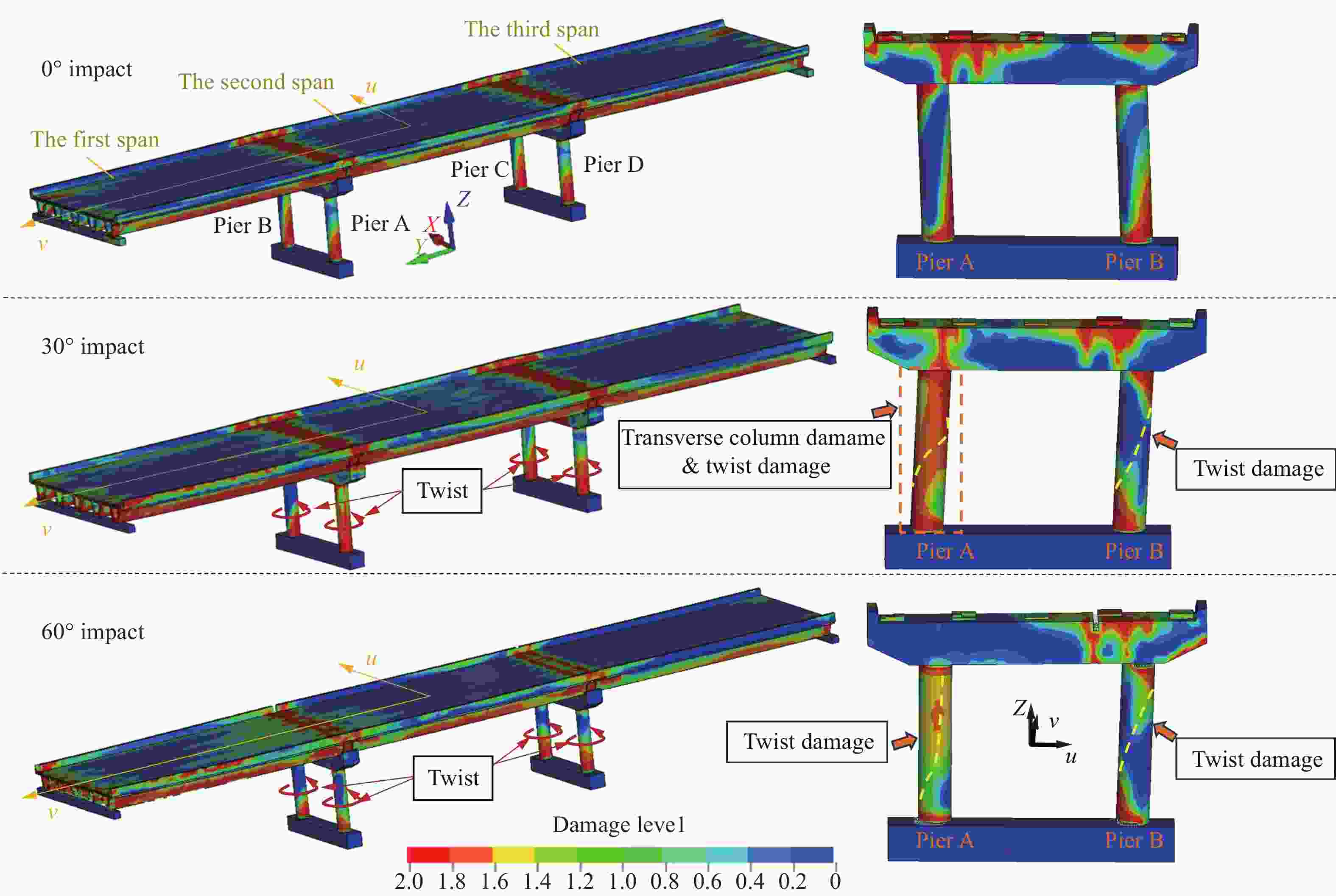
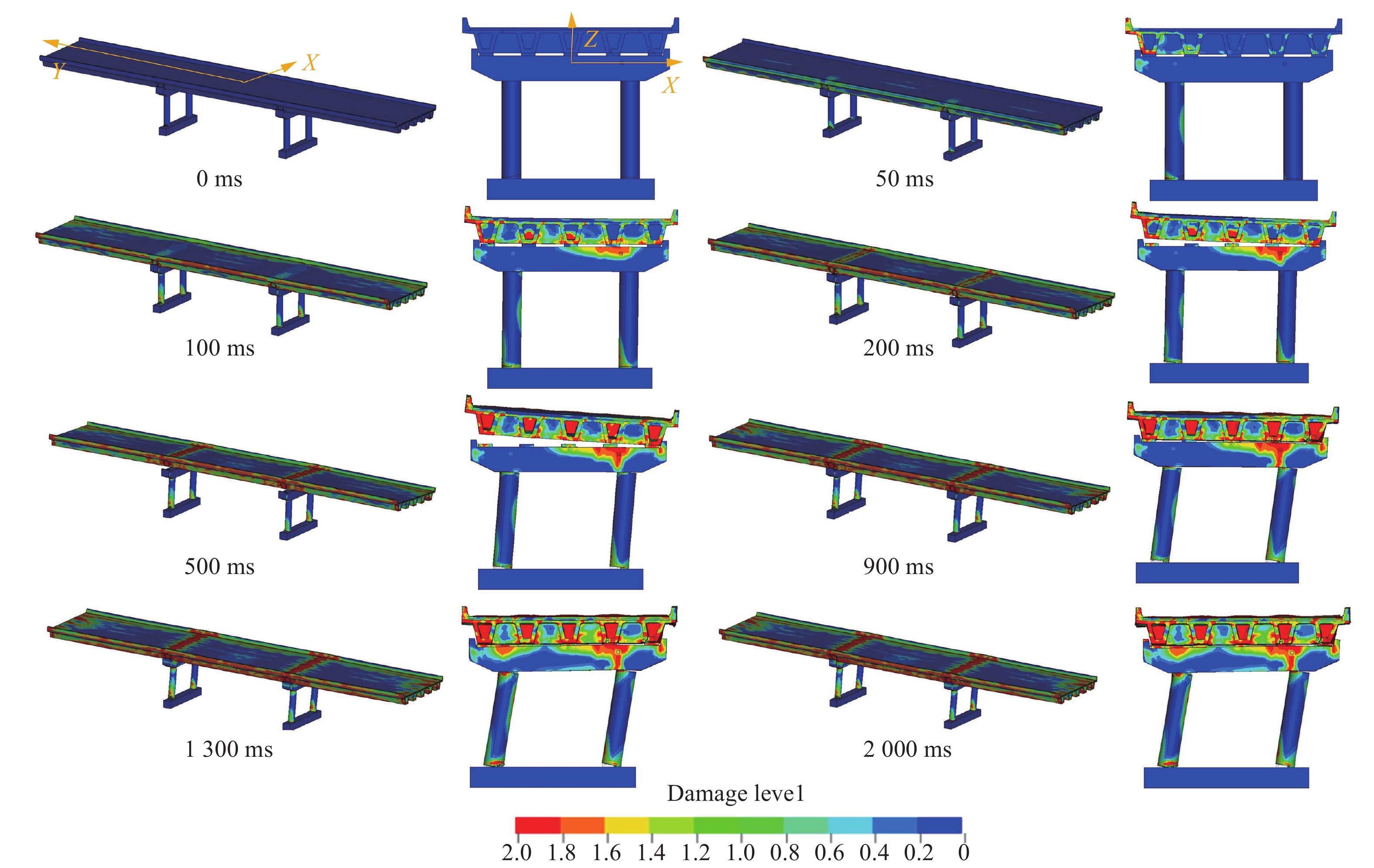
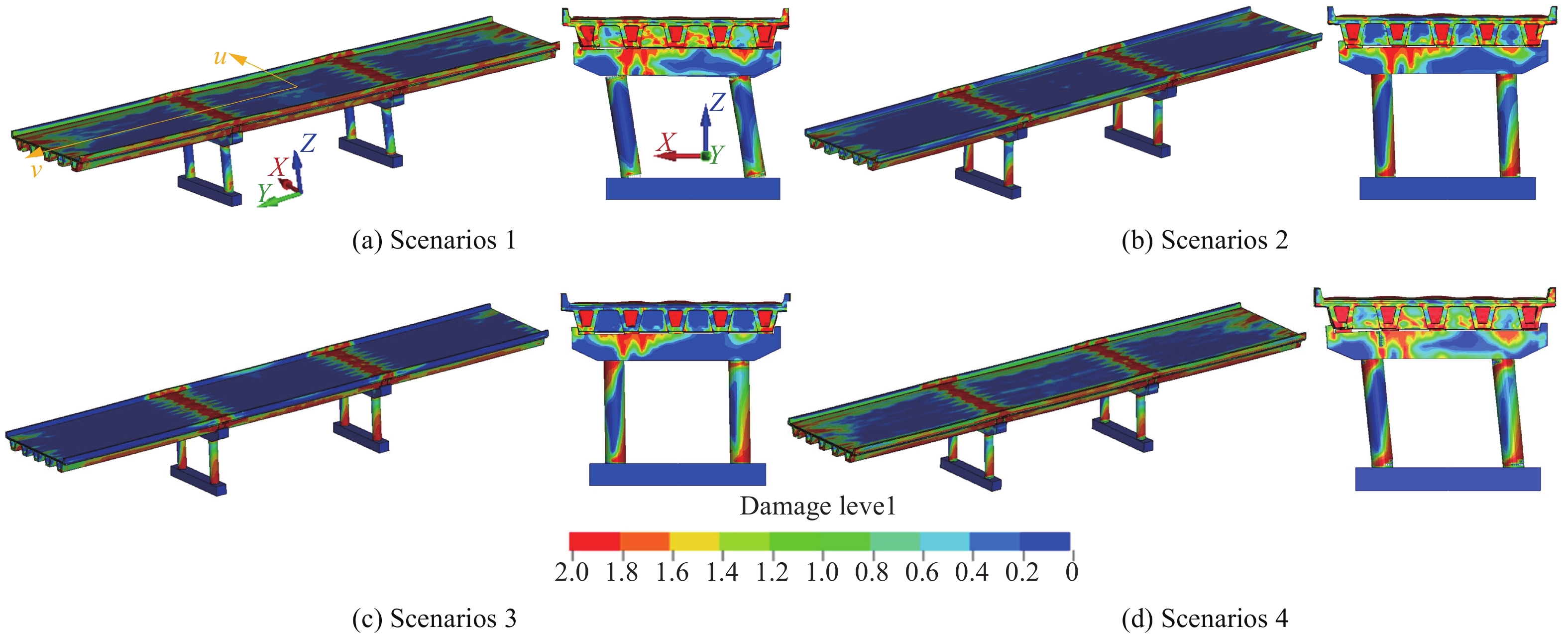
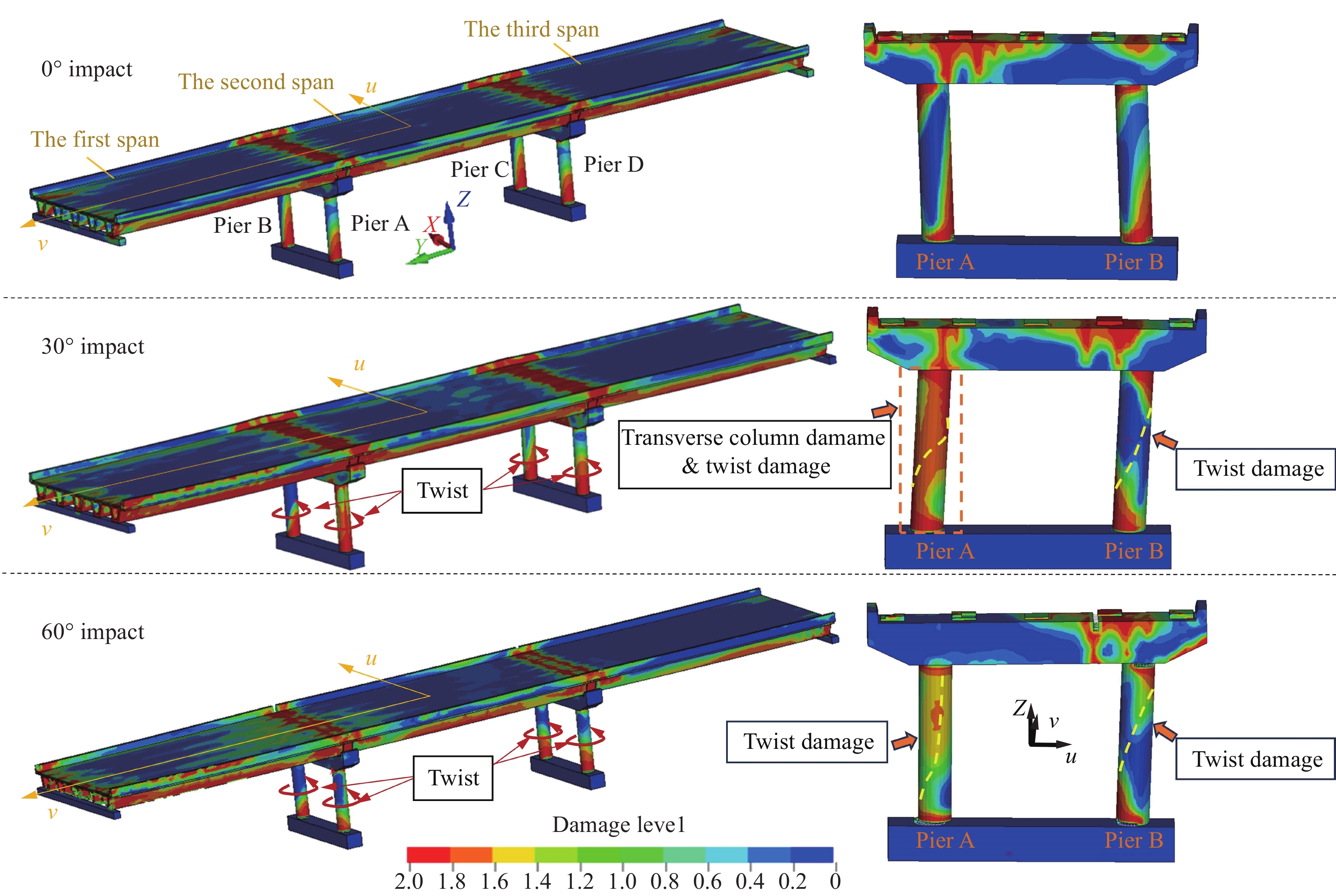
图 19 不同冲击角度下连续梁桥损伤云图
Figure 19. Damage contours of the continuous beam bridge under different impact angles
表 1 C40混凝土的材料参数
Table 1. Mechanical properties of C40 concrete
密度/(kg·m−3) 泊松比 单轴抗拉强度/MPa λm a0m a1m 2300 0.2 3.2 8.7×10⁻⁵ 17.7 0.57 a2m a0y a1y a2y a1r a2r 5.6×10⁻⁴ 11.2 0.9 1.7×10⁻³ 0.57 5.6×10⁻⁴  下载: 导出CSV
表 2 C30和C50混凝土的材料参数
Table 2. Mechanical properties of C30 and C50 a concretes
混凝土强度等级 单轴抗拉强度/MPa λm a0m a1m a2m C30 3.2 8.7×10⁻⁵ 13.3 0.57 8.4×10⁻⁴ C50 4.2 8.7×10⁻⁵ 22.1 0.57 5.0×10⁻⁴ 混凝土强度等级 a0y a1y a2y a1r a2r C30 8.4 0.9 2.8×10⁻³ 0.57 8.4×10⁻⁴ C50 14.0 0.9 1.4×10⁻³ 0.57 5.0×10⁻⁴
下载: 导出CSV
表 3 各场景爆炸参数
Table 3. Blast parameters for each scenarios
场景 爆炸当量/kt 爆炸距离/m 比例距离/(m·kg−1/3) 入射角度/(°) 1 1.0 180 1.8 0 2 1.0 220 2.2 0 3 1.0 260 2.6 0 4 1.5 220 1.92 0 5 1.0 220 2.2 30 6 1.0 220 2.2 60
下载: 导出CSV
表 4 不同工况参数
Table 4. Parameters for different cases
工况 爆炸
当量/
kt爆炸
距离/
m比例距离/
(m·kg−1/3)入射
角度/
(°)S点Z方向
峰值位移/
mmD1 A2点总
位移峰值/
mmD2 1 1 180 1.8 0 1020 1.00 1040 1.00 2 1 220 2.2 0 440 0.43 285 0.27 3 1 260 2.6 0 204 0.20 130 0.13 4 1 180 1.8 30 526 0.52 522 0.50 5 1 220 2.2 30 320 0.31 380 0.37 6 1 260 2.6 30 128 0.13 87 0.08 7 1 180 1.8 60 250 0.25 500 0.48 8 1 220 2.2 60 147 0.14 93 0.09 9 1 260 2.6 60 88 0.09 70 0.07
下载: 导出CSV
-
[1] LIN Z J, LI M, HE S, et al. Analysis on typical characteristics and causes of coal mine gas explosion accidents in China [J]. Environmental Science and Pollution Research, 2024, 31(43): 55475–55489. DOI: 10.1007/s11356-024-34890-7. [2] ÇALIŞKAN C, DAĞ N, KINIK K. Analysis of the medical consequences of global terrorist attacks in Turkic States in the last 50 years by weapon and attack type [J]. Disaster Medicine and Public Health Preparedness, 2023, 17: e514. DOI: 10.1017/dmp.2023.172. [3] ALSENDI A, EAMON C D. Observations of structural damage to girder bridges in Iraq caused by blast threats [J]. Journal of Performance of Constructed Facilities, 2024, 38(6): 04024043. DOI: 10.1061/jpcfev.cfeng-4774. [4] ALSENDI A, EAMON C D. Quantitative resistance assessment of steel girder bridges subjected to blast loads [J]. Journal of Bridge Engineering, 2024, 29(9): 04024069. DOI: 10.1061/jbenf2.beeng-6821. [5] 张海鹏, 潘钻峰, 司豆豆. 二次爆炸作用下钢筋混凝土梁动力响应的数值模拟 [J]. 爆炸与冲击, 2024, 44(10): 101404. DOI: 10.11883/bzycj-2024-0021.ZHANG H P, PAN Z F, SI D D. Numerical simulation on dynamic response of reinforced concrete beams to secondary explosion [J]. Explosion and Shock Waves, 2024, 44(10): 101404. DOI: 10.11883/bzycj-2024-0021. [6] 周广盼, 林志成, 王明洋, 等. 钢筋混凝土箱梁近场爆炸响应的试验与数值模拟 [J]. 爆炸与冲击, 2023, 43(7): 072201. DOI: 10.11883/bzycj-2022-0468.ZHOU G P, LIN Z C, WANG M Y, et al. Test and numerical study on the near-field explosion response of reinforced concrete box girder [J]. Explosion and Shock Waves, 2023, 43(7): 072201. DOI: 10.11883/bzycj-2022-0468. [7] 马世鑫, 纪杨子燚, 钟明寿, 等. 接触爆炸作用下混凝土墩体的易损性研究 [J]. 爆炸与冲击, 2023, 43(7): 073201. DOI: 10.11883/bzycj-2022-0538.MA S X, JI Y Z Y, ZHONG M S, et al. Study on the vulnerability of concrete obstacle under contact explosion [J]. Explosion and Shock Waves, 2023, 43(7): 073201. DOI: 10.11883/bzycj-2022-0538. [8] AZAR A B, SARI A. Failure analysis and structural resilience of a masonry arch Bridge subjected to blast loads: the case study, Halilviran Bridge [J]. Mechanics of Advanced Materials and Structures, 2025, 32(17): 4041–4064. DOI: 10.1080/15376494.2024.2400245. [9] 孙金山, 姚颖康, 吴亮, 等. 高架桥混凝土多室箱梁水压爆破破碎机理数值模拟 [J]. 爆炸与冲击, 2017, 37(2): 299–306. DOI: 10.11883/1001-1455(2017)02-0299-08.SUN J S, YAO Y K, WU L, et al. Numerical simulation of water-pressure blasting mechanism in breaking viaduct box girder [J]. Explosion and Shock Waves, 2017, 37(2): 299–306. DOI: 10.11883/1001-1455(2017)02-0299-08. [10] LYU C, YAN Q S. Field test and fragility analysis of RC box girder bridges subjected to contact explosion [J]. Engineering Structures, 2025, 322: 119063. DOI: 10.1016/j.engstruct.2024.119063. [11] YI Z, AGRAWAL A K, ETTOUNEY M, et al. Blast load effects on highway bridges. Ⅰ: modeling and blast load effects [J]. Journal of Bridge Engineering, 2014, 19(4): 04013023. DOI: 10.1061/(asce)be.1943-5592.0000547. [12] 方秦, 杨石刚, 陈力, 等. 天津港“8·12”特大火灾爆炸事故建筑物和人员损伤破坏情况及其爆炸威力分析 [J]. 土木工程学报, 2017, 50(3): 12–18. DOI: 10.15951/j.tmgcxb.2017.03.002.FANG Q, YANG S G, CHEN L, et al. Analysis on the building damage, personnel casualties and blast energy of the “8·12” explosion in Tianjin port [J]. China Civil Engineering Journal, 2017, 50(3): 12–18. DOI: 10.15951/j.tmgcxb.2017.03.002. [13] RIGBY S E, LODGE T J, ALOTAIBI S, et al. Preliminary yield estimation of the 2020 Beirut explosion using video footage from social media [J]. Shock Waves, 2020, 30(6): 671–675. DOI: 10.1007/s00193-020-00970-z. [14] YANG S L, LIU Z C, WANG S F, et al. Dynamic response and failure analysis for urban bridges under far-field blast loads [J]. Engineering Structures, 2023, 285: 116043. DOI: 10.1016/j.engstruct.2023.116043. [15] CANNON L, CLUBLEY S K. Structural response of simple partially-clad steel frames to long-duration blast loading [J]. Structures, 2021, 32: 1260–1270. DOI: 10.1016/j.istruc.2021.03.024. [16] MONK S, CLUBLEY S K. Experimental testing of structural arrangement on window response to long-duration blast [J]. Engineering Failure Analysis, 2021, 123: 105304. DOI: 10.1016/j.engfailanal.2021.105304. [17] WANG Y H, ZHAI X M, LEE S C, et al. Responses of curved steel-concrete-steel sandwich shells subjected to blast loading [J]. Thin-Walled Structures, 2016, 108: 185–192. DOI: 10.1016/j.tws.2016.08.018. [18] KONG W M, YANG S L, WANG S F, et al. On dynamic response and damage evaluation of bridge piers under far-field explosion loads [J]. Structures, 2023, 51: 985–1003. DOI: 10.1016/j.istruc.2023.03.030. [19] YUAN S J, HAO H, ZONG Z H, et al. Numerical analysis of axial load effects on RC bridge columns under blast loading [J]. Advances in Structural Engineering, 2021, 24(7): 1399–1414. DOI: 10.1177/1369433220979443. [20] US Department of the Army. Fundamentals of protective design for conventional weapons: TM5-855-1 [R]. Washington: US Department of the Army, 1986. [21] 周云波, 郭启涛, 佘磊, 等. 基于LBE方法的驾驶室防护仿真 [J]. 北京理工大学学报, 2016, 36(3): 237–241. DOI: 10.15918/j.tbit1001-0645.2016.03.004.ZHOU Y B, GUO Q T, SHE L, et al. Simulation of vehicle cabin protection based on load blast enhanced method [J]. Transactions of Beijing Institute of Technology, 2016, 36(3): 237–241. DOI: 10.15918/j.tbit1001-0645.2016.03.004. [22] HAN Y Z, LIU H B. Finite element simulation of medium-range blast loading using LS-DYNA [J]. Shock and Vibration, 2015, 2015(1): 631493. DOI: 10.1155/2015/631493. [23] GILSON L, ROEY J V, GUÉDERS C, et al. A simple coupling of ALE domain with empirical blast load function in LS-DYNA [J]. EPJ Web of Conferences, 2012, 26: 04018. DOI: 10.1051/epjconf/20122604018. [24] 孙晓颖, 许伟, 武岳. 钝体绕流中的计算域设置研究 [C]//第十三届全国结构风工程学术会议论文集(下册). 大连: 中国土木工程学会桥梁与结构工程分会风工程委员会, 2007: 215–220. [25] SYED Z I, RAMAN S N, NGO T, et al. The failure behaviour of reinforced concrete panels under far-field and near-field blast effects [J]. Structures, 2018, 14: 220–229. DOI: 10.1016/j.istruc.2018.03.009. [26] 黄晓莹, 陶俊林. 三种建筑钢筋材料高应变率下拉伸力学性能研究 [J]. 工程力学, 2016, 33(7): 184–189. DOI: 10.6052/j.issn.1000-4750.2014.12.1064.HUANG X Y, TAO J L. Tensile mechanical properties research of three construction steel bars in high strain rate [J]. Engineering Mechanics, 2016, 33(7): 184–189. DOI: 10.6052/j.issn.1000-4750.2014.12.1064. [27] ZAKRISSON B, WIKMAN B, HÄGGBLAD H Å. Numerical simulations of blast loads and structural deformation from near-field explosions in air [J]. International Journal of Impact Engineering, 2011, 38(7): 597–612. DOI: 10.1016/j.ijimpeng.2011.02.005. [28] WU Y C, CRAWFORD J E. Numerical modeling of concrete using a partially associative plasticity model [J]. Journal of Engineering Mechanics, 2015, 141(12): 04015051. DOI: 10.1061/(asce)em.1943-7889.0000952. [29] LIU L, ZONG Z H, LI M H. Numerical study of damage modes and assessment of circular RC pier under noncontact explosions [J]. Journal of Bridge Engineering, 2018, 23(9): 04018061. DOI: 10.1061/(asce)be.1943-5592.0001273. [30] KONG X Z, FANG Q, LI Q M, et al. Modified K&C model for cratering and scabbing of concrete slabs under projectile impact [J]. International Journal of Impact Engineering, 2017, 108: 217–228. DOI: 10.1016/j.ijimpeng.2017.02.016. [31] YIN X, LI Q H, CHEN B K, et al. An improved calibration of Karagozian & Case concrete/cementitious model for strain-hardening fibre-reinforced cementitious composites under explosion and penetration loadings [J]. Cement and Concrete Composites, 2023, 137: 104911. DOI: 10.1016/j.cemconcomp.2022.104911. [32] SU Q, WU H, POH L H, et al. Dynamic behavior of UHPC-FST under close-in explosions with large charge weight [J]. Engineering Structures, 2023, 277: 115475. DOI: 10.1016/j.engstruct.2022.115475. [33] YANG S L, ZHONG W, WANG S F, et al. On dynamic analysis and damage evaluation for bridge girders under high-energy air burst [J]. Structures, 2022, 41: 1488–1500. DOI: 10.1016/j.istruc.2022.05.088. [34] Department of the Army. Structures to resist the effects of accidental explosions: TM5-1300 [R]. Norfolk: Department of the Army, 1991. [35] 司豆豆, 潘钻峰, 曾滨, 等. 爆炸荷载作用下大跨预应力混凝土框架动力响应分析 [J]. 爆炸与冲击, 2023, 43(11): 112201. DOI: 10.11883/bzycj-2023-0080.SI D D, PAN Z F, ZENG B, et al. Analysis of the dynamic response of prestressed concrete frame structures under blast load [J]. Explosion and Shock Waves, 2023, 43(11): 112201. DOI: 10.11883/bzycj-2023-0080. [36] 王东升, 郭迅, 孙治国, 等. 汶川大地震公路桥梁震害初步调查 [J]. 地震工程与工程振动, 2009, 29(3): 84–94. DOI: 10.13197/j.eeev.2009.03.004.WANG D S, GUO X, SUN Z G, et al. Damage to highway bridges during Wenchuan Earthquake [J]. Journal of Earthquake Engineering and Engineering Vibration, 2009, 29(3): 84–94. DOI: 10.13197/j.eeev.2009.03.004. [37] LIU Z. Reconnaissance and preliminary observations of bridge damage in the great Wenchuan Earthquake, China [J]. Structural Engineering International, 2009, 19(3): 277–282. DOI: 10.2749/101686609788957883. [38] 中华人民共和国交通运输部. 公路桥梁技术状况评定标准: JTG/T H21-2011 [S]. 北京: 人民交通出版社, 2011.Ministry of Transport of the People's Republic of China. Standards for technical condition evaluation of highway bridges: JTG/T H21-2011 [S]. Beijing: China Communications Press, 2011. -

计量
- 文章访问数: 514
- HTML全文浏览量: 176
- PDF下载量: 450
- 被引次数: 0