


Boundary condition effects on failure of tempered glass subject to wind-borne debris impact and a quantification model for fragment distribution
-
摘要: 针对老旧建筑单层钢化玻璃幕墙抗风致飞射物冲击的安全隐患,填补既有研究多聚焦夹层玻璃或爆炸荷载的空白,旨在量化风致飞射物冲击下单层钢化玻璃的破坏特征、碎片分布规律及参数耦合影响机制。通过系统设计混合正交冲击实验,综合考查冲击类型、冲击物质量、速度、角度、边界条件及玻璃厚度和正方形表面边长等7个关键因素对玻璃的破坏模式和碎片质量分布的影响。基于实验矩阵的极差分析与方差解析,量化揭示了各参数对玻璃破坏特征、冲击物速度衰减率及碎片质量分布特征的敏感性权重。依据量纲齐次原理与Π定理,构建了表征碎片质量分布规律的无量纲函数关系式框架。基于实验数据,通过正交距离回归迭代算法拟合确立半经验预测公式的参数取值,验证公式具有明确的物理意义与预测可靠性。结果表明:边界条件对玻璃破坏程度和碎片飞散起决定性作用(解释53.1%的大块碎片总质量变化、97.9%的破坏面积变化),明框支撑工况碎片质量最低(最优防飞散方案),隐框支撑冲击物动能衰减率最大但碎片量次之(最优抗冲击方案),点支撑工况下玻璃均完全破碎(高危工况);冲击物的冲击角度、速度和玻璃表面边长对钢化玻璃的破坏响应也有显著影响。研究采用效应量分析(η2)方法量化各参数对破坏行为的敏感性权重,建立了钢化玻璃冲击破坏的参数影响层次体系。最终建立的预测公式能精准表征钢化玻璃破碎特征,为建筑围护系统抗风设计提供关键理论依据。Abstract: This study addressed critical safety concerns in wind-resistant design of building envelope systems, aiming to quantify secondary fragmentation effects and potential risks from tempered glass breakage under wind-borne debris impact. A systematic orthogonal experimental design was developed and implemented to comprehensively investigate the influence of seven key parameters on failure modes and fragment mass distribution. These parameters include impact type (point-to-surface and surface-to-surface), impactor mass (30 and 50 g), impact velocity (50, 100, and 150 m/s), impact angle (60°, 75°, and 90°), boundary conditions (exposed frame support, concealed frame support, and point fixing), glass thickness (6 and 8 mm), and glass square surface side length (110, 200, 290 mm). A single-stage light-gas gun was employed to reproduce wind-borne debris impact scenarios with a velocity measurement accuracy of ±5 m/s. Two high-speed cameras were used to record the dynamic response and crack propagation process of glass during impact, while an oscilloscope was utilized to collect strain data at the impact point and impact velocity. After each impact experiment, glass fragments were fully recovered from a predefined area encompassing the entire experiment chamber. This area was divided into nine zones, extending 20 mm from the impact surface and 70 mm from the non-impact surface of the glass specimen. Fragment mass distribution was then statistically analyzed with a collection efficiency exceeding 98%. Range analysis and analysis of variance (ANOVA) were performed on the experimental matrix to quantitatively reveal the relative influence of each parameter on glass fracture characteristics, impactor energy dissipation, and fragment mass distribution. To avoid overreliance on statistical significance derived solely on P-values, effect size analysis using partial Eta squared (η2) was innovatively incorporated to quantify the practical engineering significance of each parameter, complementing traditional variance analysis that relies solely on P-values. A normalized formulation characterizing fragment mass distribution was established based on the principle of dimensional homogeneity and Buckinghamʼs Π theorem. Parameter values for the semi-empirical prediction model were determined through an orthogonal distance regression iterative algorithm, which effectively accounts for errors in both independent and dependent variables. The hybrid normal distribution model was adopted to fit the fragment mass distribution data, with shape parameters fixed in accordance with boundary conditions and key parameters optimized to ensure engineering applicability. Results demonstrate that boundary conditions dominantly control glass fracture extent and fragment dispersion. Specially, exposed framing support yields the minimal fragment mass, corresponding to an optimal anti-scattering solution. The structural glazing support exhibiting the maximum kinetic energy attenuation alongside a moderate fragment quantities, and point fixing induces complete fragmentation, representing a high-risk scenario. Impact angle, glass dimensions, and velocity also exert significant influences on fragmentation behavior. The established parameter influence hierarchy for the impact failure of tempered glass, along with the semi-empirical predictive formula, accurately characterizes the fracture patterns of tempered glass. Parameters for exposed frame and concealed frame supports are both approximately unity, enabling their integration into a unifiedframed support system model. This research provided crucial theoretical foundations for wind-resistant design and reinforcementof building envelope systems, particularly for aging structures equipped with single-layer tempered glass curtain walls.
-
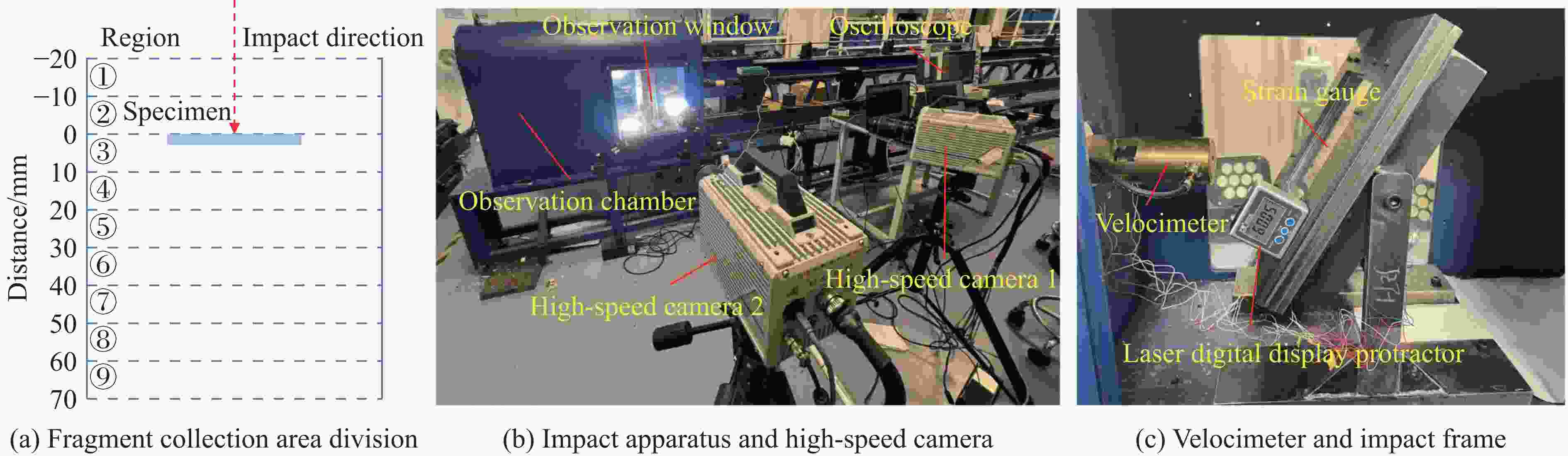
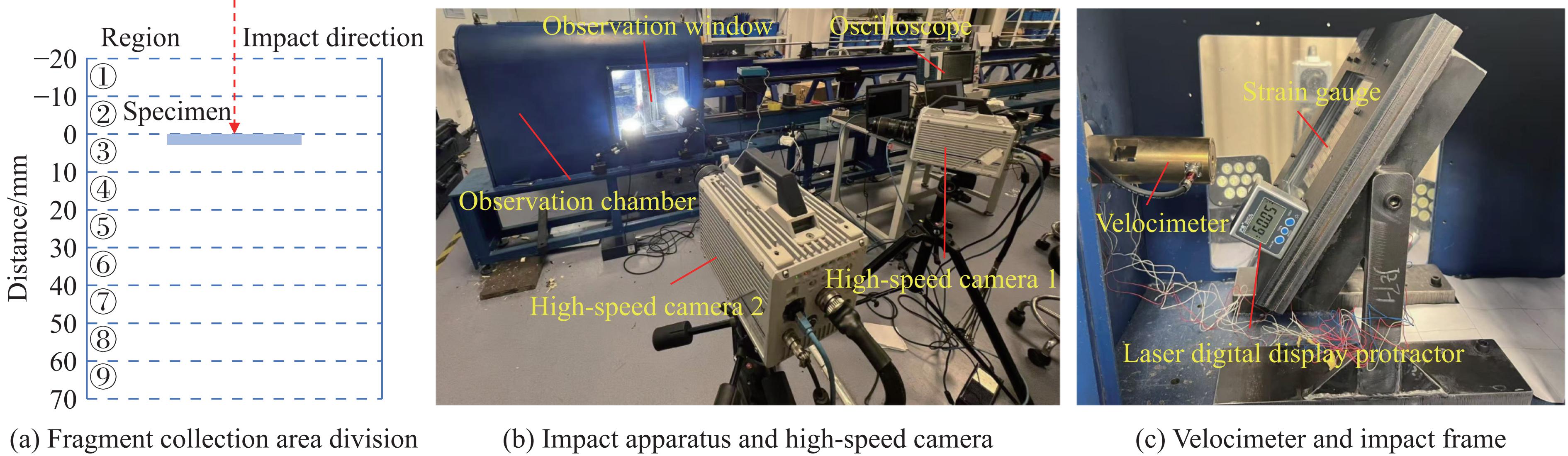
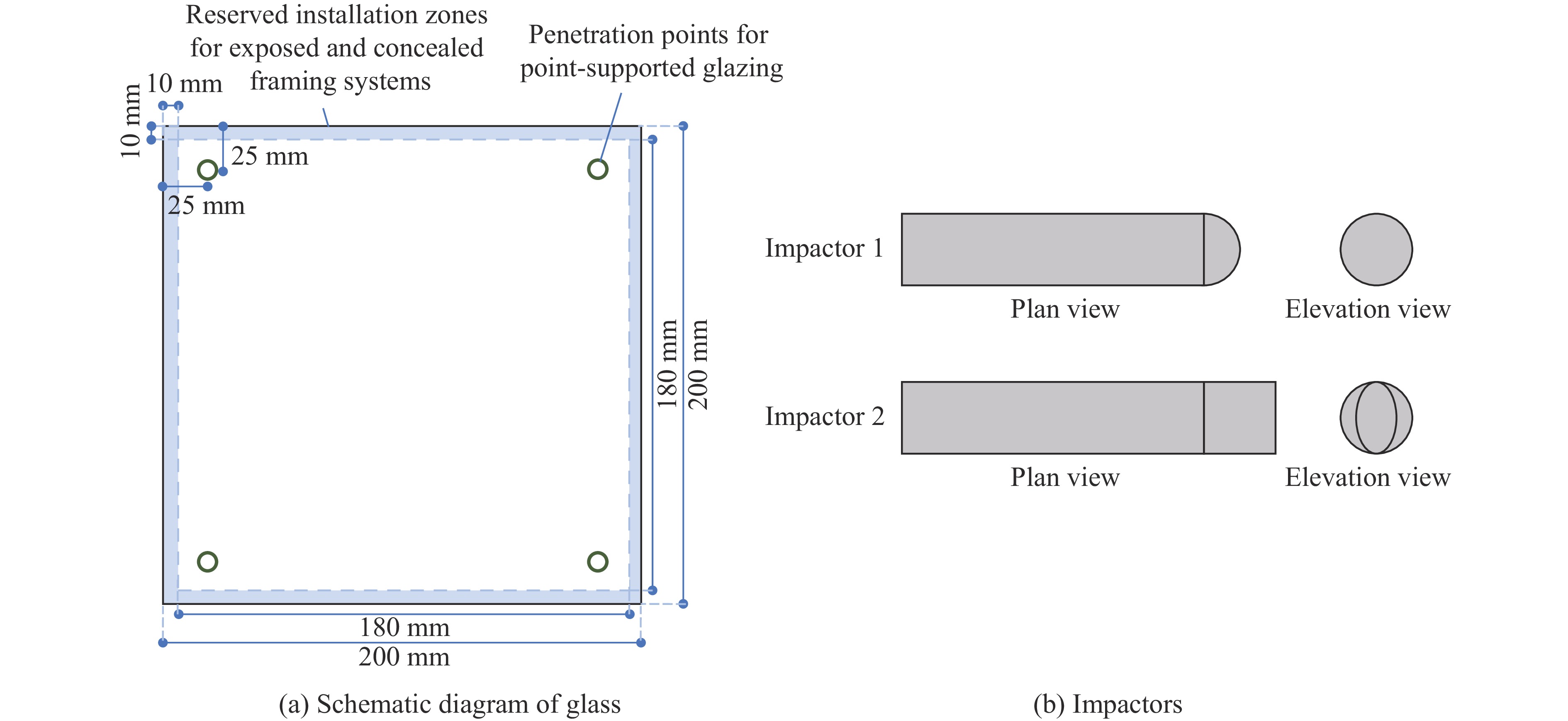
图 2 碎片区域划分和实验装置
Figure 2. Fragment collection area division and experimental apparatus
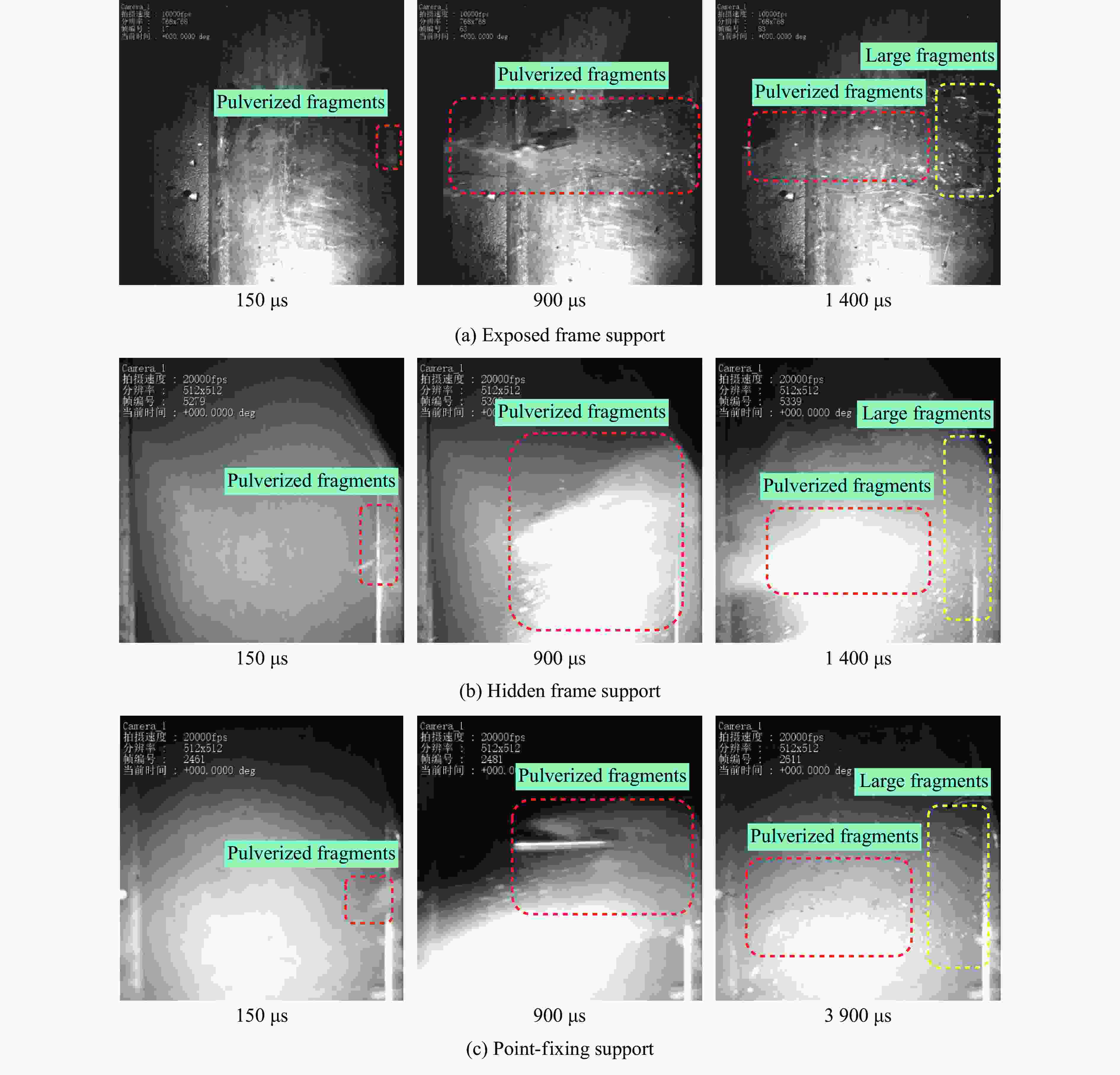
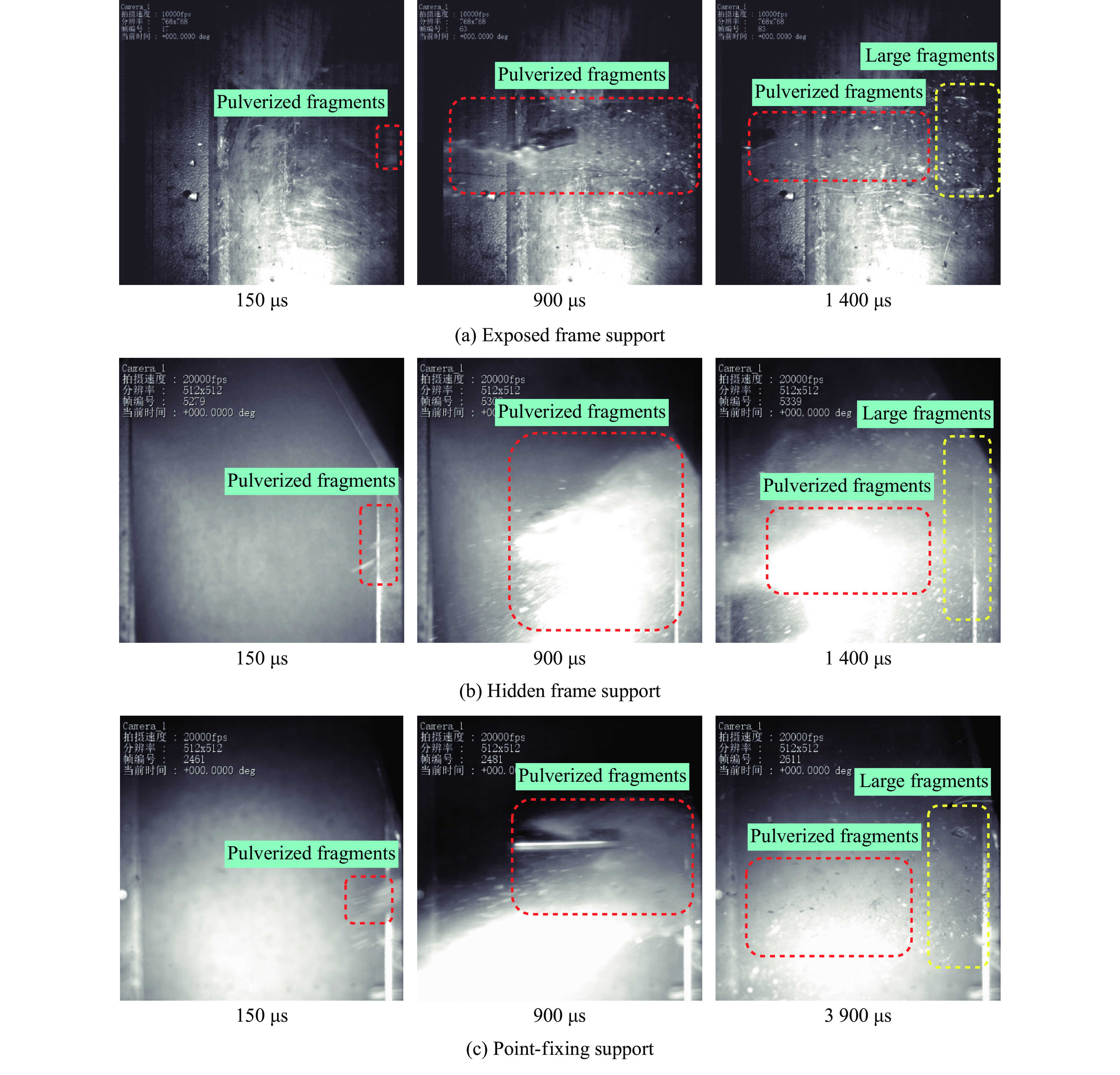
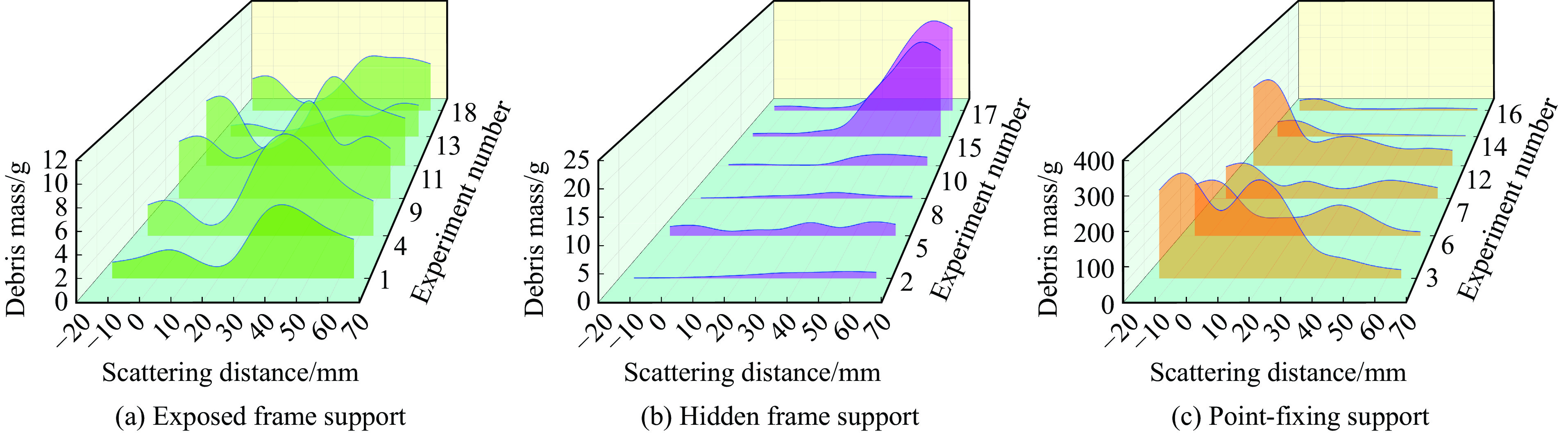
图 3 不同边界条件下钢化玻璃冲击破坏过程
Figure 3. Impact damage processes of tempered glass under different boundary conditions
表 1 实验方案
Table 1. Experimental schemes
实验编号 冲击类型 冲击物质量/g 冲击速度/(m·s−1) 玻璃尺寸/mm 冲击角度/(°) 边界条件 空白列 厚度 表面边长 1 点vs面 30 50 6 110 90 明框 1 2 点vs面 30 100 8 290 60 隐框 2 3 点vs面 50 50 8 290 75 点支撑 3 4 点vs面 50 150 6 200 60 明框 1 5 点vs面 50 100 6 110 90 隐框 2 6 点vs面 50 150 8 200 75 点支撑 3 7 点vs面 30 50 6 200 60 点支撑 1 8 点vs面 30 150 6 290 75 隐框 2 9 面vs面 50 100 8 200 75 明框 3 10 点vs面 50 150 8 110 90 隐框 1 11 面vs面 50 50 8 110 90 明框 2 12 面vs面 50 100 6 290 60 点支撑 3 13 面vs面 30 100 6 200 75 明框 1 14 面vs面 30 150 8 110 90 点支撑 2 15 面vs面 30 50 8 290 60 隐框 3 16 面vs面 30 100 6 110 90 点支撑 1 17 面vs面 30 50 8 200 75 隐框 2 18 面vs面 50 150 6 290 60 明框 3  下载: 导出CSV
表 2 实验结果
Table 2. Experimental results
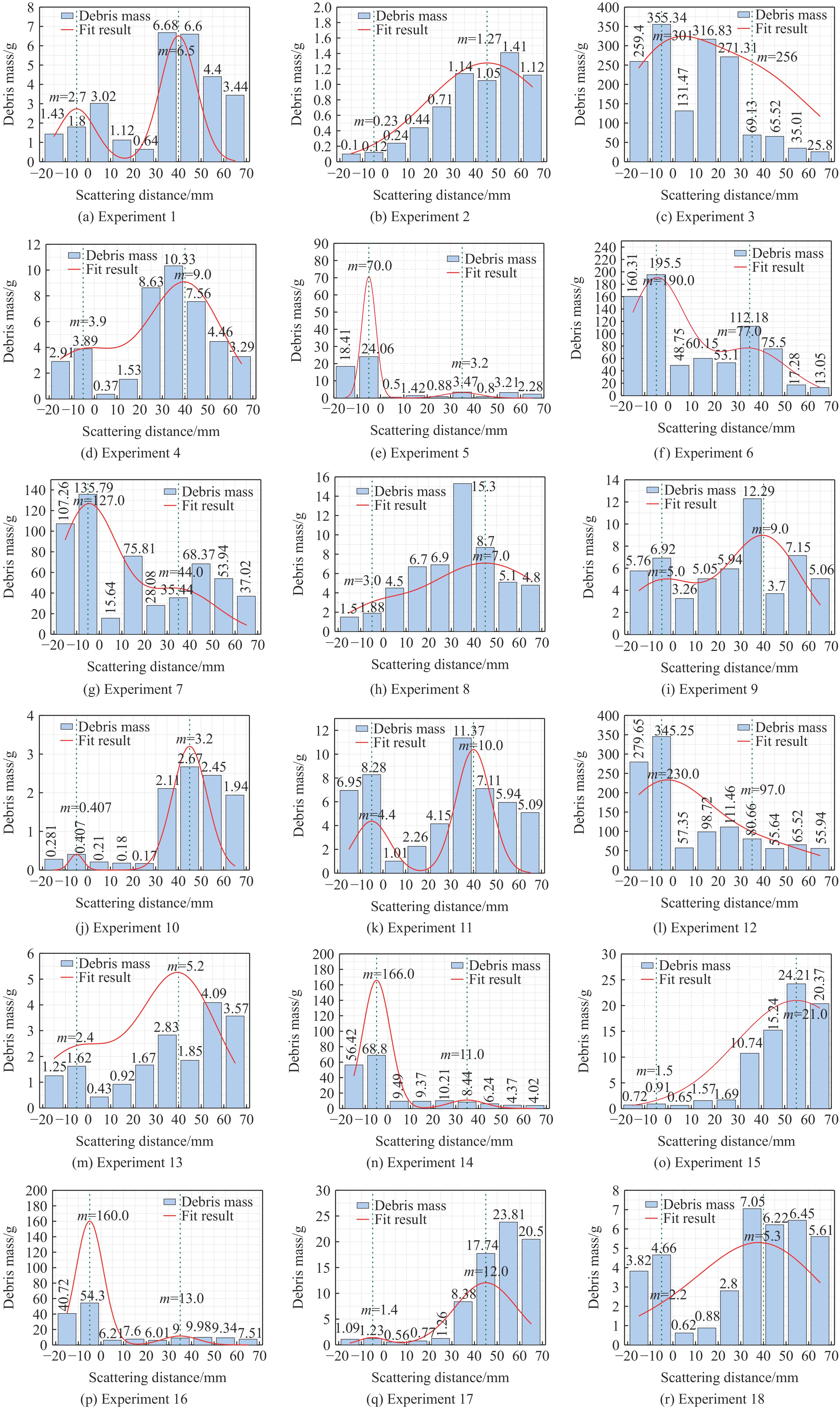
实验编号 大块碎片总质量/g 冲击物速度衰减率/% 破坏面积百分比/% 最远区域碎片总质量/g 冲击点最大主应变/10−6 1 15.25 8.50 16.22 3.44 −2.52 2 0.99 20.45 0.31 1.12 −2.66 3 1515.19 11.27 100 25.80 −3.24 4 35.11 14.86 7.55 3.29 −3.20 5 47.56 27.37 25.52 2.28 −3.85 6 714.99 12.72 100 13.05 −7.14 7 545.32 13.35 100 37.02 −1.81 8 0.80 16.43 0.21 0.48 −9.99 9 24.37 10.44 5.40 5.06 −5.90 10 3.99 13.81 1.54 1.94 −2.98 11 35.35 15.47 19.63 5.09 −3.96 12 875.97 8.78 100 55.94 −4.30 13 5.63 16.65 2.31 3.57 −8.38 14 135.18 20.20 100 4.02 −4.85 15 44.87 9.84 3.43 20.37 −3.35 16 107.51 13.84 100 7.51 −10.70 17 57.79 33.57 8.80 20.50 −3.21 18 25.85 12.10 3.03 5.61 −7.87
下载: 导出CSV
表 3 折算后极差$R' $
Table 3. Reduced range $R' $
项目 冲击类型 冲击物质量 冲击速度 玻璃尺寸 冲击角度 边界条件 厚度 表面边长 最大主应变 3.58 1.19 3.81 3.63 0.54 3.11 1.27 大块碎片总质量 370.78 559.73 275.52 206.78 449.8 419.04 796.64 最远区域碎片总质量 9.29 4.74 17.8 5.25 18.05 21.03 24.9 破坏面积百分比 2.07 7.43 7.59 3.72 11.87 10.32 118.92 冲击物速度衰减率 0.5 6.16 1.57 3.76 4.82 4.61 9.22
下载: 导出CSV
表 4 各影响因素各水平下4个响应指标的统计结果(均值±标准差)
Table 4. Statistical results (mean ± standard deviation) of the four response variables across different levels of each factor
项目 水平 样本量 大块碎片总质量/g 破坏面积百分比/% 最远区域碎片总质量/g 冲击物速度衰减率/% 冲击类型 点vs面 9 319.91±522.86 39.60±44.74 9.82±12.44 15.42±5.58 面vs面 9 145.84±276.96 38.08±46.31 14.19±16.72 15.65±7.64 冲击物质量/g 30 9 101.48±173.26 36.92±46.47 11.23±13.28 16.98±7.92 50 9 364.26±546.14 40.76±44.68 12.78±16.07 14.09±4.41 冲击速度/(m·s−1) 50 6 368.96±597.20 28.18±36.54 16.20±13.47 15.33±8.41 100 6 177.01±344.62 32.51±41.36 11.83±19.47 16.26±6.57 150 6 152.65±279.84 52.12±50.05 6.77±4.44 15.02±2.71 玻璃厚度/mm 6 9 184.33±311.23 46.43±46.82 13.52±16.64 14.65±5.13 8 9 281.41±514.76 31.25±43.26 10.49±10.60 16.42±7.16 玻璃表面边长/mm 110 6 57.47±52.48 39.77±44.12 4.30±2.35 16.53±6.31 200 6 230.54±314.62 37.29±44.08 13.75±13.46 16.93±7.69 290 6 410.61±641.00 40.79±48.74 17.18±18.85 13.15±4.64 冲击角度/(°) 90 6 57.47±52.48 39.77±44.12 4.30±2.35 16.53±6.31 75 6 386.46±618.84 27.12±38.98 13.47±11.86 16.85±7.78 60 6 254.69±368.66 52.03±46.34 19.80±19.87 13.23±4.37 边界条件 明框 6 23.59±11.57 9.02±8.55 4.34±1.12 13.00±2.86 隐框 6 26.00±26.75 6.64±10.21 7.78±9.20 20.25±8.44 点支撑 6 649.03±524.30 100.00±0.00 23.85±19.45 13.36±3.86
下载: 导出CSV
表 5 最优水平对应的工况
Table 5. Optimal levels corresponding to operating conditions
最优水平 冲击类型 冲击物质量/g 冲击速度/(m·s−1) 玻璃尺寸/mm 冲击角度/(°) 边界条件 厚度 表面边长 大块碎片总质量最少 面vs面 30 150 6 110 90 明框 玻璃破坏面积百分比最小 面vs面 30 50 8 200 75 隐框 最远区域碎片总质量最少 点vs面 30 150 8 110 90 明框 冲击物速度衰减率最大 面vs面 30 100 8 200 75 隐框
下载: 导出CSV
表 6 各影响因素的显著性
Table 6. Significances of influencing factors
项目 P 冲击类型 冲击物质量 冲击速度 玻璃厚度 玻璃表面边长 冲击角度 边界条件 大块碎片总质量 0.391 0.188 0.642 0.635 0.360 0.410 0.003 冲击物速度衰减率 0.941 0.360 0.949 0.580 0.568 0.593 0.086 破坏面积百分比 0.965 0.876 0.977 0.938 0.942 0.947 1.0×10⁻⁴ 最远区域碎片总质量 0.551 0.762 0.281 0.737 0.255 0.159 0.041 最大主应变 0.194 0.674 0.08 0.188 0.966 0.302 0.788
下载: 导出CSV
表 7 不同影响因素的效应量
Table 7. Effect sizes of different influencing factors
项目 偏η2/% 冲击类型 冲击物质量 冲击速度 玻璃厚度 玻璃表面边长 冲击角度 边界条件 大块碎片总质量 4.6(小) 10.6(中) 5.7(小) 1.4(小) 12.7(中) 11.2(中) 53.1(大) 冲击物速度衰减率 0(无) 5.3(小) 0.7(无) 2.0(小) 7.3(中) 6.7(中) 27.9(大) 破坏面积百分比 0(无) 0.2(无) 0.3(无) 0(无) 0.8(无) 0.7(无) 97.9(大) 最远区域碎片总质量 2.3(小) 0.6(无) 15.6(大) 0.7(无) 16.7(大) 21.7(大) 34.6(大) 最大主应变 10.3(中) 1.1(小) 28.6(大) 10.6(中) 0.5(无) 14.8(大) 3.1(小)
下载: 导出CSV
表 8 影响因素对碎片质量分布的效应量
Table 8. Effect size of influencing factors on debris mass distribution
碎片区域 偏η2/% 冲击类型 冲击物质量 冲击速度 玻璃厚度 玻璃表面边长 冲击角度 边界条件 ① 1.0 11.3 1.5 0.1 10.9 6.6 62.5 ② 1.3 11.3 1.9 0.1 11.3 6.7 61.5 ③ 4.3 12.5 4.6 3.6 13.5 12.3 40.6 ④ 6.0 8.3 10.4 2.4 13.7 10.9 34.6 ⑤ 3.5 12.2 6.5 2.6 16.5 10.8 31.9 ⑥ 2.7 16.1 0.7 2.0 11.7 13.4 48.9 ⑦ 6.2 5.3 7.1 0.3 14.8 14.0 58.4 ⑧ 0.7 0.4 17.3 0.8 16.4 22.1 37.6 ⑨ 2.3 0.6 15.6 0.7 16.7 21.7 34.6
下载: 导出CSV
表 9 碎片质量分布中相关物理量及其单位和量纲
Table 9. Parameters, unit and dimensions related to fragments mass distribution
对象 物理量 符号 单位 量纲 碎片 质量 m kg M 碎片飞散距离 L m L 冲击物 冲击类型 Ti 1 DQ 冲击物质量 mi kg M 冲击速度 v m/s LT−1 冲击角度 θ ° DQ 空气 初始压力 pa kg/(m·s2) ML−1T−2 空气密度 ρa kg/m3 ML−3 运动黏度 νa m2/s L2T−1 绝热指数 γa 1 DQ 玻璃 密度 ρg kg/m3 ML−3 厚度 dg m L 长度 l m L 宽度 w m L 杨氏模量 E kg/(m·s2) ML−1T−2 泊松比 ν 1 DQ 屈服强度 γ kg/(m·s2) ML−1T−2 抗拉强度 S kg/(m·s2) ML−1T−2 边界条件 Bc m2 L2
下载: 导出CSV
表 10 实验参数
Table 10. Experimental parameters
实验编号 mi/g θ/(°) Bc/mm2 v/(m·s−1) l/mm Lp1/mm Lp2/mm 1 30 90 8000 50 110 5 35 2 30 60 11200 100 290 −5 55 3 50 75 138 50 290 −5 35 4 50 60 15200 150 200 −5 35 5 50 90 4000 100 110 −5 35 6 50 75 138 150 200 −5 35 7 30 60 138 50 200 −5 35 8 30 75 11200 150 290 −5 35 9 50 75 15200 100 200 −5 35 10 50 90 4000 150 110 −5 45 11 50 90 8000 50 110 −5 35 12 50 60 138 100 290 −5 25 13 30 75 15200 100 200 −5 55 14 30 90 138 150 110 −5 25 15 30 60 11200 50 290 −5 55 16 30 90 138 100 110 −5 45 17 30 75 7600 50 200 −5 55 18 50 60 2240 150 290 −5 35
下载: 导出CSV
表 11 部分参数取值
Table 11. Partial parameter values
边界条件 a c e f g 明框 −0.15 2.3 0.07 −0.05 2.5 隐框 0.68 2.9 0.2 0.06 2.5 点支撑 0.76 2.5 0.3 0.09 2.5
下载: 导出CSV
表 12 $b $和$d $的取值、决定系数$R^2 $和权重因子${\pi} $
Table 12. Parameter values (b, d), determination coefficient (R2) and weight factor π
支撑条件 实验编号 b d R2 π 明框 1 0.42013 0.26194 0.99521 0.31 4 0.40986 0.26303 0.99493 0.278 9 0.39813 0.26186 0.99145 0.36 11 0.38804 0.24603 0.98352 0.42 13 0.46035 0.29631 0.99447 0.28 18 0.39785 0.26591 0.99259 0.4 隐框 2 2.234 0.7248 0.99995 0.08 5 0.23 0.35 0.99064 0.87 8 2.0125 0.7361 0.98542 0.11 10 1.9542 0.7248 0.9991 0.13 15 2.0682 0.7329 0.94719 0.04 17 2.1609 0.6835 0.93524 0.05 点支撑 3 − 0.05301 0.0935 0.94322 0.837 6 − 0.05109 0.10964 0.95684 0.64 7 − 0.0669 0.1541 0.84013 0.67 12 − 0.06393 0.1138 0.81784 0.76 14 − 0.05679 0.1353 0.98469 0.87 16 − 0.0509 0.10541 0.96742 0.84
下载: 导出CSV
-
[1] RAMISETTY M, SASTRI S, KASHALIKAR U, et al. Transparent polycrystalline cubic spinels protect and defend [J]. American Ceramic Society Bulletin, 2013, 92(2): 20–25. [2] MALLIK A, BASUMAJUMDAR A, KUNDU P, et al. Some studies on nucleation, crystallization, microstructure and mechanical properties of mica glass-ceramics in the system 0.2BaO·0.8K2O·4MgO·Al2O3·6SiO2·2MgF2 [J]. Ceramics International, 2013, 39(3): 2551–2559. DOI: 10.1016/j.ceramint.2012.09.015. [3] 温祖坚. 风致飞射物致高层建筑玻璃幕墙破坏研究 [D]. 厦门: 厦门大学, 2021: 4–10. DOI: 10.27424/d.cnki.gxmdu.2021.001594.WEN Z J. Research on the damage mechanism of glass curtain wall of high-rise buildings caused by wind-borne debris [D]. Xiamen: Xiamen University, 2021: 4–10. DOI: 10.27424/d.cnki.gxmdu.2021.001594. [4] 吕明辉, 赵慧霞, 张晓美, 等. 基于综合灾害风险防范模式的台风灾害防御效益评价研究初探 [J]. 灾害学, 2021, 36(1): 157–163. DOI: 10.3969/j.issn.1000-811X.2021.01.030.LYU M H, ZHAO H X, ZHANG X M, et al. Preliminary study on benefit evaluation of disaster prevention of typhoon based on integrated disaster risk governance model [J]. Journal of Catastrophology, 2021, 36(1): 157–163. DOI: 10.3969/j.issn.1000-811X.2021.01.030. [5] DONG Y, GUO Y L, VAN DE LINDT J W. Fragility modeling of urban building envelopes subjected to windborne debris hazards [J]. Journal of Structural Engineering, 2023, 149(5): 04023041. DOI: 10.1061/JSENDH.STENG-11732. [6] ABDELHADY A U, SPENCE S M J, MCCORMICK J. A three-dimensional six-degree-of-freedom windborne debris trajectory model for tornadoes [J]. Journal of Wind Engineering and Industrial Aerodynamics, 2021, 214: 104622. DOI: 10.1016/j.jweia.2021.104622. [7] LIN N, HOLMES J D, LETCHFORD C W. Trajectories of wind-borne debris in horizontal winds and applications to impact testing [J]. Journal of Structural Engineering, 2007, 133(2): 274–282. DOI: 10.1061/(ASCE)0733-9445(2007)133:2(274). [8] 陈胜, 黄鹏, 顾明. 风致飞掷物冲击建筑浮法玻璃试验和数值模拟 [J]. 振动与冲击, 2022, 41(1): 24–30. DOI: 10.13465/j.cnki.jvs.2022.01.004.CHEN S, HUANG P, GU M. Tests and numerical simulation of wind-induced flying projectile impacting building float glass [J]. Journal of Vibration and Shock, 2022, 41(1): 24–30. DOI: 10.13465/j.cnki.jvs.2022.01.004. [9] 李培玉. 退火玻璃在风致飞射物冲击下的破坏机理 [D]. 哈尔滨: 哈尔滨工业大学, 2023: 37–52. DOI: 10.27061/d.cnki.ghgdu.2023.004983.LI P Y. Failure mechanism of annealed glass under impact of wind-borne debris [D]. Harbin: Harbin Institute of Technology, 2023: 37–52. DOI: 10.27061/d.cnki.ghgdu.2023.004983. [10] ZHANG W N, ZHAO W C, QIAN J. Safety assessment of airtight protective doors of nuclear power plants subjected to wind-borne missile impact [J]. Buildings, 2024, 14(2): 437. DOI: 10.3390/buildings14020437. [11] YANG C X, NAN Z, HUO Y J, et al. Research on the mechanical performance of windshield glass for rail vehicles under gravel impact loadings [J]. Results in Engineering, 2024, 23: 102587. DOI: 10.1016/j.rineng.2024.102587. [12] 张英杰, 韩阳, 刘姗姗, 等. 中空钢化夹层玻璃抗冲击性能的影响因素 [J]. 应用力学学报, 2021, 38(5): 1861–1868. DOI: 10.11776/cjam.38.05.B110.ZHANG Y J, HAN Y, LIU S S, et al. Influence factors of impact resistance of hollow tempered laminated glass [J]. Chinese Journal of Applied Mechanics, 2021, 38(5): 1861–1868. DOI: 10.11776/cjam.38.05.B110. [13] 郭鑫. 冲击荷载作用下钢化玻璃损伤及断裂的力学机理研究 [D]. 呼和浩特: 内蒙古工业大学, 2020: 39–51. DOI: 10.27225/d.cnki.gnmgu.2020.000193.GUO X. Mechanical mechanism of damage and fracture of tempered glass under impact load [D]. Hohhot: Inner Mongolia University of Technology, 2020: 39–51. DOI: 10.27225/d.cnki.gnmgu.2020.000193. [14] 韩阳. 冲击载荷下中空钢化玻璃和中空钢化夹层玻璃动态响应研究 [D]. 太原: 太原理工大学, 2019: 57–70.HAN Y. Dynamic response of hollow tempered glass and hollow tempered laminated glass under impact loading [D]. Taiyuan: Taiyuan University of Technology, 2019: 57–70. [15] 刘炘炜, 杨健, 王星尔, 等. 冲击致损的夹层玻璃板开裂后的静载强度 [J]. 上海交通大学学报, 2020, 54(3): 227–238. DOI: 10.16183/j.cnki.jsjtu.2020.03.002.LIU X W, YANG J, WANG X E, et al. Post-breakage strength of laminated glass panel cracked by impact [J]. Journal of Shanghai Jiao Tong University, 2020, 54(3): 227–238. DOI: 10.16183/j.cnki.jsjtu.2020.03.002. [16] VEER F, ROMEIN T, BUSKERMOLEN P. Small hard body impact on annealed, heat strengthened and fully tempered laminated glass [J]. International Journal of Structural Glass and Advanced Materials Research, 2022, 6(1): 15–22. DOI: 10.3844/sgamrsp.2022.15.22. [17] KANAN A, STORM J, KALISKE M. A nonlocally-informed locally-scaled method for fracture: numerical implementation to model fragmentation of tempered glass [J]. Computational Mechanics, 2025, 76(3): 745–767. DOI: 10.1007/s00466-025-02623-3. [18] PAN Z F, YANG J, WANG X E, et al. Scratch-induced micro-fracture behaviour and translational failure of glass: an experimental and numerical study [J]. Thin-Walled Structures, 2024, 205: 112341. DOI: 10.1016/j.tws.2024.112341. [19] 王义戈, 王星尔, 杨健, 等. 考虑碎片膨胀效应的物理钢化夹层玻璃开裂后变形分析模型 [J]. 应用力学学报, 2025, 42(1): 141–148. DOI: 10.11776/j.issn.1000-4939.2025.01.015.WANG Y G, WANG X E, YANG J, et al. Deformation analysis model of fractured laminated tempered glass considering fragment expansion [J]. Chinese Journal of Applied Mechanics, 2025, 42(1): 141–148. DOI: 10.11776/j.issn.1000-4939.2025.01.015. [20] 师燕超, 于海涛, 李忠献. 爆炸荷载作用下建筑玻璃的破碎分析 [J]. 天津大学学报(自然科学与工程技术版), 2015, 48(10): 888–893. DOI: 10.11784/tdxbz201411025.SHI Y C, YU H T, LI Z X. Analysis of architecture glass breaking under explosion load [J]. Journal of Tianjin University (Science and Technology), 2015, 48(10): 888–893. DOI: 10.11784/tdxbz201411025. [21] 李洪祥, 陶俊林, 卢永刚, 等. 爆炸作用下玻璃碎片云轮廓扩展数据拟合研究 [J]. 兵器装备工程学报, 2016, 37(5): 129–134. DOI: 10.11809/scbgxb2016.05.031.LI H X, TAO J L, LU Y G, et al. Glass debris cloud contour extend calculation method research under the explosion [J]. Journal of Ordnance Equipment Engineering, 2016, 37(5): 129–134. DOI: 10.11809/scbgxb2016.05.031. [22] 葛杰, 李国强, 陈素文. 高应变率加载下玻璃板碎片尺寸的理论模型 [J]. 振动与冲击, 2013, 32(1): 69–72,98. DOI: 10.3969/j.issn.1000-3835.2013.01.015.GE J, LI G Q, CHEN S W. Theoretical model of glass fragment size under high strain rate [J]. Journal of Vibration and Shock, 2013, 32(1): 69–72,98. DOI: 10.3969/j.issn.1000-3835.2013.01.015. [23] 濮勇, 张红, 谢于真, 等. 中高速冲击下PVB夹层玻璃开裂及碎片特性研究 [J]. 硅酸盐通报, 2019, 38(11): 3565–3572. DOI: 10.16552/j.cnki.issn1001-1625.2019.11.030.PU Y, ZHANG H, XIE Y Z, et al. Study on crack and fragment characteristics of PVB laminated glass under medium and high speed impact [J]. Bulletin of the Chinese Ceramic Society, 2019, 38(11): 3565–3572. DOI: 10.16552/j.cnki.issn1001-1625.2019.11.030. [24] WANG X E, YANG J, LIU Q, et al. Experimental investigations into SGP laminated glass under low velocity impact [J]. International Journal of Impact Engineering, 2018, 122: 91–108. DOI: 10.1016/j.ijimpeng.2018.06.010. [25] JGJ 102-2003 玻璃幕墙工程技术规范 [S].JGJ 102-2003 Technical code for glass curtain wall engineering [S]. [26] GB 15763.2-2005 建筑用安全玻璃 第2部分: 钢化玻璃 [S].GB 15763.2-2005 Safety glass in building: Part 2: Tempered glass [S]. [27] GB/T 29738-2013 建筑幕墙和门窗抗风携碎物冲击性能分级及检测方法 [S].GB/T 29738-2013 Classification and test method for performance of building curtain wall, doors and windows resisting windborne debris impact [S]. [28] COHEN J. Statistical power analysis for the behavioral sciences [M]. 2nd ed. New York: Routledge, 1988: 412–414. DOI: 10.4324/9780203771587. [29] 谈庆明. 量纲分析 [M]. 合肥: 中国科学技术大学出版社, 2005: 9–18.TAN Q M. Dimensional analysis [M]. Hefei: University of Science and Technology of China Press, 2005: 9–18. [30] JIAO J J, GUAN R J. Tolerance interval for the mixture normal distribution based on generalized extreme value theory [J]. Mathematics, 2024, 12(7): 1114. DOI: 10.3390/math12071114. [31] RUDSHAUG J, AASEN K O, HOPPERSTAD O S, et al. A physically based strength prediction model for glass [J]. International Journal of Solids and Structures, 2023, 285: 112548. DOI: 10.1016/j.ijsolstr.2023.112548. [32] CUI Y W, LAM N, SHI S M, et al. Deterministic failure prediction of toughened glass when impacted by ice [J]. International Journal of Impact Engineering, 2024, 185: 104833. DOI: 10.1016/j.ijimpeng.2023.104833. [33] SCHMIDT J, JANDA T, ŠEJNOHA M. Prediction of pre- and post-breakage behavior of laminated glass using a phase-field damage model [J]. Applied Sciences, 2023, 13(3): 1708. DOI: 10.3390/app13031708. [34] ANGELIDES S C, TALBOT J P, OVEREND M. Blast response of laminated glass: a gas-gun experimental investigation of the fracture pattern and yield lines observed in full-scale blast tests [J]. Composite Structures, 2023, 321: 117286. DOI: 10.1016/j.compstruct.2023.117286. [35] EL-SISI A, ELBELBISI A, ELEMAM H, et al. Effect of glass type and thickness on the static and blast response of LG panels [J]. Journal of Building Engineering, 2024, 86: 108870. DOI: 10.1016/j.jobe.2024.108870. [36] KRAUS M A, BISCHOF R, RIEDEL H, et al. Strength Lab AI: a mixture-of-experts deep learning approach for limit state analysis and design of monolithic and laminate structures made of glass [J]. Glass Structures & Engineering, 2024, 9(3): 607–655. DOI: 10.1007/s40940-024-00277-w. [37] ZHANG R, LI P Y, ZHI X D, et al. Johnson-Holmquist-Ⅱ model of annealed glass and its verification in dynamic compression test [J]. Structures, 2023, 53: 396–407. DOI: 10.1016/j.istruc.2023.04.082. -

计量
- 文章访问数: 404
- HTML全文浏览量: 65
- PDF下载量: 73
- 被引次数: 0