


Spatial dispersion characteristics of behind-armor debris generated during the penetration of tantalum alloy explosively-formed projectile
-
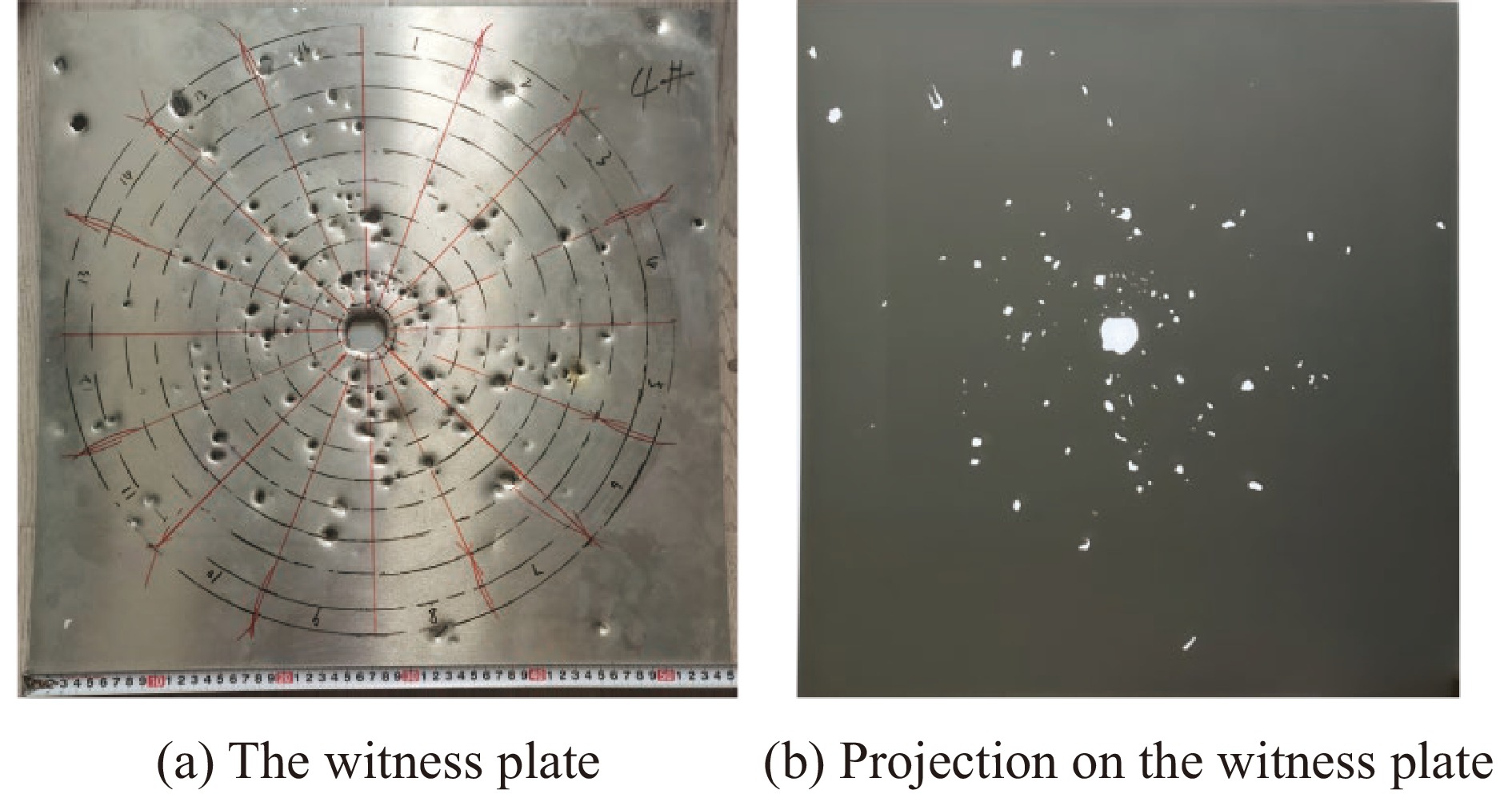
摘要: 为研究钽合金爆炸成型弹丸(explosively-formed projectile,EFP)侵彻靶板产生靶后破片的空间散布,首先开展了钽合金EFP侵彻45钢的X光及破片散布试验;其次,采用经试验验证的FE-SPH(finite element-smoothed particle hydrodynamics)固定耦合方法开展了多种弹、靶条件下EFP垂直侵彻靶板的数值模拟,获得了靶后破片空间散布的数据集;最后,采用基于贝叶斯优化的支持向量回归对靶后破片密集飞散角数据进行训练,得到了基于贝叶斯优化的支持向量回归模型。研究结果表明:从试验结果来看,靶后破片云形貌为典型的截椭球状,由于钽、钢密度差异导致不同材料破片径向膨胀能力不同,钢破片分布在椭球的外表面而钽破片分布在椭球的内表面,靶后破片主要集中在验证靶上中心穿孔处周围的圆形区域;采用FE-SPH固定耦合方法模拟再现了靶后破片的形成过程,得到的靶后破片云形貌与试验结果十分接近,靶后破片平均最大飞散角与试验结果相对误差不超过10%,验证了数值模拟结果的准确性;建立的基于贝叶斯优化的支持向量回归模型能够实现对不同靶板厚度、着靶速度条件下靶后破片的密集飞散角的准确预测,数值模拟结果与模型预测结果最大相对误差均小于10%,在此基础上可以实现对靶后一定距离内验证靶毁伤面积的快速预测。Abstract: To investigate the spatial dispersion characteristics of behind-armor debris (BAD) generated by the penetration of tantalum alloy explosively-formed projectile (EFP) into steel targets, a comprehensive study combining experimental testing, numerical simulation, and machine learning prediction was performed. First, X-ray imaging and fragment-distribution experiments were conducted on 45 steel targets penetrated by tantalum alloy EFP to obtain initial experimental data. Subsequently, the finite element-smoothed particle hydrodynamics (FE-SPH) fixed-coupling method, which had been validated by the experimental data, was employed to simulate the perforation process. These numerical simulations were carried out under a wide range of working conditions, specifically varying the projectile velocity and target thickness. Through this process, a comprehensive dataset describing the spatial dispersion of BAD was generated. Finally, to achieve rapid prediction capabilities, a support vector regression (SVR) model was established. The Bayesian optimization algorithm was utilized to train the model using the dense-fragment dispersion angle data extracted from the simulation dataset, thereby creating a robust predictive model for spatial dispersion of BAD. The experimental results indicate that the morphology of the BAD cloud exhibits a typical truncated-ellipsoidal shape. Due to the density difference between tantalum and steel, fragments composed of different materials display distinct radial expansion behaviors, i.e. steel fragments are distributed along the outer surface of the ellipsoid whereas tantalum fragments are concentrated on the inner surface. Spatially, the debris is primarily concentrated within a circular region surrounding the central perforation area of the witness plate. The FE-SPH fixed-coupling method successfully reproduced the BAD formation process, yielding debris-cloud morphologies that closely match the experimental results. The relative error between the simulated and measured mean maximum fragment dispersion angles is less than 10%, thereby confirming the accuracy of the numerical simulations. Furthermore, the analysis reveals that the Bayesian-optimized SVR model enables accurate prediction of dense-fragment dispersion angles under varying target thicknesses and EFP impact velocities, with maximum relative errors below 10%. Based on these predictions, the damage area on witness plates within a certain distance behind the target can be rapidly estimated.
-
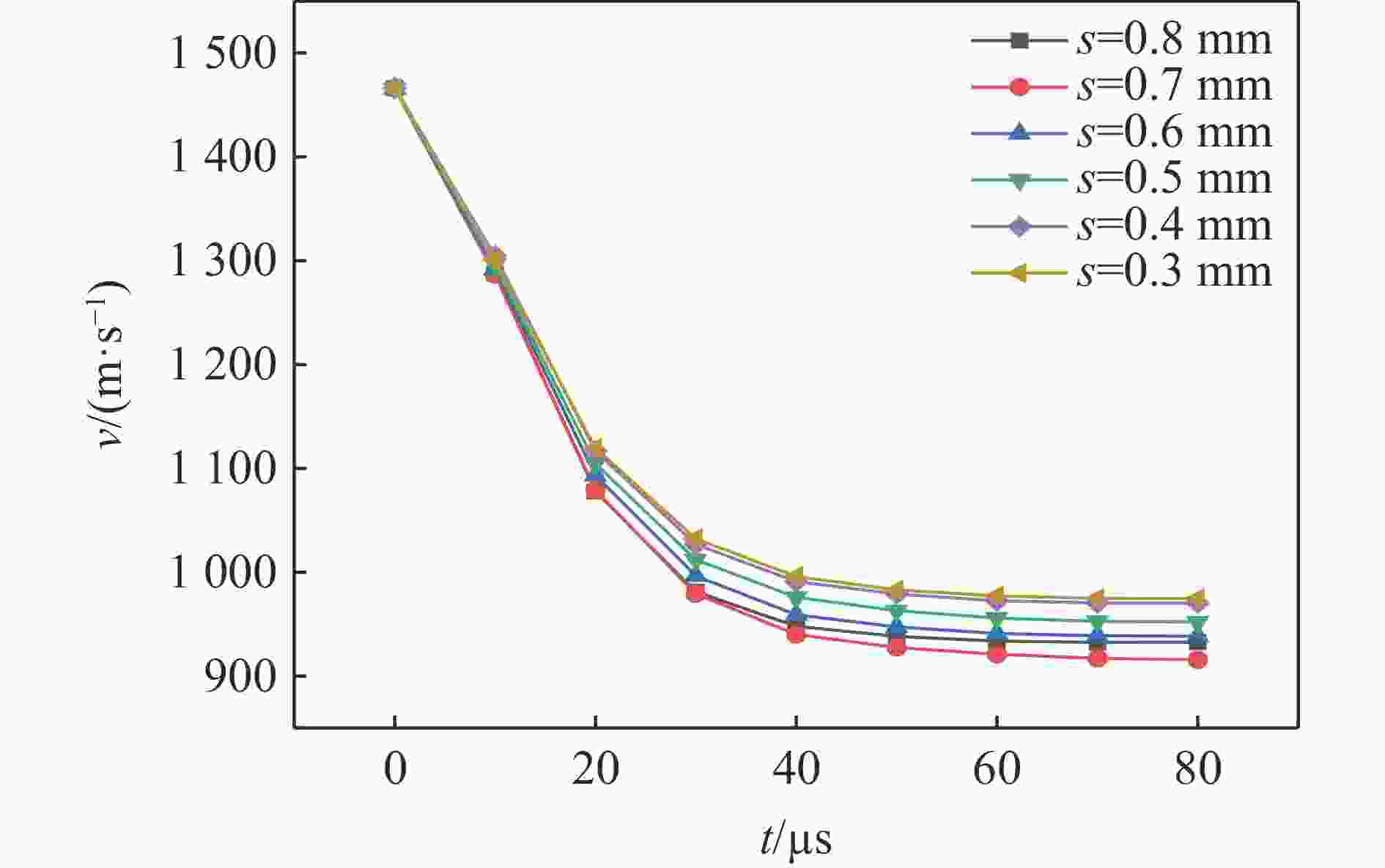
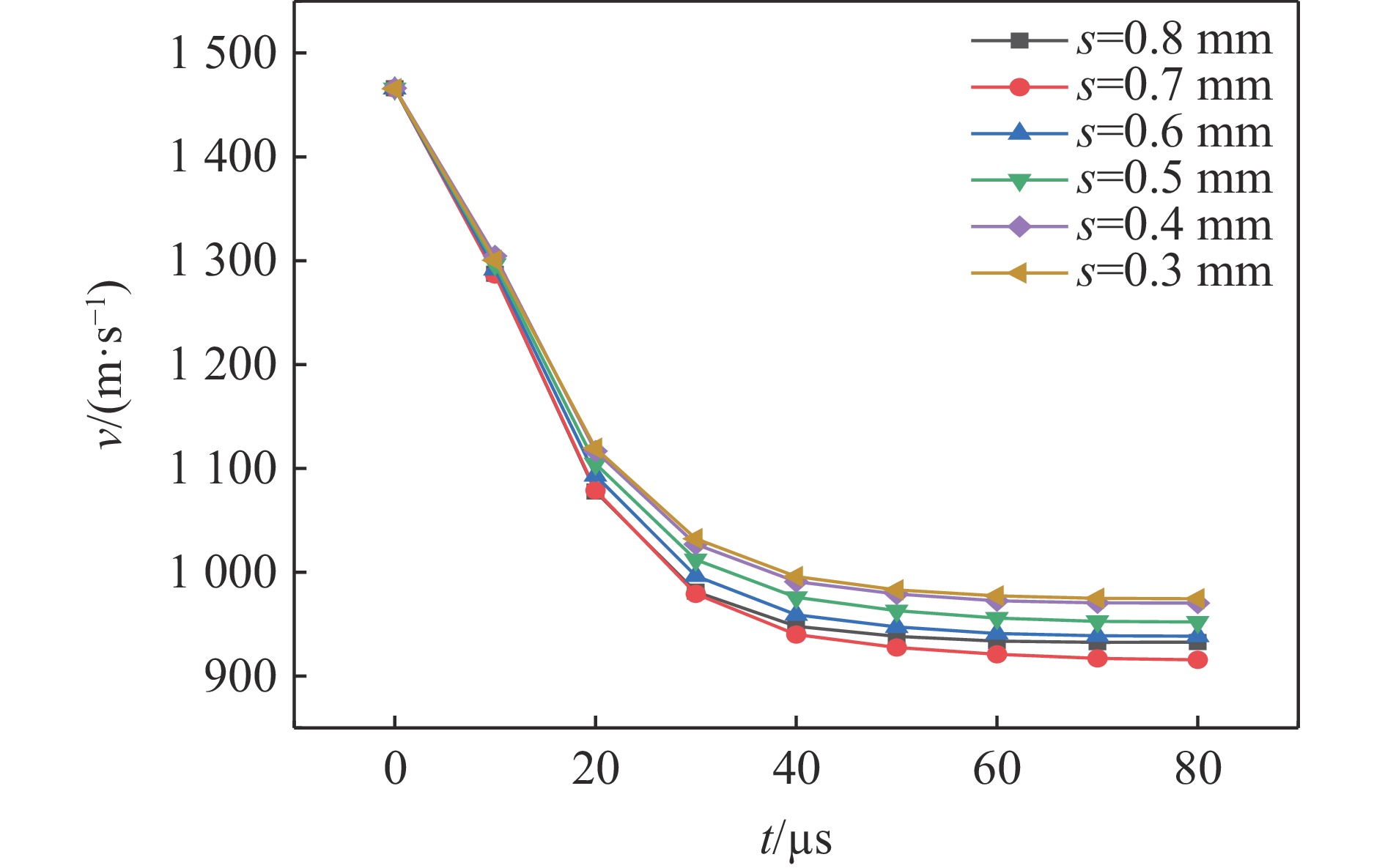
图 8 不同粒子尺寸下EFP速度时程曲线对比
Figure 8. Comparison of EFP velocity-time curves for different particle sizes
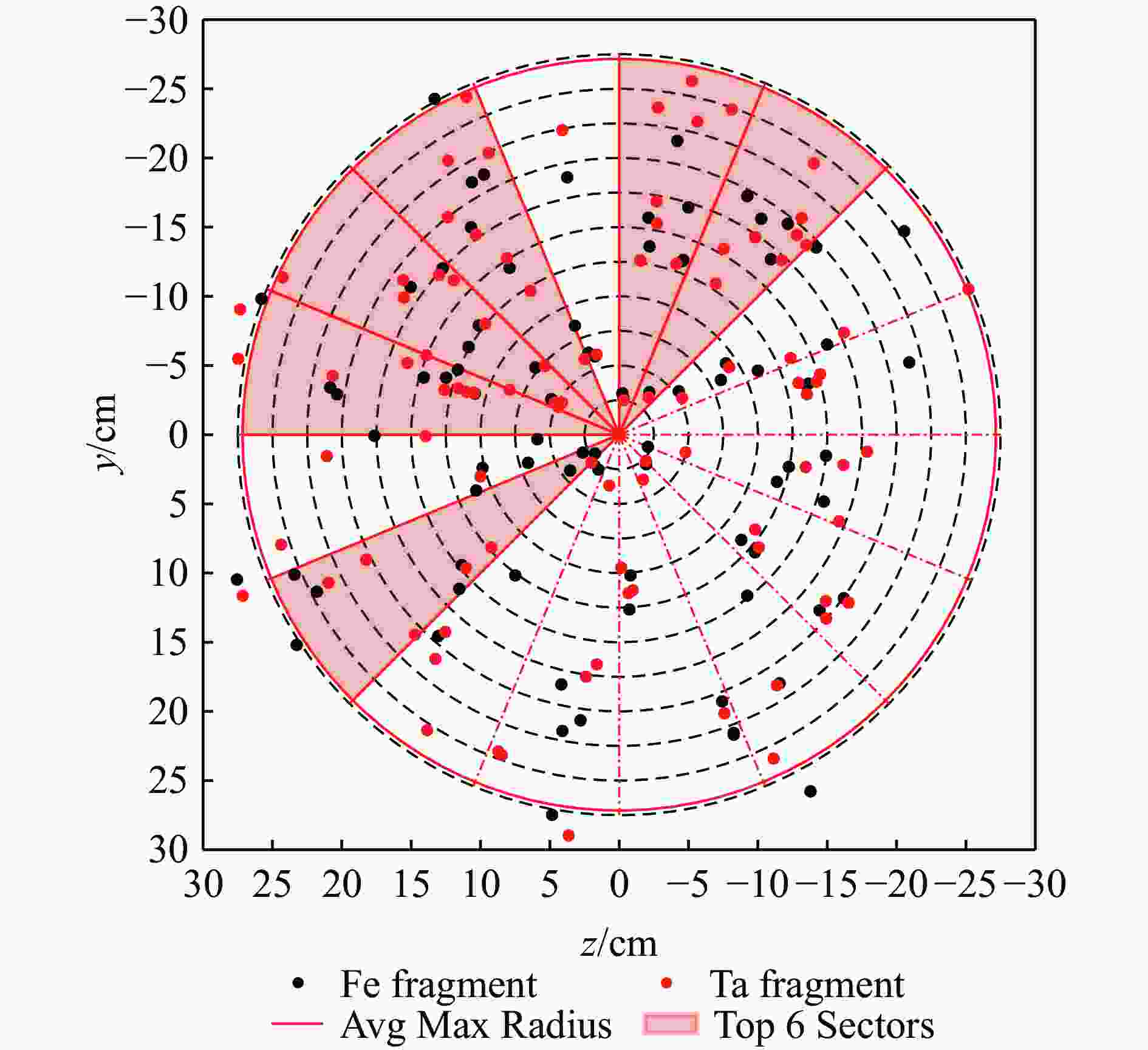
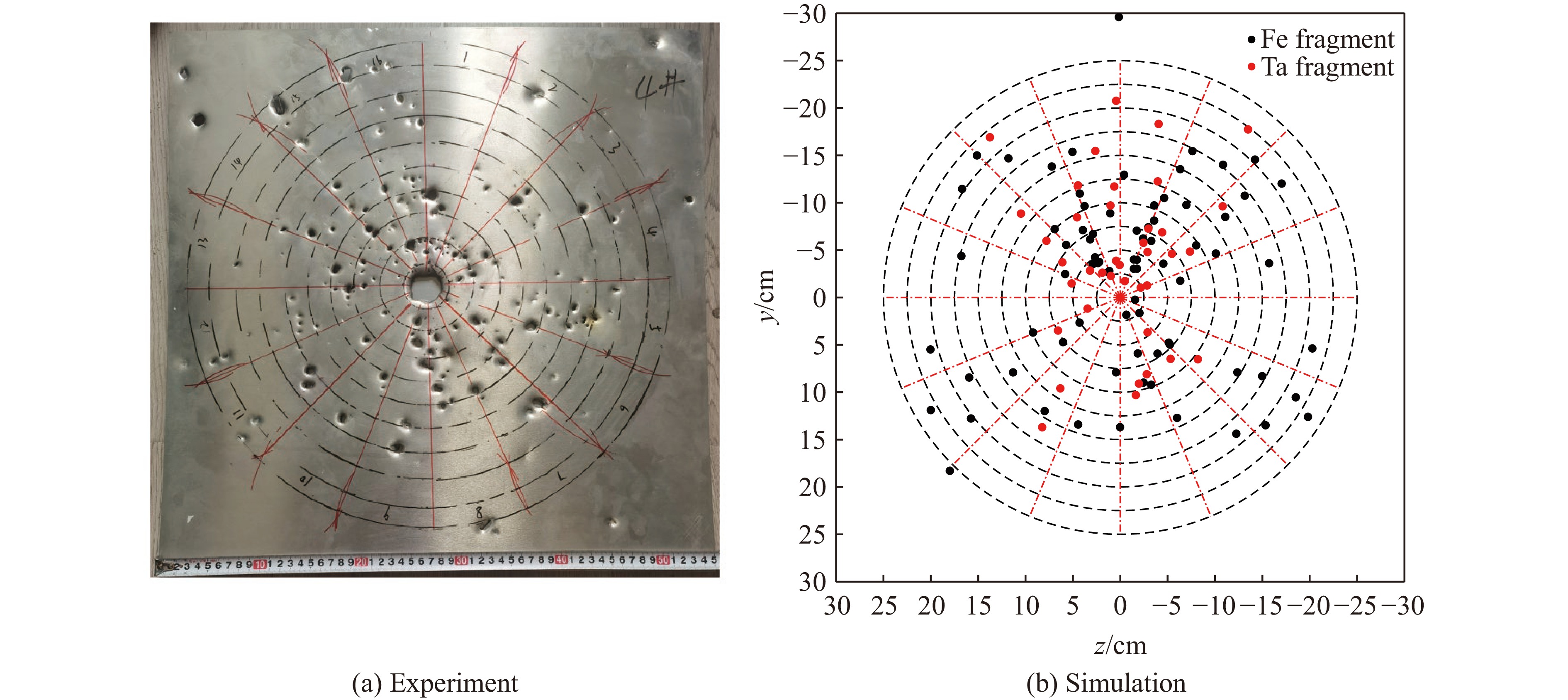
图 11 靶后破片在验证靶上的散布(v0=
1900 m/s,h0=30 mm)Figure 11. The dispersion of fragments on the witness plate (v0=
1900 m/s,h0=30 mm)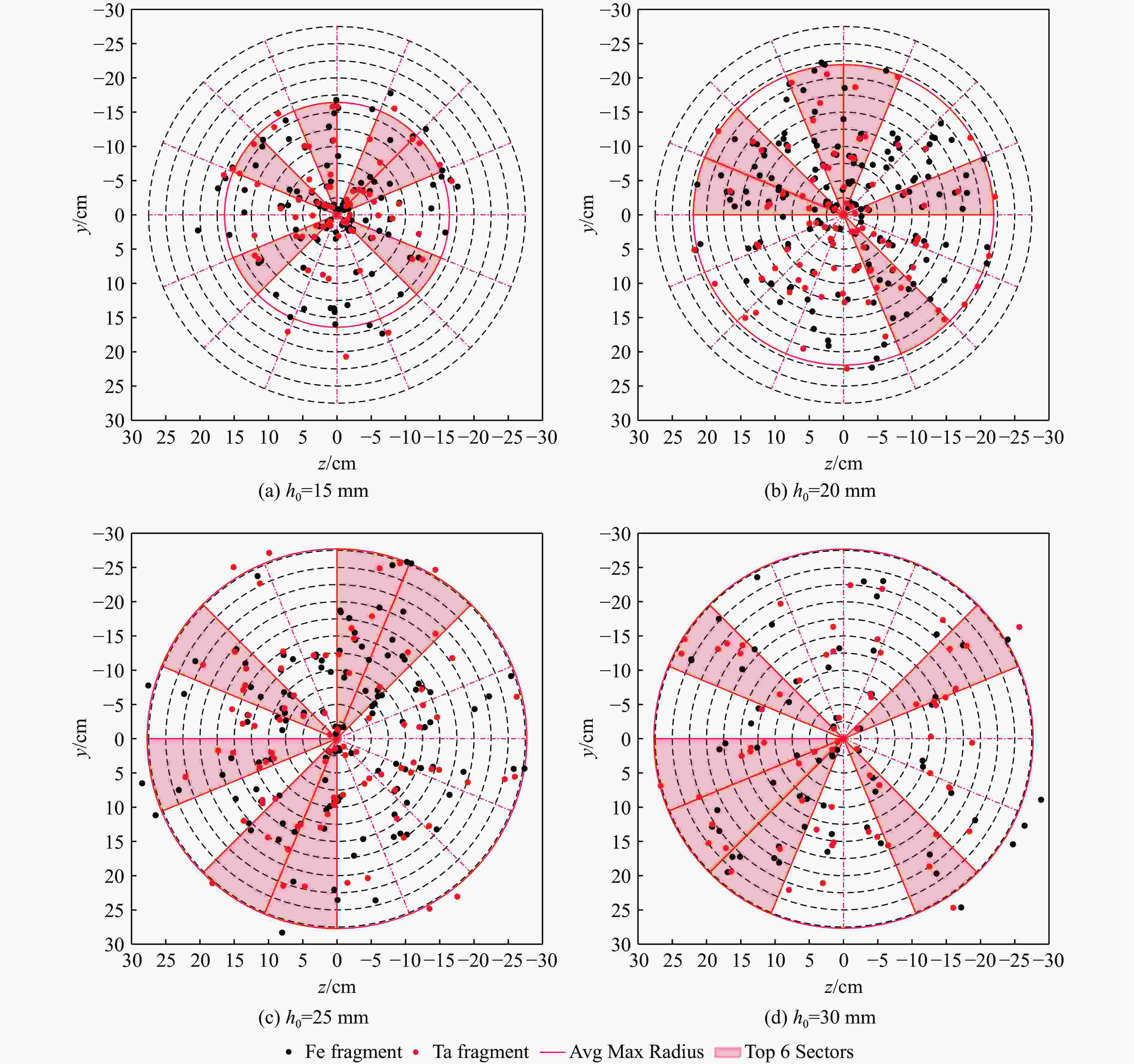
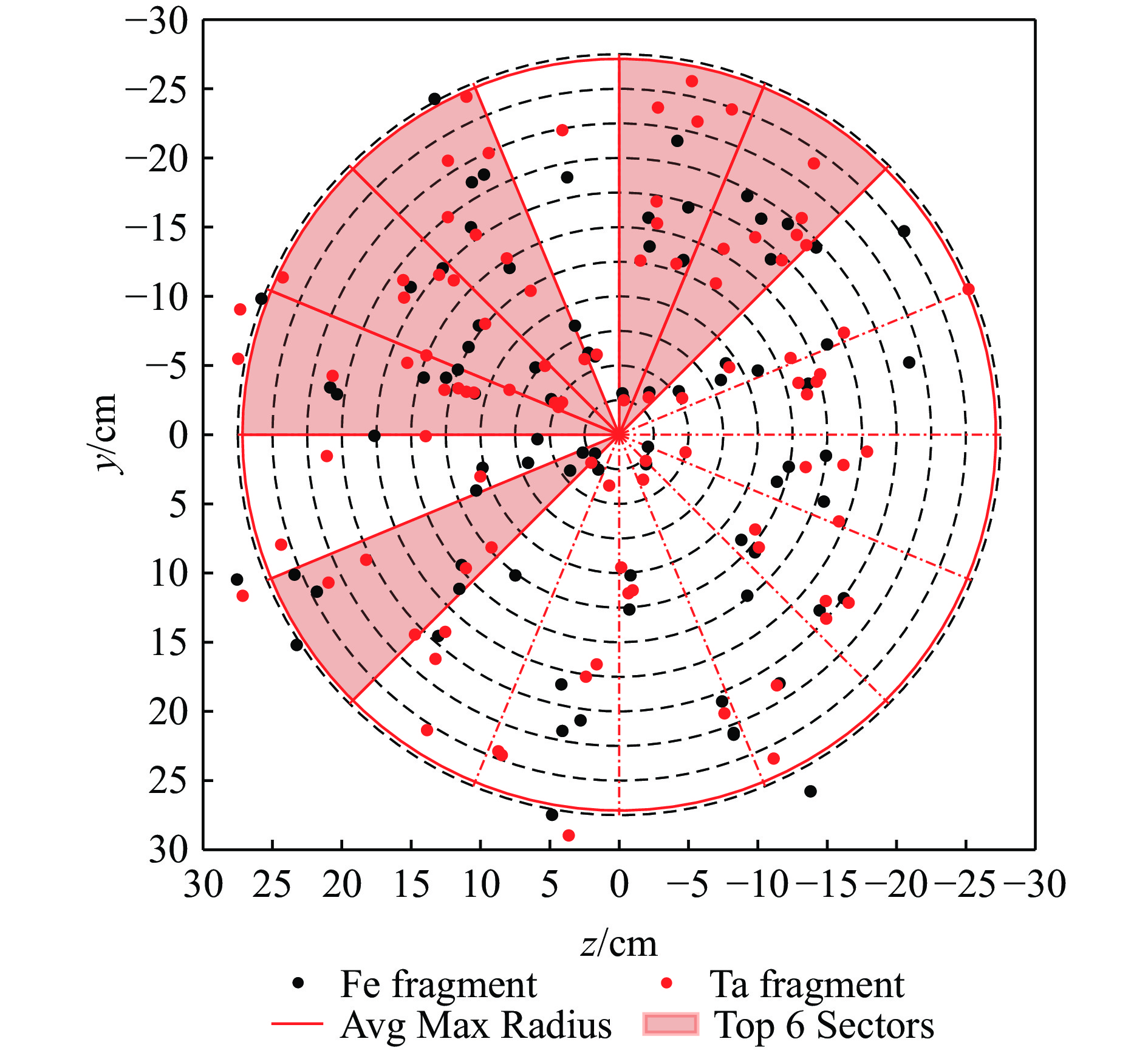
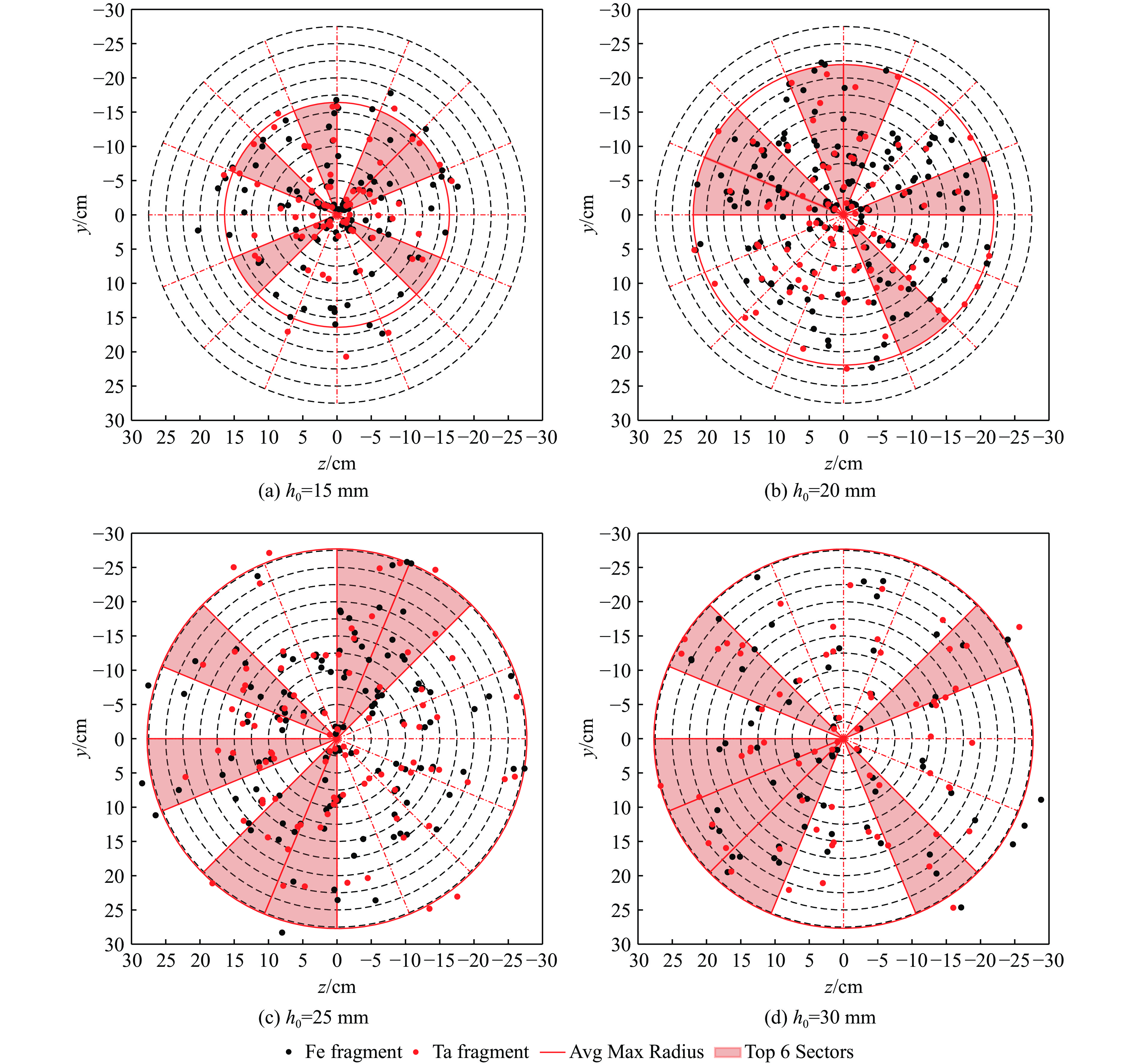
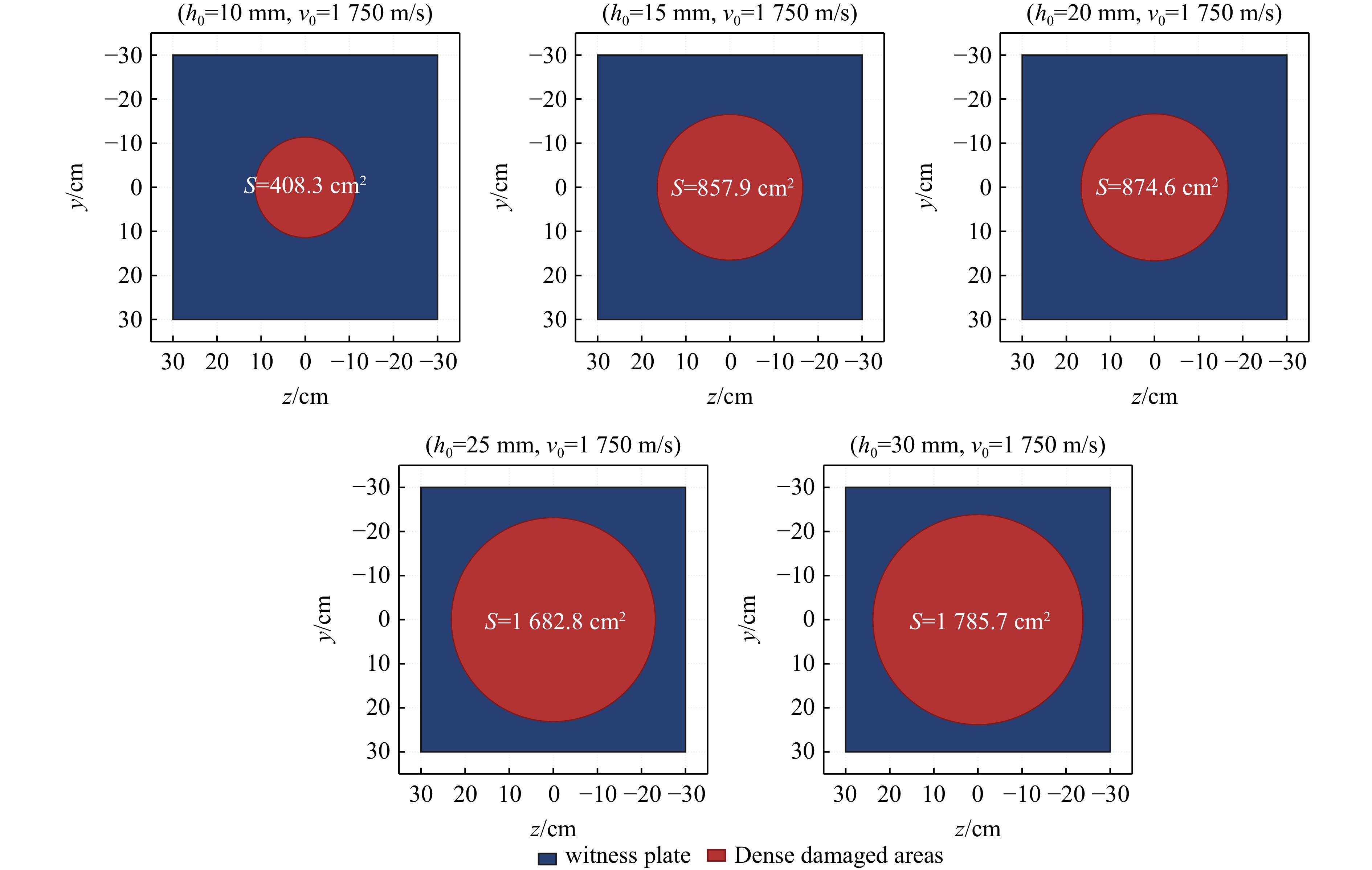
图 12 不同靶板厚度下破片在验证靶上的散布
Figure 12. The dispersion of fragments on the witness plate for different thicknesses of targets
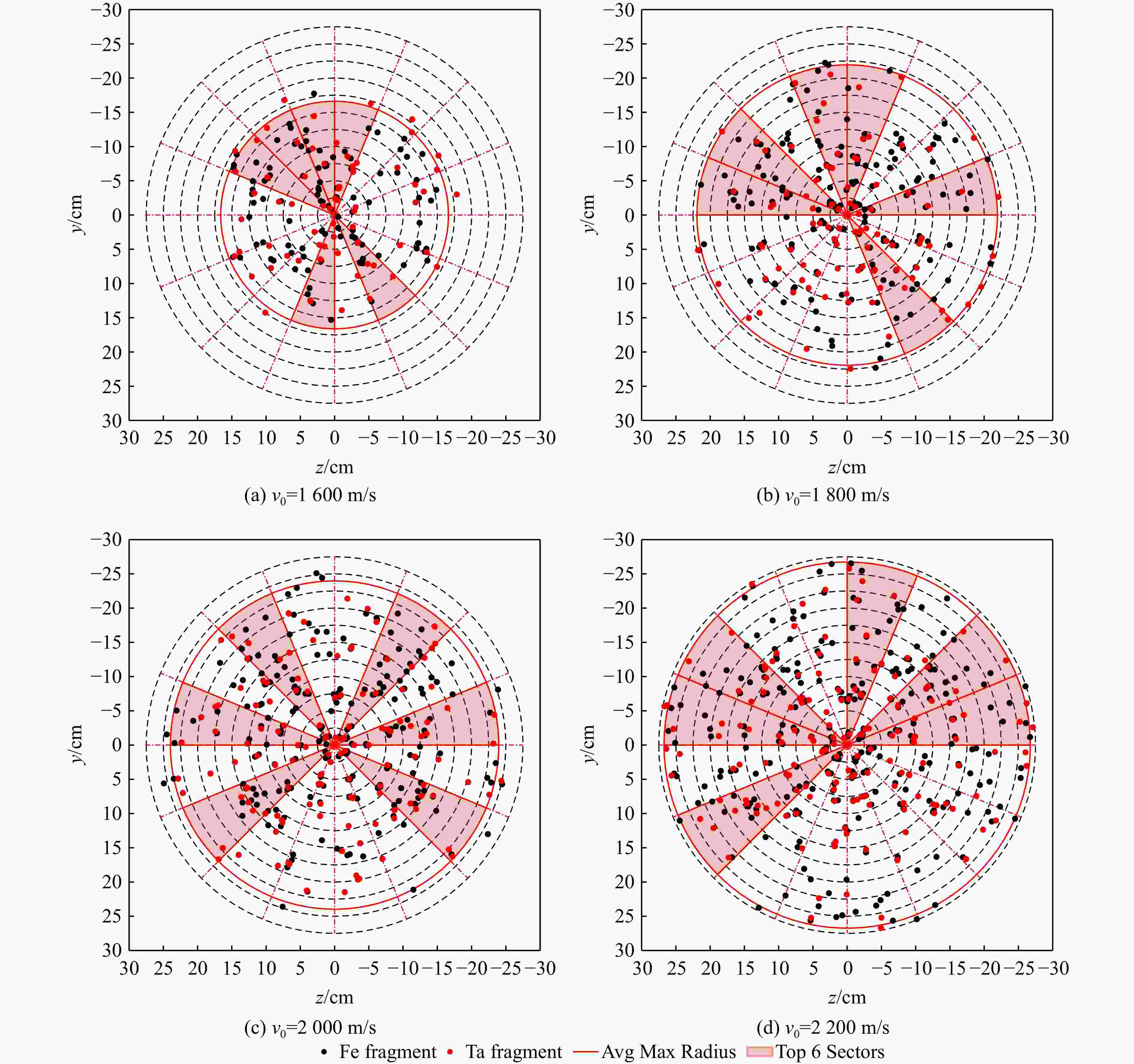
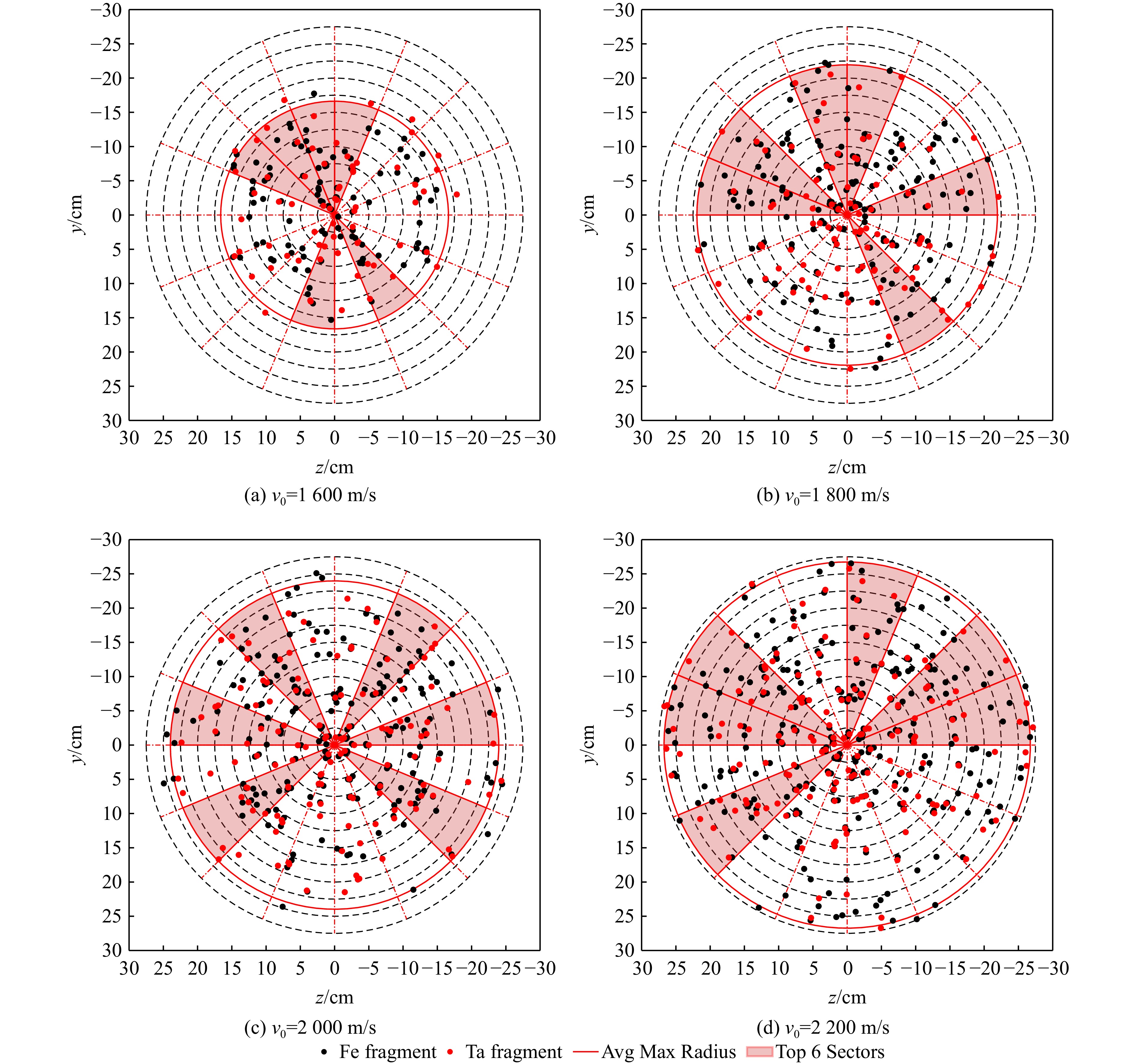
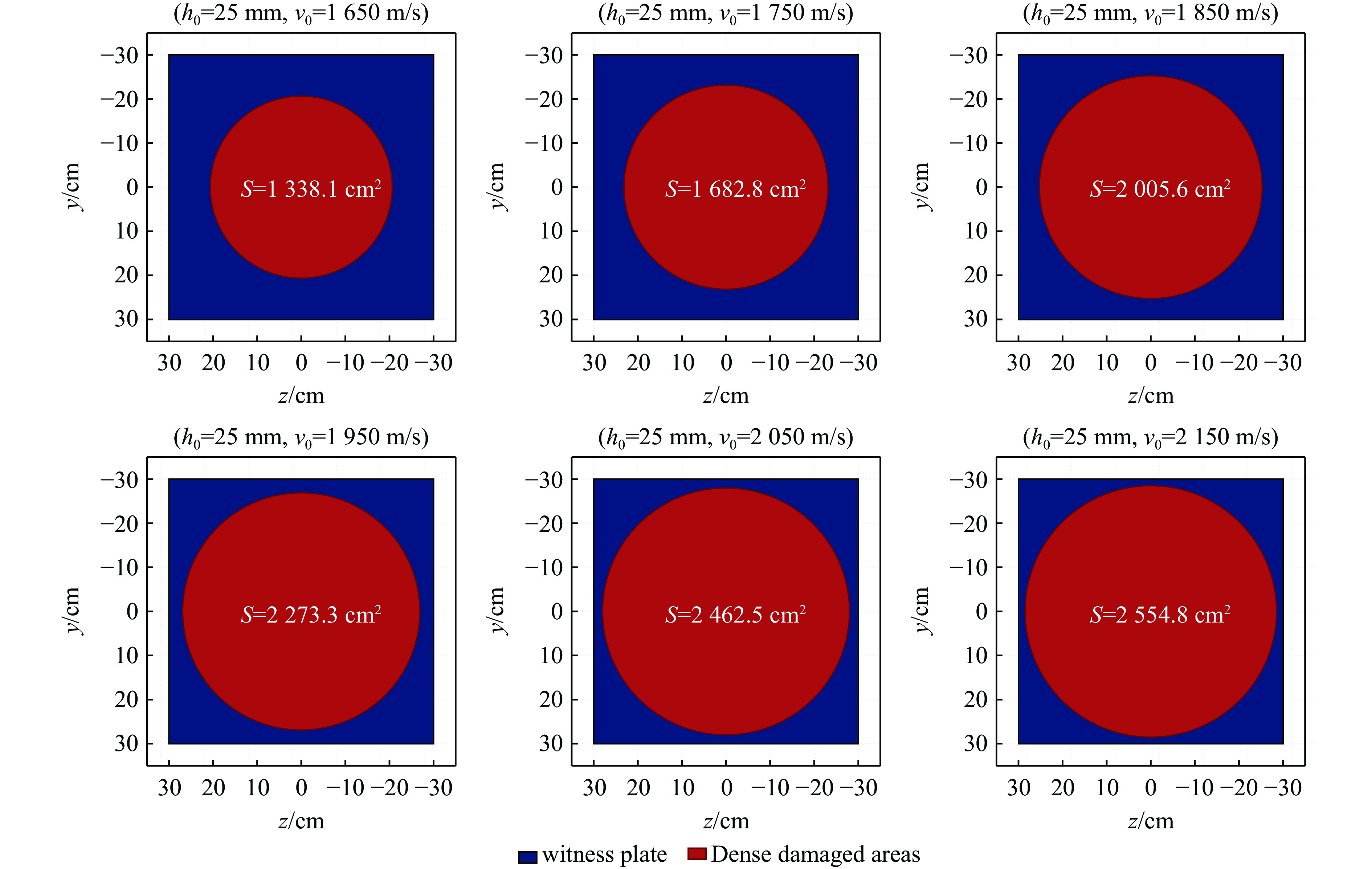
图 13 不同着靶速度下破片在验证靶上的散布
Figure 13. The dispersion of fragments on the witness plate for different impact velocities of EFP
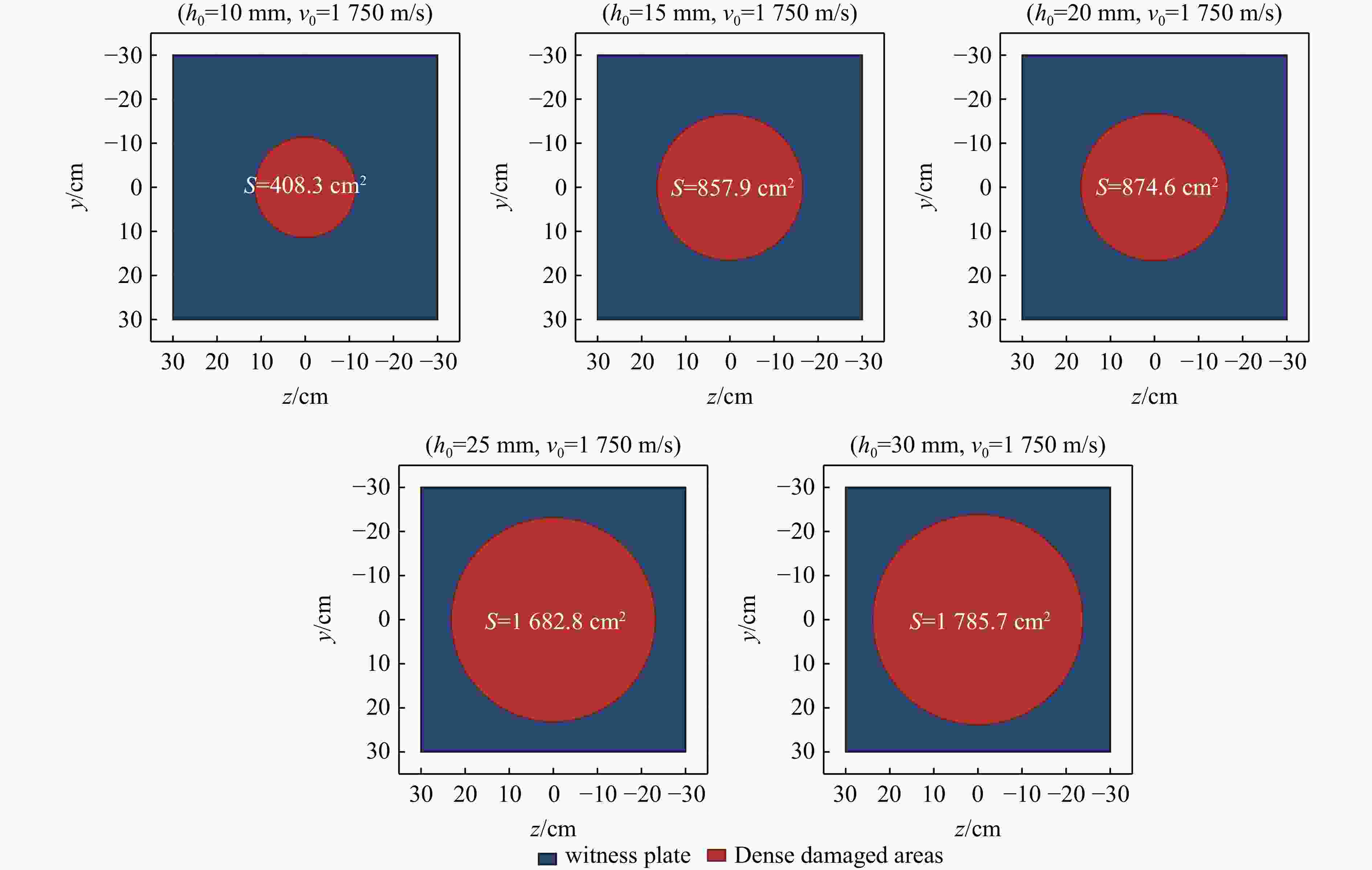
图 16 验证靶上密集毁伤区域面积随靶板厚度变化情况
Figure 16. The variation of the area of densely damaged areas on the witness plate with the thickness of the target
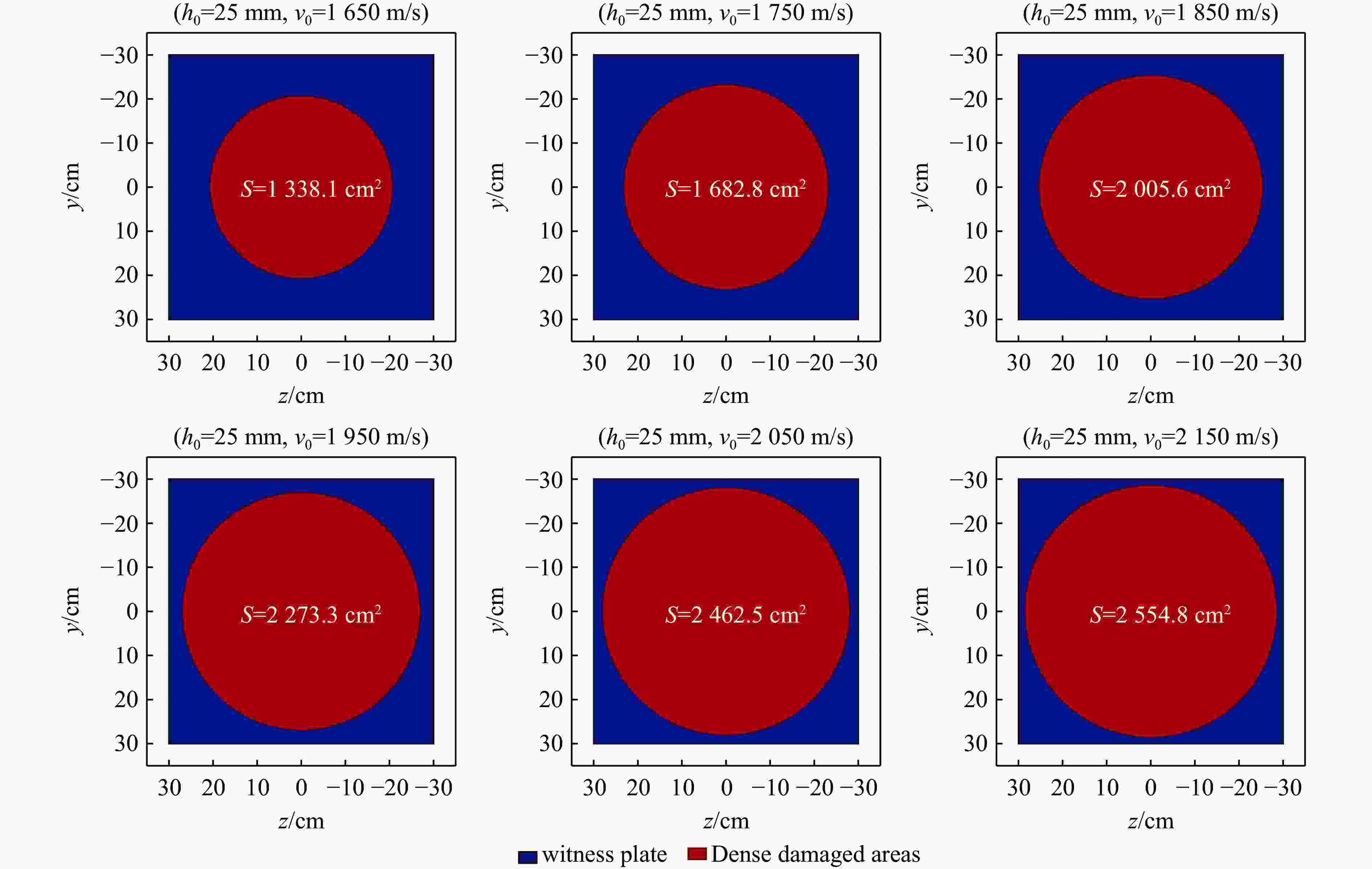
图 17 验证靶上密集毁伤区域面积随着靶速度变化情况
Figure 17. The variation of the area of densely damaged areas on the witness plate with the impact velocities of EFP
表 1 Ta_2.5W及45钢基础力学性能
Table 1. The basic mechanical properties of Ta 2.5W and 45 steel
材料 屈服强度
σs/MPa抗拉强度
σb/MPa断后伸长率
δ/%硬度 Ta_2.5W 223 354 50 130HV 45钢 ≥ 355 ≥ 600 ≥ 16 ≤ 229HBW  下载: 导出CSV
材料 ρ0/(g·cm−3) A/MPa B/MPa n c m D1 D2 D3 D4 D5 Ta_2.5W 16.70 211 381 0.75 0.068 0.38 1.355 1.833 -1.93 0.015 1.868 P1/GPa c0/(m·s−1) S1 S2 S3 a γ0 5.6 3410 1.2 0 0 0.42 1.67
下载: 导出CSV
下载: 导出CSV
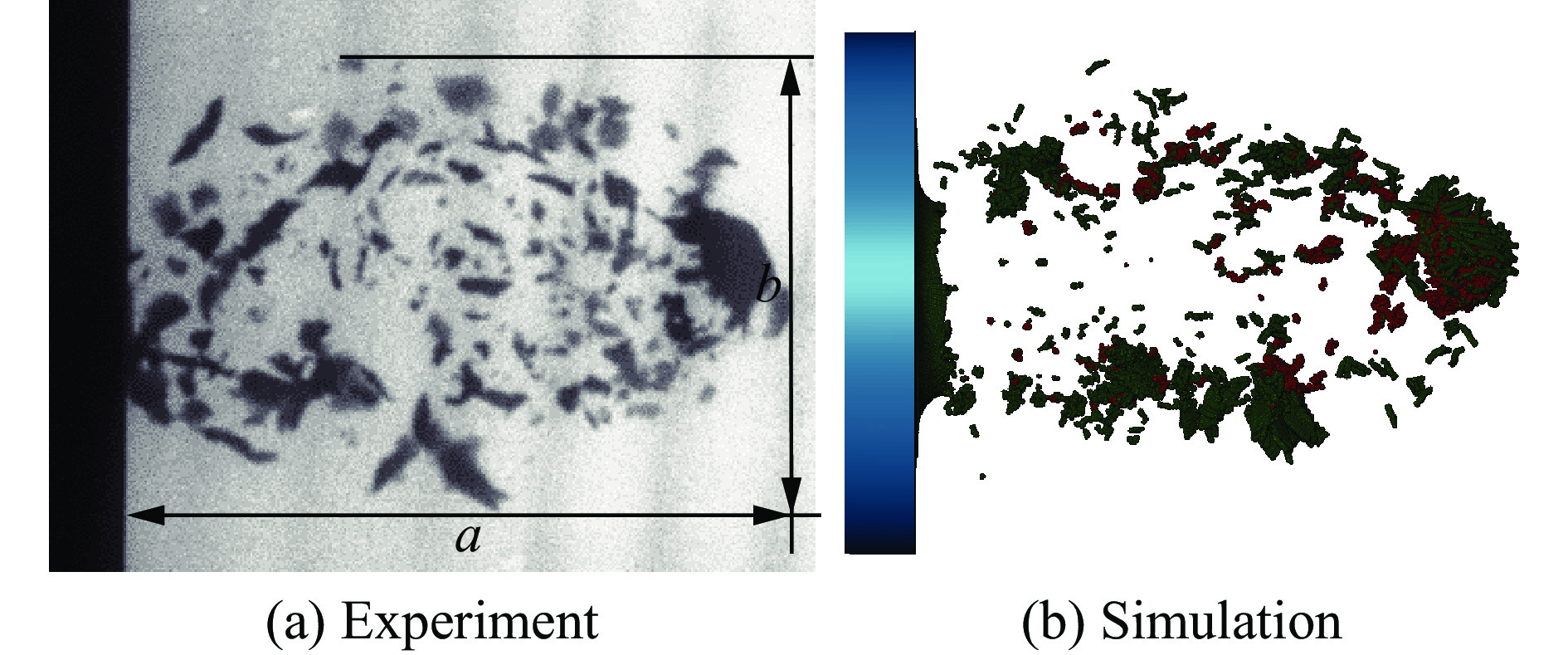
表 4 靶后破片云形貌特征尺寸数值模拟与试验对比
Table 4. Comparison of numerical simulation and experimental results of the morphological feature sizes of the behind-armor debris clouds
方法 长轴a/mm 短轴b/mm a/b 轴向膨胀速度/(m·s−1) 试验 111.4 72.2 1.54 1123 数值模拟 115.4 77.0 1.50 1060 相对误差/% 3.59 6.65 −2.60 −5.61
下载: 导出CSV
表 5 用于训练的数值模拟工况
Table 5. Numerical simulation conditions used for training
设计变量 变量值 工况数 v0/(m·s−1) 1500 ,1600 ,1700 ,1800 ,1900,2000,2100 ,2200 8 h0/mm 10,15,20,25,30 5
下载: 导出CSV
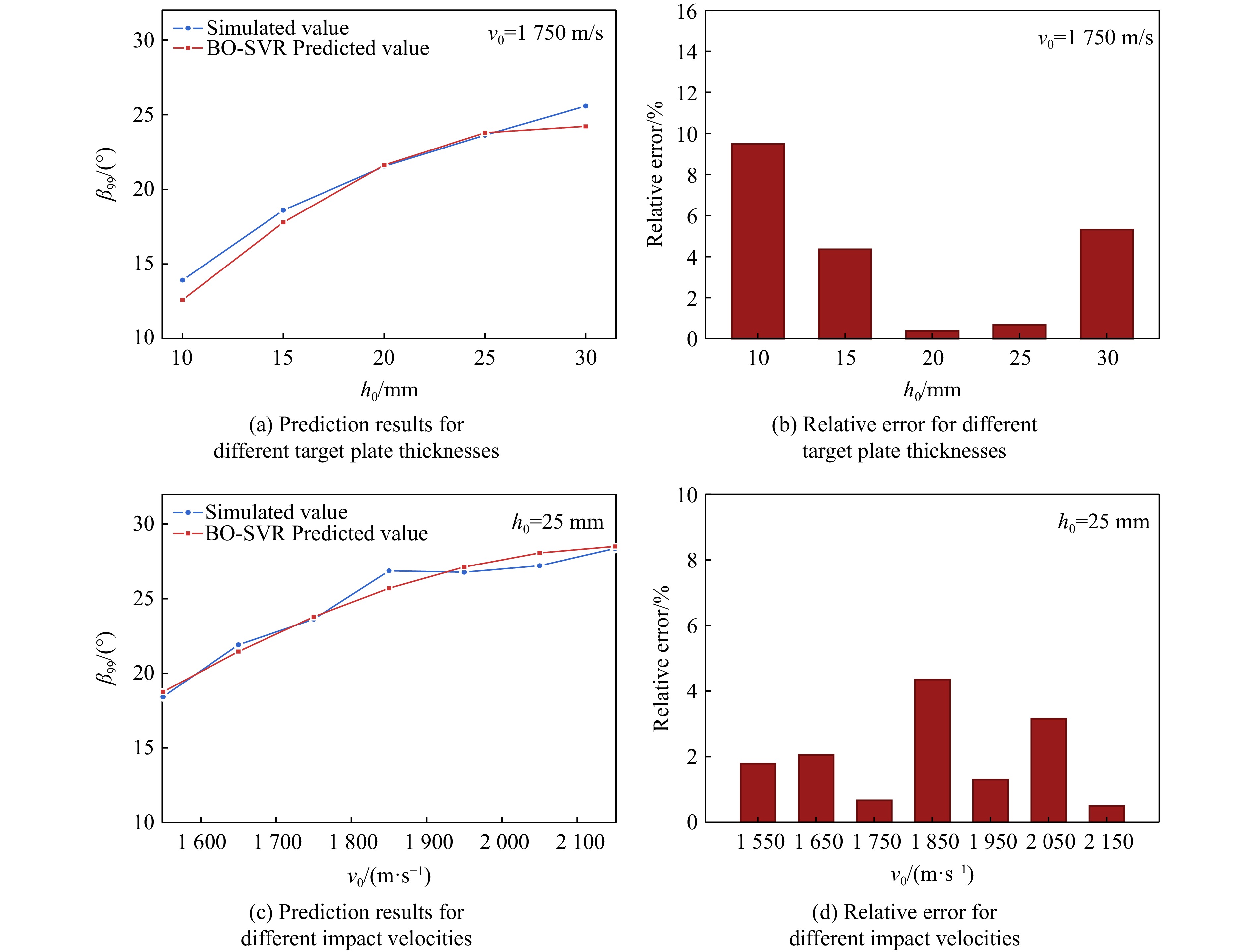
表 6 BO-SVR模型的预测性能
Table 6. The predictive performance of the BO-SVR model
预测指标 R2 εMAPE/% εRMSE 训练集性能 0.9678 4.2100 1.0428 交叉验证性能 0.9484 5.3612 1.2404
下载: 导出CSV
-
[1] DALZELL M W, HAZELL P J, MEULMAN J H. Modelling behind-armour debris formed by the perforation of an EFP through a steel target [C]//CARLEONE J, ORPHAL D. 20th International Symposium on Ballistics. Orlando, Florida, USA: DEStech Publications Inc., 2002. [2] 王昕, 蒋建伟, 王树有, 等. 爆炸成型弹丸侵彻钢靶的后效破片云实验研究 [J]. 兵工学报, 2018, 39(7): 1284–1290. DOI: 10.3969/j.issn.1000-1093.2018.07.005.WANG X, JIANG J W, WANG S Y, et al. Experimental research on fragments after explosively-formed projectile penetrating into steel target [J]. Acta Armamentarii, 2018, 39(7): 1284–1290. DOI: 10.3969/j.issn.1000-1093.2018.07.005. [3] 黄炫宁, 李伟兵, 李文彬, 等. 爆炸成型弹丸侵彻不同材料靶板后效破片特性试验研究 [J]. 兵工学报, 2024, 45(1): 58–68. DOI: 10.12382/bgxb.2022.0696.HUANG X N, LI W B, LI W B, et al. Experimental research on the characteristics of behind-armor debris from explosively formed projectile penetrating targets of different materials [J]. Acta Armamentarii, 2024, 45(1): 58–68. DOI: 10.12382/bgxb.2022.0696. [4] 邢柏阳, 赵建霞, 陈亮, 等. 爆炸成型弹丸垂直穿透钢板靶后破片飞散特性 [J]. 北京理工大学学报, 2022, 42(10): 1026–1033. DOI: 10.15918/j.tbit1001-0645.2021.304.XING B Y, ZHAO J X, CHEN L, et al. Disperse characteristic of behind-armor debris formed by explosively formed penetrator vertically penetrating steel target [J]. Transactions of Beijing Institute of Technology, 2022, 42(10): 1026–1033. DOI: 10.15918/j.tbit1001-0645.2021.304. [5] 朱志鹏, 门建兵, 蒋建伟, 等. 大长径比钽爆炸成型弹丸控制研究 [J]. 兵工学报, 2018, 39(S1): 29–36. DOI: 10.3969/j.issn.1000-1093.2018.S1.005.ZHU Z P, MEN J B, JIANG J W, et al. Forming control of tantalum EFP with large aspect ratio [J]. Acta Armamentarii, 2018, 39(S1): 29–36. DOI: 10.3969/j.issn.1000-1093.2018.S1.005. [6] 郭腾飞, 李伟兵, 李文彬, 等. 钽罩结构参数对EFP成型及侵彻性能的控制 [J]. 高压物理学报, 2018, 32(3): 035104. DOI: 10.11858/gywlxb.20170667.GUO T F, LI W B, LI W B, et al. Controlling effect of tantalum liner’s structural parameters on EFP formation and penetration performance [J]. Chinese Journal of High Pressure Physics, 2018, 32(3): 035104. DOI: 10.11858/gywlxb.20170667. [7] 门建兵, 卢易浩, 蒋建伟, 等. 杆式EFP用钽钨合金JC失效模型参数 [J]. 高压物理学报, 2020, 34(6): 065105. DOI: 10.11858/gywlxb.20200550.MEN J B, LU Y H, JIANG J W, et al. Johnson-Cook failure model parameters of tantalum-tungsten alloy for rod-shaped EFP [J]. Chinese Journal of High Pressure Physics, 2020, 34(6): 065105. DOI: 10.11858/gywlxb.20200550. [8] 丁力, 蒋建伟, 王树有, 等. 钽爆炸成型弹丸成型及断裂特性 [J]. 兵工学报, 2021, 42(S1): 53–58. DOI: 10.3969/j.issn.1000-1093.2021.S1.007.DING L, JIANG J W, WANG S Y, et al. Tantalum EFP’s forming and fracture characteristics [J]. Acta Armamentarii, 2021, 42(S1): 53–58. DOI: 10.3969/j.issn.1000-1093.2021.S1.007. [9] 邢柏阳, 侯云辉, 李泰华, 等. 爆炸成型弹丸垂直侵彻装甲钢靶后破片动能分析 [J]. 兵工学报, 2019, 40(10): 2014–2021. DOI: 10.3969/j.issn.1000-1093.2019.10.006.XING B Y, HOU Y H, LI T H, et al. Analysis of kinetic energy of behind-armor debris generated during the normal penetration of EFP into armor steel [J]. Acta Armamentarii, 2019, 40(10): 2014–2021. DOI: 10.3969/j.issn.1000-1093.2019.10.006. [10] 邢柏阳, 郭锐, 侯云辉, 等. 爆炸成型弹丸贯穿靶板靶后破片空间分布模型 [J]. 国防科技大学学报, 2022, 44(4): 141–150. DOI: 10.11887/j.cn.202204015.XING B Y, GUO R, HOU Y H, et al. Spatial distribution model for behind-armor debris formed by the perforation of explosively formed projectile through target [J]. Journal of National University of Defense Technology, 2022, 44(4): 141–150. DOI: 10.11887/j.cn.202204015. [11] 邢柏阳, 郭锐, 侯云辉, 等. 变截面爆炸成型弹丸垂直侵彻装甲钢板靶后破片轴向分布分析 [J]. 兵工学报, 2018, 39(S1): 62–65. DOI: 10.3969/j.issn.1000-1093.2018.S1.010.XING B Y, GUO R, HOU Y H, et al. Analysis of velocity and mass axial distributions of behind-armor debris generated by armor steel plate subjected to normal penetration of variable cross-section EFP [J]. Acta Armamentarii, 2018, 39(S1): 62–65. DOI: 10.3969/j.issn.1000-1093.2018.S1.010. [12] WANG X, JIANG J W, SUN S J, et al. Investigation on the spatial distribution characteristics of behind-armor debris formed by the perforation of EFP through steel target [J]. Defence Technology, 2020, 16(1): 119–135. DOI: 10.1016/j.dt.2019.05.016. [13] XING B Y, GUO R, HOU Y H, et al. The mass distribution of behind-armor debris generated during the normal penetration of variable cross-section explosive formed projectile on rolled homogeneous armor steel [J]. International Journal of Impact Engineering, 2019, 129: 12–25. DOI: 10.1016/j.ijimpeng.2019.02.008. [14] XING B Y, ZHANG D J, GUO Z Y, et al. Analysis of the mass of behind-armor debris generated by RHA subjected to normal penetration of variable cross-section EFP [J]. Defence Technology, 2019, 15(3): 390–397. DOI: 10.1016/j.dt.2018.10.006. [15] WEI G X, GUO R, LI X D, et al. The mass distribution of behind-armor debris generated during the normal penetration of an explosively formed projectile on rolled homogeneous armor steel [J]. Journal of Physics: Conference Series, 2024, 2891: 052007. DOI: 10.1088/1742-6596/2891/5/052007. [16] 张庆武, 蒋军成, 喻源, 等. 基于支持向量机的导管泄爆容器压力峰值预测 [J]. 爆炸与冲击, 2014, 34(6): 748–753. DOI: 10.11883/1001-1455(2014)06-0748-06.ZHANG Q W, JIANG J C, YU Y, et al. Prediction of peak pressure in the explosion-vented vessel with a venting duct based on support vector machine [J]. Explosion and Shock Waves, 2014, 34(6): 748–753. DOI: 10.11883/1001-1455(2014)06-0748-06. [17] 张宁, 史金光, 王中原, 等. 基于支持向量回归模型的弹用冲压发动机性能预测及优化 [J]. 兵工学报, 2023, 44(10): 2944–2953. DOI: 10.12382/bgxb.2022.0493.ZHANG N, SHI J G, WANG Z Y, et al. Performance prediction and optimization of ramjet for projectiles using support vector regression model [J]. Acta Armamentarii, 2023, 44(10): 2944–2953. DOI: 10.12382/bgxb.2022.0493. [18] HOHLER V, KLEINSCHNITGER K, SCHMOLINSKE E, et al. Debris cloud expansion around a residual rod behind a perforated plate target [C]//JANZON B, HOLMLIN R. 13th International Symposium on Ballistics. Stockholm, Sweden: National Defence Research Establishment, 1992: 327–334. [19] WEBER K, HOHLER V, KLEINSCHNITGER K, et al. Debris cloud expansion behind oblique single plate targets perforated by rod projectiles [C]//MOORE C, CULLIS I G. 17th International Symposium on Ballistics. Midrand, South Africa: Mid-South Chapter of ADPA/NDIA , 1998: 89–96. [20] ARNOLD W, ROTTENKOLBER E. Behind armor debris investigation (Part II) [J]. International Journal of Impact Engineering, 2003, 29(1/2/3/4/5/6/7/8/9/10): 95-104. DOI: 10.1016/j.ijimpeng.2003.09.009. [21] 黄炫宁, 李伟兵, 郭腾飞, 等. EFP垂直侵彻靶板后效破片云形状描述 [J]. 含能材料, 2020, 28(11): 1068–1075. DOI: 10.11943/CJEM2019297.HUANG X N, LI W B, GUO T F, et al. Shape description of behind-armor debris cloud from vertical penetration of target plate by EFP [J]. Chinese Journal of Energetic Materials, 2020, 28(11): 1068–1075. DOI: 10.11943/CJEM2019297. [22] 位国旭, 崔浩, 周昊, 等. 钨合金弹丸侵彻钢靶的数值模拟方法 [J]. 爆炸与冲击, 2025, 45(8): 084202. DOI: 10.11883/bzycj-2024-0147.WEI G X, CUI H, ZHOU H, et al. Numerical simulation method for tungsten alloy projectile penetration into steel target [J]. Explosion and Shock Waves, 2025, 45(8): 084202. DOI: 10.11883/bzycj-2024-0147. [23] 陈刚, 陈忠富, 陶俊林, 等. 45钢动态塑性本构参量与验证 [J]. 爆炸与冲击, 2005, 25(5): 451–456. DOI: 10.11883/1001-1455(2005)05-0451-06.CHEN G, CHEN Z F, TAO J L, et al. Investigation and validation on plastic constitutive parameters of 45 steel [J]. Explosion and Shock Waves, 2005, 25(5): 451–456. DOI: 10.11883/1001-1455(2005)05-0451-06. [24] 陈刚, 陈忠富, 徐伟芳, 等. 45钢的J-C损伤失效参量研究 [J]. 爆炸与冲击, 2007, 27(2): 131–135. DOI: 10.11883/1001-1455(2007)02-0131-05.CHEN G, CHEN Z F, XU W F, et al. Investigation on the J-C ductile fracture parameters of 45 steel [J]. Explosion and Shock Waves, 2007, 27(2): 131–135. DOI: 10.11883/1001-1455(2007)02-0131-05. [25] GRADY D E. The spall strength of condensed matter [J]. Journal of the Mechanics and Physics of Solids, 1988, 36(3): 353–384. DOI: 10.1016/0022-5096(88)90015-4. [26] GONGSHUN G, BAOJUN P, WEI Z, et al. Crater distribution on the rear wall of AL-Whipple shield by hypervelocity impacts of AL-spheres [J]. International Journal of Impact Engineering, 2008, 35(12): 1541–1546. DOI: 10.1016/j.ijimpeng.2008.07.028. -

计量
- 文章访问数: 270
- HTML全文浏览量: 78
- PDF下载量: 171
- 被引次数: 0