


Model test on damage control of the composite cushion charging structure subjected to blast at the bottom of underwater borehole
-
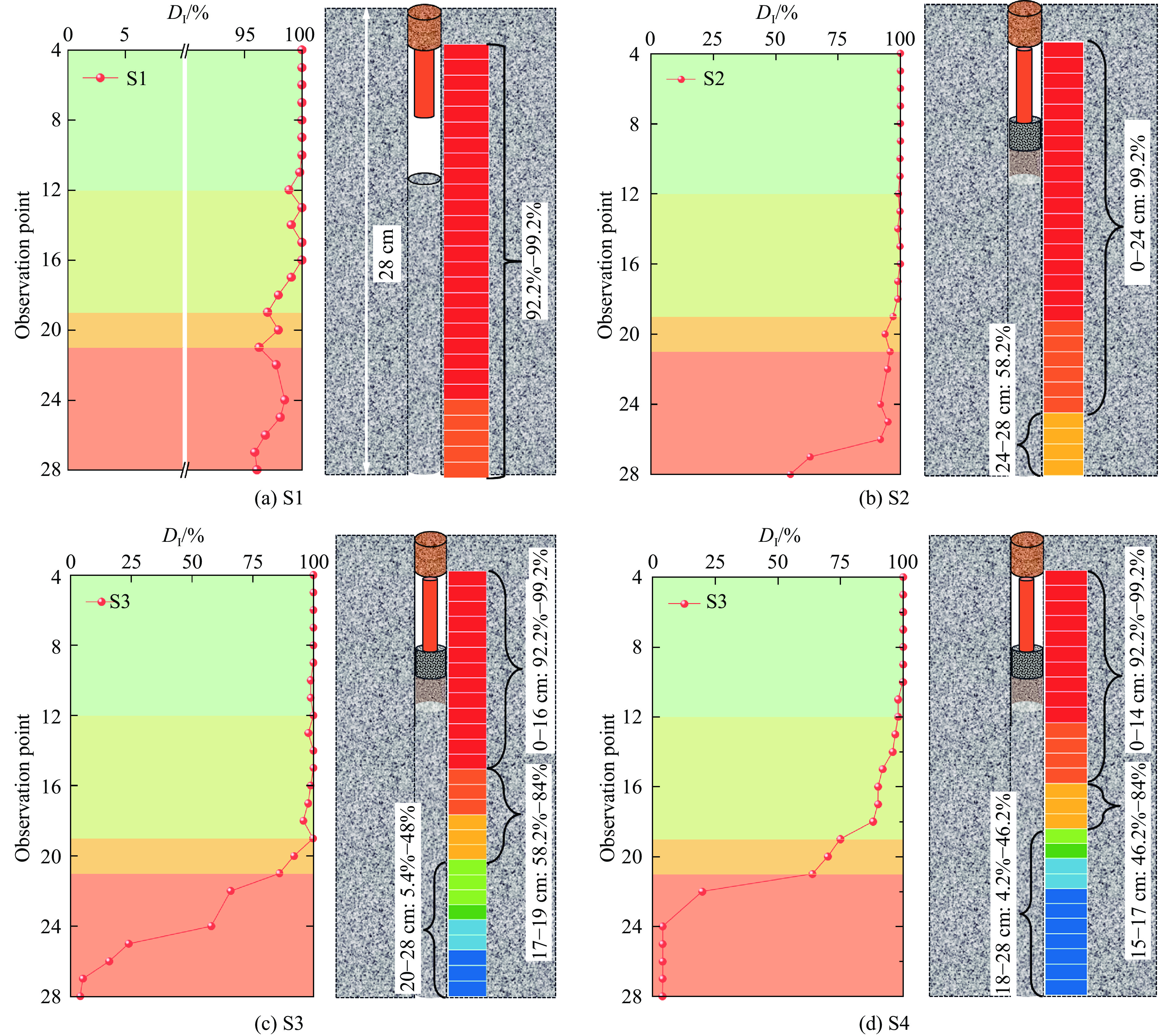
摘要: 为有效控制跨海工程中爆破开挖对基岩的损伤,研究了水下钻孔爆破中孔底复合垫层装药结构的损伤控制效果。结合某跨海大桥嵌入式沉井爆破开挖工程实例,通过现场取样和水下爆炸模型试验,利用压电陶瓷检测系统定量分析了孔底复合垫层中不同波阻抗铁砂混凝土对岩样损伤的影响;基于实测压电信号,运用小波包分析方法计算了炮孔轴向损伤因子;并结合分形维数与损伤理论,对不同工况下岩样顶部裂纹的扩展行为进行了量化评估。结果表明:孔底复合垫层能有效抑制岩样宏观裂纹扩展,减少顶部裂纹数量,并降低裂纹的轴向扩展深度。对岩样轴向损伤的分析表明,随着波阻抗的提高,炮孔区(0~12 cm)轴向损伤因子最大降幅约为10.70%;基岩底部测点损伤因子降幅高达95.7%~95.8%。水下钻孔爆破中采用孔底复合垫层装药结构可显著减轻基岩的爆破损伤,通过调节铁砂混凝土波阻抗可实现对岩样轴向损伤的有效控制。Abstract: The present investigation examines the effectiveness of a composite cushion charging structure, placed at the bottom of underwater boreholes, to mitigate bedrock damage induced by blasting excavation during cross-sea engineering. With reference to the embedded open caisson blasting project for a major cross-sea bridge, this research adopted a combined methodology of field sampling and controlled underwater explosion model tests. A piezoelectric ceramic detection system was employed to quantitatively analyze how the composite cushion, composed of iron-sand concrete layers with varying wave impedances, affects rock sample damage. Piezoelectric signals were processed via wavelet packet analysis to calculate the axial damage factor (DI) of the blast hole. Furthermore, by integrating fractal dimension theory with damage mechanics, a quantitative assessment was performed on the propagation behavior of cracks formed on the top surfaces of rock specimens under different test conditions. Results demonstrate that the implemented composite bottom cushion effectively mitigates blast-induced damage by significantly inhibiting macroscopic crack propagation, reducing surface crack density, and decreasing the axial penetration depth of cracks into the rock mass. Detailed analysis of axial damage reveals a clear trend, showing that the reduction in DI becomes more pronounced as the wave impedance of the cushion material increases. Specifically, within the borehole-affected zone (0–12 cm), the maximum achievable reduction in DI reaches 10.70%. In the adjacent bedrock zone, damage mitigation is even more evident, with DI decreasing by 95.7% to 95.8%, depending on the specific wave impedance. In conclusion, this work confirms that employing a composite cushion charging structure in underwater drilling and blasting operations can significantly alleviate blast-induced damage to foundational bedrock. The findings also establish that axial damage to the rock mass can be effectively controlled by adjusting the wave impedance of the iron-sand concrete in the cushion layer. These outcomes offer valuable insights for optimizing blasting design and enhancing damage control in marine engineering projects.
-
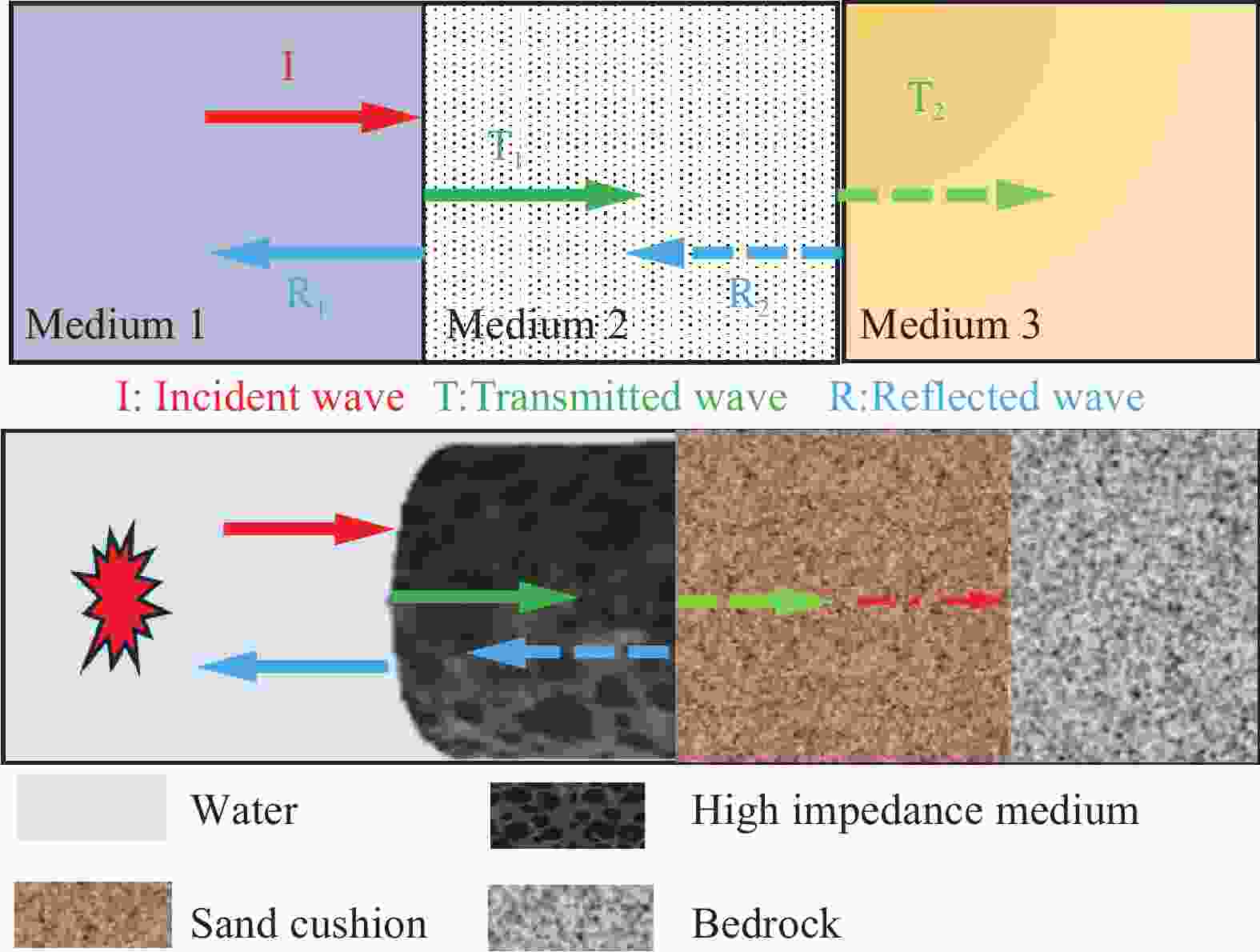
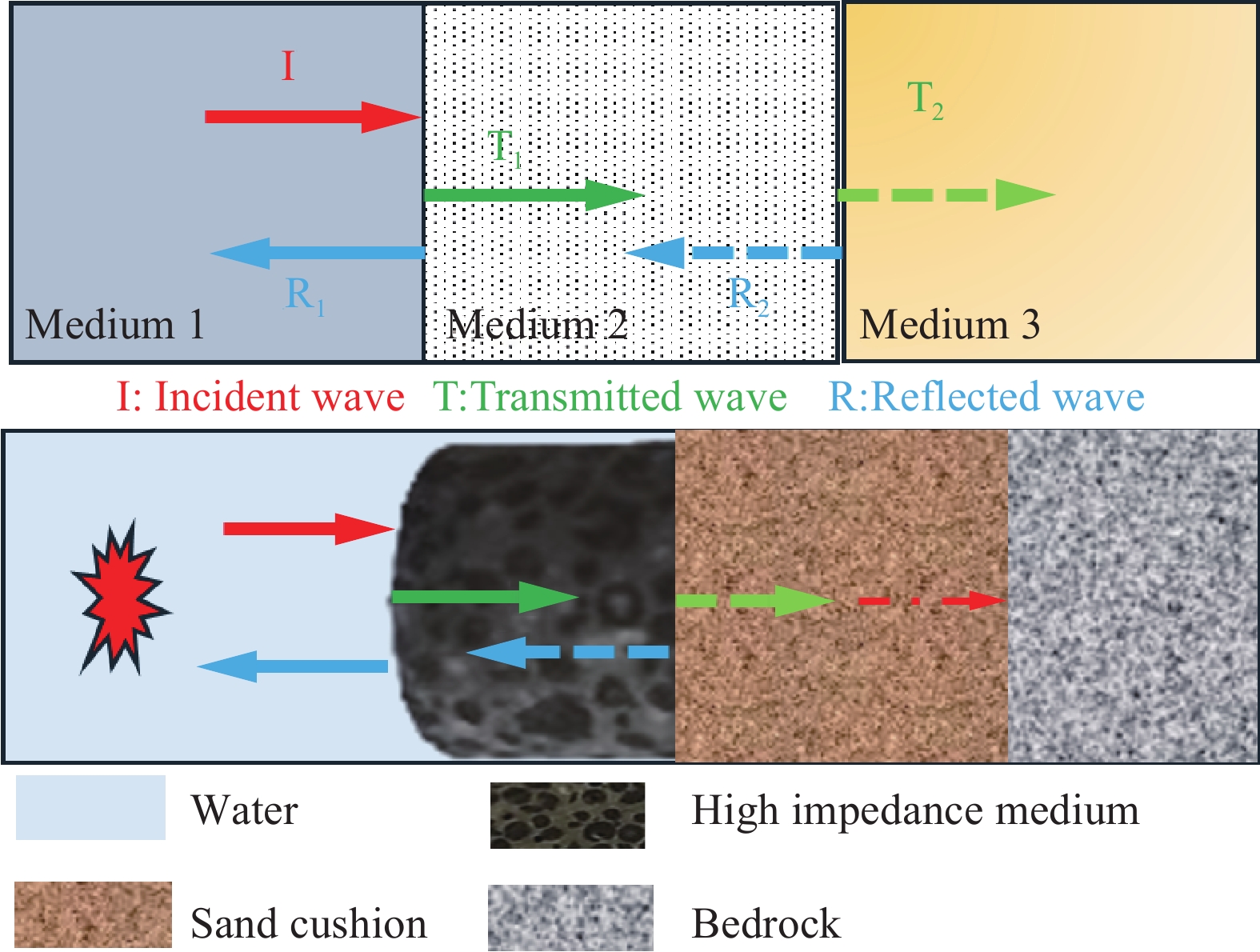
图 1 应力波垂直入射时在界面的反射与透射
Figure 1. Reflection and transmission of stress waves at the interface under normal incidence
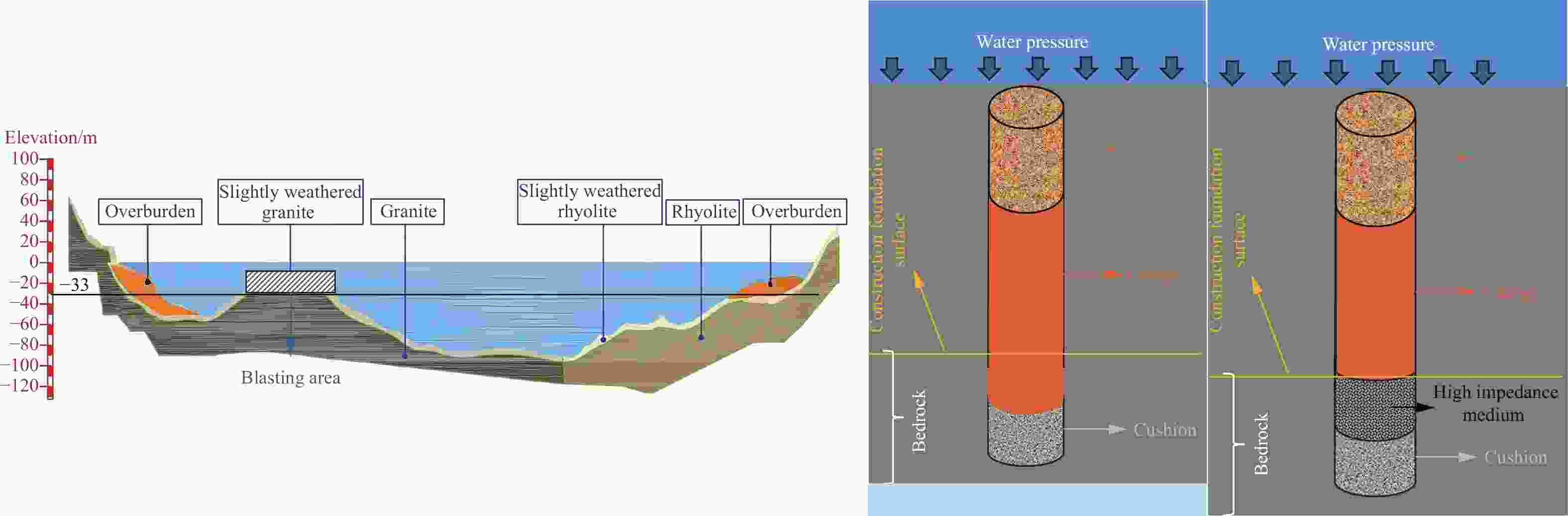
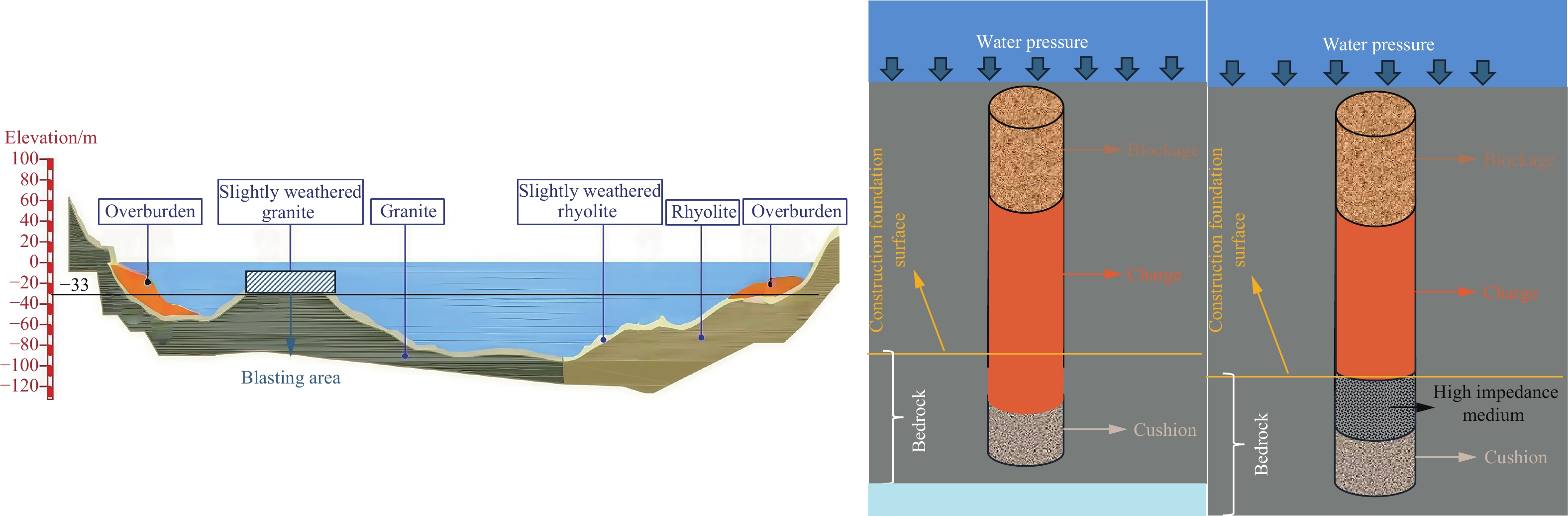
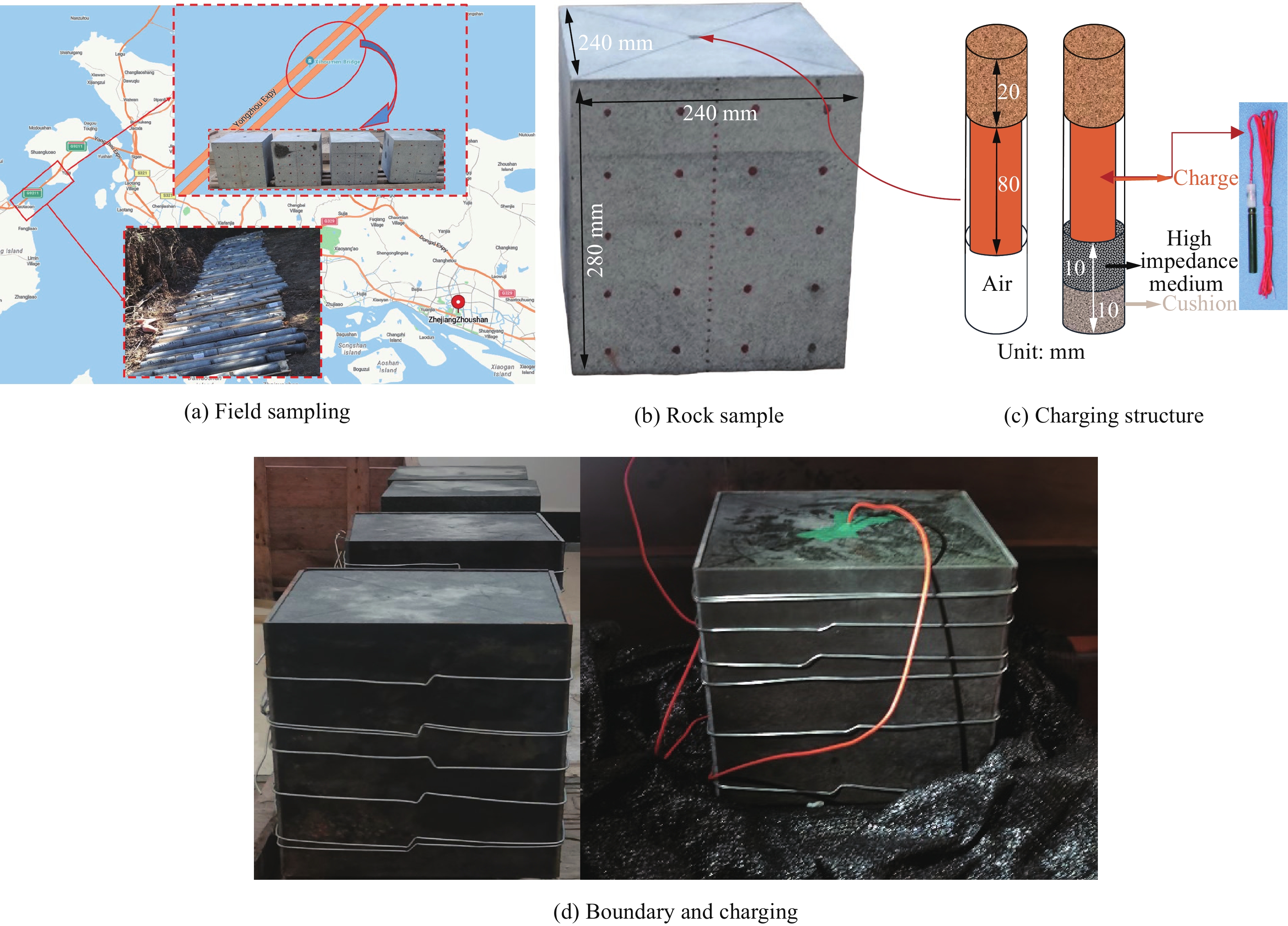
图 2 水下爆破环境及装药结构设计
Figure 2. Underwater blasting environment and charging structure design
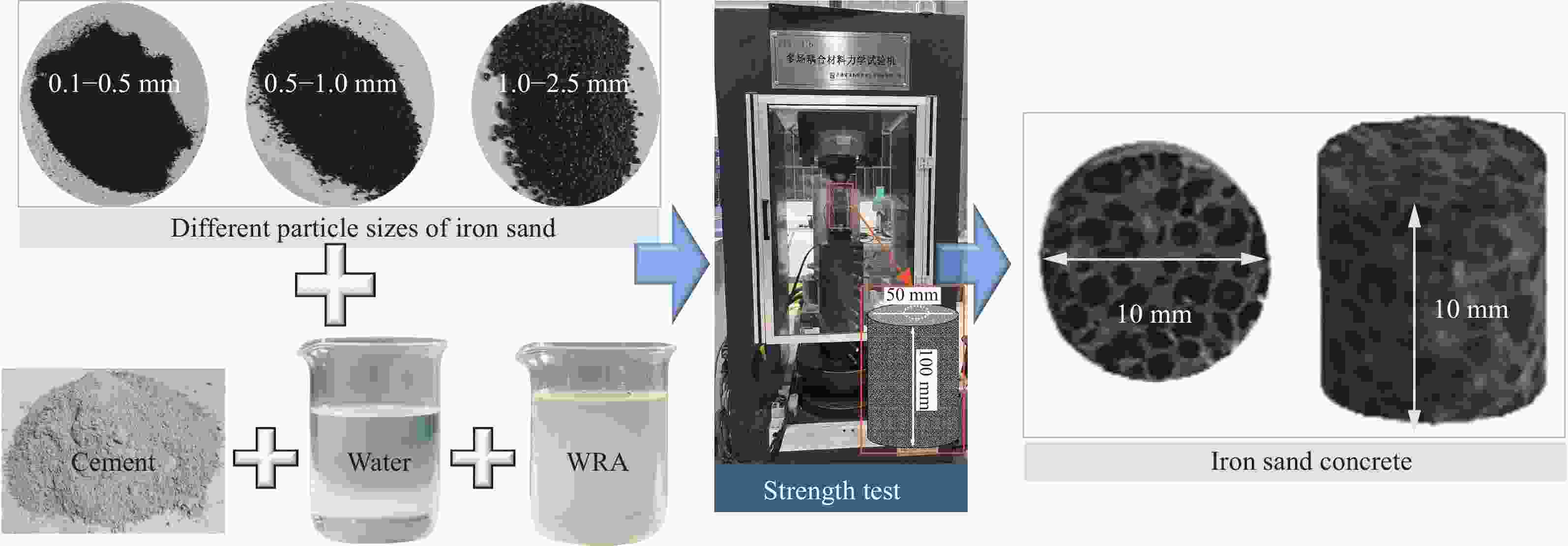
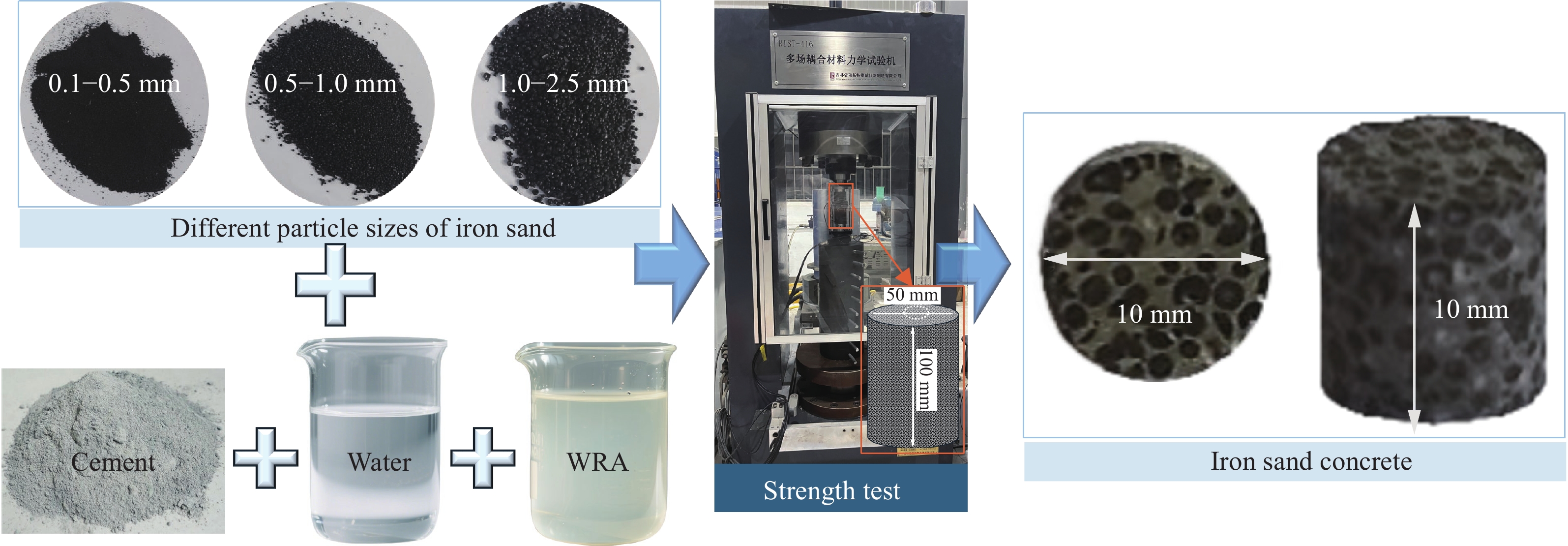
图 4 制备不同粒径下的铁砂混凝土
Figure 4. Preparation of iron-sand concrete specimens with different particle sizes
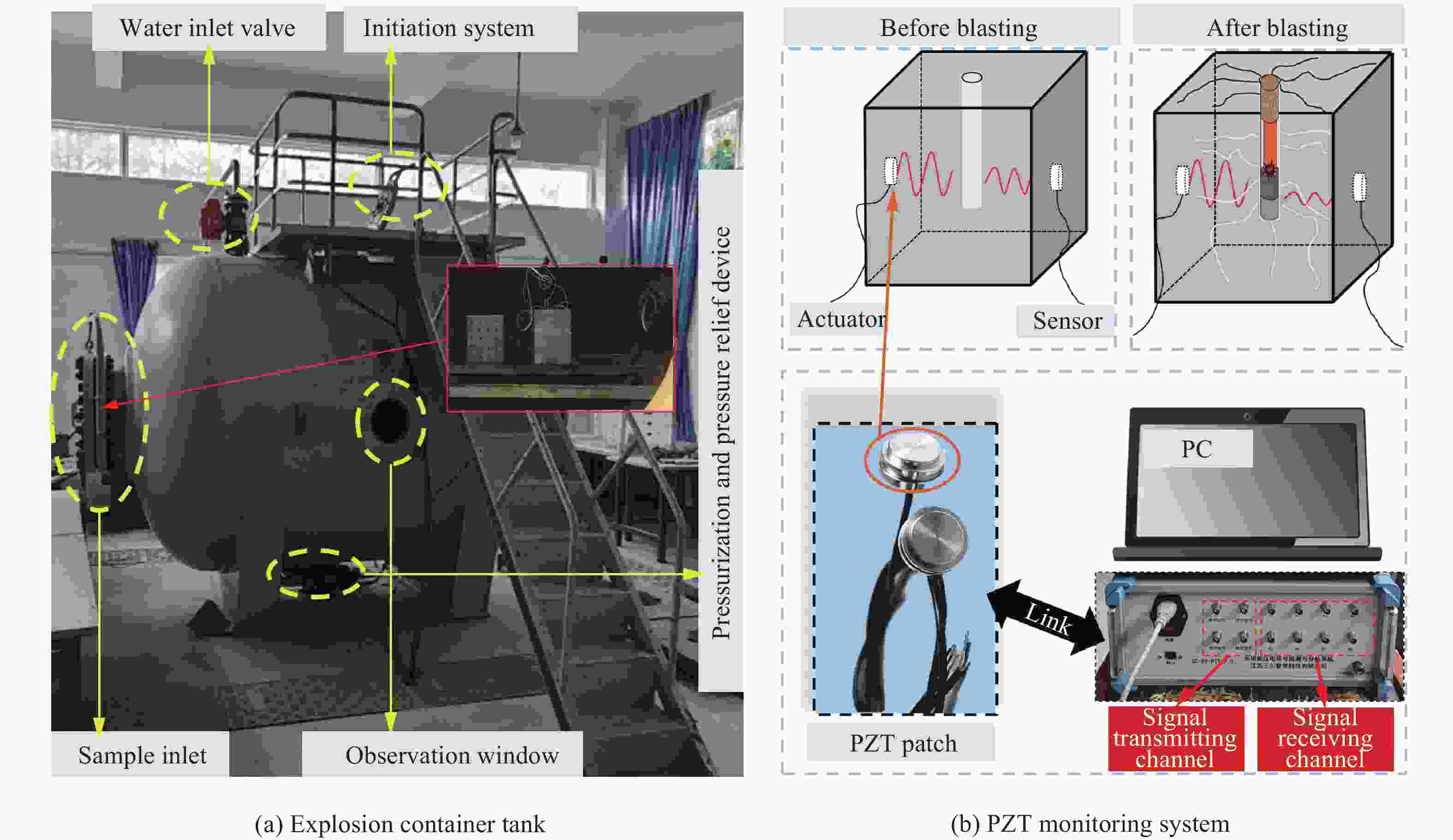
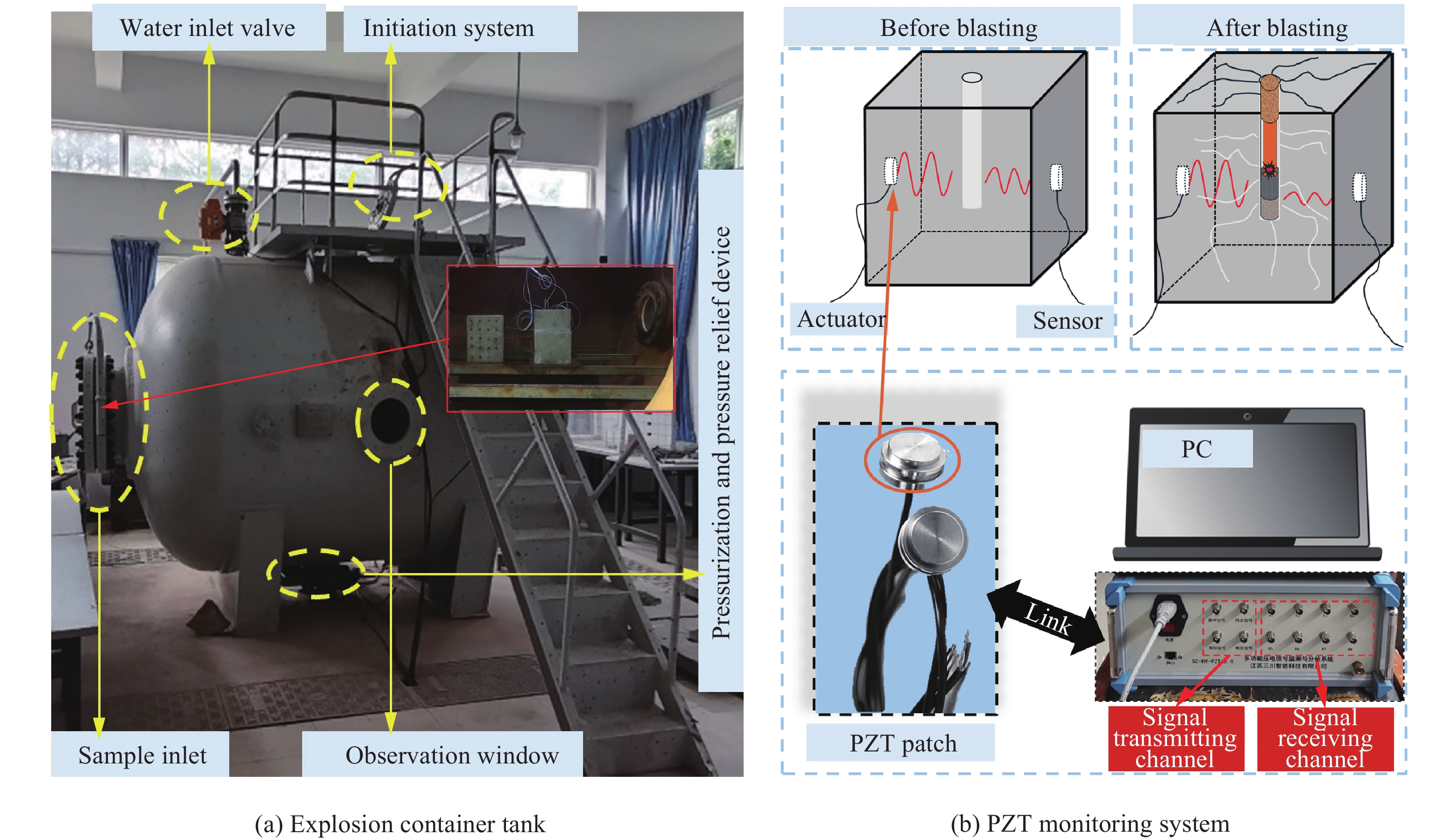
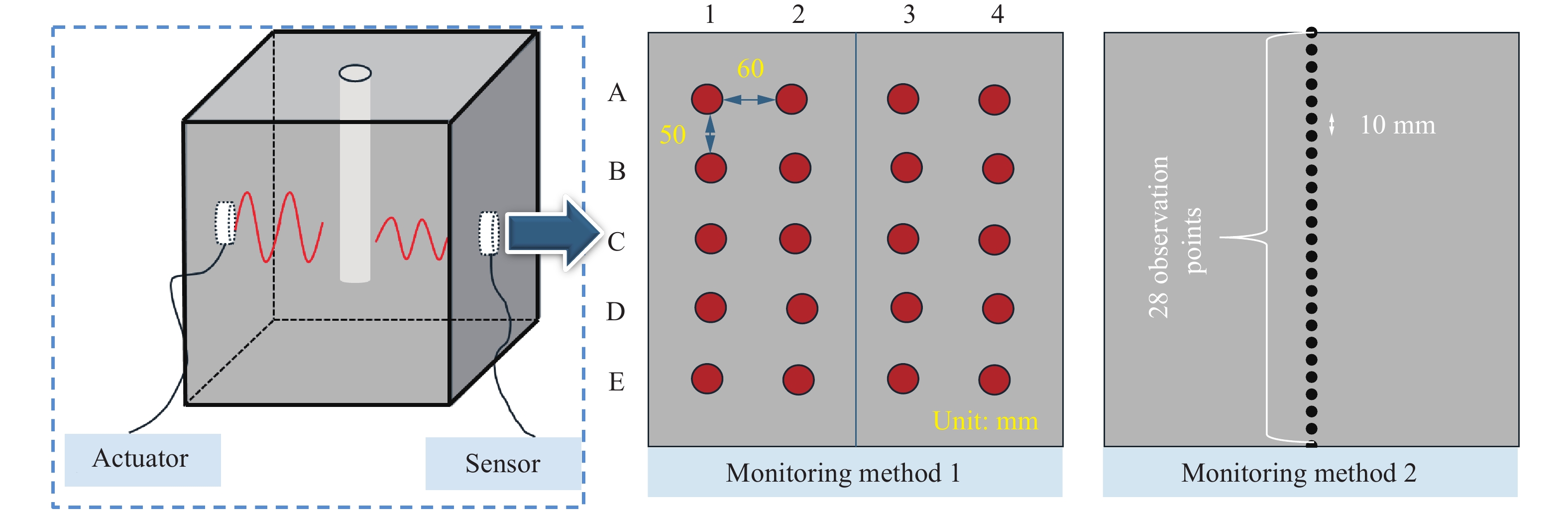
图 5 水下爆炸装置及压电信号监测系统
Figure 5. Underwater explosion device and piezoelectric signal monitoring system
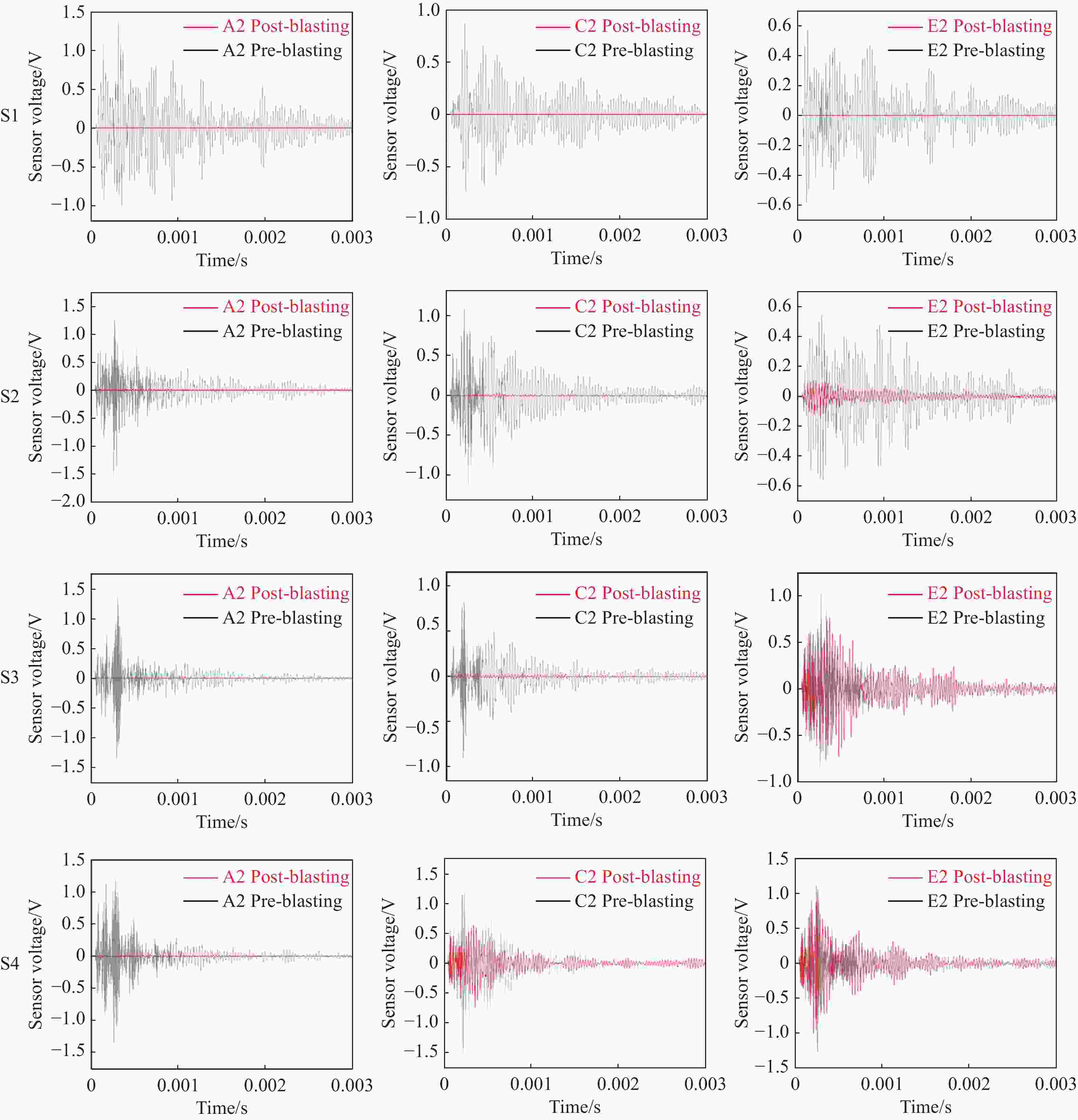
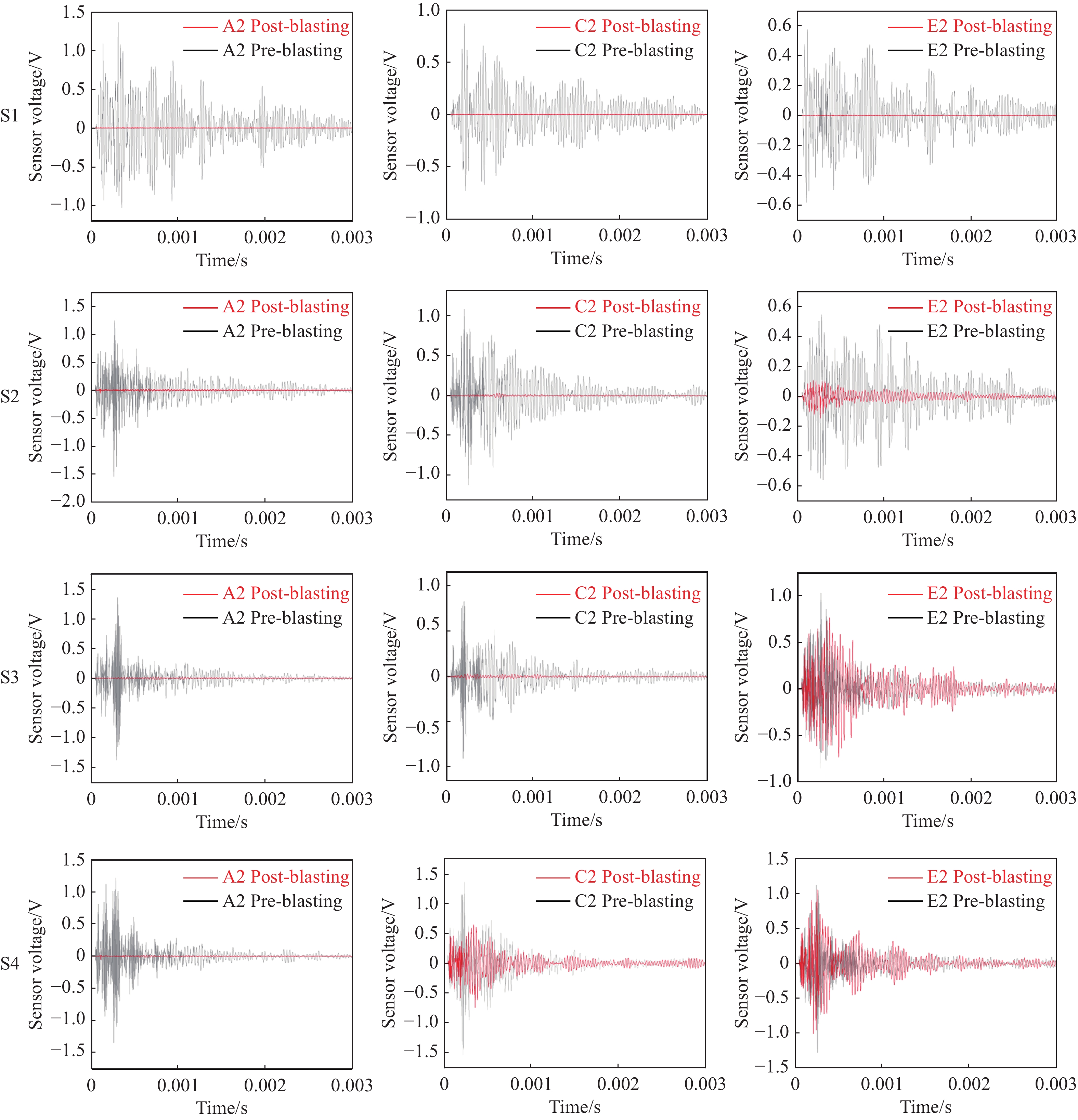
图 8 岩样不同测点爆破前后压电信号
Figure 8. Piezoelectric Signals at Different Measurement Points of the Rock Sample Before and After Blasting
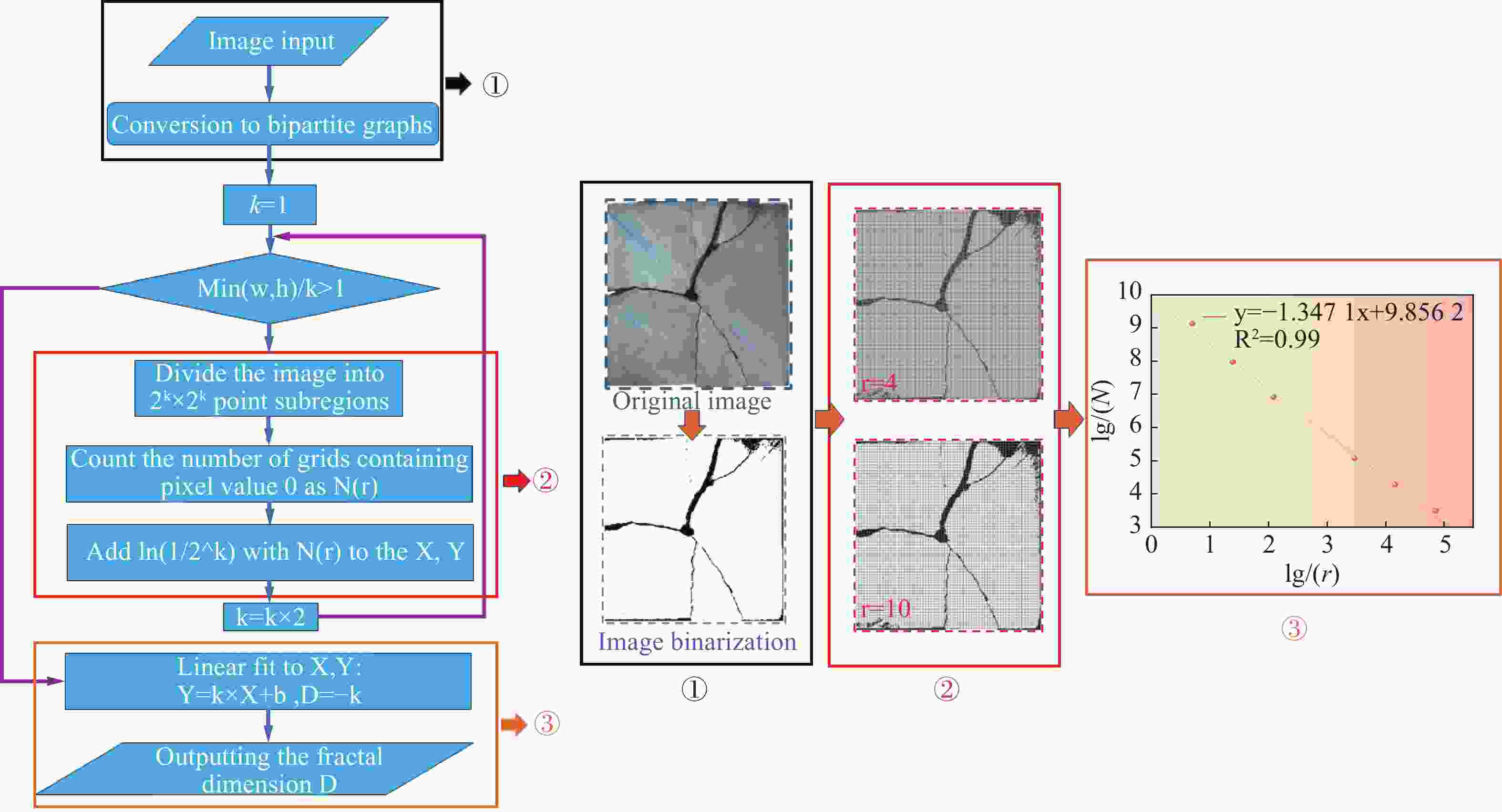
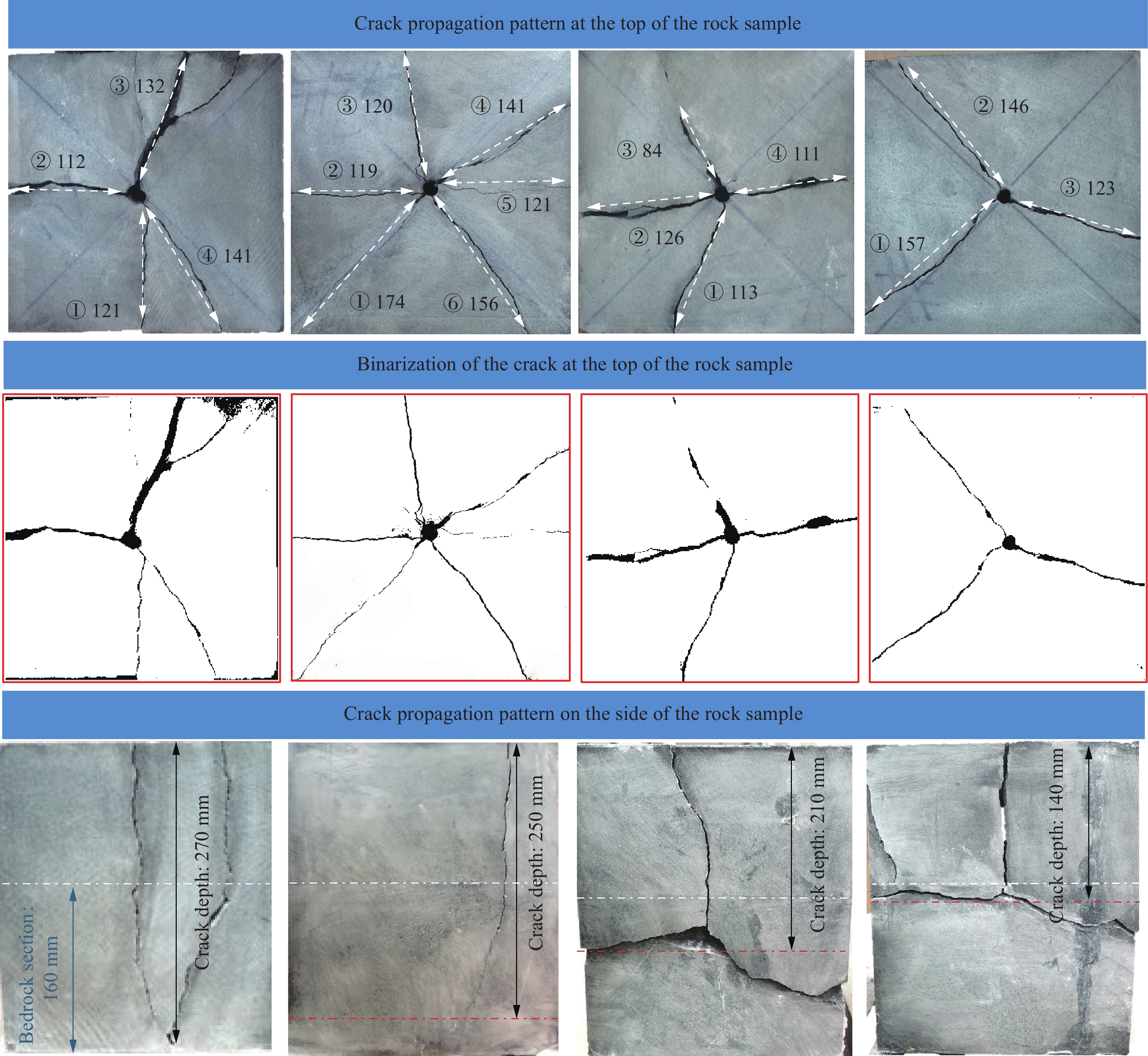
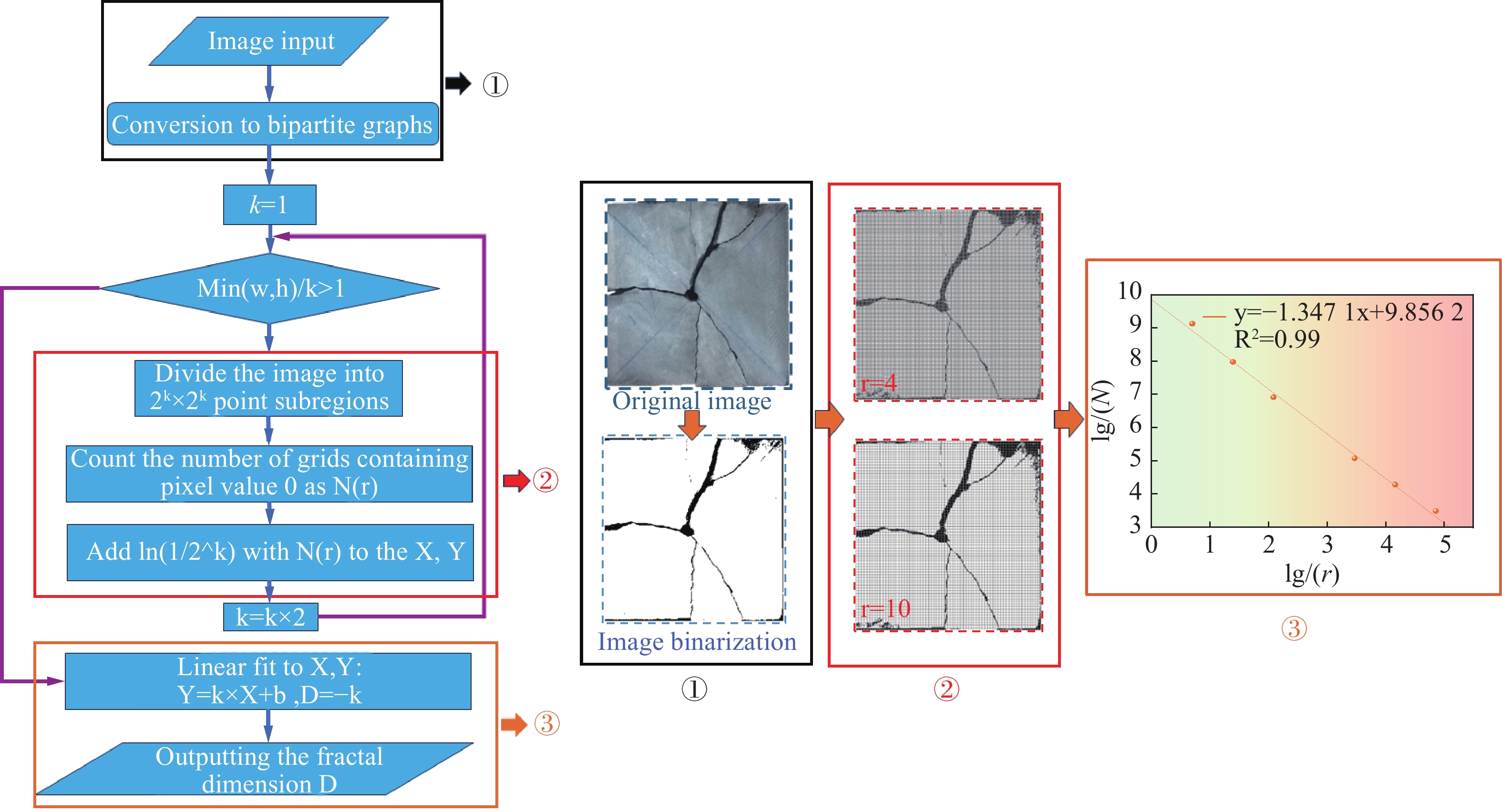
图 10 岩样爆生裂纹分形维数的计算流程
Figure 10. Calculation procedure of fractal dimension for blast-induced cracks in rock samples
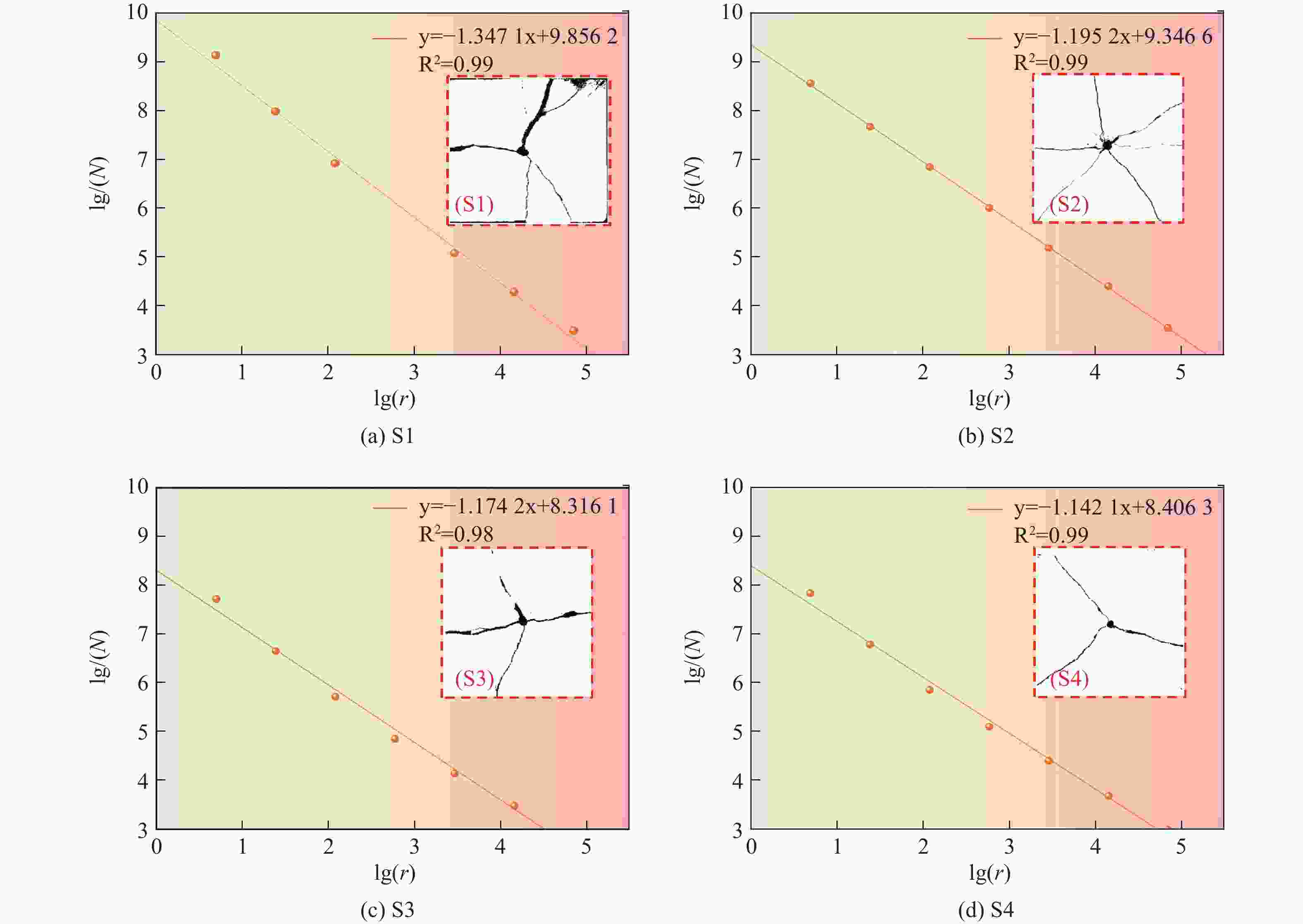
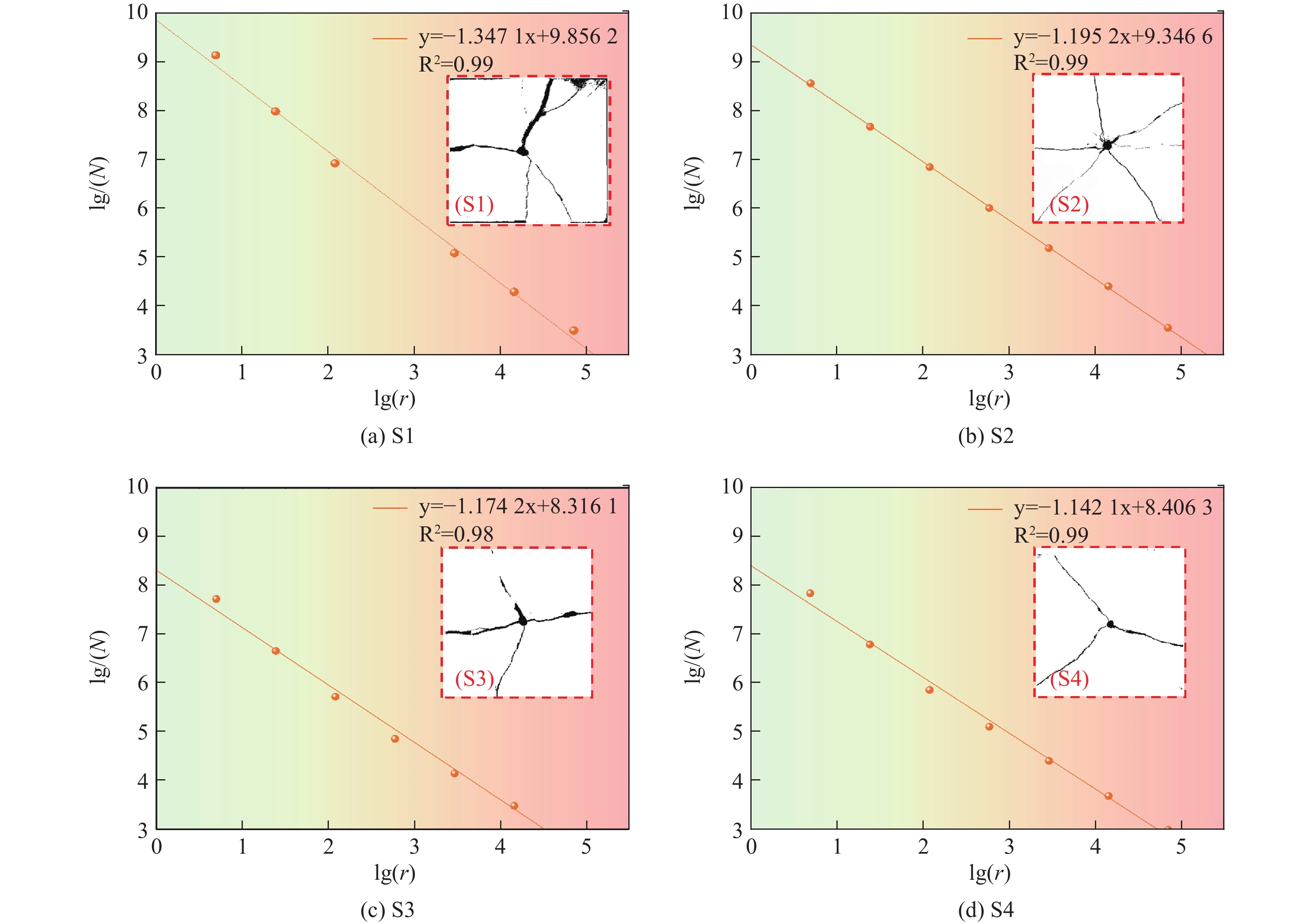
图 11 岩样爆破顶面的爆生裂纹盒维数拟合曲线
Figure 11. Fitting curve of box dimension for blast-induced cracks on the top surface of rock sample after blasting
表 1 模型试验方案
Table 1. Model test plan
试件编号 孔径/mm 孔深/mm 药量/g 铁砂混凝土垫层 细砂垫层 S1 10 120 1 无 无 S2 10 120 1 F1 有 S3 10 120 1 F2 有 S4 10 120 1 F3 有  下载: 导出CSV
表 2 铁砂混凝土配比及物理参数
Table 2. Iron Sand Concrete Mix Proportion and Physical Parameters
编号 配比 物理参数 水泥 水 铁砂 减水剂/% 密度/
(g·cm−3)纵波波速/
(m.s−1)波阻抗/
(g·cm−3·m·s−1)铁砂混凝土到细砂
垫层的透射系数F1 1 0.43 1.4(0.1~0.5 mm) 1 2.1 3 774 7 925.4 0.6979 F2 1 0.32 2.0(0.5~1.0 mm) 1 2.6 4 082 10 613.2 0.5720 F3 1 0.26 2.6(1.0~2.5 mm) 1 3.2 4 651 14 883.2 0.4441
下载: 导出CSV
-
[1] JIANG N, LYU G P, WU T, et al. Vibration effect and ocean environmental impact of blasting excavation in a subsea tunnel [J]. Tunnelling and Underground Space Technology, 2023, 131: 104855. DOI: 10.1016/j.tust.2022.104855. [2] 杨洋, 卢文波, 王洋, 等. 水下钻孔爆破激发水中冲击波的机制研究 [J]. 振动与冲击, 2025, 44(12): 269–278. DOI: 10.13465/j.cnki.jvs.2025.12.028.YANG Y, LU W B, WANG Y, et al. Research on the mechanism of underwater drilling blasting to excite shock waves in water [J]. Journal of Vibration and Shock, 2025, 44(12): 269–278. DOI: 10.13465/j.cnki.jvs.2025.12.028. [3] 马晨阳, 吴立, 孙苗. 自由面数量对水下钻孔爆破振动信号能量分布及衰减规律的影响 [J]. 爆炸与冲击, 2022, 42(1): 145-156. DOI: 10.11883/bzycj-2020-0436.MA C Y, WU L, SUN M. Influence of free surface numbers on the energy distribution and attenuation of vibration signals of underwater drilling blasting [J]. Explosion And Shock Waves, 2022, 42(1): 015201. DOI: 10.11883/bzycj-2020-0436. [4] 方厚林, 卢强, 郭权势, 等. 水下爆炸冲击波和气泡行为自由面效应的实验研究 [J]. 爆炸与冲击, 2024, 44(8): 081444. DOI: 10.11883/bzycj-2024-0003.FANG H L, LU Q, GUO Q S, et al. Experimental research on the free surface effect of shock wave and bubble behavior of small yield underwater explosion [J]. Explosion And Shock Waves, 2024, 44(8): 081444. DOI: 10.11883/bzycj-2024-0003. [5] 赵根, 陆少锋, 杨招伟, 等. 水下钻孔爆破技术新发展 [J]. 工程爆破, 2024, 30(5): 102–111. DOI: 10.19931/j.EB.20240141.ZHAO G, LU S F, YANG Z W, et al. New development of underwater drilling and blasting technology [J]. Engineering Blasting., 2024, 30(5): 102–111. DOI: 10.19931/j.EB.20240141. [6] 叶海旺, 唐可, 万涛, 等. 时序控制预裂爆破参数优化及应用 [J]. 爆炸与冲击, 2017, 37(3): 502–509. DOI: 10.11883/1001-1455(2017)03-0502-08.YE H W, TANG K, WAN T, et al. Optimization of time sequence controlled pre-splitting blasting parameters and its application [J]. Explosion And Shock Waves, 2017, 37(3): 502–509. DOI: 10.11883/1001-1455(2017)03-0502-08. [7] 许国庆, 黄高翔, 王协康, 等. 新型弧形聚能爆破作用下的岩石破裂演化机制研究 [J]. 岩土力学, 2025, 46(10): 3267–3279. DOI: 10.16285/j.rsm.2024.00573.XU G Q, HUANG G X, WANG X K, et al. Rock cracking and evolution mechanism under the action of new type of arc-shaped charge blasting [J]. Rock and Soil Mechanics, 2025, 46(10): 3267–3279. DOI: 10.16285/j.rsm.2024.00573. [8] 傅师贵, 刘泽功, 邱进伟, 等. 深部隧道切缝装药爆破岩体损伤演化及致裂特征 [J]. 工程科学学报, 2025, 47(6): 1191–1206. DOI: 10.13374/j.issn2095-9389.2024.07.09.002.FU S G, LIU Z G, QIU J W, et al. Study on the evolution of rock damage and blasting characteristics of deep tunnel splitting and drilling with explosives [J]. Chinese Journal of Engineering, 2025, 47(6): 1191–1206. DOI: 10.13374/j.issn2095-9389.2024.07.09.002. [9] 卢文波, 胡浩然, 严鹏, 等. 垂直孔复合消能爆破技术及其在建基面开挖中的应用 [J]. 岩石力学与工程学报, 2018, 37(S1): 3143–3152. DOI: 10.13722/j.cnki.jrme.2017.1051.LU W B, HU H R, YAN P, et al. Vertical borehole shock-reflection blasting technique and its application in foundation excavation [J]. Chinese Journal of Rock Mechanics and Engineering, 2018, 37(S1): 3143–3152. DOI: 10.13722/j.cnki.jrme.2017.1051. [10] 胡浩然, 卢文波, 席浩, 等. 聚-消能复合垫层保护下的水平建基面开挖方法研究 [J]. 岩石力学与工程学报, 2016, 35(S2): 4129–4138. DOI: 10.13722/j.cnki.jrme.2015.1005.HU H R, LU W B, XI H, et al. Horizontal foundation surface excavation method under the protection of energy shaped and dissipation composite cushion [J]. Chinese Journal of Rock Mechanics and Engineering, 2016, 35(S2): 4129–4138. DOI: 10.13722/j.cnki.jrme.2015.1005. [11] KAUSHIK A P, HIMANSHU V K, ROY M P, et al. Comprehensive review on principles and practices of underwater drilling and blasting, its environmental impacts, and mitigation techniques [J]. Sādhanā, 2024, 49(1): 21. DOI: 10.1007/s12046-023-02395-7. [12] 万佳伟, 钟冬望, 徐顺香, 等. 水下爆破减振孔对减振效果的影响研究 [J]. 爆破, 2025, 42(2): 158–166,177. DOI: 10.3963/j.issn.1001-487X.2025.02.019.WAN J W, ZHONG D W, XU S X, et al. Study on influence of vibration-reduction holes on blast vibration mitigation in underwater blasting [J]. Blasting, 2025, 42(2): 158–166,177. DOI: 10.3963/j.issn.1001-487X.2025.02.019. [13] 李腾飞, 钟冬望, 司剑峰, 等. 基于复合消能爆破技术的海底基坑开挖数值模拟研究 [J]. 爆破, 2023, 40(1): 139–146. DOI: 10.3963/j.issn.1001-487X.2023.01.019.LI T F, ZHONG D W, SI J F, et al. Numerical simulation research on submarine foundation pit excavation based on energy dissipation blasting technology [J]. Blasting, 2023, 40(1): 139–146. DOI: 10.3963/j.issn.1001-487X.2023.01.019. [14] 王劼耘, 王哲, 许欣, 等. 水下聚能控界爆破方法及机理研究 [J]. 爆破, 2026, 43(1): 178–189. DOI: 10.3963/j.issn.1001-487X.2026.01.020.WANG J Y, WANG Z, XU X, et al. Study on method and mechanism for controlled boundary blasting using underwater shaped charge [J]. Blasting, 2026, 43(1): 178–189. DOI: 10.3963/j.issn.1001-487X.2026.01.020. [15] 胡克琛, 陶好好, 冯庆蔚, 等. 水下减振孔对涉水建(构)筑物爆破振动响应规律 [J]. 工程爆破, 2025, 31(2): 148–156. DOI: 10.19931/j.EB.20240182.HU K C, TAO H H, FENG Q W, et al. The response laws of underwater vibration dampening holes to blasting vibrations of water-related structures [J]. Engineering Blasting, 2025, 31(2): 148–156. DOI: 10.19931/j.EB.20240182. [16] 吴亮, 刘琳, 余创, 等. 抵抗线对水下台阶爆破效果影响的模型试验及其数值分析 [J]. 爆破, 2025, 42(1): 56–62. DOI: 10.3963/j.issn.1001-487X.2025.01.007.WU L, LIU L, YU C, et al. Model test and numerical analysis of resistance line influence on underwater bench blasting [J]. Blasting, 2025, 42(1): 56–62. DOI: 10.3963/j.issn.1001-487X.2025.01.007. [17] WU L, LIANG Z J, CHEN M, et al. Experiments and fluent-engineering discrete element method-based numerical analysis of block motion in underwater rock-plug blasting [J]. Applied Sciences, 2022, 13(1): 348. DOI: 10.3390/APP13010348. [18] LIU X, GU W B, LIU J Q, et al. Investigation of the propagation characteristics of underwater shock waves in underwater drilling blasting [J]. Shock and Vibration, 2018, 2018(1): 9483756. DOI: 10.1155/2018/9483756. [19] FAN Y, MIAO X Z, GAO Q D, et al. Influence of water depth on the range of crushed zones and cracked zones for underwater rock drilling and blasting [J]. International Journal of Geomechanics, 2022, 22(10): 04022164. DOI: 10.1061/(asce)gm.1943-5622.0002485. [20] KUMAR MODI S, MURTHY V M S R. Assessment of blasting impacts in underwater concrete berth demolition and development of a Hybrid Controlled Blasting (HCB) technique-a case study [J]. Structures, 2022, 40: 420–433. DOI: 10.1016/J.ISTRUC.2022.04.036. [21] Liu R T, Liu Y K, Xin D D, et al. Prediction of Water Inflow in Subsea Tunnels under Blasting Vibration [J]. Water, 2018, 10(10): 1336–1336. DOI: 10.3390/w10101336. [22] 杨仁树, 李炜煜, 杨国梁, 等. 炸药类型对富铁矿爆破效果影响的试验研究 [J]. 爆炸与冲击, 2020, 40(6): 065201. DOI: 10.11883/bzycj-2019-0396.YANG R S, LI W Y, YANG G L, et al. Experimental study on the blasting effects of rich-iron ore with different explosives [J]. Explosion and Shock Waves, 2020, 40(6): 065201. DOI: 10.11883/bzycj-2019-0396. [23] DENG J, LI X D, ZHU M C, et al. Debonding damage detection of the CFRP-concrete interface based on piezoelectric ceramics by the electromechanical impedance method [J]. Construction and Building Materials, 2021, 303: 124431. DOI: 10.1016/J.CONBUILDMAT.2021.124431. [24] WANG Y, LI X D, LI J H, et al. Debonding damage detection of the CFRP-concrete interface based on piezoelectric ceramics by the wave-based method [J]. Construction and Building Materials, 2019, 210: 514–524. DOI: 10.1016/j.conbuildmat.2019.03.042. [25] DAI L Z, OU L Z, YI S C, et al. Multi-stage damage identification method for PC structures based on machine learning driven by piezoelectric singular feature [J]. Engineering Failure Analysis, 2024, 165: 108769. DOI: 10.1016/J.ENGFAILANAL.2024.108769. [26] PENG X L, HAO H, LI Z X, et al. Experimental study on subsea pipeline bedding condition assessment using wavelet packet transform [J]. Engineering Structures, 2013, 48: 81–97. DOI: 10.1016/j.engstruct.2012.09.001. [27] 孙威, 阎石, 焦莉, 等. 基于压电波动法的混凝土裂缝损伤监测技术 [J]. 工程力学, 2013, 30(S1): 206–211. DOI: 10.6052/j.issn.1000-4750.2012.04.S058.SUN W, YAN S, JIAO L, et al. Monitoring technology for crack damage of concrete structure based on piezoelectric wave method [J]. Engineering Mechanics, 2013, 30(S1): 206–211. DOI: 10.6052/j.issn.1000-4750.2012.04.S058. [28] 张浩, 李俊杰, 康飞. 基于压电智能骨料的混凝土梁裂缝损伤监测研究 [J]. 振动与冲击, 2021, 40(21): 215–222. DOI: 10.13465/j.cnki.jvs.2021.21.029.ZHANG H, LI J J, KANG F. Crack damage monitoring of concrete beam based on piezoelectric intelligent aggregate [J]. Journal of Vibration and Shock, 2021, 40(21): 215–222. DOI: 10.13465/j.cnki.jvs.2021.21.029. [29] GIURGIUTIU V, REYNOLDS A, ROGERS C A. Experimental investigation of E/M impedance health monitoring for spot-welded structural joints [J]. Journal of Intelligent Material Systems and Structures, 1999, 10(10): 802–812. DOI: 10.1106/N0J5-6UJ2-W1GV-Q8MC. [30] 杨国梁, 毕京九, 董智文, 等. 定向断裂控制爆破下层理页岩的致裂机理 [J]. 爆炸与冲击, 2024, 44(6): 061001. DOI: 10.11883/bzycj-2023-0336.YANG G L, BI J J, DONG Z W, et al. Fracturing mechanism of bedding shale under directional fracture-controlled blasting [J]. Explosion and Shock Waves, 2024, 44(6): 061001. DOI: 10.11883/bzycj-2023-0336. [31] 王雁冰, 李雪, 王兆阳, 等. 围压作用下等离子体的爆破破岩效应 [J]. 爆炸与冲击, 2025, 45(4): 045201. DOI: 10.11883/bzycj-2024-0089.WANG Y B, LI X, WANG Z Y, et al. Rock breaking effect of plasma blasting under confining pressure [J]. Explosion and Shock Waves, 2025, 45(4): 045201. DOI: 10.11883/bzycj-2024-0089. [32] LIU W T, JIA Y S, YUAN F, et al. Dynamic evolution mechanism of cracks in eccentric decoupled charge blasting under high in-situ stress in rock mass [J]. Engineering Failure Analysis, 2025, 180: 109909. DOI: 10.1016/J.ENGFAILANAL.2025.109909. [33] WANG K, CHANG C G. Study on the characteristics of CO2 fracturing rock damage based on fractal theory [J]. Theoretical and Applied Fracture Mechanics, 2024, 134: 104691. DOI: 10.1016/J.TAFMEC.2024.104691. [34] PAN T B, XU X B, ZHENG Y L, et al. Acoustic emission-driven fractal analysis for damage warning in FRP-strengthened corroded RC beams [J]. Engineering Fracture Mechanics, 2025, 328: 111563. DOI: 10.1016/J.ENGFRACMECH.2025.111563. [35] XIAO C L, YANG R S, MA X M, et al. Damage evaluation of rock blasting based on multi-fractal study [J]. International Journal of Impact Engineering, 2024, 188: 104953. DOI: 10.1016/J.IJIMPENG.2024.104953. [36] WAN R Z, ZUO Y J, WU Z H, et al. Study on damage evolution characteristics of the deep roadway surrounding rock with fault based on microseismic monitoring and fractal theory [J]. Alexandria Engineering Journal, 2025, 132: 27–39. DOI: 10.1016/J.AEJ.2025.10.004. -

计量
- 文章访问数: 540
- HTML全文浏览量: 137
- PDF下载量: 248
- 被引次数: 0