


Equivalence study of granite and reinforced concrete targets under penetration based on modified compensation method
-
摘要: 由于侵彻花岗岩试验存在原料获取难度大、费用高的问题,开展了钢筋混凝土(reinforced concrete,RC)与花岗岩靶标的等效性研究。为确定钢筋混凝土与花岗岩靶板之间的等效关系,使用量纲分析与修正补偿法,以剩余速度作为等效前提,获得等效厚度计算方法。依据现有试验研究,使用LS-DYNA软件,结合数值模拟方法,建立弹体中速侵彻靶标的数值模型,以弹体侵彻速度和靶标厚度为变量设计典型工况,数据拟合得到花岗岩靶体与钢筋混凝土靶体的具体等效设计公式。研究表明:建立的数值仿真模型能够较为准确地模拟弹体侵彻花岗岩和钢筋混凝土靶体过程中弹体的剩余速度以及靶体的破坏特征;在弹体侵彻过程中,相较于钢筋混凝土靶体,花岗岩靶体的压实区和隧道区直径更小,裂纹更细、更长、扩展速度更快,靶面上裂纹面积更大,容易形成较大的剥落弹坑;在相同侵彻条件下,花岗岩与等效厚度钢筋混凝土靶体的破坏特征相近,破坏区域均可划分为5个部分;基于量纲分析与补偿修正法获得了弹体在侵彻钢筋混凝土和花岗岩时的无量纲剩余速度函数表达式以及钢筋混凝土和花岗岩靶体的等效厚度公式;拟合得到的花岗岩和钢筋混凝土等效靶厚系数为
1.69966 ,并使用等效靶厚系数对靶厚等效设计公式进行验证,原型靶体与模型靶体弹体剩余速度误差不超过5%。研究结果可为弹体中速侵彻岩石靶板的等效设计提供参考。Abstract: Because of the difficulty in obtaining granite materials and the high cost of conducting penetration tests on granite targets, an equivalence study between reinforced concrete and granite targets was carried out. To establish the equivalence relationship between the two target types, dimensional analysis and a modified compensation method were adopted, with the projectile residual velocity taken as the equivalence criterion, and a computational method for determining equivalent thickness was derived. Based on existing experimental data, numerical models for medium-velocity projectile penetration into reinforced concrete and granite targets were developed and validated using the LS-DYNA software. By varying the projectile impact velocity and target thickness in the numerical simulations, the similarities in damage characteristics between reinforced concrete and granite targets were systematically investigated, and the corresponding failure regions were classified. On the basis of the simulation results, specific equivalent design formulas for granite and reinforced concrete targets were obtained through data fitting. The results show that the established numerical models can accurately predict the projectile residual velocity and reproduce the failure characteristics of both target types during penetration. Compared with reinforced concrete, granite exhibits a smaller compaction zone and tunnel diameter, finer and longer cracks with higher propagation velocities, larger surface crack areas, and a greater tendency to form large spallation craters. Under identical penetration conditions, granite targets and reinforced concrete targets of equivalent thickness display similar failure characteristics, and both can be divided into five distinct failure regions. Through dimensional analysis and compensation correction, a dimensionless residual-velocity function for projectile penetration into reinforced concrete and granite targets was derived, together with an equivalent thickness formula relating the two materials. The fitted equivalent thickness coefficient between granite and reinforced concrete was determined to be 1.69966. Validation of the proposed equivalence formula indicates that the residual-velocity error between the prototype and equivalent model targets is less than 5%. These results provide a useful reference for the equivalent design of rock targets subjected to medium-velocity projectile penetration and offer a systematic methodology for substituting reinforced concrete for granite in related experimental and engineering applications.-
Key words:
- granite /
- RC target /
- projectile penetration /
- material equivalence /
- correction compensation method
-
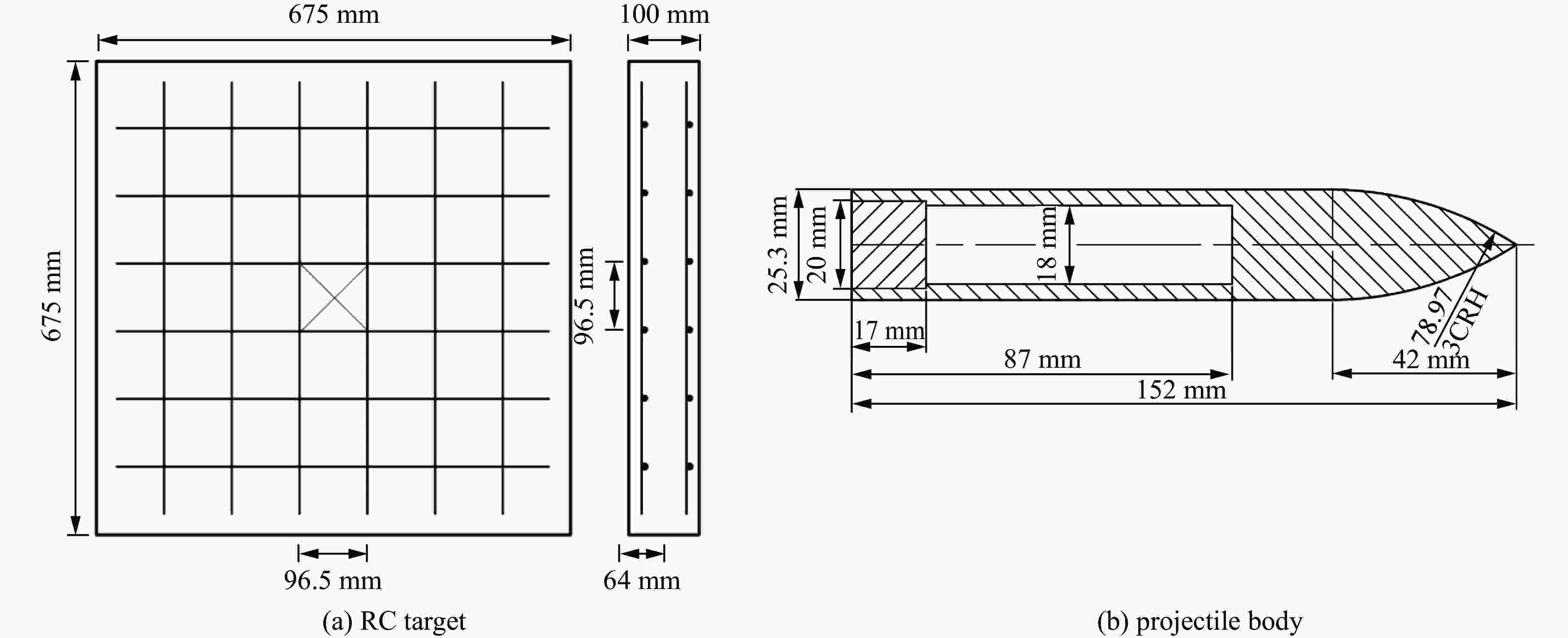
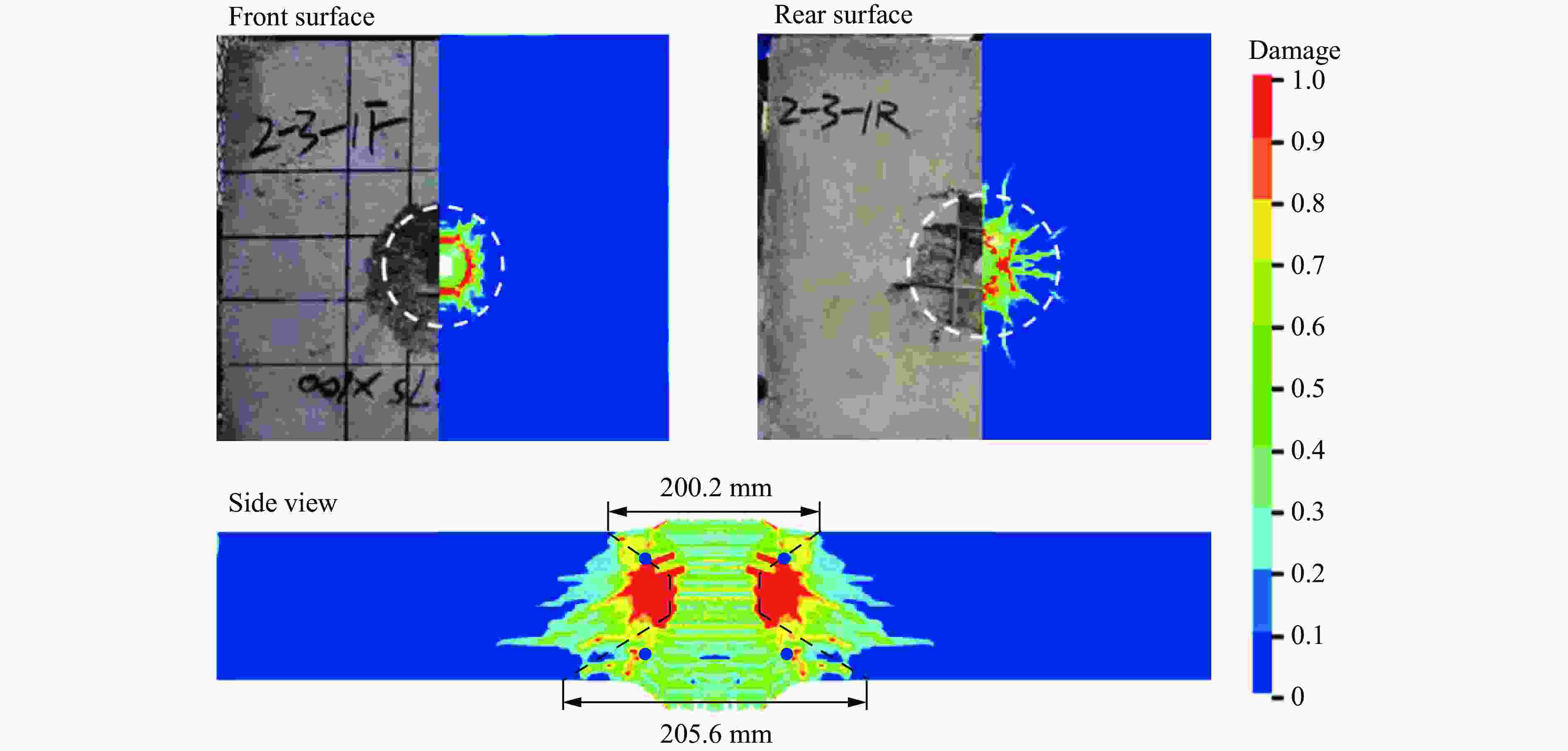
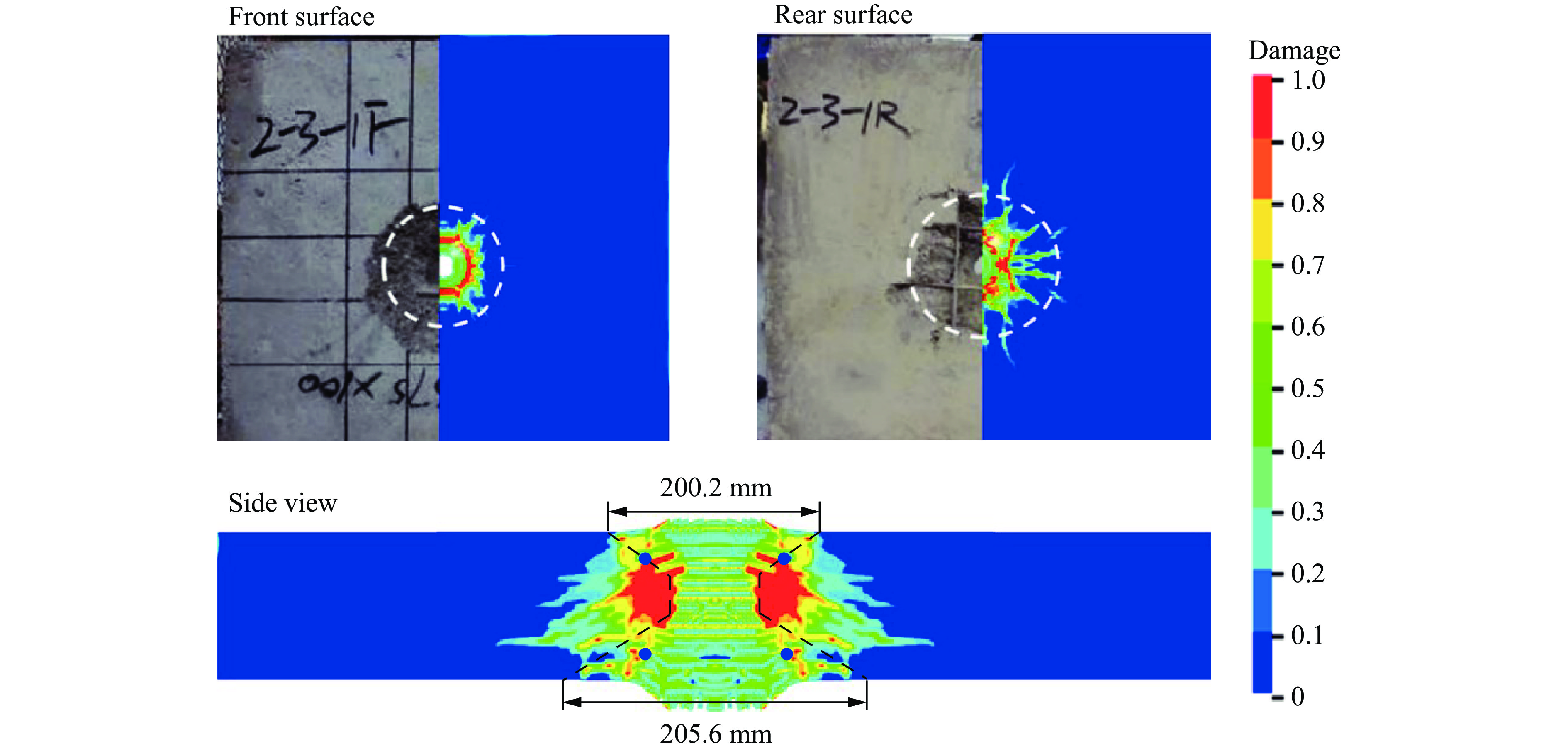
图 3 试验与仿真靶体破坏特征对比
Figure 3. Comparison of damage characteristics of test and simulated targets
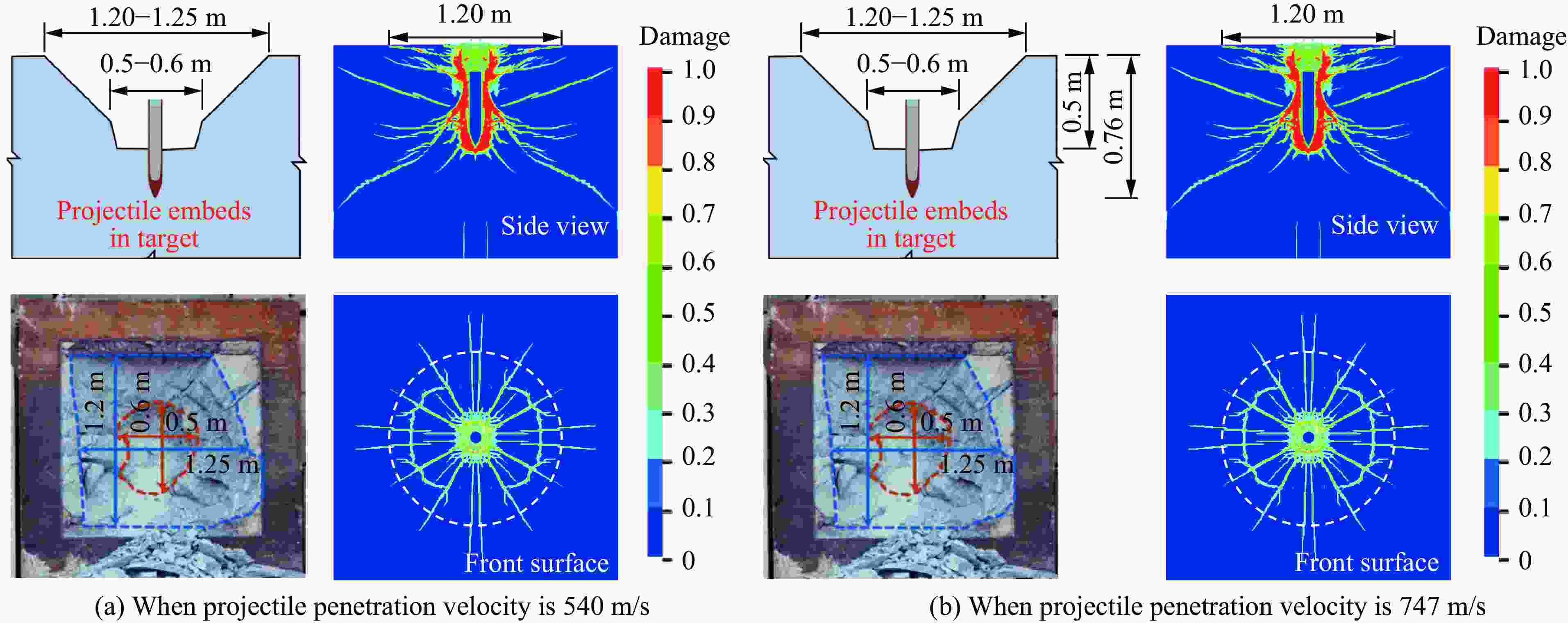
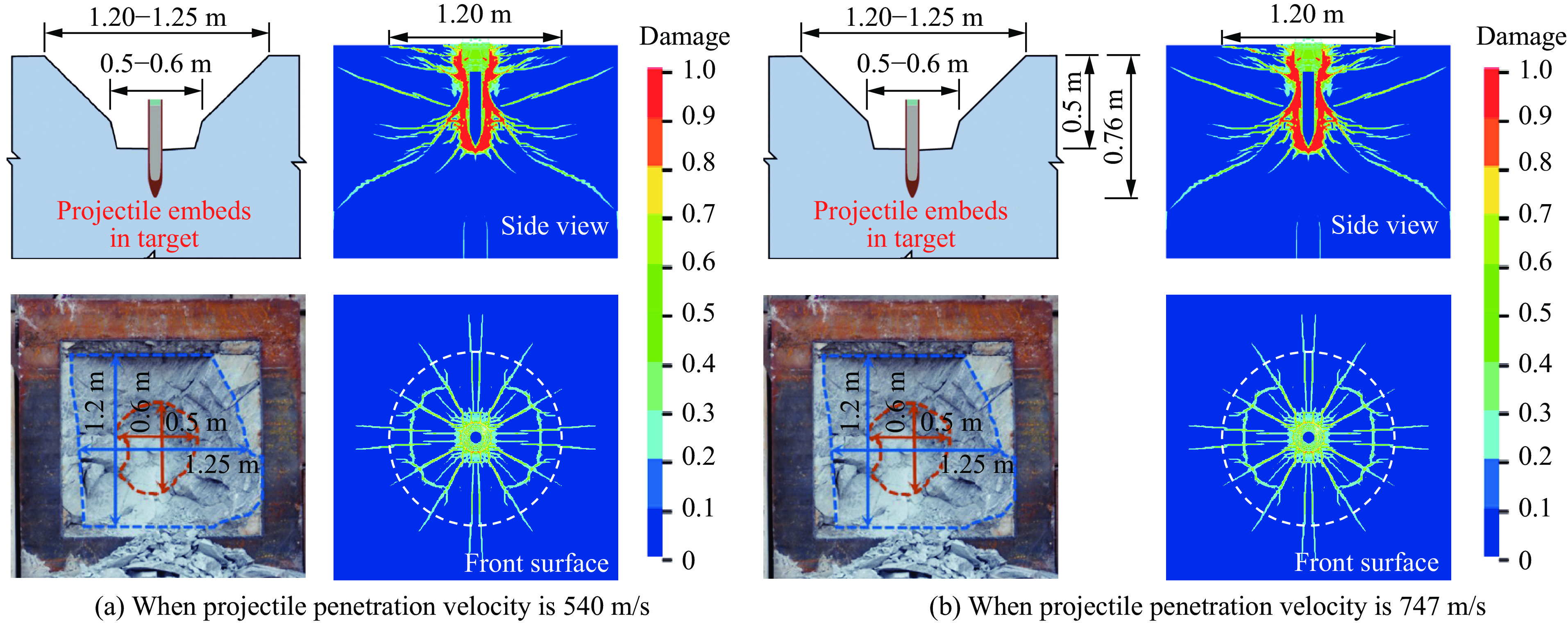
图 5 试验与仿真靶体破坏特征对比
Figure 5. Comparison of damage characteristics of test and simulated targets
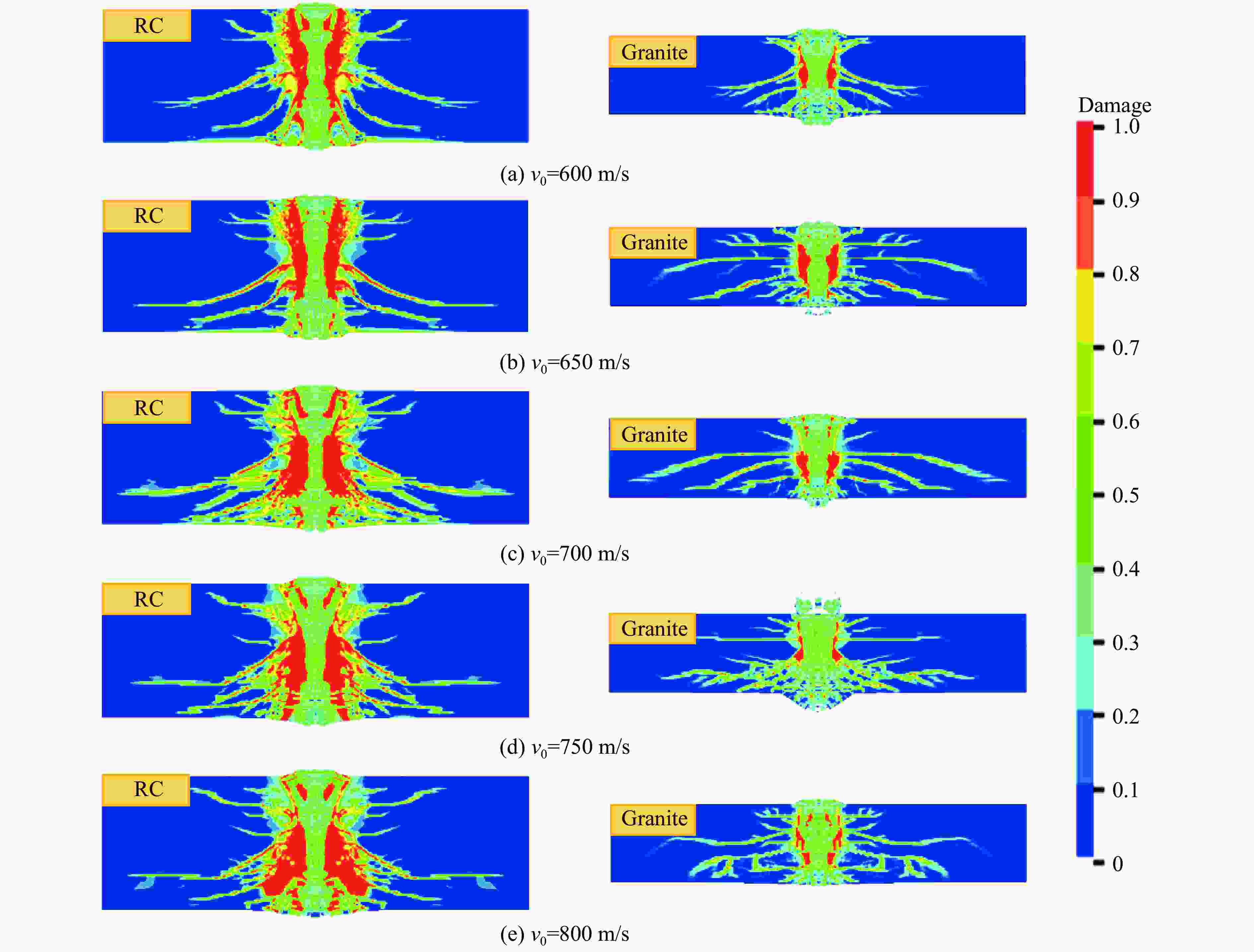
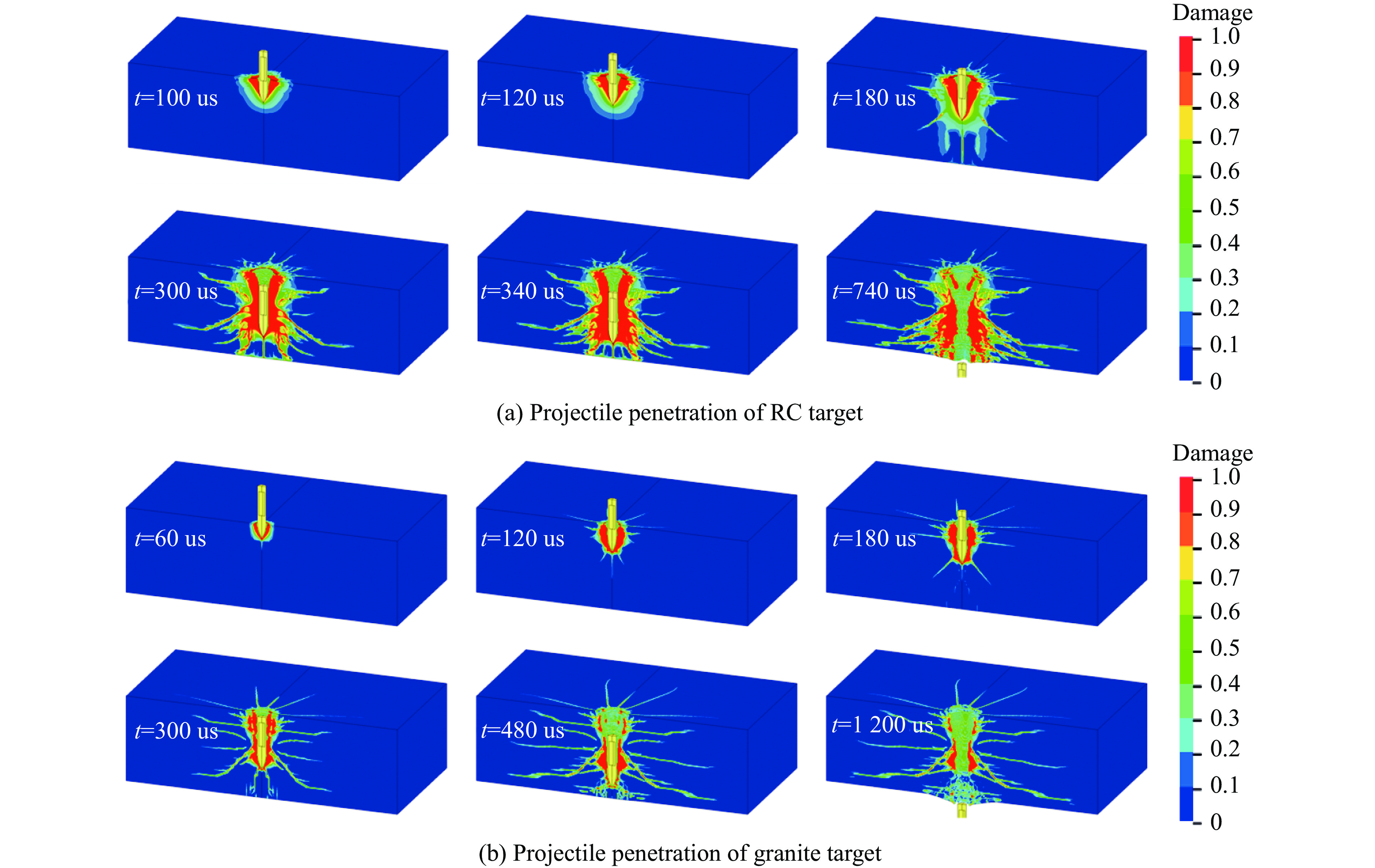
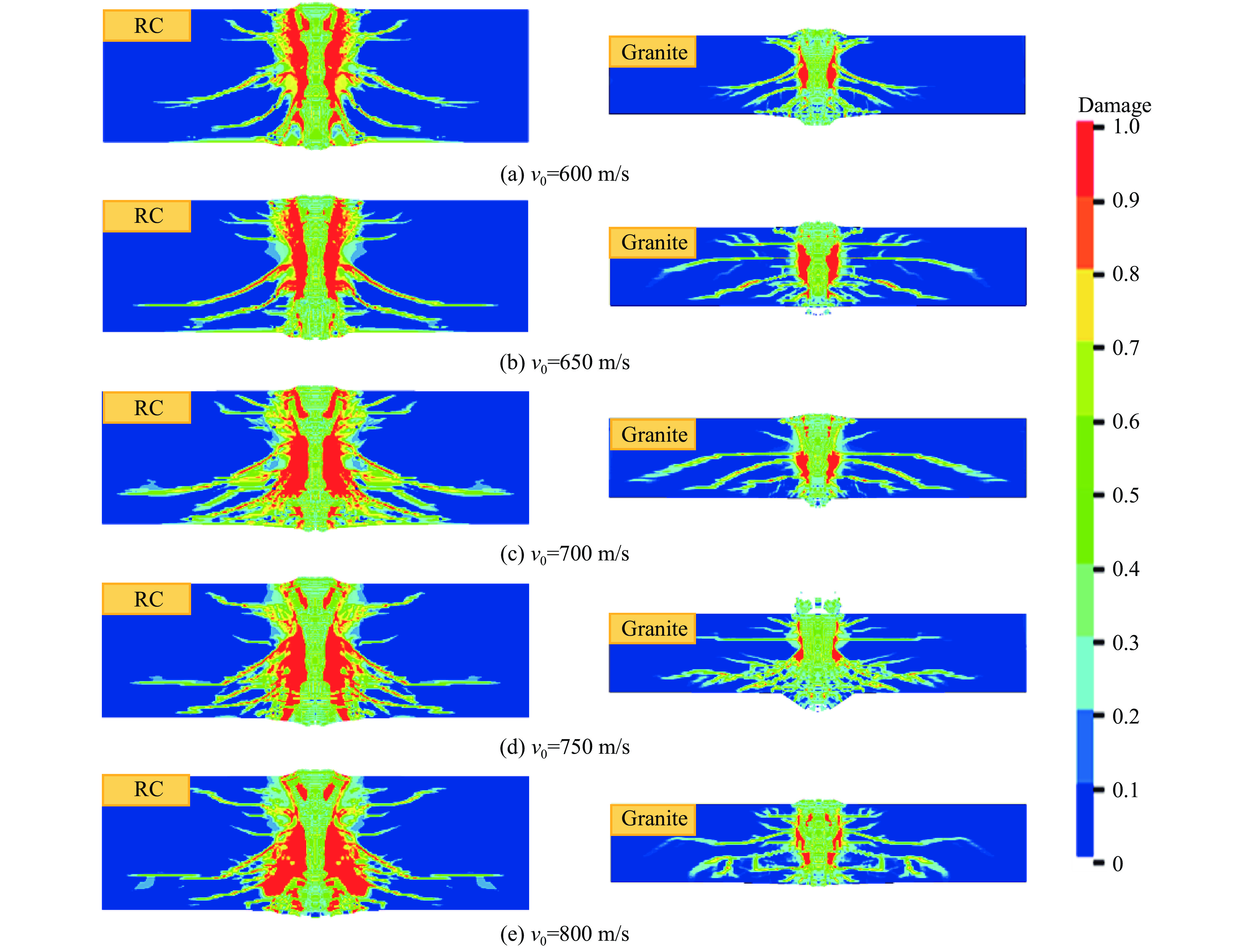
图 7 卵锥形弹体侵彻钢筋混凝土与花岗岩靶体的破坏特征
Figure 7. Damage characteristics of ovoid conical projectiles penetrating reinforced concrete and granite targets
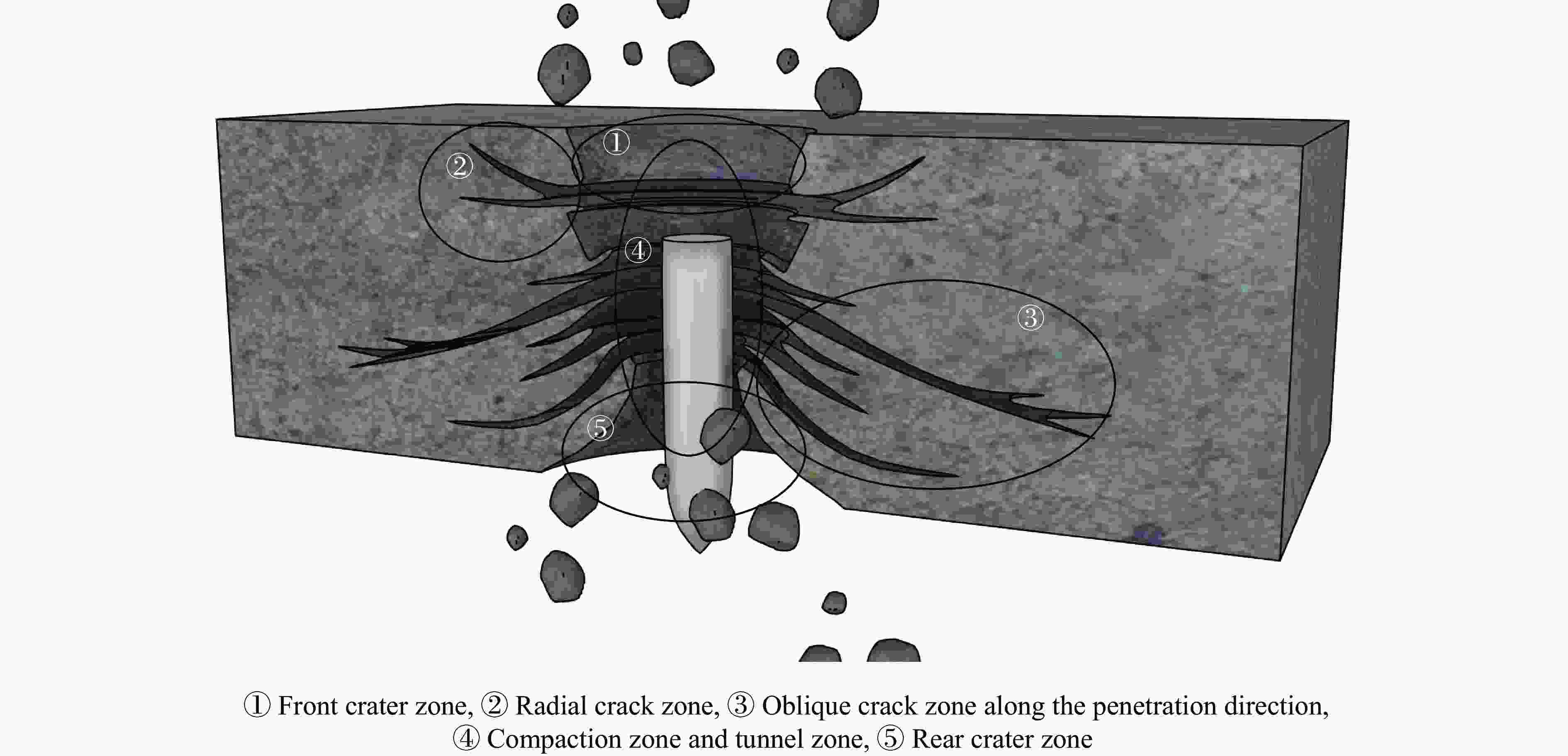
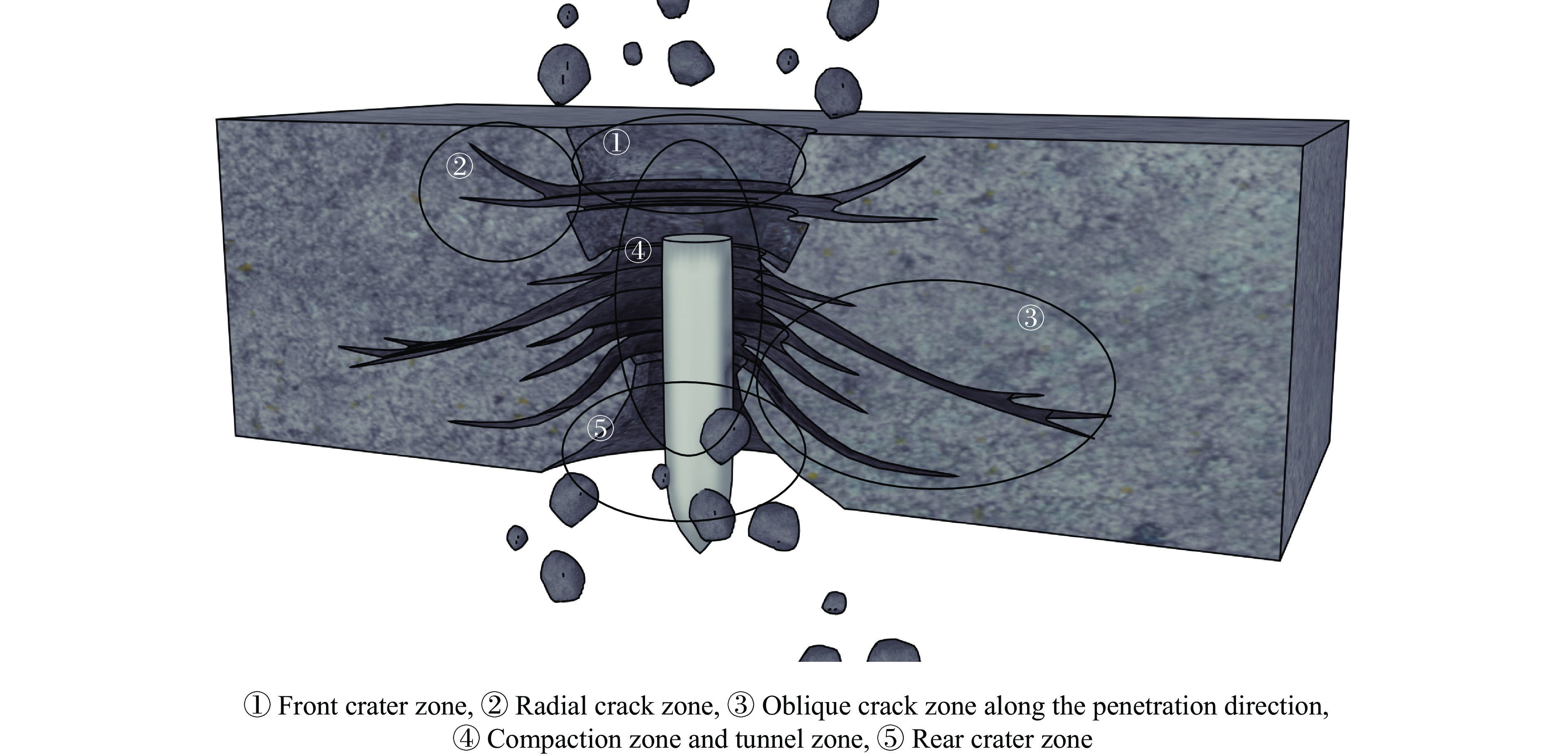
图 8 卵锥形弹体侵彻作用下靶体破坏区域划分示意图
Figure 8. Schematic diagram of the damage area of the target under the penetration effect of the ovoid conical projectile
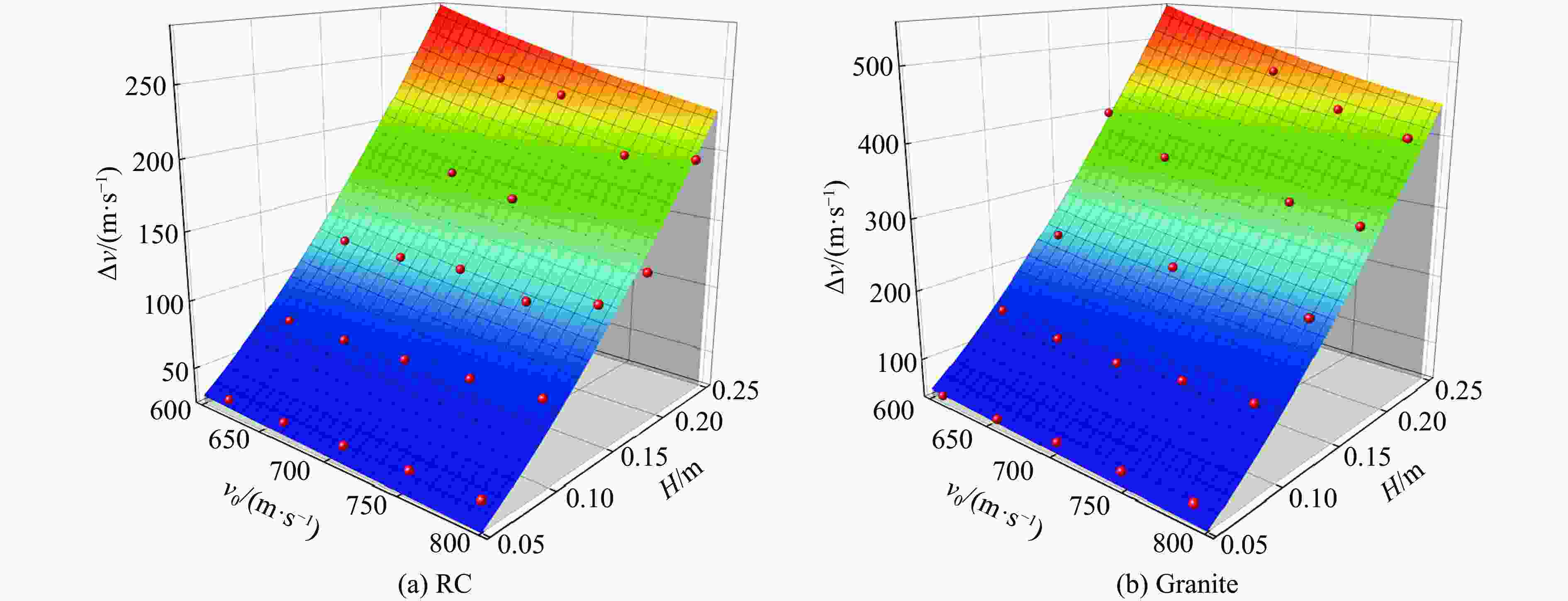
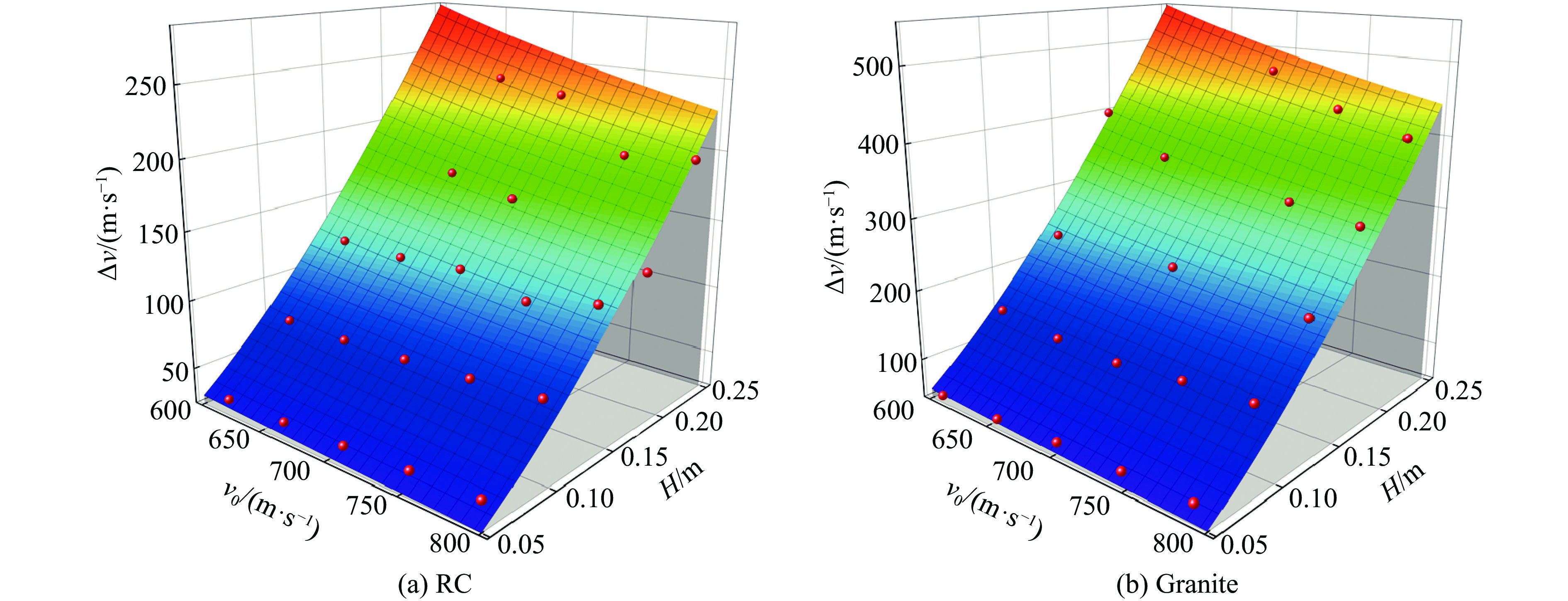
图 9 卵形弹侵彻钢筋混凝土与花岗岩靶板拟合曲面
Figure 9. Oval bullet intrusion into reinforced concrete and granite target plate fitting surface
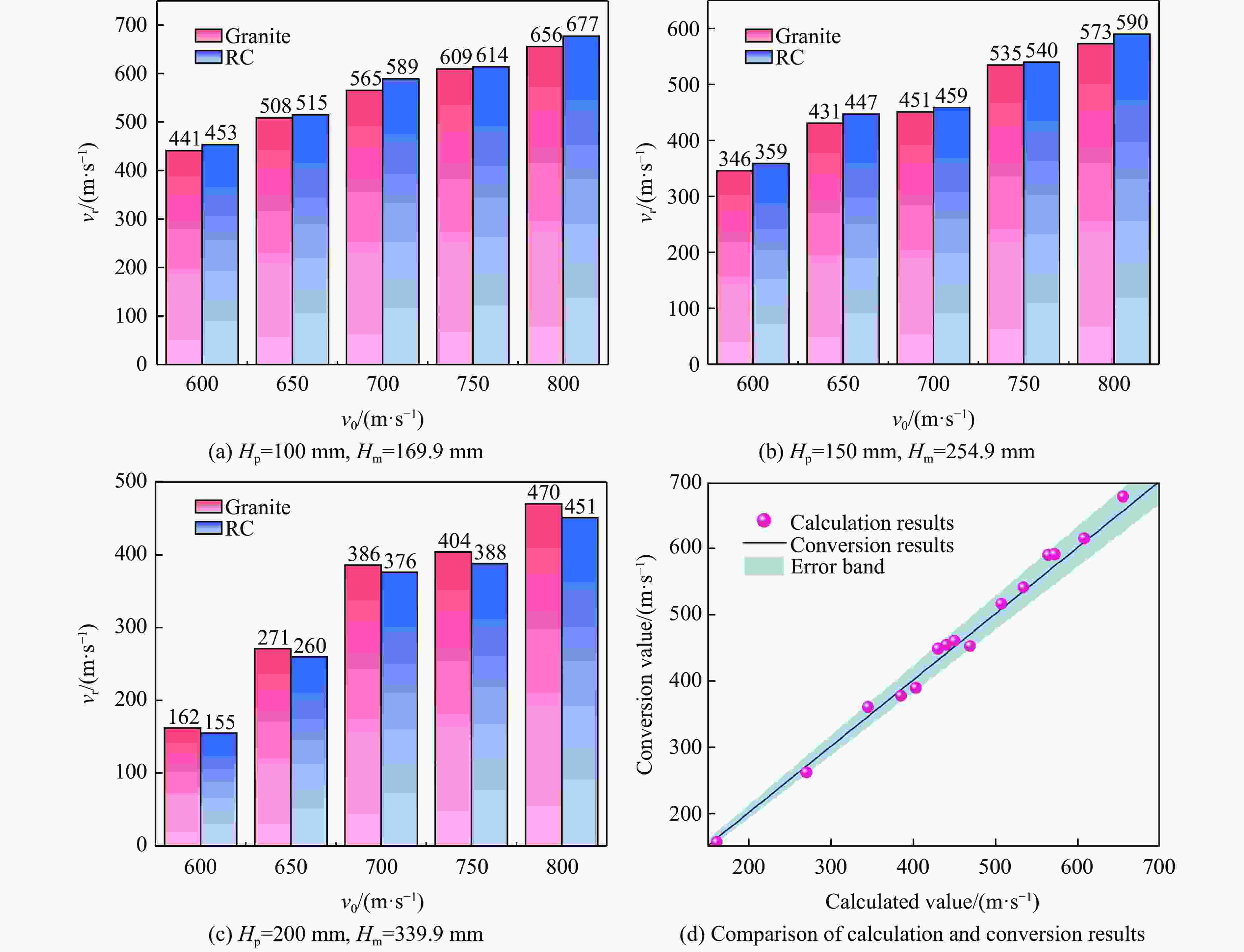
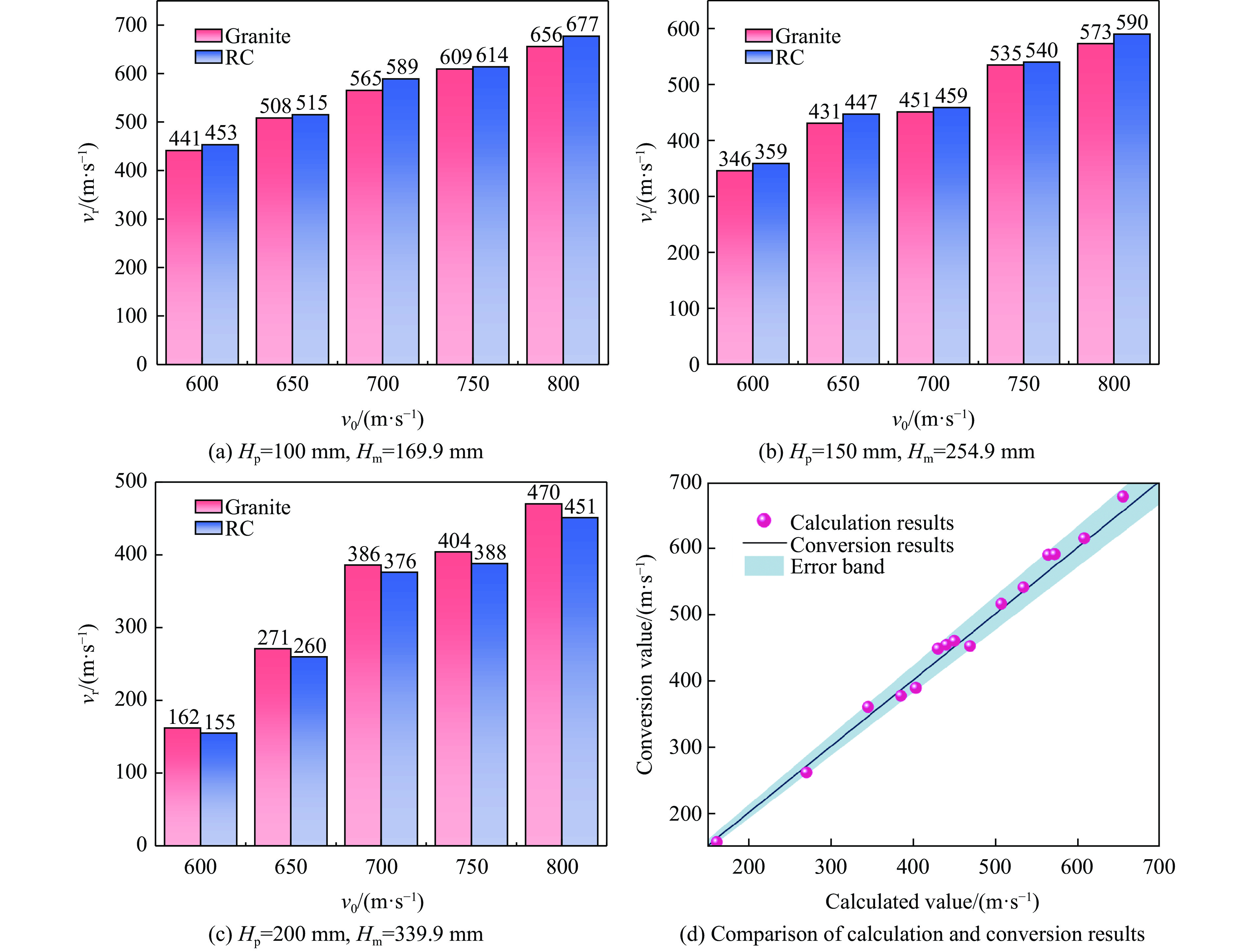
图 10 弹体剩余速度结果对比及误差分布
Figure 10. Comparison of residual velocity results of projectiles and error distribution
表 1 弹体侵彻靶板影响参数
Table 1. Parameters of impact of projectile penetration into the target plate
符号 符号含义 符号 符号含义 D 弹体直径 H 靶体厚度 L 弹体有效长度 ρt 靶体密度 N 弹头形状参数 Ety 靶体弹性模量 Dp 弹体截顶直径 Ett 靶体切线模量 ρp 弹体密度 fc 靶体单轴抗压强度 Epy 弹体弹性模量 μt 靶体材料泊松比 Ept 弹体切线模量 εtf 靶体失效应变 σp 弹体屈服强度 v0 弹体初始速度 σpd 弹体动态屈服强度 α 弹体着角 μp 弹体材料泊松比 β 弹体攻角 εpf 弹体失效应变  下载: 导出CSV
下载: 导出CSV
下载: 导出CSV
ρ/(kg·m−3) v E/GPa γ/GPa β1 7 860 0.3 210 0.4 1 注:E为弹性模量;γ为屈服极限;β1为硬化系数。
下载: 导出CSV
表 4 试验与仿真剩余速度与弹坑直径对比
Table 4. Comparison of experimental and simulated residual velocities and crater diameters
正面弹坑直径 背面弹坑直径 剩余速度 试验/mm 模拟/mm 误差/% 试验/mm 模拟/mm 误差/% 试验/(m·s−1) 模拟/(m·s−1) 误差/% 227.5 200.0 12 227.5 205.6 9.6 544 567.5 4.3
下载: 导出CSV
表 5 试验与仿真侵彻深度与弹坑直径对比
Table 5. Comparison of experimental and simulated penetration depth and crater diameter
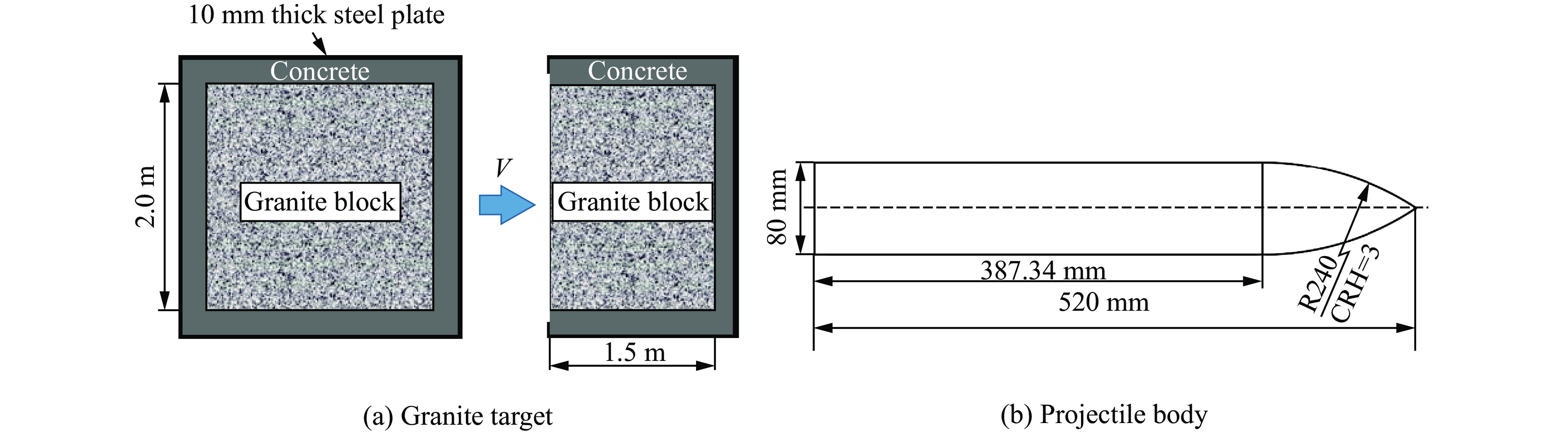
侵彻速度/(m·s−1) 弹坑直径 侵彻深度 试验/mm 模拟/mm 误差/% 试验/mm 模拟/mm 误差/% 540 120 112 6.6 660 540 3.2 747 120~125 120 2.0 760 747 3.7 注:侵彻速度为747 m/s工况下,计算弹坑直径相对误差时,弹坑直径试验结果取平均值,为122.5 mm。
下载: 导出CSV
表 6 卵锥形弹体垂直侵彻RC与花岗岩靶体的结果
Table 6. Results of vertical penetration of RC with granite targets by ovoid conical projectiles
靶体
材料H/mm vr/(m·s−1) v0=600 m/s v0=650 m/s v0=700 m/s v0=750 m/s v0=800 m/s RC 50 572 622 671 719 768 100 525 576 625 673 720 150 472 524 571 633 671 200 421 466 528 598 663 250 343 394 452 544 589 花岗岩 50 543 595 643 696 748 100 441 508 565 609 656 150 346 431 451 535 573 200 162 271 386 404 470 250 − − 184 282 362 注:−表明弹体未能穿透靶体。
下载: 导出CSV
表 7 钢筋混凝土等效材料参数
Table 7. Reinforced concrete equivalent material parameters
fcs/MPa ρ/(kg·m−3) E/GPa v 40 2443.2 40.93 0.203
下载: 导出CSV
表 8 靶厚等效公式验证结果
Table 8. Validation results of the target thickness equivalence equation
初速度/(m·s−1) 花岗岩靶厚/mm 钢筋混凝土靶厚/mm 弹体侵彻花岗岩靶
剩余速度/(m·s−1)弹体侵彻钢筋混凝土靶
剩余速度/(m·s−1)误差/% 600 100 169.9 441 453 2.7 600 150 254.9 346 359 3.7 600 200 339.9 162 155 4.3 650 100 169.9 508 515 1.3 650 150 254.9 431 447 3.7 650 200 339.9 271 260 4.0 700 100 169.9 565 589 4.2 700 150 254.9 451 459 1.5 700 200 339.9 386 376 2.5 750 100 169.9 609 614 0.8 750 150 254.9 535 540 0.9 750 200 339.9 404 388 3.9 800 100 169.9 656 677 3.2 800 150 254.9 573 590 2.9 800 200 339.9 470 451 4.0
下载: 导出CSV
-
[1] 周义. 美军大力发展深钻地武器 [J]. 国防科技, 2001, 22(12): 40–43. DOI: 10.13943/j.issn1671-4547.2001.12.007. [2] 杨秀敏, 邓国强. 常规钻地武器破坏效应的研究现状和发展 [J]. 后勤工程学院学报, 2016, 32(05): 1–9. DOI: 10.13943/j.issn1671-4547.2001.12.007.Yang X M, Deng G Q. The Research Status and Development of Damage Effect of Conventional Earth Penetration Weapon [J]. Journal of Logistical Engineering University, 2016, 32(05): 1–9. DOI: 10.13943/j.issn1671-4547.2001.12.007. [3] GILSON L, RABET L, IMAD A, et al. Experimental and numerical assessment of non-penetrating impacts on a composite protection and ballistic gelatine [J]. International Journal of Impact Engineering, 2020, 136: 103417. DOI: 10.1016/j.ijimpeng.2019.103417. [4] 唐曾智, 郭东, 侯晓峰, 等. 超高强堆石混凝土抗侵彻性能研究 [J]. 防护工程, 2024, 46(04): 9–12. DOI: 10.3969/j.issn.1674-1854.2024.04.003.Tang Z Z, Guo D, Hou X F, et al. Research on penetration resistance of ultra-high strength rock-filled concrete [J]. Protective Engineering, 2024, 46(04): 9–12. DOI: 10.3969/j.issn.1674-1854.2024.04.003. [5] 黄成龙, 陈叶青, 李述涛, 等. 弹着点对钢筋混凝土侵彻深度的影响 [J]. 应用数学和力学, 2023, 44(9): 1097–1111. DOI: 10.21656/1000-0887.440016.Huang C L, Chen Y Q, Li S T, et al. Influences of Impact Points on the Penetration Depth of Reinforced Concrete [J]. Applied Mathematics and Mechanics, 2023, 44(9): 1097–1111. DOI: 10.21656/1000-0887.440016. [6] WARREN T L, HANCHAK S J, POORMON K L. Penetration of limestone targets by ogive-nosed VAR 4340 steel projectiles at oblique angles: Experiments and simulations [J]. International Journal of Impact Engineering, 2004, 30(10): 1307–1331. DOI: 10.1016/j.ijimpeng.2003.09.047. [7] 宋小东, 汪维, 杨建超, 等. 卵形弹中低速侵彻UR50超早强混凝土靶机理 [J]. 振动与冲击, 2023, 42(06): 8–15. DOI: 10.13465/j.cnki.jvs.2023.06.002.SONG X D, WANG W, YANG J C, et al. Mechanism of ogive-nose projectiles penetrating a UR50 ultra-early-strength concrete target at middle and low speed [J]. Journal of Vibration and Shock, 2023, 42(06): 8–15. DOI: 10.13465/j.cnki.jvs.2023.06.002. [8] WANG W, SONG X, YANG J, et al. Experimental and numerical research on the effect of ogive-nose projectile penetrating UR50 ultra-early-strength concrete [J]. Cement and Concrete Composites, 2023, 136: 104902. DOI: 10.1016/j.cemconcomp.2022.104902. [9] 刘兵, 郭瑞奇, 康雨嫣, 等. 刚性弹体侵彻混凝土和花岗岩数值模拟研究 [J]. 湘潭大学学报(自然科学版), 2024, 46(04): 28–39. DOI: 10.1016/j.cemconcomp.2022.104902.Liu B, Guo R Q, Kang Y Y, et al. Numerical simulation of rigid projectile penetrating concrete and granite [J]. Journal of Xiangtan University(Natural Science Edition), 2024, 46(04): 28–39. DOI: 10.1016/j.cemconcomp.2022.104902. [10] ME-BAR Y. A method for scaling ballistic penetration phenomena [J]. International Journal of Impact Engineering, 1997, 19(9-10): 821–829. DOI: 10.1016/S0734-743X(97)00020-1. [11] CHAI C G, PI A G, LI Q M, et al. On the friction effects on rigid-body penetration in concrete and aluminium-alloy targets [J]. Defence Technology, 2019, 15(4): 576–581. DOI: 10.1016/j.dt.2019.03.003. [12] 徐天涵, 谢方, 何勇. 刚性弹侵彻缩比试验尺寸效应分析 [J]. 南京理工大学学报, 2024, 48(2): 141–147. DOI: 10.14177/j.cnki.32-1397n.2024.48.02.003.Xu T H, Xie F, He Y. Analysis of size effect for scaled penetration test of rigid projectiles [J]. Journal of Nanjing University of Science and Technology, 2024, 48(2): 141–147. DOI: 10.14177/j.cnki.32-1397n.2024.48.02.003. [13] HUANG M, OU Z-C, TONG Y, et al. Similarity analysis of projectile penetration into concrete [J]. Defence Science Journal, 2018, 68(4): 417. DOI: 10.14429/dsj.68.10595. [14] FENG J, SUN W, LI B. Numerical study of size effect in concrete penetration with LDPM [J]. Defence Technology, 2018, 14(5): 560–569. DOI: 10.1016/j.dt.2018.07.006. [15] 张建伟, 吴子奇, 张丰超, 等. 基于修正补偿模型法的不同材料钢板靶标相似性及等效设计方法 [J]. 兵工学报, 2024, 45(04): 1297–1310. DOI: 10.12382/bgxb.2022.1255.Zhang J W, Wu Z Q, Zhang F C, et al. Study on Similarity and Equivalent Design Method of Steel Plate Targets with Different Materials Based on Modified Compensation Model [J]. Acta Armamentarii, 2024, 45(04): 1297–1310. DOI: 10.12382/bgxb.2022.1255. [16] MAZZARIOL L M, OSHIRO R E, ALVES M. A method to represent impacted structures using scaled models made of different materials [J]. International Journal of Impact Engineering, 2016, 90: 81–94. DOI: 10.1016/j.ijimpeng.2015.11.018. [17] WANG Y, WANG Z, YAO X, et al. Material similarity law of blunt projectiles penetrating scaled steel target plates [J]. International Journal of Impact Engineering, 2023, 178: 104603. DOI: 10.1016/j.ijimpeng.2023.104603. [18] 汪维. 钢筋混凝土构件在爆炸载荷作用下的毁伤效应及评估方法研究[D/OL]. 国防科学技术大学, 2012.Wang W. Study on Damage Effects and Assessments Method of Reinforced Concrete Structural Members under Blast loading [D]. National University of Defence Technology, 2012. [19] 于蓝. 基于后效损伤的陶瓷复合装甲等效靶研究[D/OL]. 北京理工大学, 2018[2025-12-08].Yu L. After effect-Based Research in Equivalent Target of Ceramic Composite Armor [D]. Beijing Institute of Technology, 2018. [20] 何丽灵, 郭虎, 陈小伟, 等. 结构变形对深侵彻弹体偏转的影响 [J]. 爆炸与冲击, 2023, 43(09): 76–90. DOI: 10.11883/bzycj-2023-0068.He L l, Guo H, Chen X W, et al. Influence of structural deformation on the deflection of penetrator into concrete target with deep penetration [J]. Explosion and Shock Waves, 2023, 43(09): 76–90. DOI: 10.11883/bzycj-2023-0068. [21] 何勇, 徐天涵, 张效晗, 等. 钻地弹侵彻深度尺寸效应分析与实用计算公式 [J]. 爆炸与冲击, 2025, 45(04): 93–110. DOI: 10.11883/bzycj-2024-0248.He Y, Xu T H, Zhang X H, et al. Analysis of the size effect on the penetration depth of earth-penetrating projectiles and practical calculating formula [J]. E Explosion and Shock Waves, 2025, 45(04): 93–110. DOI: 10.11883/bzycj-2024-0248. [22] WU H, FANG Q, PENG Y, et al. Hard projectile perforation on the monolithic and segmented RC panels with a rear steel liner [J]. International Journal of Impact Engineering, 2015, 76: 232–250. DOI: 10.1016/j.ijimpeng.2014.10.010. [23] 张山豹, 孔祥振, 方秦, 等. 弹体超高速侵彻石灰岩靶体地冲击的数值模拟研究 [J]. 爆炸与冲击, 2022, 42(1): 71–83. DOI: 10.11883/bzycj-2021-0007.Zhang S B, Kong X Z, Fang Q, et al. Numerical simulation on ground shock waves induced by hypervelocity penetration of a projectile into a limestone target [J]. Explosion and Shock Waves, 2022, 42(1): 71–83. DOI: 10.11883/bzycj-2021-0007. [24] ALI I, LONG X. Penetration resistance of reinforced concrete slab subjected to rigid projectile impact based on finite element and analytical models [J]. Construction and Building Materials, 2025, 473: 140828. DOI: 10.1016/j.conbuildmat.2025.140828. [25] 韩明海, 刘闯, 李鹏程, 等. 弹体高速侵彻花岗岩靶体的结构响应特性 [J]. 爆炸与冲击, 2025, 45(01): 104–124. DOI: 10.11883/bzycj-2024-0145.Han M H, Liu G, Li P C, et al. A study on structural response characteristics of projectile penetrating on granite target [J]. Explosion and Shock Waves, 2025, 45(01): 104–124. DOI: 10.11883/bzycj-2024-0145. [26] ZHANG M, DENG G, DU Y, et al. Development and validation of a dynamic constitutive model for high-strength granite subjected to projectile impact [J]. Computers and Geotechnics, 2024, 173: 106479. DOI: 10.1016/j.compgeo.2024.106479. [27] WANG W, XU Z, LI Y, et al. Experimental and numerical investigation of polyurea reinforced concrete thick slab under contact explosion [J]. Engineering Failure Analysis, 2025, 171: 109349. DOI: 10.1016/j.engfailanal.2025.109349. [28] YAN J, LIU Y, YAN J, et al. Collapse of concrete target subjected to embedded explosion of shelled explosive [J]. Engineering Failure Analysis, 2024, 161: 108298. DOI: 10.1016/j.engfailanal.2024.108298. [29] ABDEL-KADER M. Modified settings of concrete parameters in RHT model for predicting the response of concrete panels to impact [J]. International Journal of Impact Engineering, 2019, 132: 103312. DOI: 10.1016/j.ijimpeng.2019.06.001. [30] ZHANG X, YAO W, WANG X, et al. Experimental and numerical investigation of the damage characteristics of rocks under ballistic penetration [J]. Applied Sciences, 2022, 12(12): 6120. DOI: 10.3390/app12126120. [31] 艾亿谋, 杜成斌, 洪永文, 等. 混凝土坝抗震加固中钢筋混凝土的动力本构模型 [J]. 水利学报, 2009, 40(3): 289–295. DOI: 10.3321/j.issn:0559-9350.2009.03.006.Ai Y M, Du C B, Hong Y W, et al. Dynamic constitutive modelling of reinforced concrete for seismic strengthening of concrete dams [J]. Journal of Hydraulic Engineering, 2009, 40(3): 289–295. DOI: 10.3321/j.issn:0559-9350.2009.03.006. [32] 屈铁军, 徐荣桓, 石云兴. 配筋率对钢筋混凝土构件弹性模量影响的试验研究 [J]. 混凝土, 2014(9): 113–115,119. DOI: 10.3969/j.issn.1002-3550.2014.09.029.Qu T J, Xu R H, Shi Y X. Experimental study on influence of ratio of reinforcement to modulus of elasticity of reinforced concrete component [J]. Concrete, 2014(9): 113–115,119. DOI: 10.3969/j.issn.1002-3550.2014.09.029. -

计量
- 文章访问数: 508
- HTML全文浏览量: 119
- PDF下载量: 217
- 被引次数: 0