


Damage characteristics of concrete arch slabs subject to underwater contact explosion
-
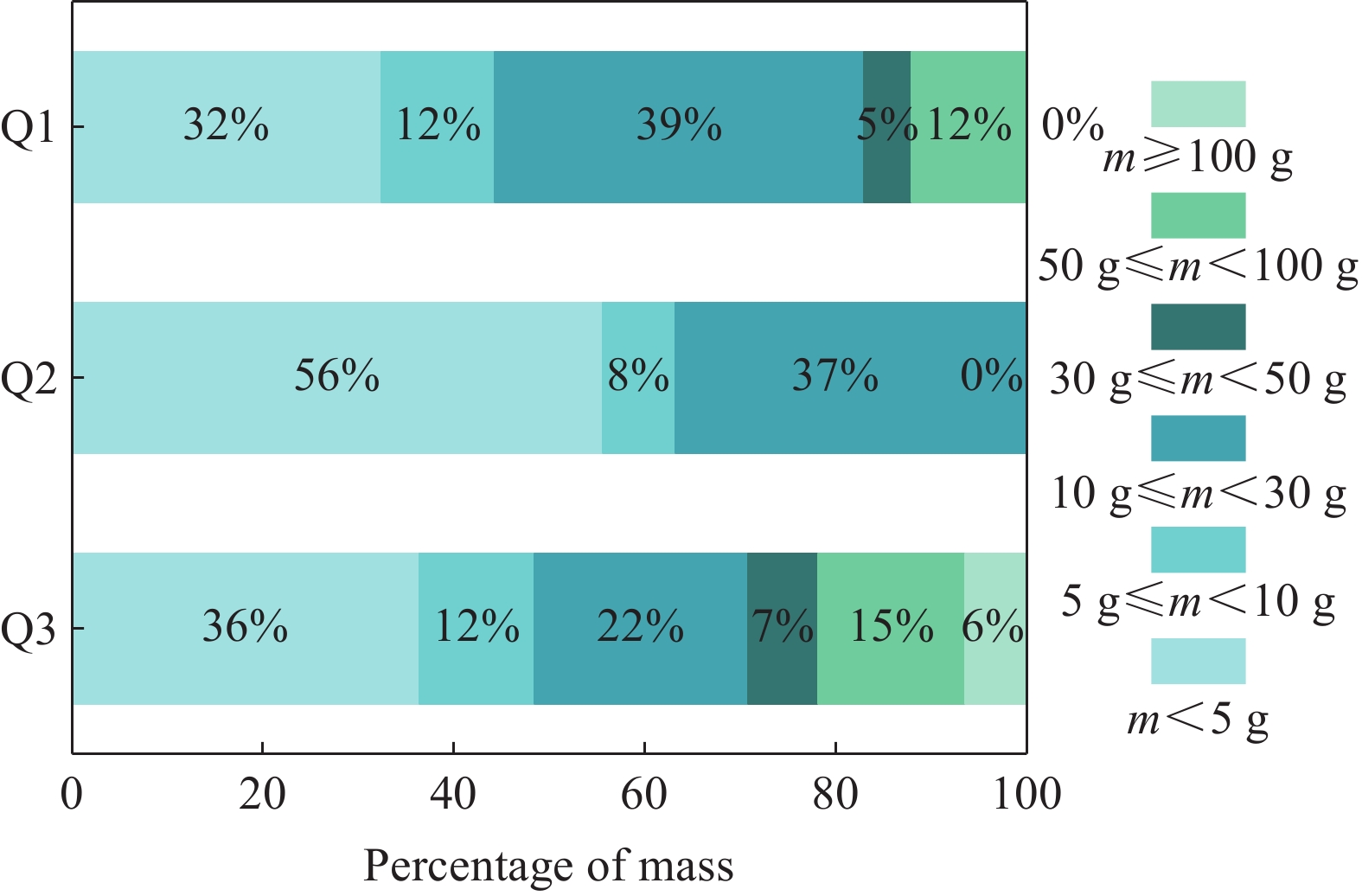
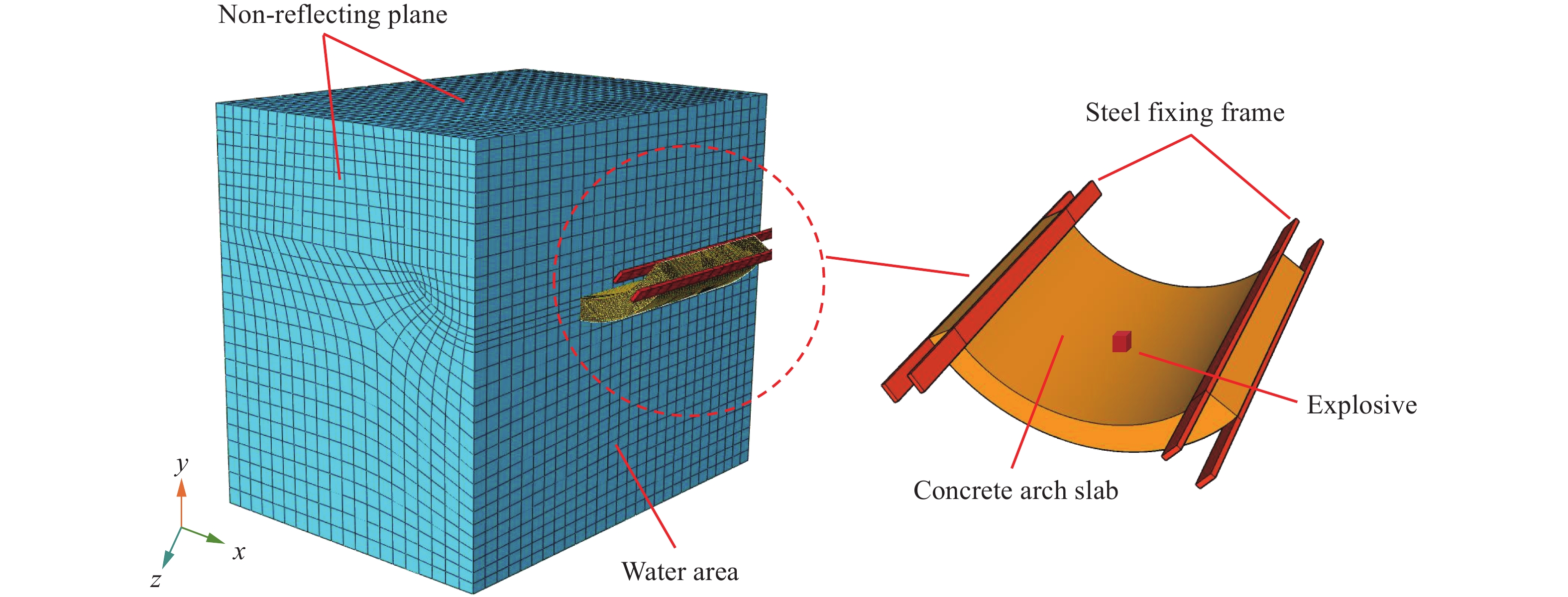
摘要: 为探究水下接触爆炸作用下混凝土拱板的毁伤特性,对三块混凝土拱板开展了水下接触爆炸试验,并对剥落的拱板碎片进行了质量分区统计。基于耦合欧拉-拉格朗日算法(coupled Eulerian-Lagrangian, CEL)建立了“水-混凝土-TNT”三维数值仿真模型,通过与试验结果的对比,验证了模型的可靠性。在此基础上,研究了爆炸荷载下拱板内部应力波的传播过程,阐明了混凝土拱板的损伤机理,并进一步探究了爆炸荷载以及拱板跨度对拱板损伤特性的影响。结果表明:在水下接触爆炸作用下,拱板迎爆面形成由辐射状裂纹和环状裂纹组成的环形破碎带;爆炸荷载增大,拱板剥落碎片增多且趋于细化;拱板跨度增大,结构更易产生大块碎片;随着TNT药量由0.4 g增加至1.6 g,拱板迎爆面形成的环状破碎带由局部区域扩展至贯穿拱板全宽度,拱板的破坏模式由局部损伤演变为整体失效;随着拱板跨度的增大,拱端处的破坏程度减轻,而跨中区域的破坏范围扩大;相较于跨度为400 mm的拱板,跨度为600 mm的拱板总耗散能增加了4.3%。Abstract: To investigate the damage characteristics of concrete arch slabs subjected to underwater contact explosions, a series of underwater contact explosion tests was conducted on three concrete arch slabs. During the experiments, the spalled fragments generated by detonation were carefully collected and quantitatively analyzed using a mass-based partitioning statistical method, thereby enabling systematic characterization of the slabs’ fragmentation and spalling behavior. On this basis, a three-dimensional fluid–structure interaction numerical model was developed using the Coupled Eulerian-Lagrangian (CEL) method, which incorporates water, a concrete arch slab, and TNT. The reliability and effectiveness of the numerical model were validated by comparing the simulated macroscopic failure patterns and crack propagation paths with the experimental observations. Further analyses were conducted using the validated model to investigate the damage evolution process and the characteristics of stress wave propagation within the arch slabs under explosive loading, thereby systematically elucidating the damage mechanisms of concrete arch slabs subjected to underwater contact explosions. In addition, parametric studies were performed to examine the effects of explosive charge and span length on the damage characteristics of the arch slabs. The results indicate that, under underwater contact explosion, an annular damage zone composed of radial and circumferential cracks forms on the blast-facing surface of the arch slab. With increasing explosive charge, the number of spalled fragments increases, and their size becomes progressively finer. As the span length increases, the structure tends to generate larger fragments. When the TNT charge increases from 0.4 g to 1.6 g, the annular damage zone on the blast-facing surface expands from a localized region to the full width of the slab, and the failure mode transitions from localized damage to global failure. With increasing span length, the degree of damage at the arch ends decreases, while the damaged region near the mid-span expands. Compared with the slab with a span of 400 mm, the total energy dissipation of the slab with a span of 600 mm increases by 4.3%.
-
Key words:
- underwater explosion /
- concrete arch slab /
- destructive characteristics
-
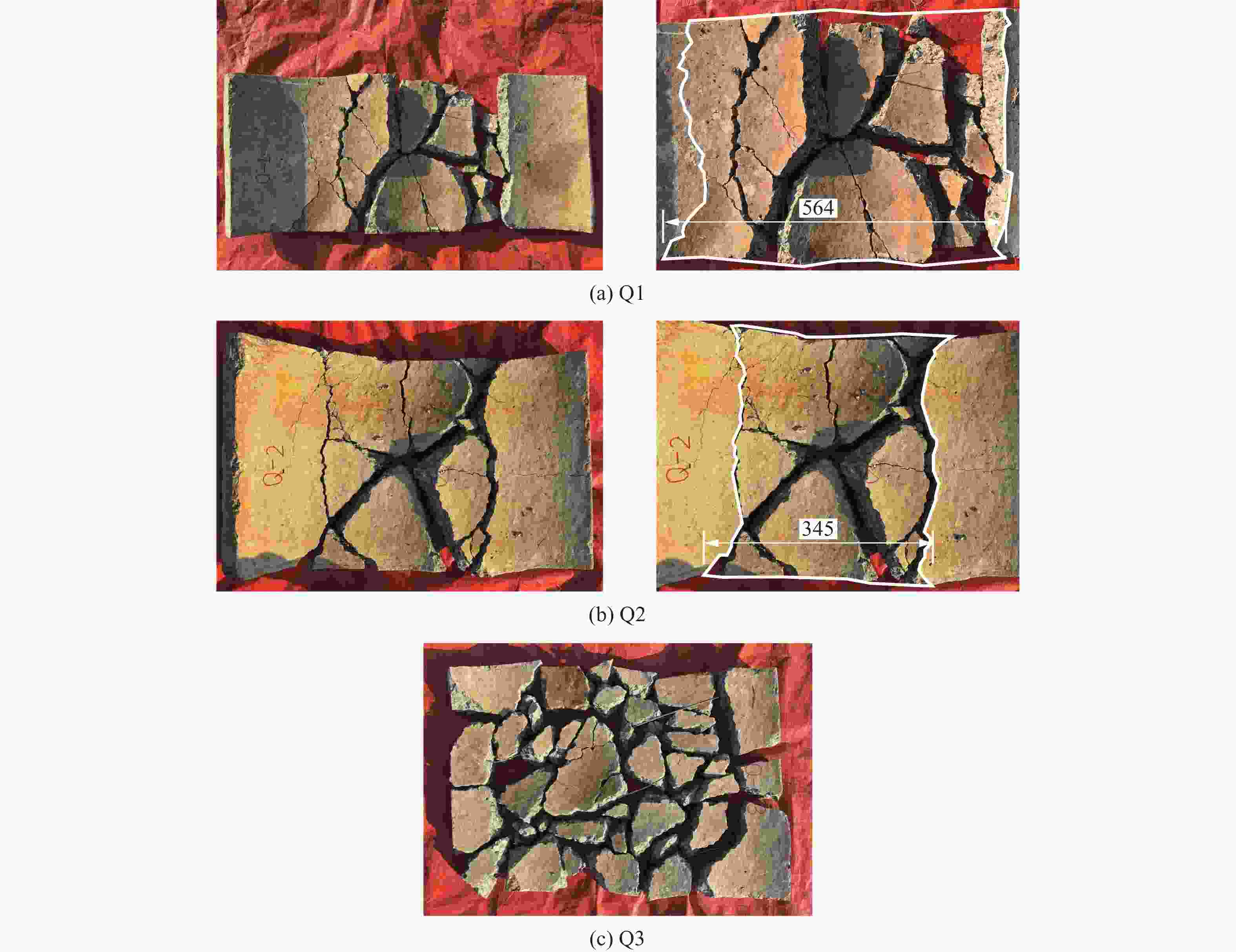
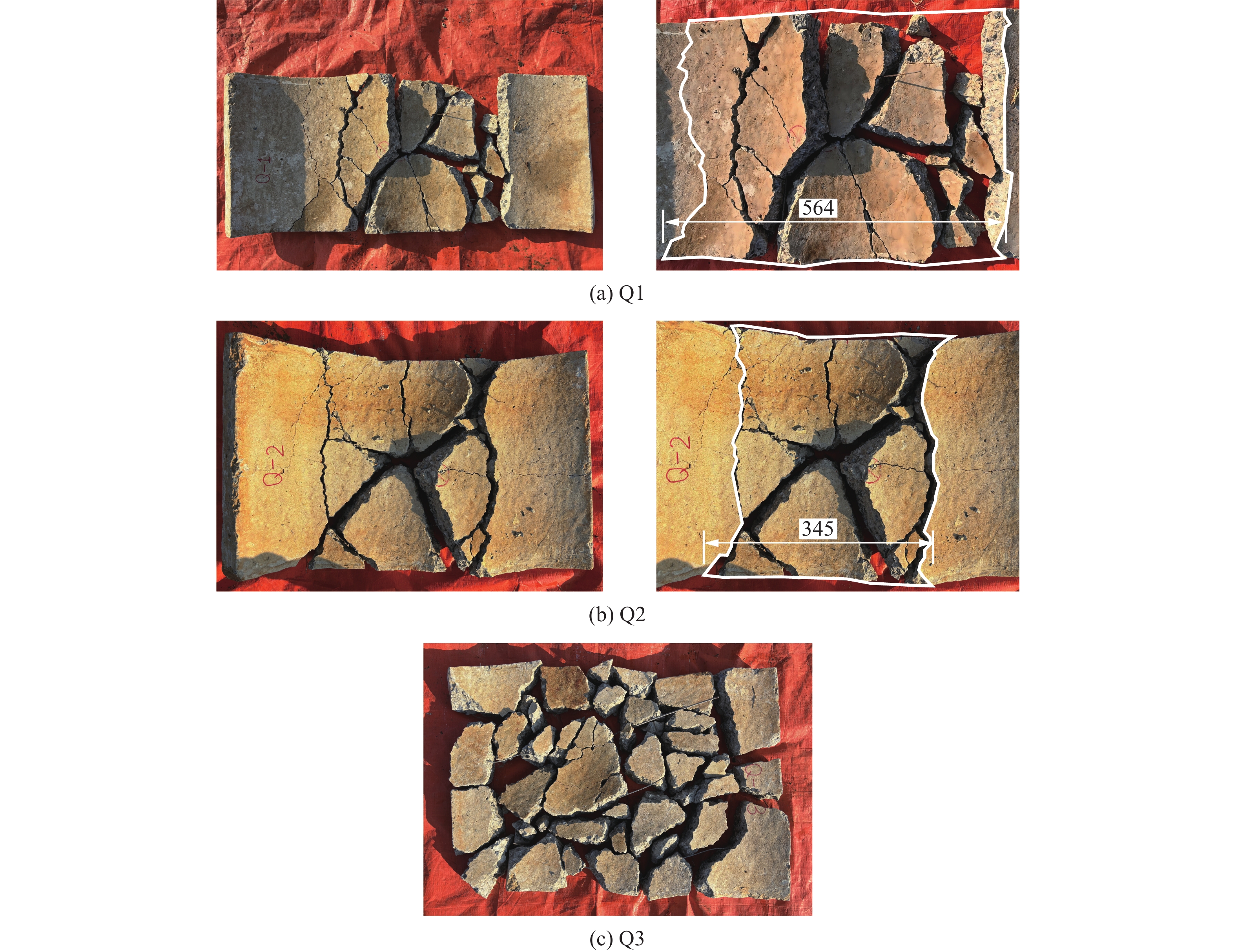
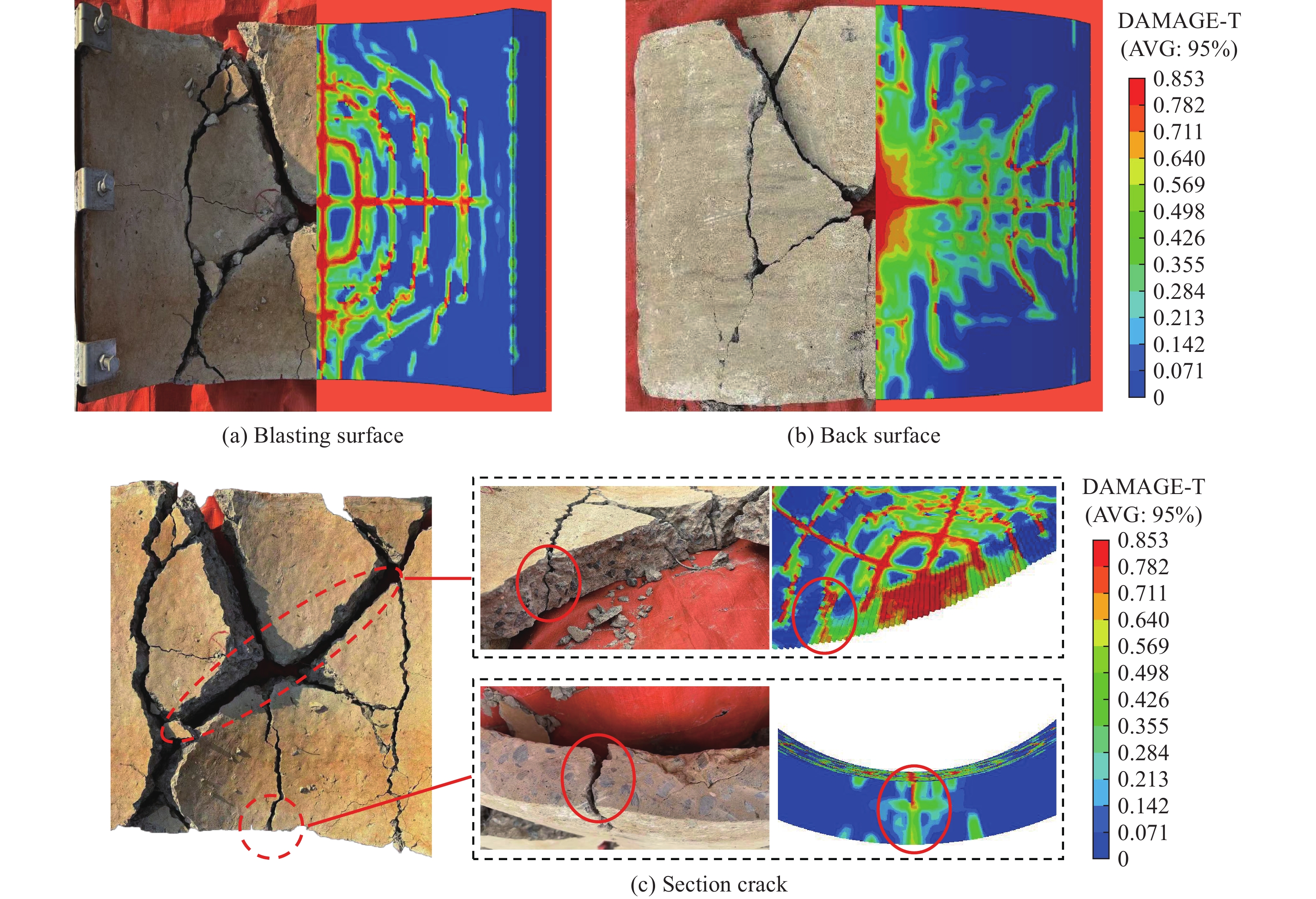
图 3 混凝土拱板水下接触爆炸测试结果(单位:mm)
Figure 3. Underwater contact explosion test results of concrete arch slabs (unit: mm)
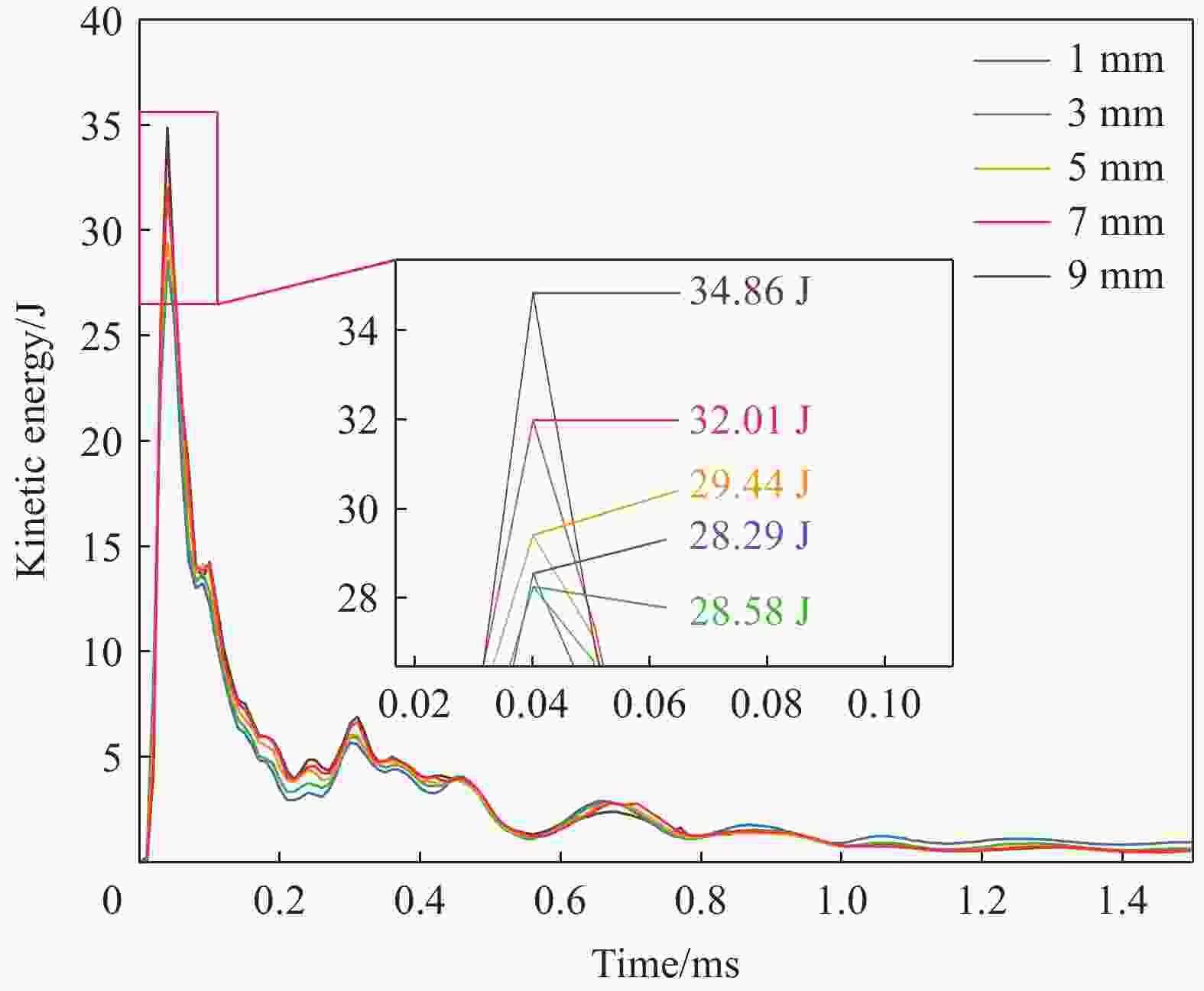
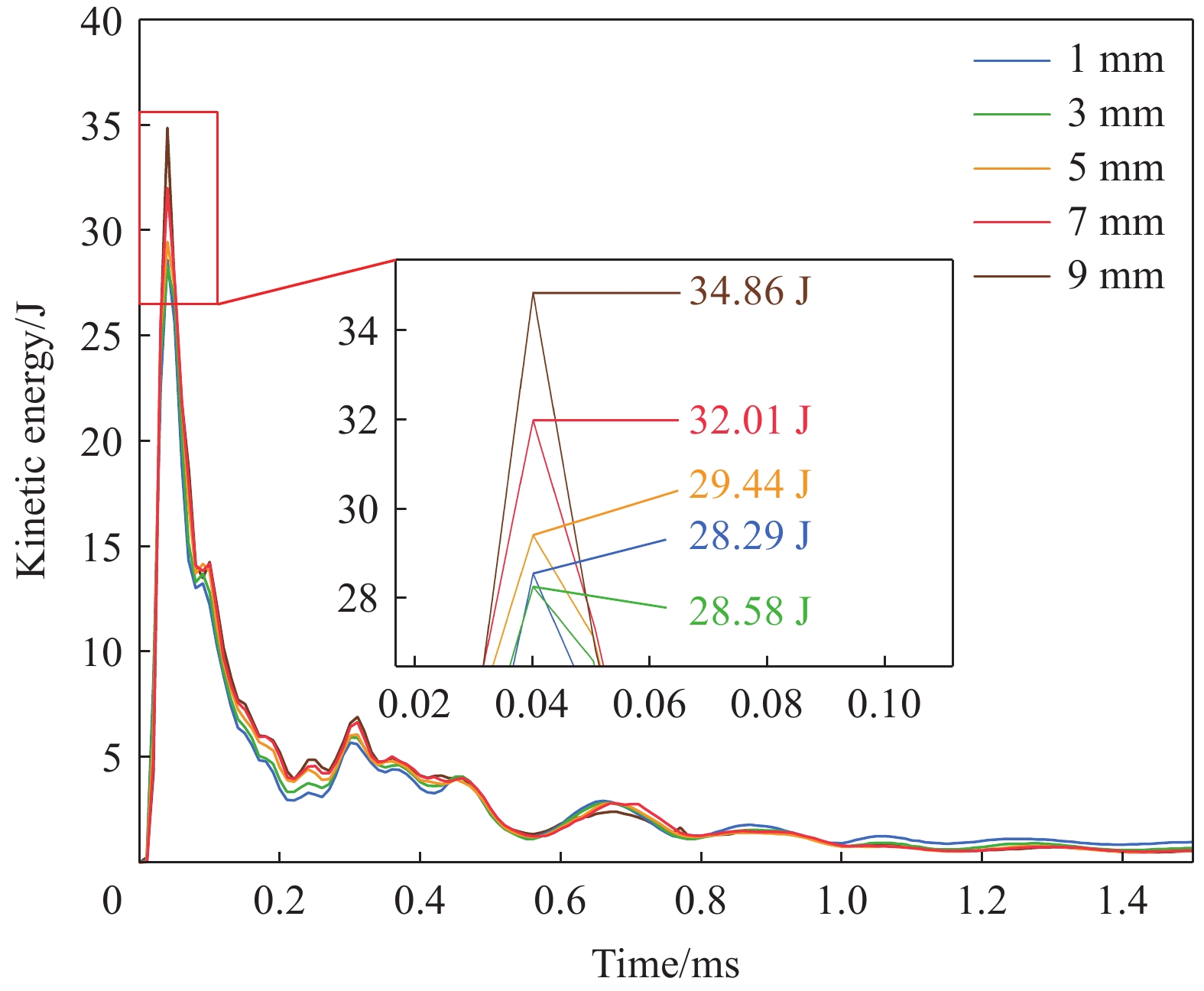
图 8 不同网格尺寸下拱板的动能时程曲线
Figure 8. Kinetic time history curves of the arch slabs under different grid sizes
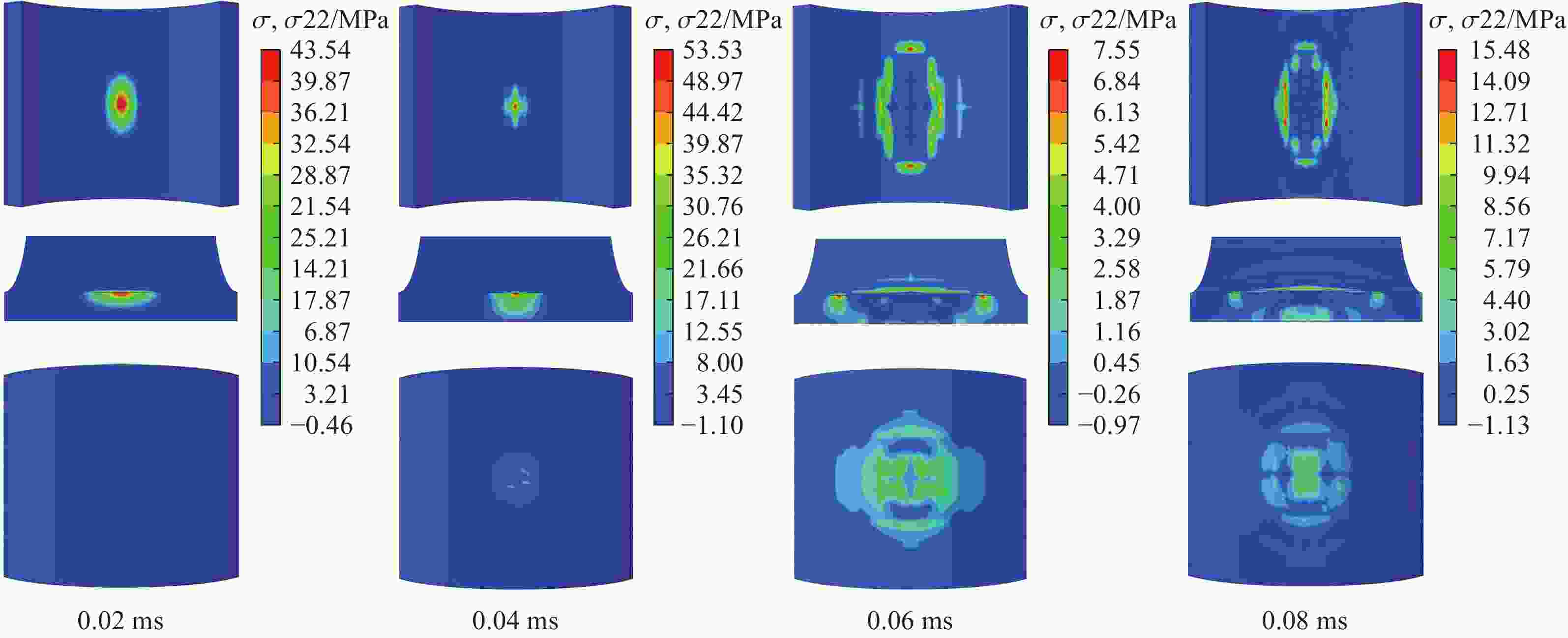
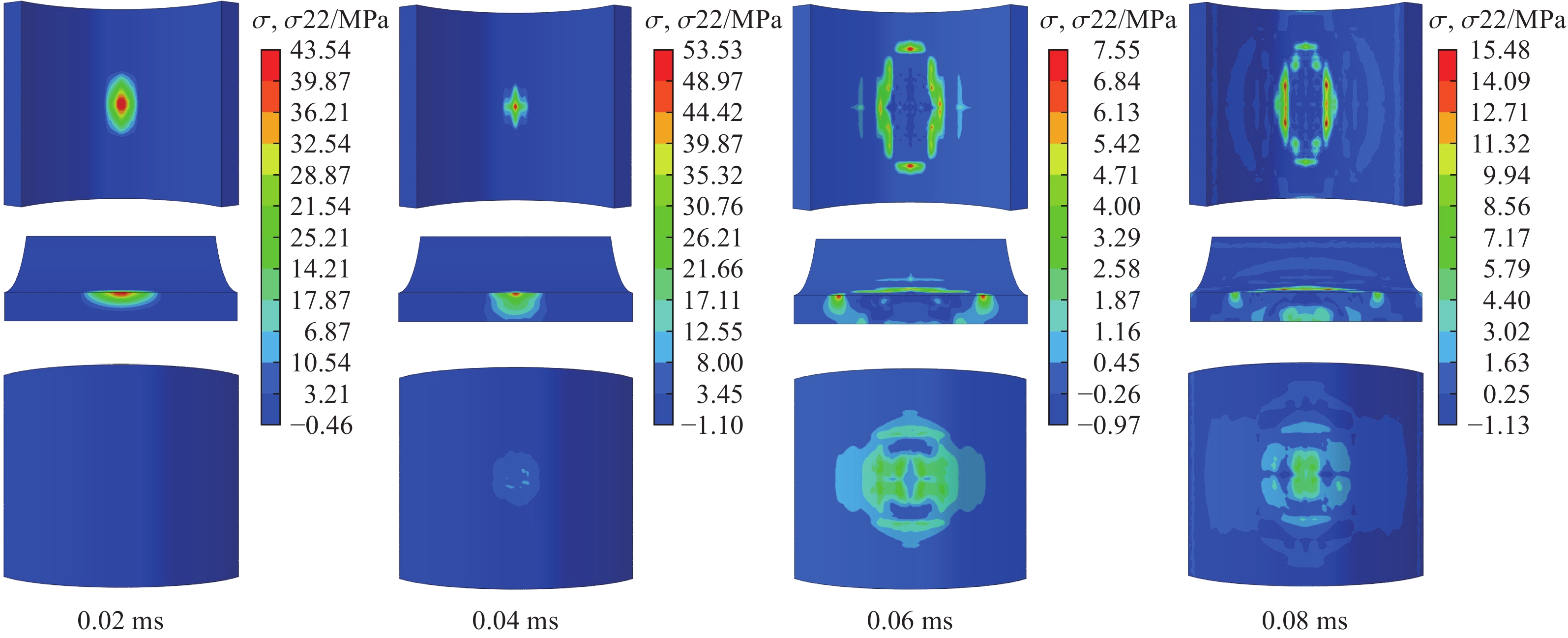
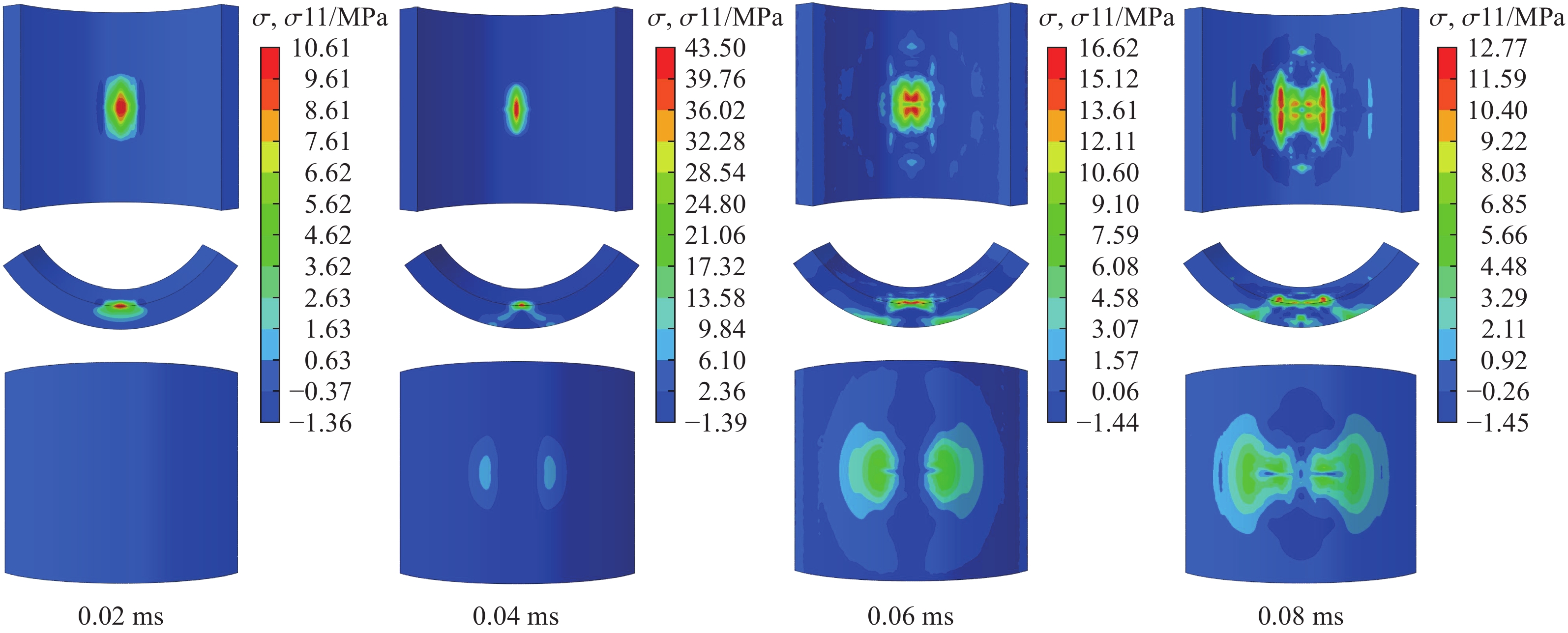
图 11 拱板厚度方向应力分布图
Figure 11. Stress distribution of the arch slabs in the thickness direction
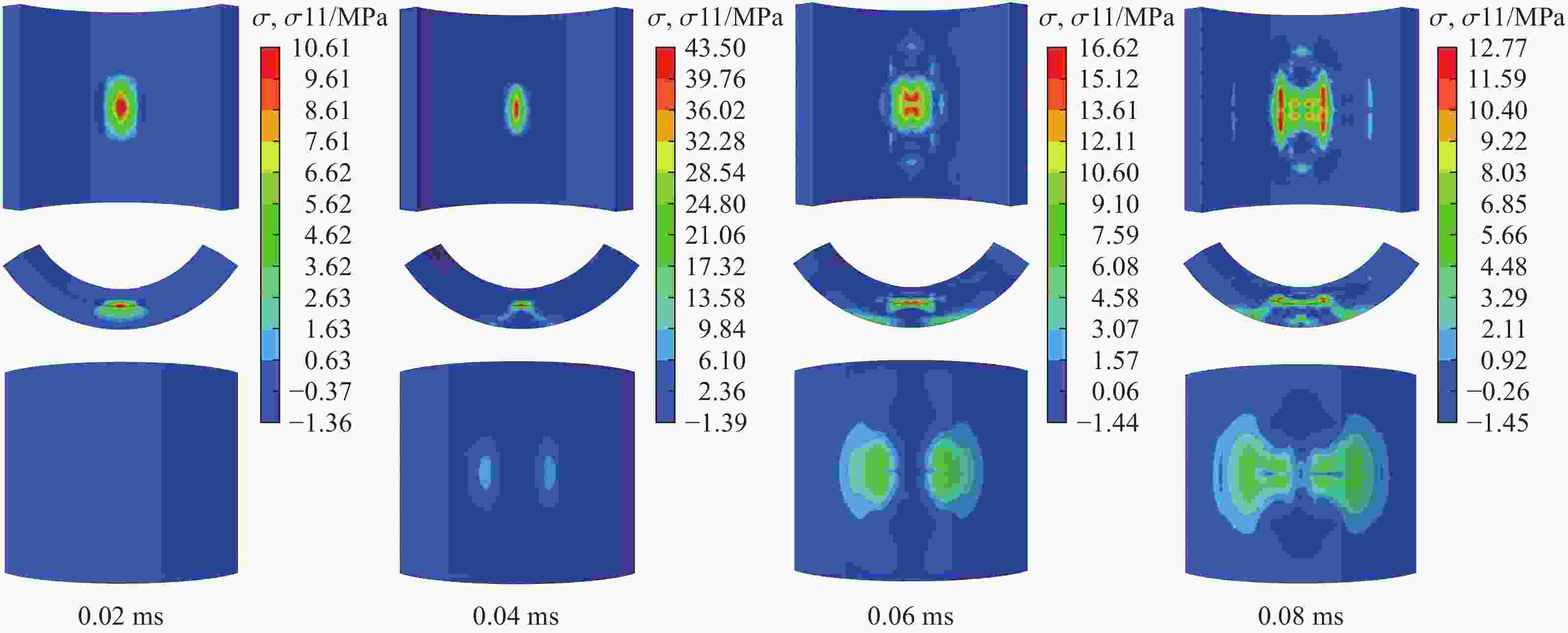
图 12 拱板跨度方向应力分布图
Figure 12. Stress distribution of the arch slabs in the span direction
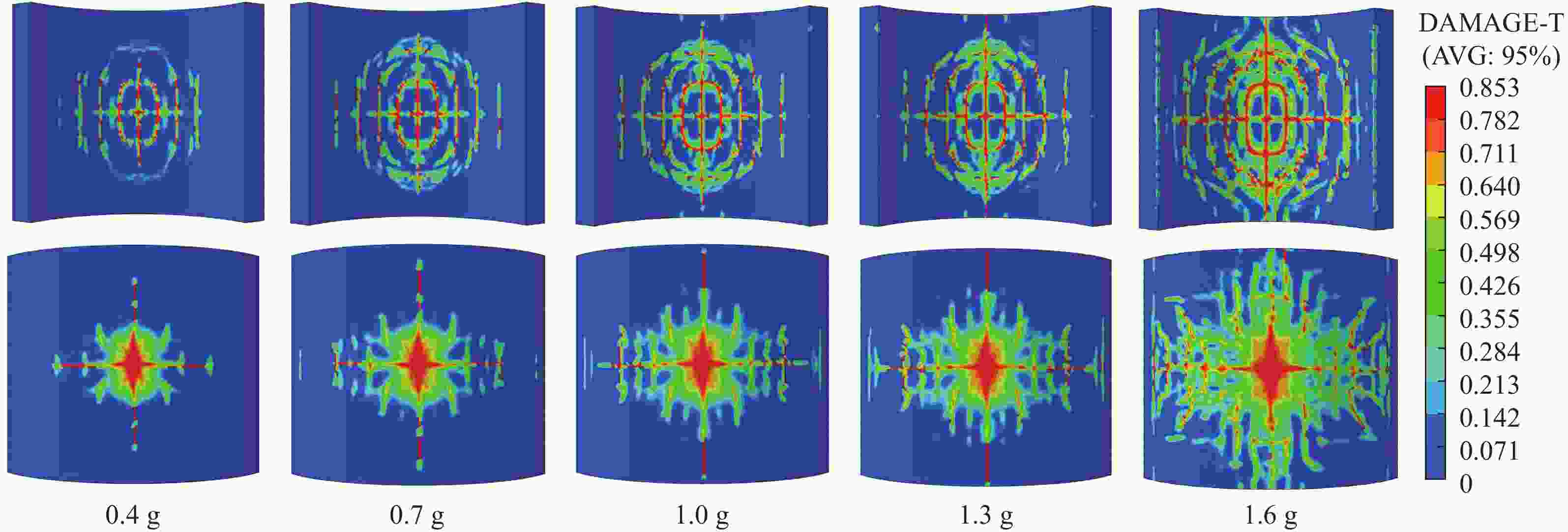
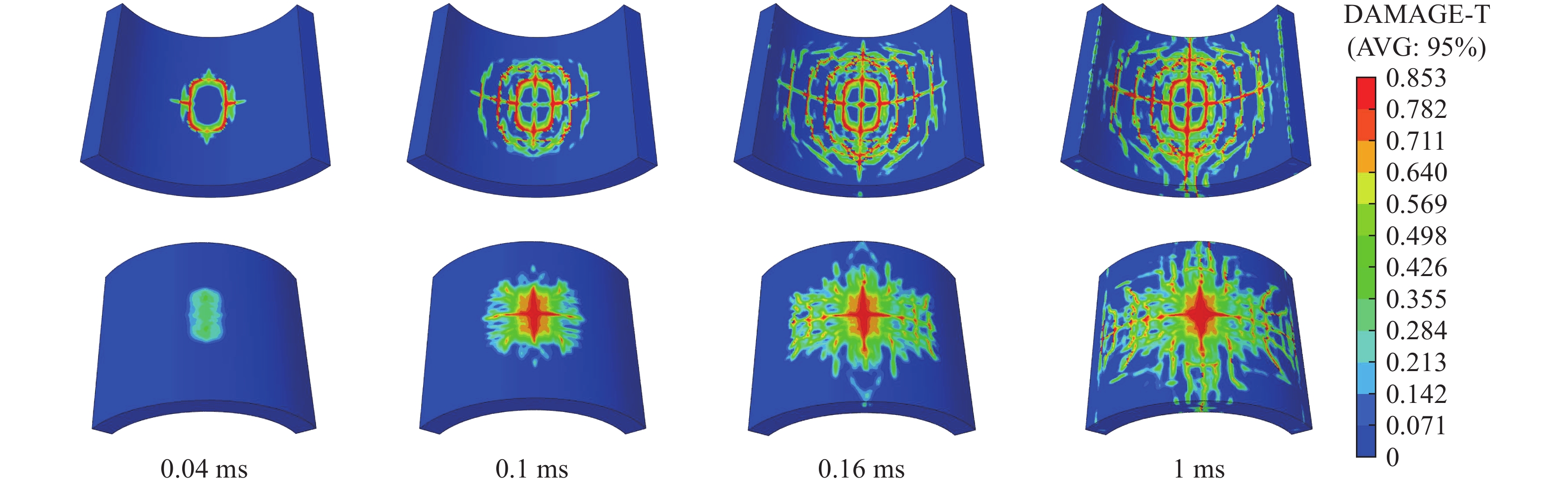
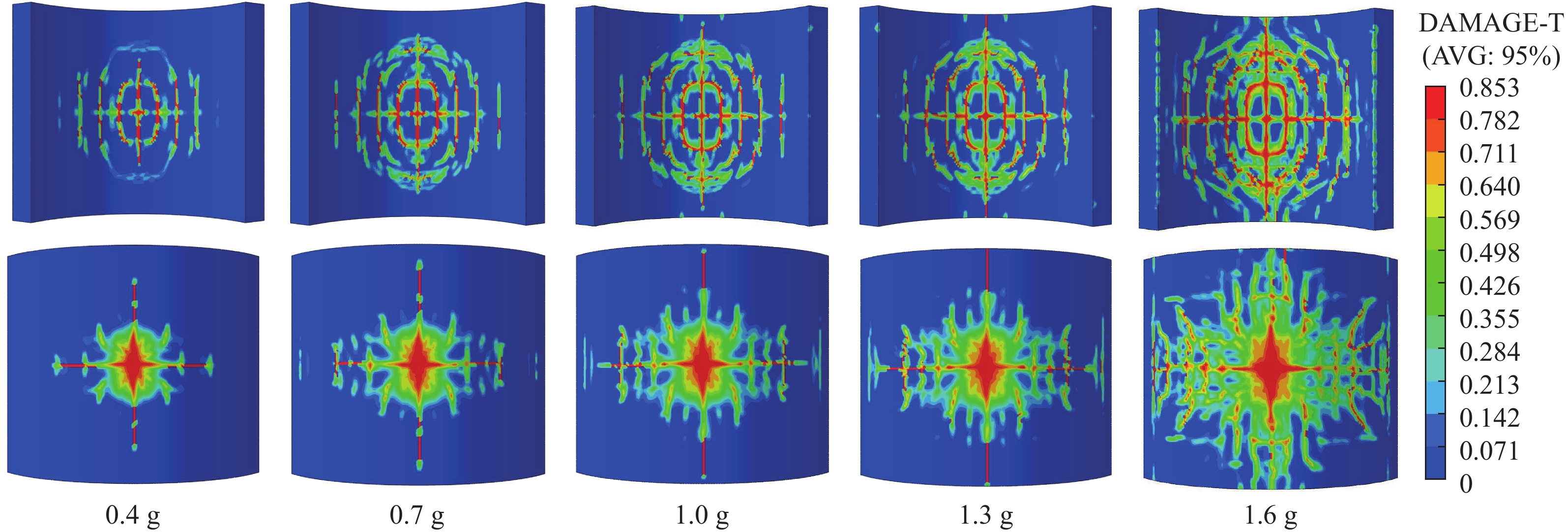
图 14 不同水下爆炸荷载下混凝土拱板的损伤模式
Figure 14. Damage modes of concrete arch slabs subject to different underwater explosive loads
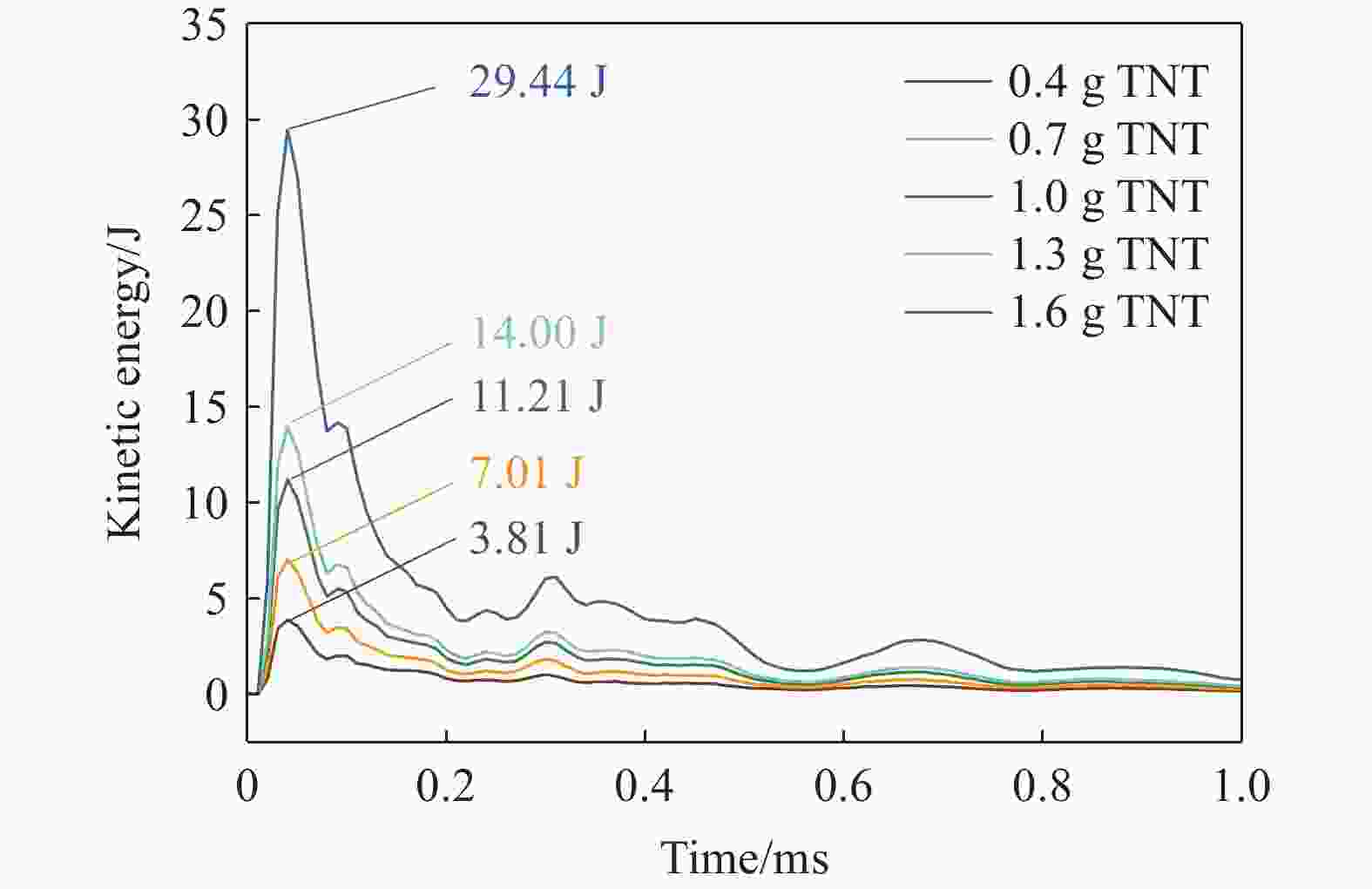
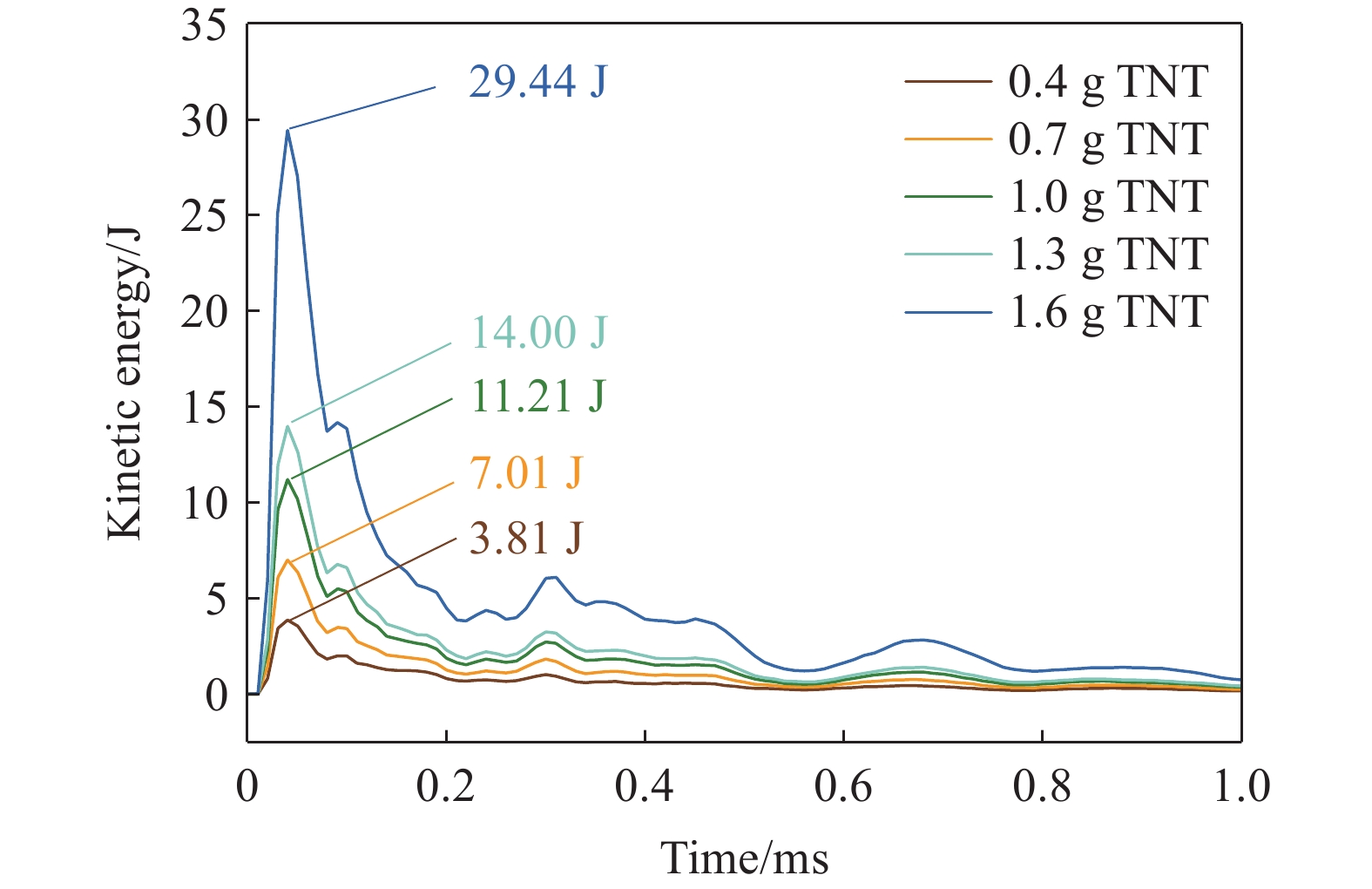
图 15 不同水下爆炸荷载下拱板的动能时程曲线
Figure 15. Kinetic time history curves of arch slabs subject to different underwater explosion loads
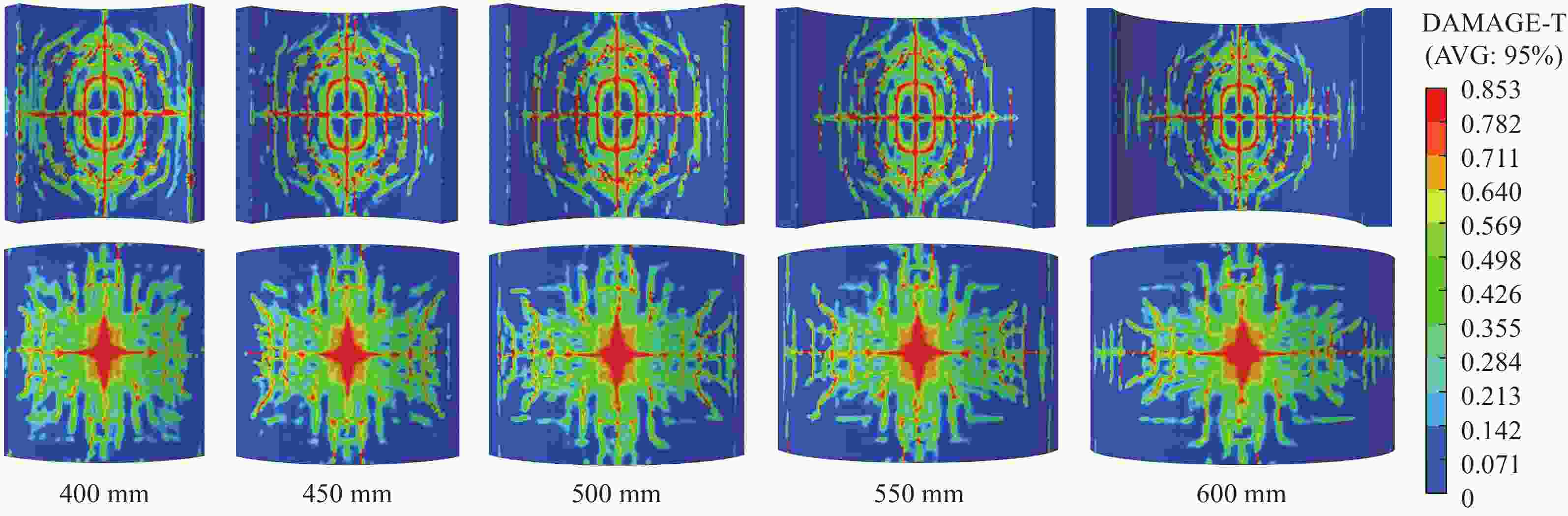
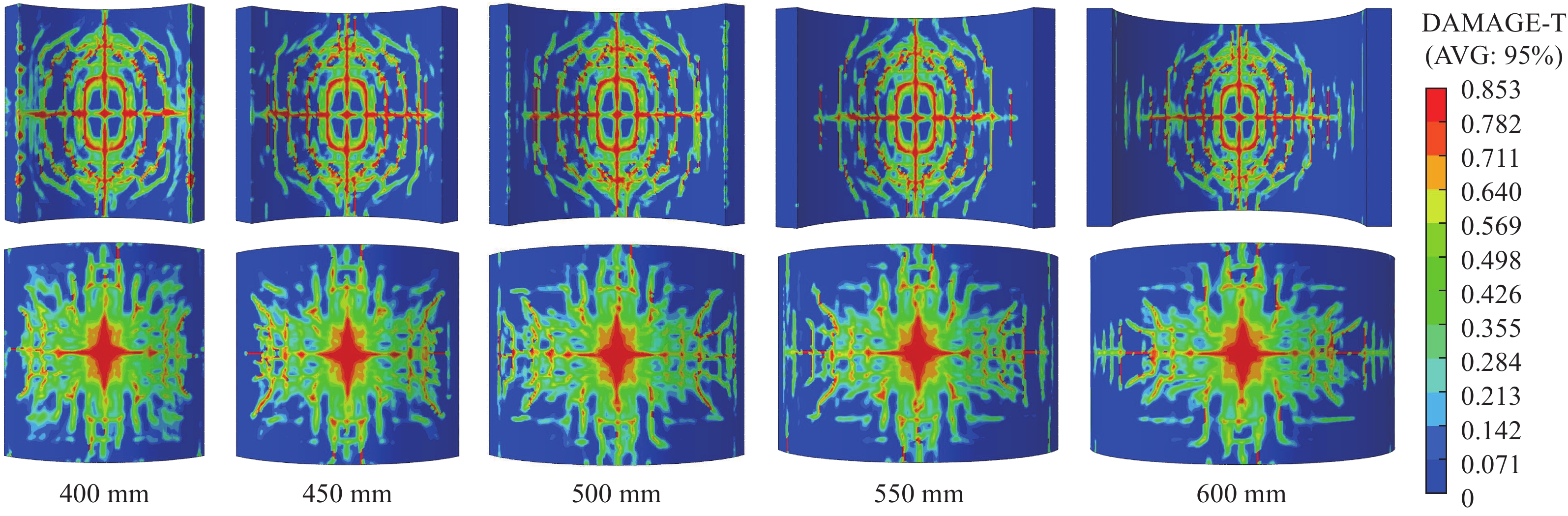
图 16 不同跨度的拱板在水下爆炸荷载下的损伤模式
Figure 16. Damage modes of arch slabs with different spans subject to underwater explosive loads
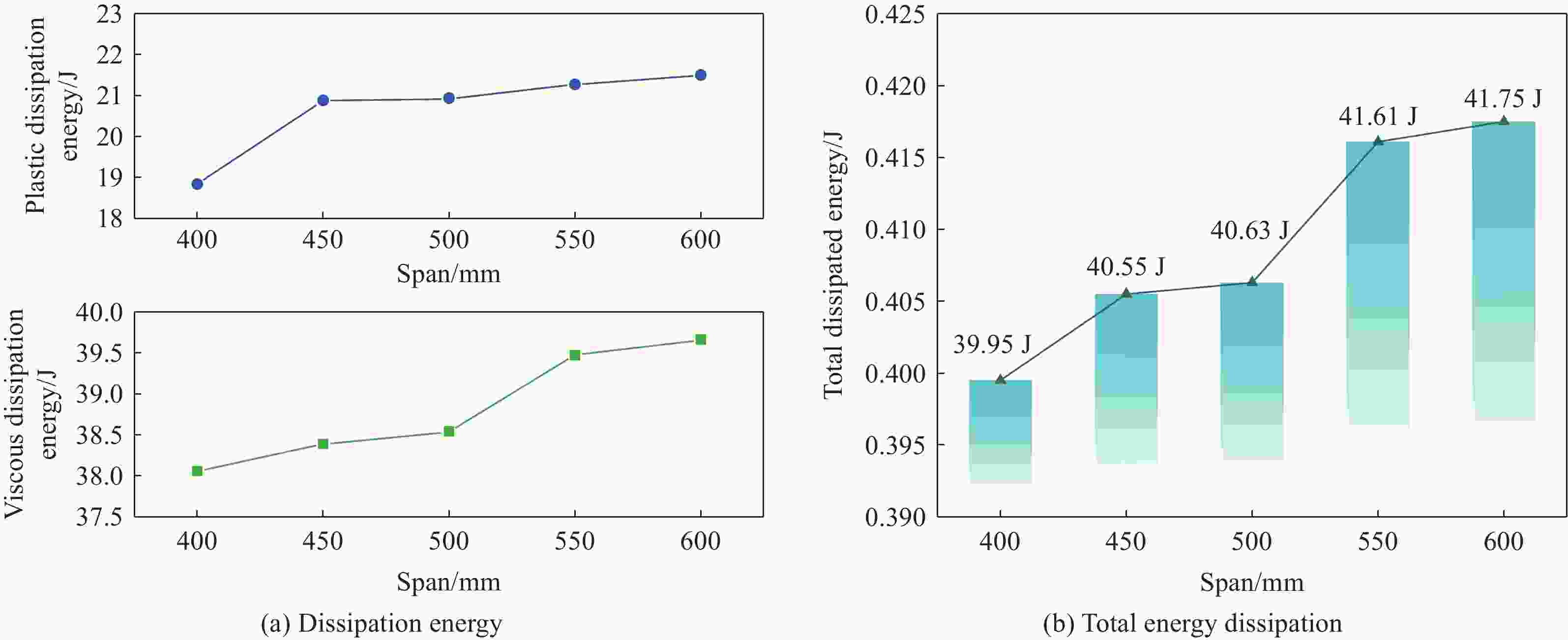
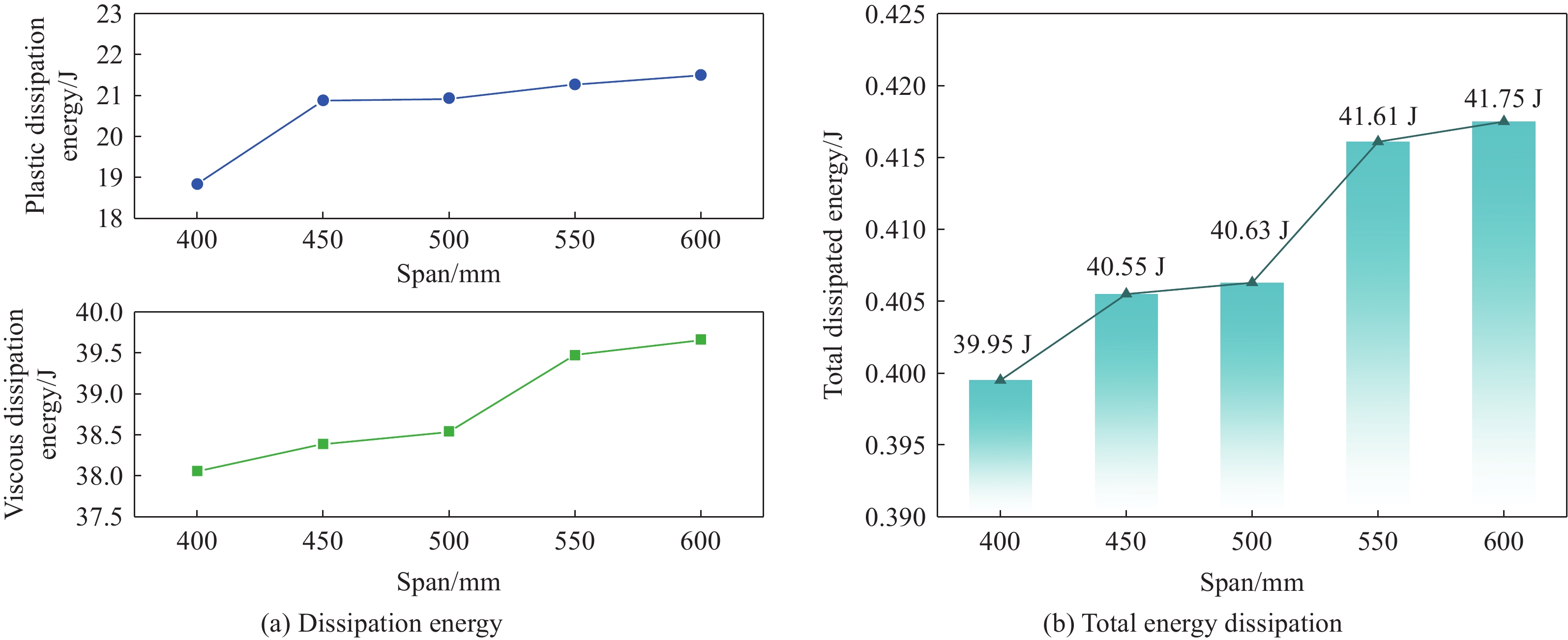
图 17 不同跨度拱板在爆炸过程中的耗散能
Figure 17. Dissipated energy of arch slabs with different spans during the explosion process
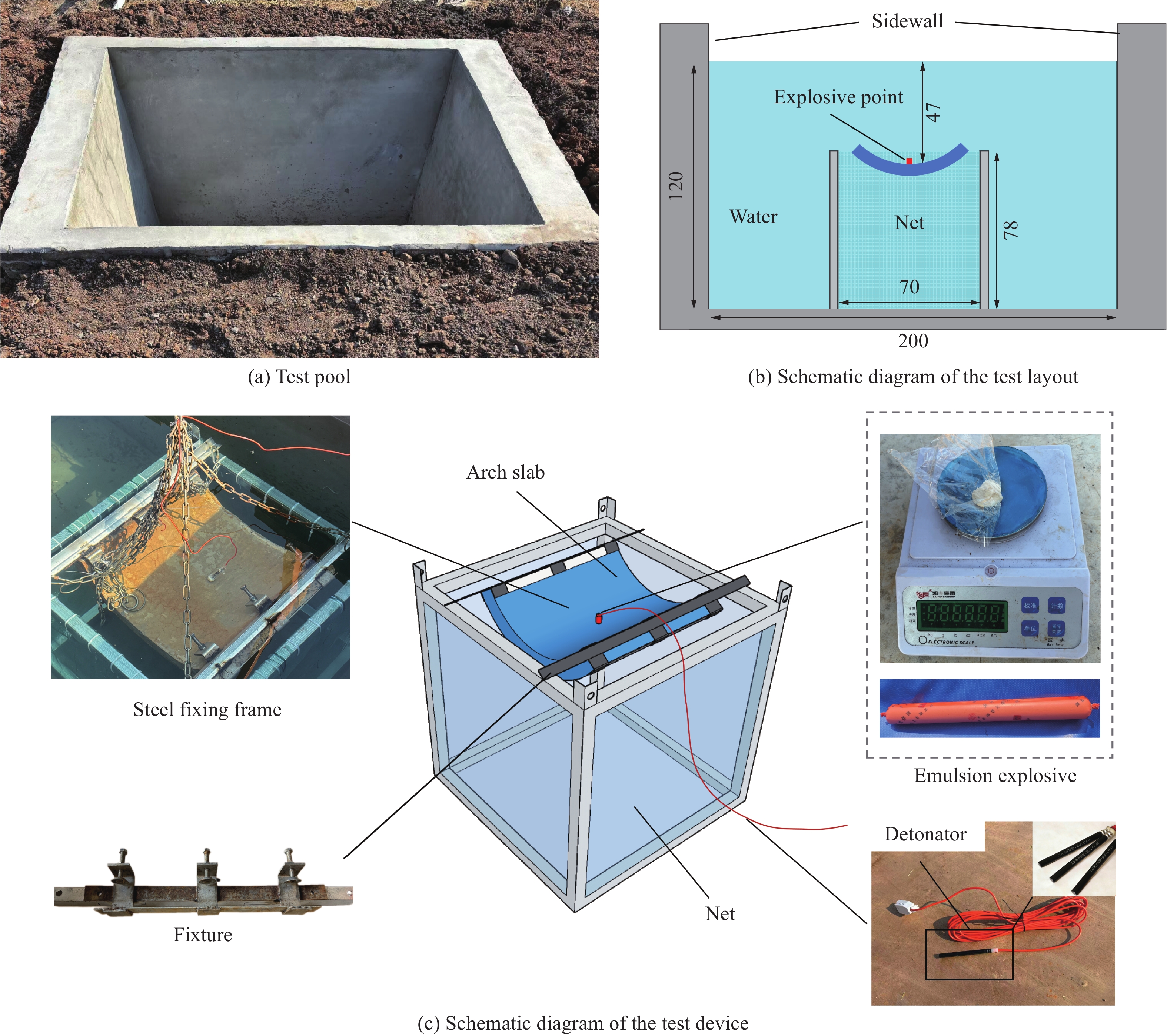
表 1 水下接触爆炸试验工况参数
Table 1. Experimental conditions of underwater contact explosion tests
试件编号 拱板跨度/mm TNT当量/g 起爆位置 Q1 600 1.6 内拱侧跨中 Q2 500 1.6 内拱侧跨中 Q3 500 4.7 内拱侧跨中  下载: 导出CSV
表 2 同等药量下不同跨度拱板迎爆面跨中区域破坏情况对比
Table 2. Comparison of failure conditions in the mid-span area of blasting surface of arch slabs with different spans under the same explosive charge
试验编号 相对破坏直径
(破坏直径/破坏前拱板内弧长)相对破坏面积
(破坏面积/破坏前内拱面面积)贯穿性裂纹数/条 Q1 59.9 55.2 6 Q2 54.1 34.6 6
下载: 导出CSV
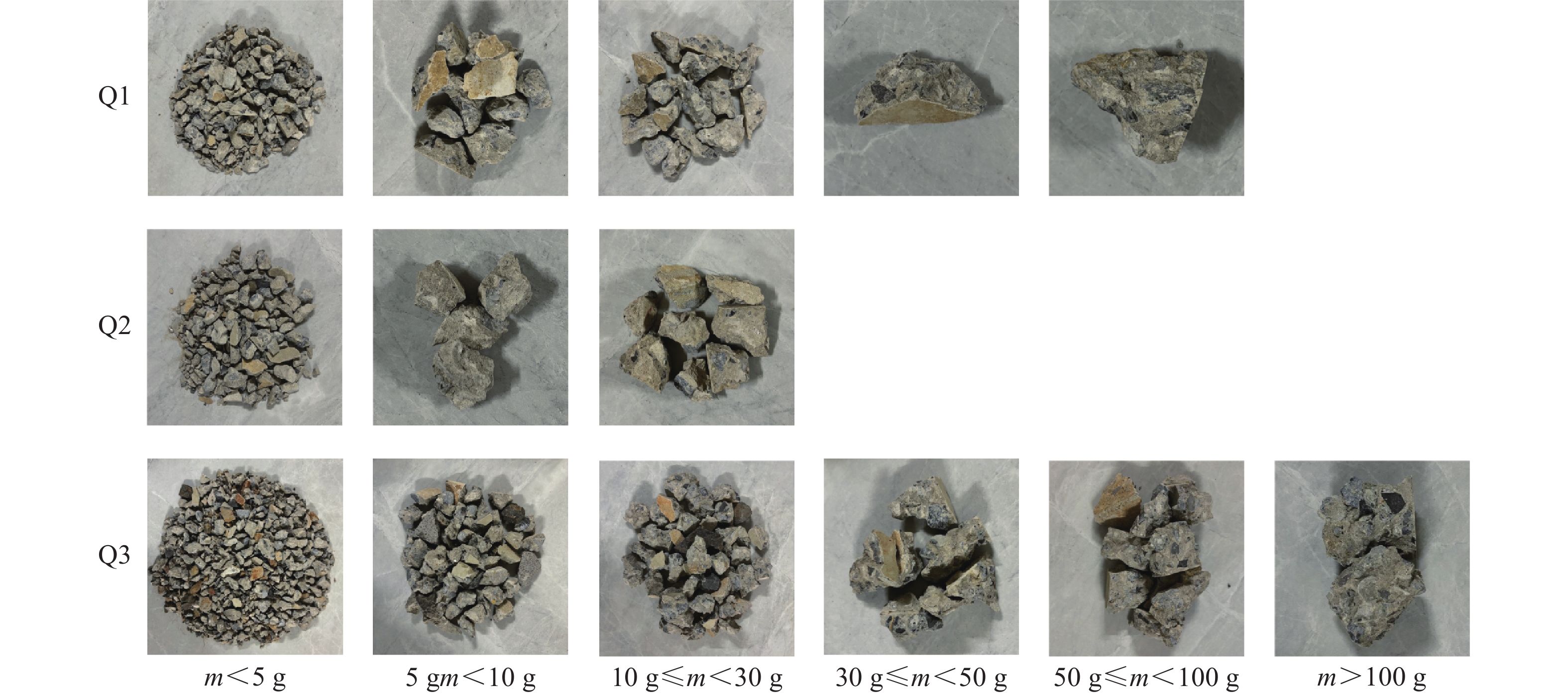
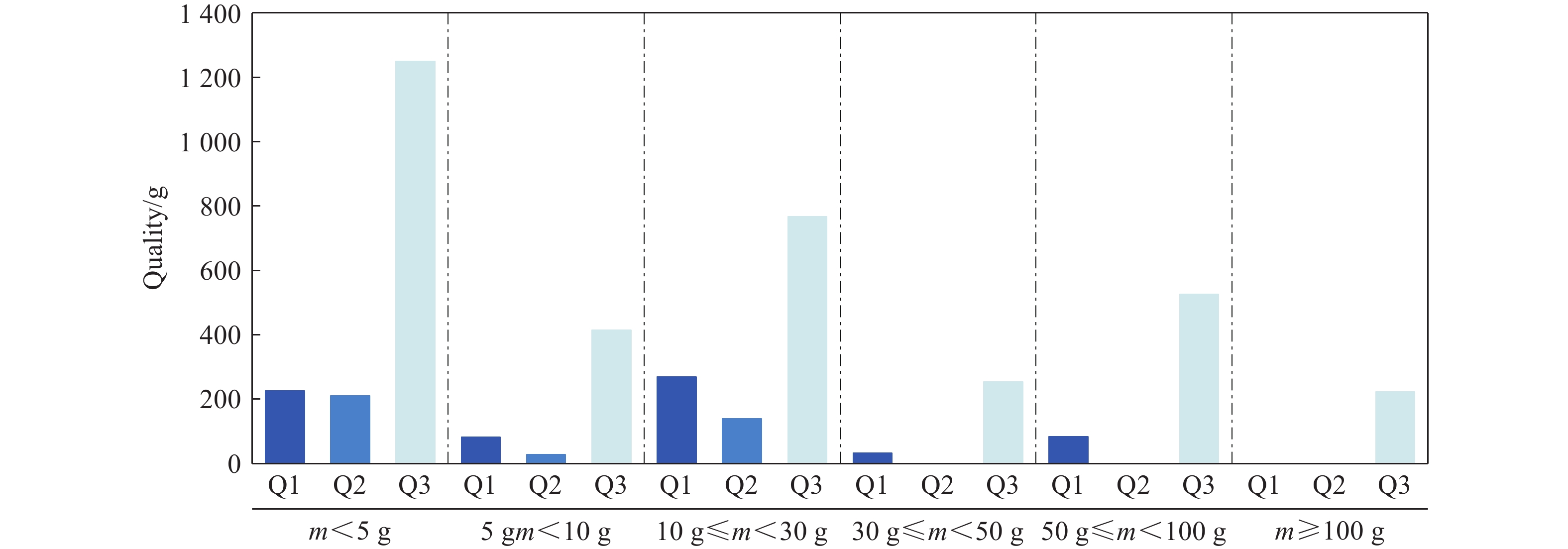
表 3 碎片质量变异系数
Table 3. Variation coefficient of fragment mass
试件 Q1 Q2 Q3 CV 0.8450 1.3045 0.6156
下载: 导出CSV
表 4 TNT材料参数
Table 4. Parameters of TNT material
ρ/(kg·m−3) E/(GJ·m−3) A/GPa B/GPa R1 R2 ω 1650 7 371.2 3.2 4.2 0.95 0.35
下载: 导出CSV
表 5 混凝土CDP模型材料参数
Table 5. Material parameters of concrete CDP model
Ec/(MPa) 泊松比 膨胀角/(°) 偏心率 fc0/fb0 K 黏性参数 29791.5 0.2 30 0.1 1.16 0.667 0.0005
下载: 导出CSV
-
[1] HE Z H, CHEN X Q, ZHANG X Q, et al. Damage prediction of hull structure under near-field underwater explosion based on machine learning [J]. Applied Ocean Research, 2025, 154: 104329. DOI: 10.1016/j.apor.2024.104329. [2] 汤长兴, 曹克磊, 赵瑜, 等. 钢纤维增强多孔混凝土板水下接触爆炸防爆机理及损伤等级预测 [J]. 爆炸与冲击, 2025, 45(5): 053201. DOI: 10.11883/bzycj-2024-0239.TANG C X, CAO K L, ZHAO Y, et al. Study on explosion-proof mechanism and damage level prediction of steel fiber reinforced cellular concrete slab in underwater contact explosion [J]. Explosion and Shock Waves, 2025, 45(5): 053201. DOI: 10.11883/bzycj-2024-0239. [3] 杨允锴, 武双章, 高振儒, 等. 近爆作用下钢筋混凝土柱损伤判据的试验研究 [J]. 工程爆破, 2023, 29(5): 47–56. DOI: 10.19931/j.EB.20220165.YANG Y K, WU S Z, GAO Z R, et al. Experimental study on damage criterion of reinforced conerete column under the action of close range explosion [J]. Engineering Blasting, 2023, 29(5): 47–56. DOI: 10.19931/j.EB.20220165. [4] 薛建锋, 章琪月, 许红浩, 等. 接触爆炸下POZD涂覆钢筋混凝土梁的抗爆性能 [J]. 高压物理学报, 2025, 39(5): 054203. DOI: 10.11858/gywlxb.20240881.XUE J F, ZHANG Q Y, XU H H, et al. Blast resistance of POZD-coated reinforced concrete beams under contact explosion [J]. Chinese Journal of High Pressure Physics, 2025, 39(5): 054203. DOI: 10.11858/gywlxb.20240881. [5] 刘靖晗, 高屹, 唐廷, 等. 梁板式高桩码头水下爆炸试验及数值模拟研究 [J]. 振动与冲击, 2025, 44(11): 29–38,49. DOI: 10.13465/j.cnki.jvs.2025.11.004.LIU J H, GAO Y, TANG T, et al. Underwater explosion tests and numerical simulation of beam-slab high pile wharf [J]. Journal of Vibration and Shock, 2025, 44(11): 29–38,49. DOI: 10.13465/j.cnki.jvs.2025.11.004. [6] YU S Y, WU H X, ZHANG G K, et al. Experimental study on anti-shallow-buried-explosion capacity of a corrugated steel-plain concrete composite structure [J]. International Journal of Impact Engineering, 2023, 172: 104393. DOI: 10.1016/j.ijimpeng.2022.104393. [7] NING J G, YANG S, MA T B, et al. Fragment behavior of concrete slab subjected to blast loading [J]. Engineering Failure Analysis, 2022, 138: 106370. DOI: 10.1016/j.engfailanal.2022.106370. [8] 李军润, 卢永刚, 冯晓伟, 等. RC箱型结构内爆炸载荷特性和动力行为分析 [J]. 爆炸与冲击, 2026, 46(1): 013101. DOI: 10.11883/bzycj-2024-0388.LI J R, LU Y G, FENG X W, et al. Analysis of internal explosion load characteristics and dynamic behavior in RC box structures [J]. Explosion and Shock Waves, 2026, 46(1): 013101. DOI: 10.11883/bzycj-2024-0388. [9] TRAN D H, NG A W M, PERERA B J C. Neural networks deterioration models for serviceability condition of buried stormwater pipes [J]. Engineering Applications of Artificial Intelligence, 2007, 20(8): 1144–1151. DOI: 10.1016/j.engappai.2007.02.005. [10] KANG J, MENG X X, SU T, et al. Research on leakage control of river oil and gas pipelines based on accident situation evolution model [J]. Journal of Loss Prevention in the Process Industries, 2025, 96: 105615. DOI: 10.1016/j.jlp.2025.105615. [11] REDA A, HOWARD I M, FORBES G L, et al. Design and installation of subsea cable, pipeline and umbilical crossing interfaces [J]. Engineering Failure Analysis, 2017, 81: 193–203. DOI: 10.1016/j.engfailanal.2017.07.001. [12] 陈昊, 卢浩, 孙善政, 等. 常规武器二次爆炸作用下浅埋钢筋混凝土拱结构破坏规律 [J]. 爆炸与冲击, 2023, 43(8): 085104. DOI: 10.11883/bzycj-2022-0260.CHEN H, LU H, SUN S Z, et al. Failure law of shallow buried reinforced concrete arch structure under secondary explosion of conventional weapons [J]. Explosion and Shock Waves, 2023, 43(8): 085104. DOI: 10.11883/bzycj-2022-0260. [13] LIU G K, WANG W, LIU R C, et al. Deriving formulas of loading distribution on underground arch structure surface under close-in explosion [J]. Engineering Failure Analysis, 2020, 115: 104608. DOI: 10.1016/j.engfailanal.2020.104608. [14] HUO Q, LIU G K, WANG W, et al. Failure mode and damage assessment of underground reinforced concrete arched structure under side top explosion [J]. Structures, 2024, 59: 105801. DOI: 10.1016/j.istruc.2023.105801. [15] 罗军洪, 刘宏伟, 付安琪, 等. 顶爆作用下地下大跨度硐室抗爆性能研究 [J]. 地下空间与工程学报, 2022, 18(5): 1630–1638. DOI: 10.20174/j.juse.2022.05.025.LUO J H, LIU H W, FU A Q, et al. Study on anti-explosion performance of large-span underground cavern under top-explosion load [J]. Chinese Journal of Underground Space and Engineering, 2022, 18(5): 1630–1638. DOI: 10.20174/j.juse.2022.05.025. [16] MAIORANA E, DENIS TETOUGUENI C, ZAMPIERI P. Effect of blast load on the structural integrity of steel arch bridge slab [J]. Engineering Failure Analysis, 2022, 139: 106498. DOI: 10.1016/j.engfailanal.2022.106498. [17] YUE Z Y, ZHOU J N, WANG P, et al. Experimental study on the anti-blast performance of polyurea reinforced concrete arch structures [J]. Journal of Building Engineering, 2023, 77: 107483. DOI: 10.1016/j.jobe.2023.107483. [18] JIANG M R, QI S H, PU S K, et al. Experimental study on the blast resistance performance of FRP grid & mortar reinforced concrete arch structure [J]. Materials, 2022, 15(20): 7149. DOI: 10.3390/ma15207149. [19] SONG D Y, TAN Q H, CAO Y Y Y, et al. Experimental investigation on blast and post-blast performance of reinforced concrete straight-wall arches strengthened with polyurea coating [J]. Construction and Building Materials, 2023, 385: 131352. DOI: 10.1016/j.conbuildmat.2023.131352. [20] 陈健, 袁大军, 苏秀婷, 等. 超大直径水下盾构隧道施工技术进展与展望 [J]. 现代隧道技术, 2024, 61(2): 124–138. DOI: 10.13807/j.cnki.mtt.2024.02.012.CHEN J, YUAN D J, SU X T, et al. Progress and prospects of construction technology for ultra-large diameter underwater shield tunnels [J]. Modern Tunnelling Technology, 2024, 61(2): 124–138. DOI: 10.13807/j.cnki.mtt.2024.02.012. [21] 黄超, 徐维铮, 曾繁, 等. 近水面空中爆炸冲击波的载荷特性 [J]. 爆炸与冲击, 2026, 46(1): 011001. DOI: 10.11883/bzycj-2024-0457.HUANG C, XU W Z, ZENG F, et al. The characteristics of shock wave loads from air blast near the water surface [J]. Explosion and Shock Waves, 2026, 46(1): 011001. DOI: 10.11883/bzycj-2024-0457. [22] 张社荣, 孔源, 王高辉. 水下和空中爆炸冲击波传播特性对比分析 [J]. 振动与冲击, 2014, 33(13): 148–153. DOI: 10.13465/j.cnki.jvs.2014.13.026.ZHANG S R, KONG Y, WANG G H. Comparative analysis on propagation characteristics of shock wave induced by underwater and air explosions [J]. Journal of Vibration and Shock, 2014, 33(13): 148–153. DOI: 10.13465/j.cnki.jvs.2014.13.026. [23] KUMAR R A, RAJESH G, JAGADEESH G. The reflection and refraction of a curved shock front sliding over an air-water interface [J]. Shock Waves, 2022, 32(6): 497–515. DOI: 10.1007/s00193-022-01097-z. [24] ZHAO X H, WANG G H, LU W B, et al. Damage features of RC slabs subjected to air and underwater contact explosions [J]. Ocean Engineering, 2018, 147: 531–545. DOI: 10.1016/j.oceaneng.2017.11.007. [25] 杨广栋, 田许杰, 范勇, 等. 钢筋混凝土拱的水下抗爆性能 [J]. 爆炸与冲击, 2024, 44(2): 023101. DOI: 10.11883/bzycj-2023-0235.YANG G D, TIAN X J, FAN Y, et al. Blast resistance of reinforced concrete arches subjected to underwater explosions [J]. Explosion and Shock Waves, 2024, 44(2): 023101. DOI: 10.11883/bzycj-2023-0235. [26] FAN Y, YANG G D, TIAN X J, et al. Experimental and numerical investigation on normal strength and high strength RC arches subjected to underwater explosions [J]. Engineering Structures, 2025, 322: 119138. DOI: 10.1016/j.engstruct.2024.119138. [27] ZHAO X H, YANG S H, Jia Y S, et al. Study on damage characteristics and mechanisms of arch concrete slabs with outer arch side facing water under inner-arch contact explosion [J]. International Journal of Impact Engineering, 2024, 191: 105007. DOI: 10.1016/j.ijimpeng.2024.105007. [28] 汪旭光, 郑炳旭, 张正忠, 等. 爆破手册 [M]. 北京: 冶金工业出版社, 2010.WANG X G, ZHENG B X, ZHANG Z Z, et al. Handbook of blasting [M]. Beijing: Metallurgical Industry Press, 2010. [29] COOPER P W. Explosives engineering [M]. Weinheim: Wiley-VCH, 1996. [30] REN L J, MA H H, SHEN Z W, et al. Blast response of water-backed metallic sandwich panels subject to underwater explosion-Experimental and numerical investigations [J]. Composite Structures, 2019, 209: 79–92. DOI: 10.1016/j.compstruct.2018.10.082. [31] ZHENG X Y, LI H T, ZHANG C, et al. Experimental study on load characteristics of underwater explosion for an emulsion explosive [J]. Chinese Journal of High Pressure Physics, 2022, 36(4): 045101. DOI: 10.11858/gywlxb.20220502. [32] CUI P, ZHANG A M, WANG S P. Small-charge underwater explosion bubble experiments under various boundary conditions [J]. Physics of Fluids, 2016, 28(11): 117103. DOI: 10.1063/1.4967700. [33] 徐佳星, 夏珉, 杨克成, 等. 非球形颗粒系粒径分布的机器学习反演算法 [J]. 光学学报, 2023, 43(9): 0929002. DOI: 10.3788/AOS221901.XU J X, XIA M, YANG K C, et al. Machine learning-based inversion algorithm for particle size distribution of non-spherical particle system [J]. Acta Optica Sinica, 2023, 43(9): 0929002. DOI: 10.3788/AOS221901. [34] ZAID M, SADIQUE M R, ALAM M M. Blast analysis of tunnels in manhattan-schist and quartz-schist using coupled-Eulerian-Lagrangian method [J]. Innovative Infrastructure Solutions, 2021, 6(2): 69. DOI: 10.1007/s41062-020-00446-0. [35] 董聪慧, 马志钢, 邵子豪, 等. 雷管爆炸产物与破片飞散过程研究 [J]. 工程爆破, 2016, 22(4): 82–86. DOI: 10.3969/j.issn.1006-7051.2016.04.017.DONG C H, MA Z G, SHAO Z H, et al. Flying process of explosion products and metal fragments of detonator [J]. Engineering Blasting, 2016, 22(4): 82–86. DOI: 10.3969/j.issn.1006-7051.2016.04.017. [36] 杜志明, 蒲薇华, 路光明. 典型雷管起爆、传爆过程模拟仿真 [C]//中国兵工学会第十一届火工烟火学会年会论文集. 西安: 中国兵工学会, 2001: 39–47.DU Z M, PU W H, LU G M. Simulation of initiation and detonation transfer process of typical detonators [C]//Proceedings of the 11th Annual Conference on Initiation and Pyrotechnics of China Ordnance Society. Xi’ an: China Ordnance Society, 2001: 39–47. [37] 邢英剑, 赵小华, 方宏远, 等. 水下接触爆炸下拱形结构的毁伤特性分析 [J]. 工程爆破, 2025, 31(2): 1–10,38. DOI: 10.19931/j.EB.20220317.XING Y J, ZHAO X H, FANG H Y, et al. Analysis of damage characteristics of arch structure under underwater contact explosion [J]. Engineering Blasting, 2025, 31(2): 1–10,38. DOI: 10.19931/j.EB.20220317. [38] 甘宁, 孙卓, 王帅. 水下爆炸载荷作用下船体梁毁伤特性研究 [J]. 舰船科学技术, 2025, 47(6): 7–12. DOI: 10.3404/j.issn.1672-7649.2025.06.002.GAN N, SUN Z, WANG S. Research on damage features of the ship hull girder subjected to underwater explosion loads [J]. Ship Science and Technology, 2025, 47(6): 7–12. DOI: 10.3404/j.issn.1672-7649.2025.06.002. [39] RAJASEKAR J, KIM T H, KIM H D. Visualization of shock wave propagation due to underwater explosion [J]. Journal of Visualization, 2020, 23(5): 825–837. DOI: 10.1007/s12650-020-00664-9. [40] 王天召, 孙远翔, 陈岩武. 水下接触爆炸气泡脉动特性的理论研究 [J]. 爆炸与冲击, 2026, 46(1): 011104. DOI: 10.11883/bzycj-2025-0092.WANG T Z, SUN Y X, CHEN Y W. Theoretical study of bubble pulsation characteristics in underwater contact explosions [J]. Explosion and Shock Waves, 2026, 46(1): 011104. DOI: 10.11883/bzycj-2025-0092. [41] LUBLINER J, OLIVER J, OLLER S, et al. A plastic-damage model for concrete [J]. International Journal of Solids and Structures, 1989, 25(3): 299–326. DOI: 10.1016/0020-7683(89)90050-4. [42] LEE J, FENVES G L. Plastic-damage model for cyclic loading of concrete structures [J]. Journal of Engineering Mechanics, 1998, 124(8): 892–900. DOI: 10.1061/(ASCE)0733-9399(1998)124:8(892). [43] XIA Y, LI X D, XIE T Y, et al. Seismic performance of RC bent columns: Experimental, numerical and life-cycle cost analysis [J]. Case Studies in Construction Materials, 2024, 20(c): e02692. DOI: 10.1016/j.cscm.2023.e02692. [44] KRAUTHAMMER T, OTANI R K. Mesh, gravity and load effects on finite element simulations of blast loaded reinforced concrete structures [J]. Computers & Structures, 1997, 63(6): 1113–1120. DOI: 10.1016/S0045-7949(96)00406-3. [45] 商贵昊, 商飞, 潘正伟. 超压与冲量综合作用下金属薄板的塑性变形特性分析与建模 [J]. 高压物理学报, 2025, 39(6): 064201. DOI: 10.11858/gywlxb.20240958.SHANG G H, SHANG F, PAN Z W. Analysis and modeling of plastic deformation characteristics of sheet metal under the combined action of overpressure and impulse [J]. Chinese Journal of High Pressure Physics, 2025, 39(6): 064201. DOI: 10.11858/gywlxb.20240958. -

计量
- 文章访问数: 573
- HTML全文浏览量: 165
- PDF下载量: 278
- 被引次数: 0