


Experimental and numerical study on directional rock fracture induced by a composite shaped charge liner
-
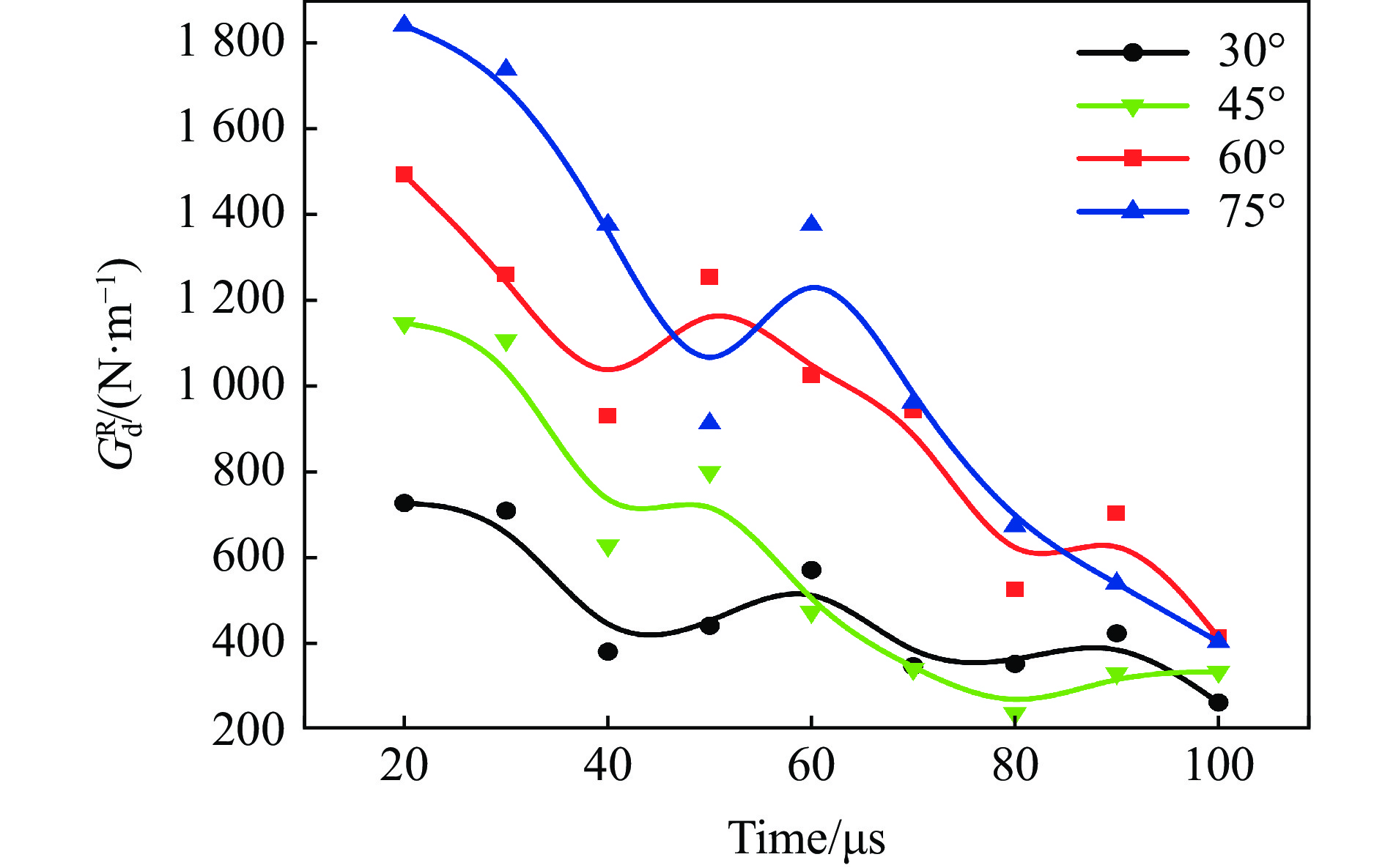
摘要: 为克服岩石爆破过程中裂纹扩展的随机性导致的定向断裂控制难的问题,提高岩石定向断裂爆破的能量利用效率,设计了一种“切缝+聚能”复合型药型罩结构,采用动态焦散线实验与数值模拟相结合的方法,研究了药型罩开口角度对裂纹扩展与能量释放的影响。结果表明:复合型聚能药型罩能够显著增强聚能方向裂纹扩展并抑制非聚能方向损伤,聚能效应随开口角增大呈先增强后减弱的变化规律。开口角为60°时,裂纹扩展长度、裂纹扩展速度、聚能与非聚能方向分形维数比值及动态应力强度因子均达到峰值,定向断裂效果最佳;能量释放率随开口角增大呈上升趋势,在75°时达到746.05 N/m。数值模拟显示,开口角为60°时形成的金属射流形态最完整、头部速度最高,对岩石的侵彻深度和入射孔径分别达到21.5和14.1 mm。Abstract: Crack propagation in rock blasting exhibits strong randomness, making directional fracture control difficult and leading to low energy utilization efficiency, which remains a key issue in controlled blasting. To improve the energy utilization efficiency in directional fracturing, a composite shaped charge liner with a “slotting + shaped-charge” structure was designed. A combination of dynamic caustics experiments and numerical simulations was employed to investigate the effects of liner opening angle on crack propagation and energy release. In the experimental study, dynamic caustics technique was used to capture the initiation and evolution of cracks under blasting loading, and key dynamic parameters such as crack propagation velocity and stress intensity factor were obtained from caustic patterns. Meanwhile, fractal dimension analysis was introduced to quantitatively characterize the complexity and directional distribution of blast-induced cracks. In the numerical study, a fluid-structure coupled model was established to simulate the blasting process, enabling further analysis of stress wave propagation, energy release behavior, and the formation and penetration characteristics of the shaped charge jet under different opening angles. The results show that the composite shaped charge liner significantly enhances crack propagation in the energy-focused direction while suppressing damage in non-focused directions. The shaped-charge effect first increases and then decreases with increasing opening angle. When the opening angle is 60°, the crack propagation length, propagation velocity, the ratio of fractal dimensions between focused and non-focused directions, and the dynamic stress intensity factor all reach their peak values, indicating the optimal directional fracturing performance. The energy release rate increases with the opening angle and reaches 746.05 N/m at 75°. Numerical simulations indicate that, at an opening angle of 60°, the formed metal jet exhibits the most coherent morphology and the highest jet-tip velocity, with the penetration depth and inlet aperture reaching 21.5 mm and 14.1 mm, respectively.
-
Key words:
- shaped charge /
- composite shaped charge liner /
- dynamic caustics line /
- fractal dimension
-
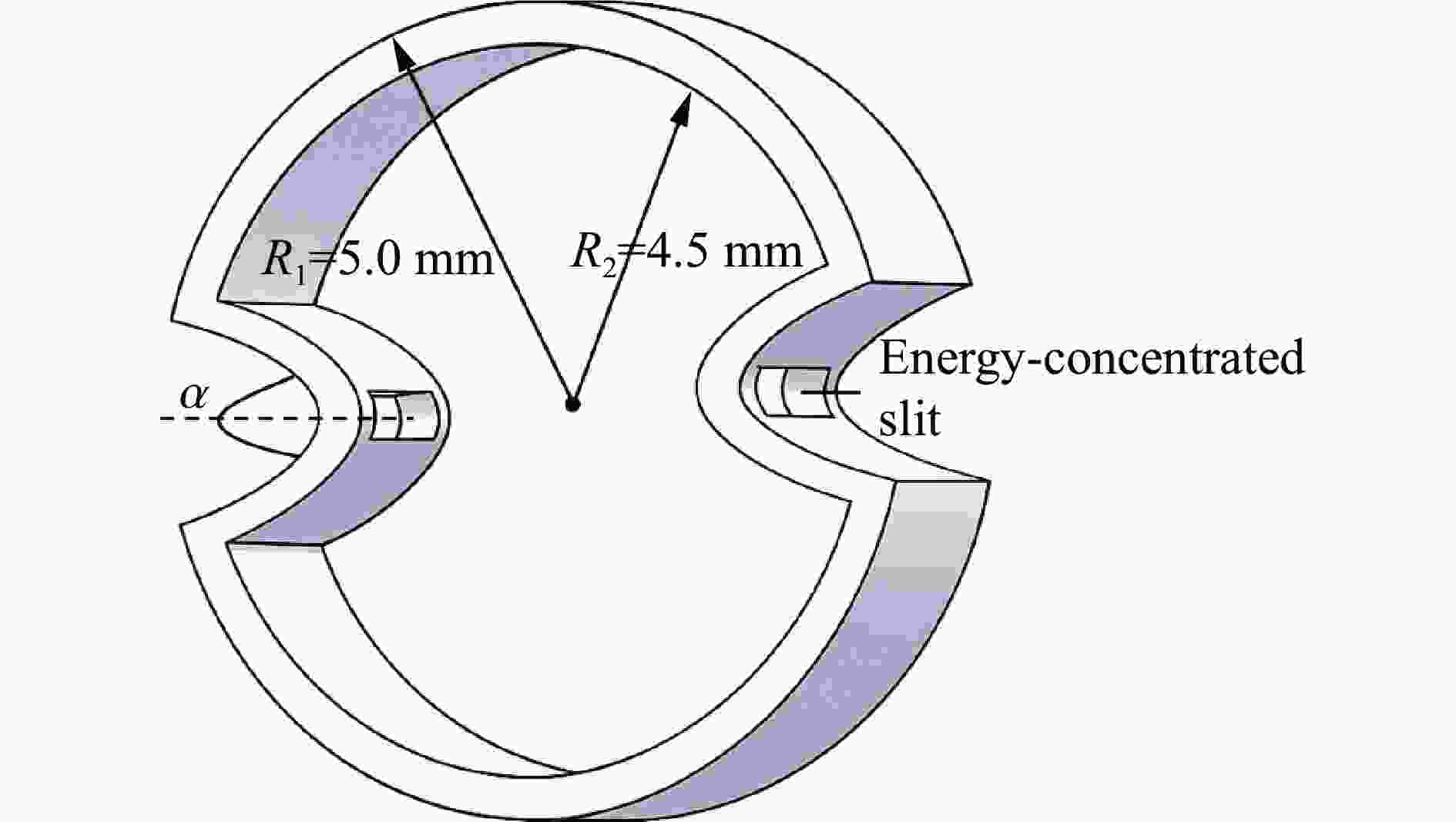
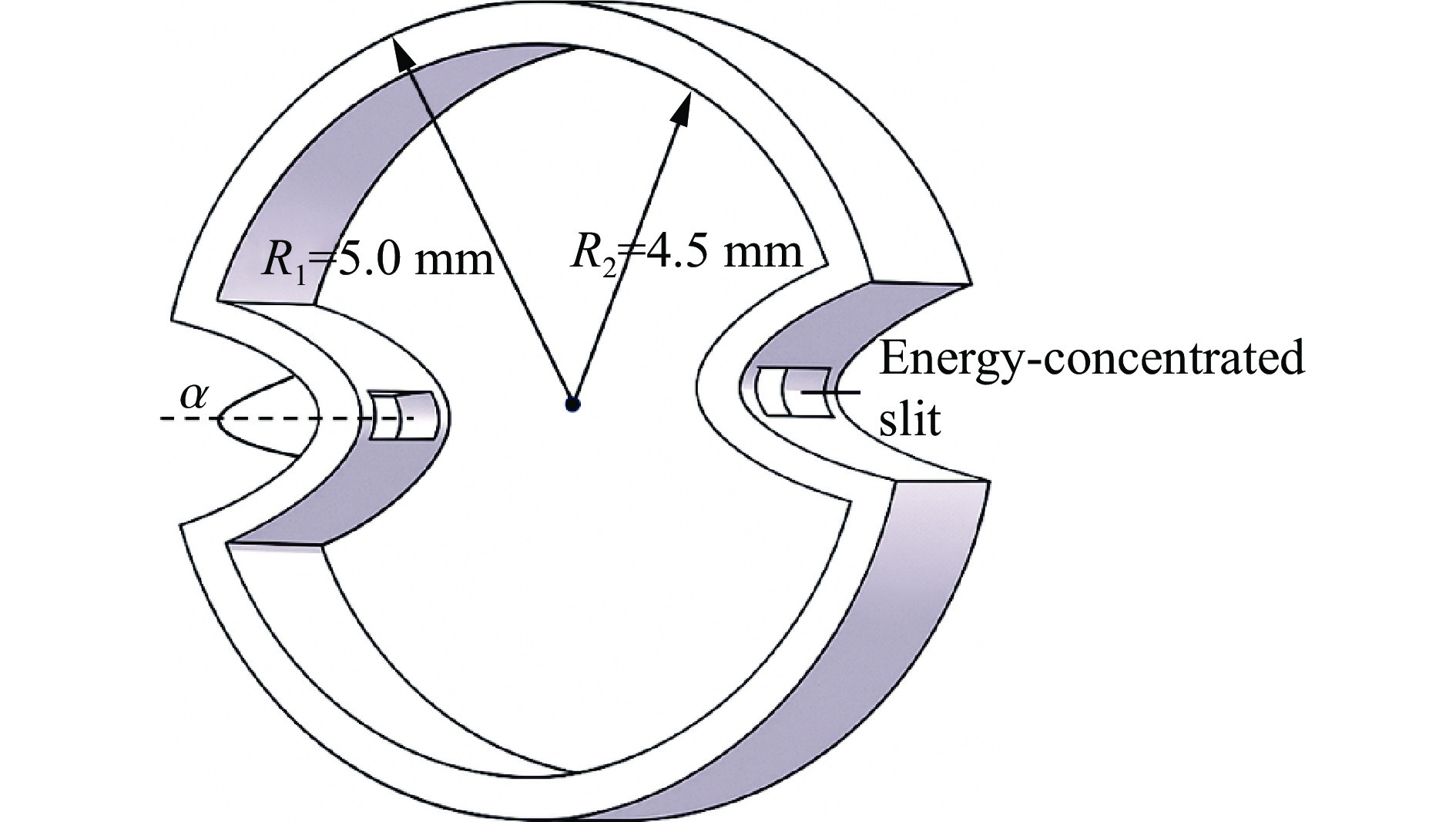
图 3 新型复合结构聚能药型罩示意图
Figure 3. Schematic diagram of the novel composite-structure shaped-charge liner
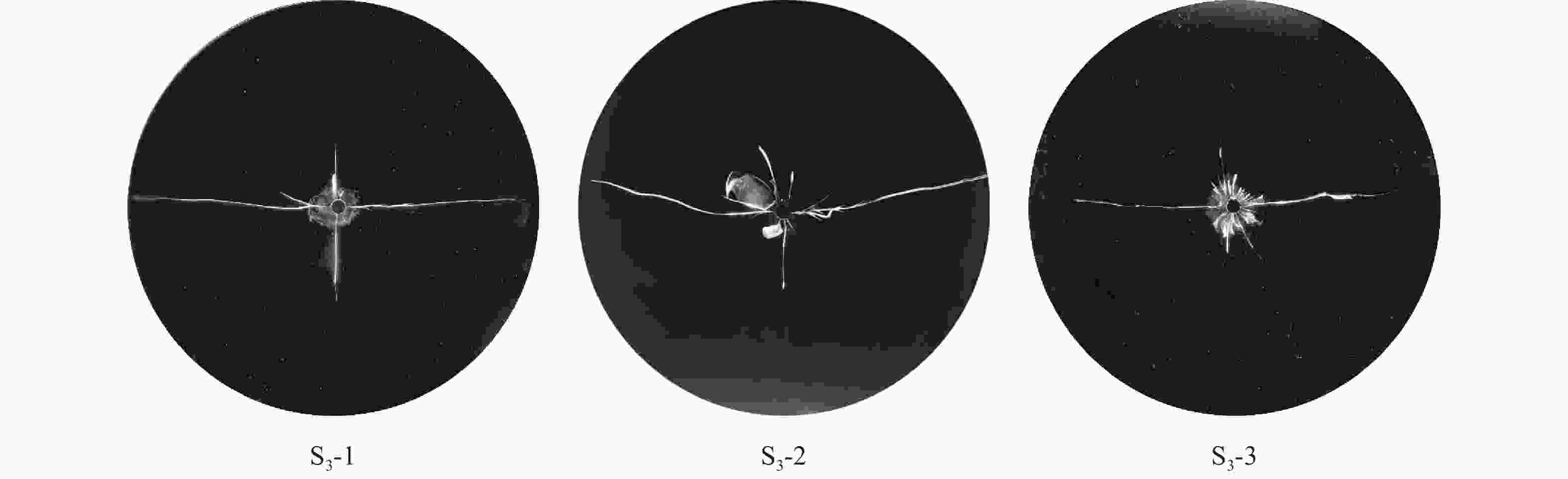
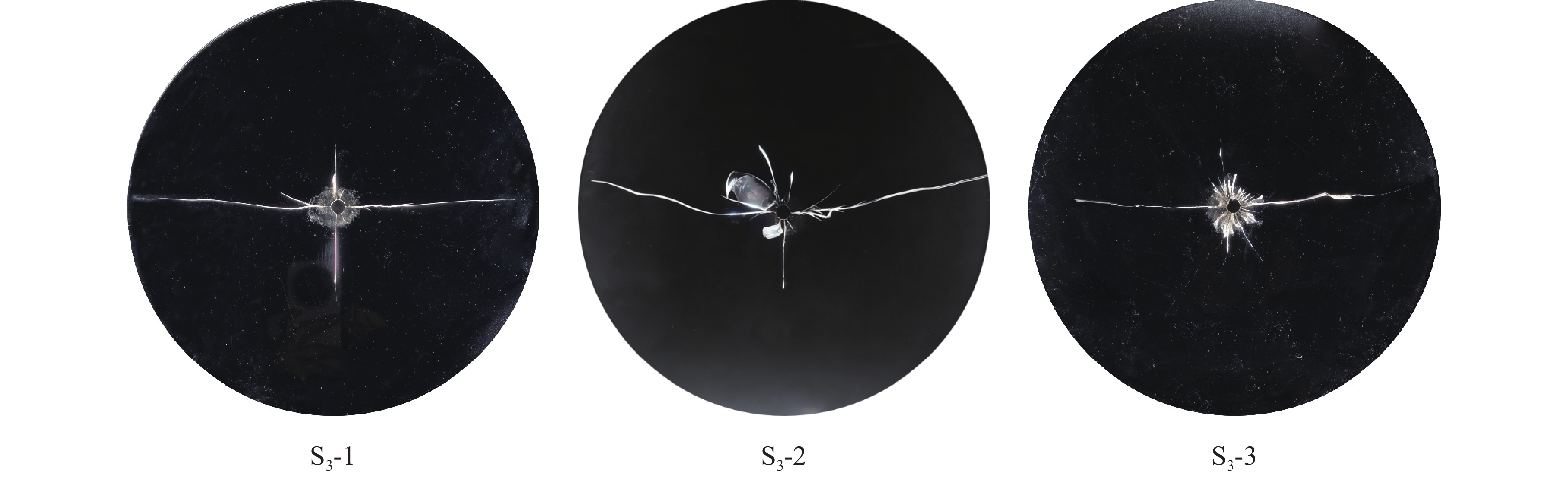
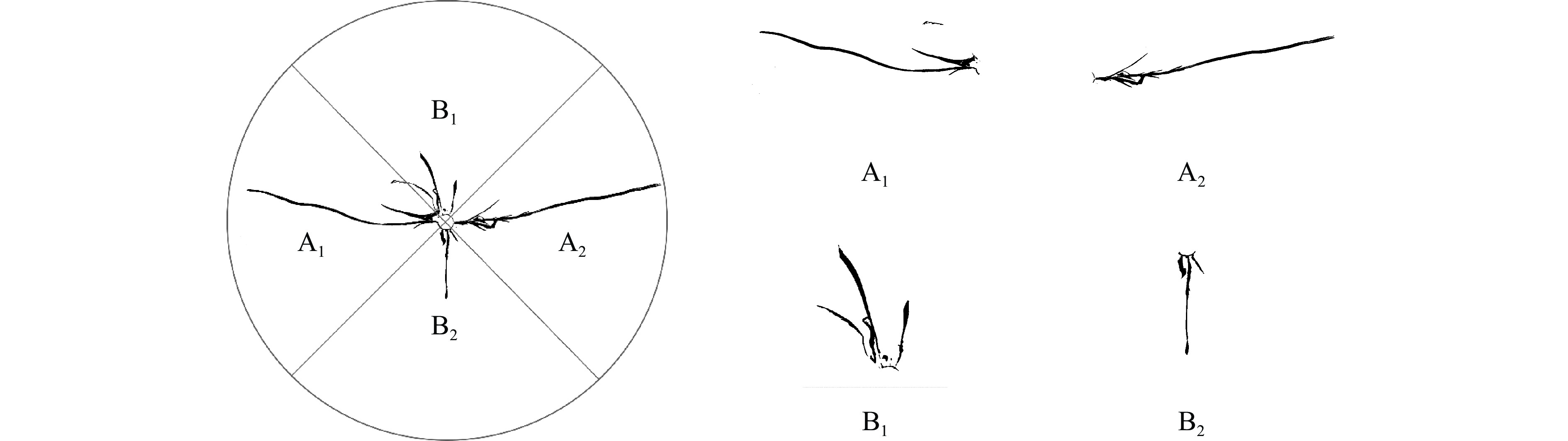
图 5 60°工况重复试验试件断裂形态
Figure 5. Fracture patterns of specimens from repeated tests at an opening angle of 60°
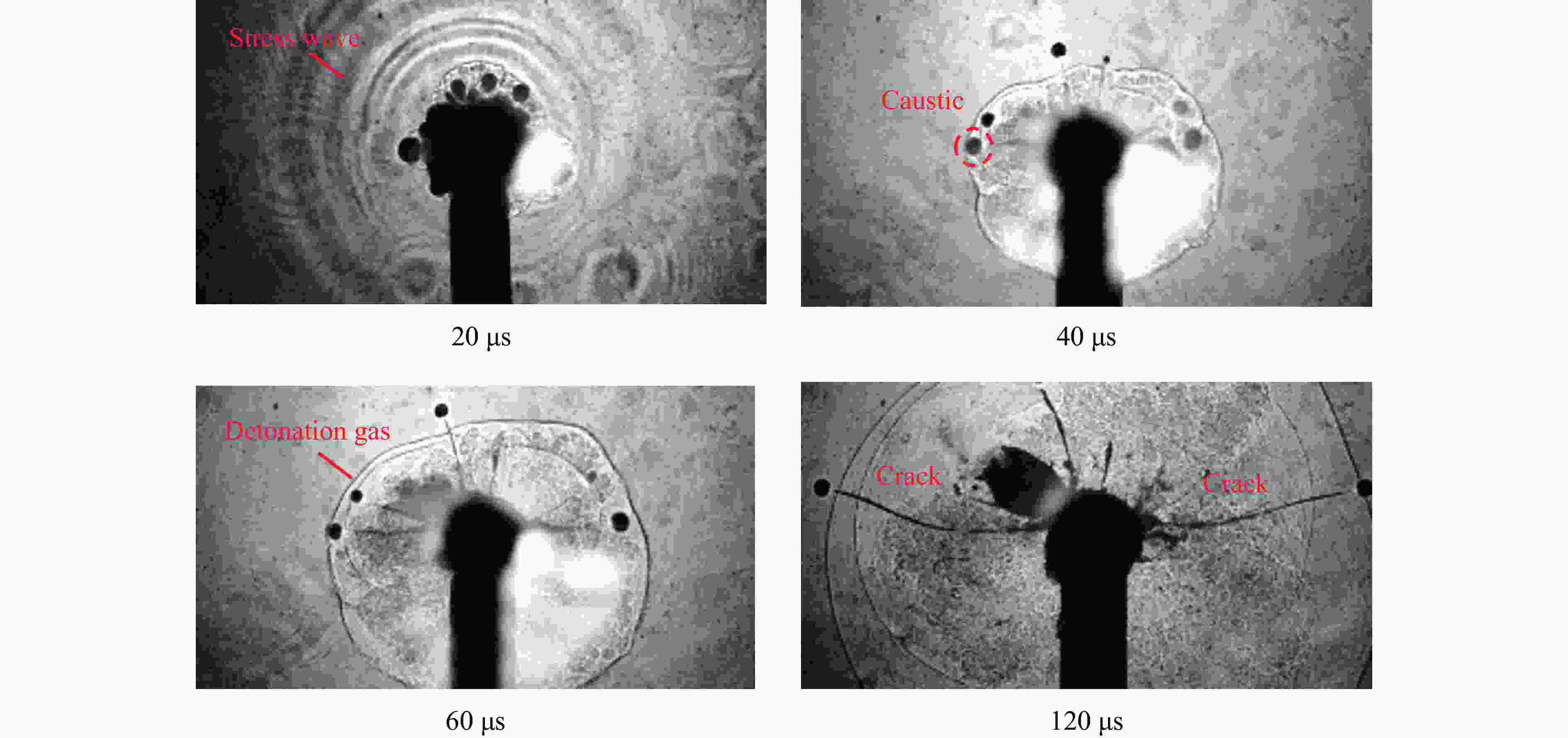
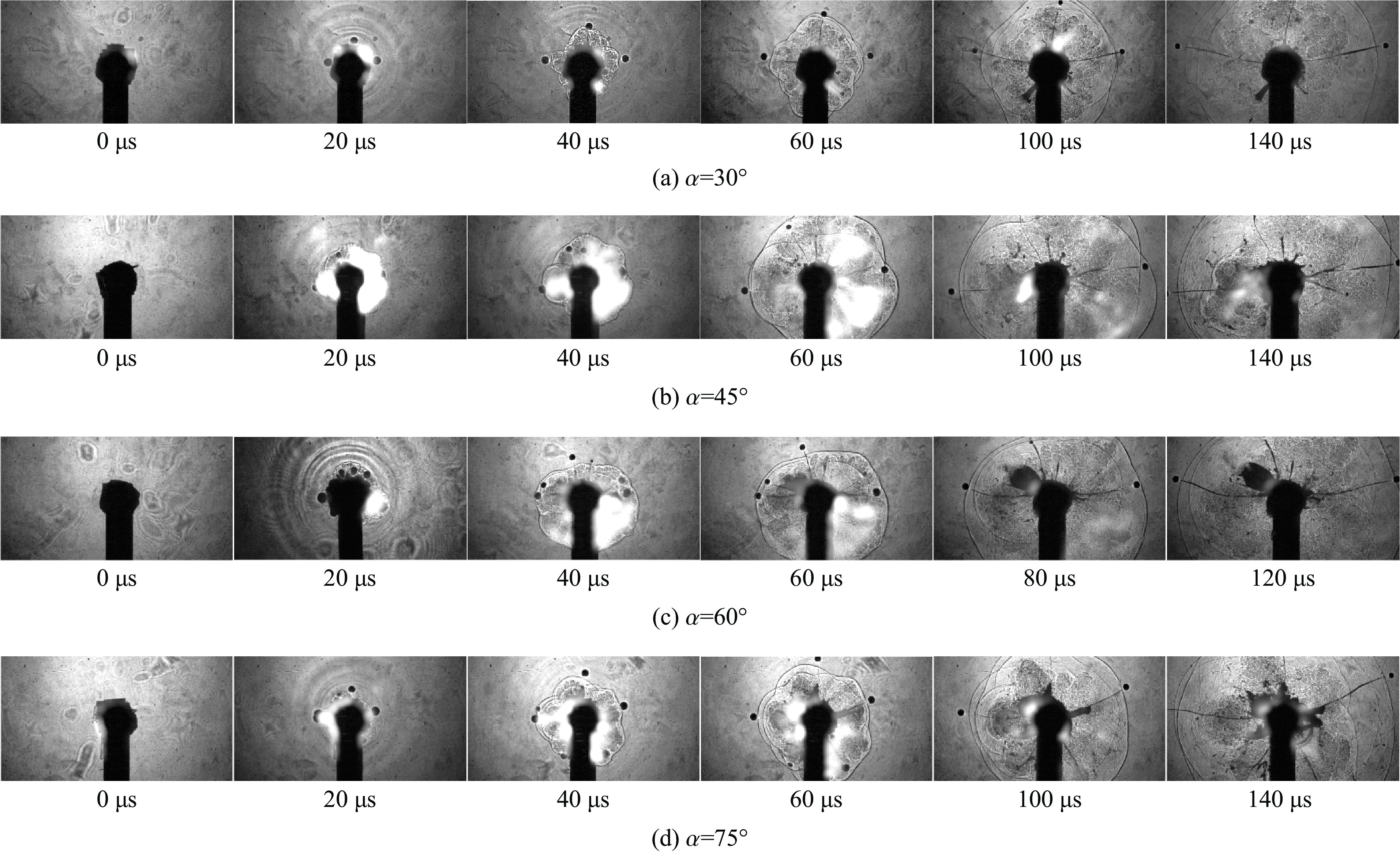
图 8 60°工况裂纹扩展时序图
Figure 8. Time-sequence images of crack propagation at an opening angle of 60°
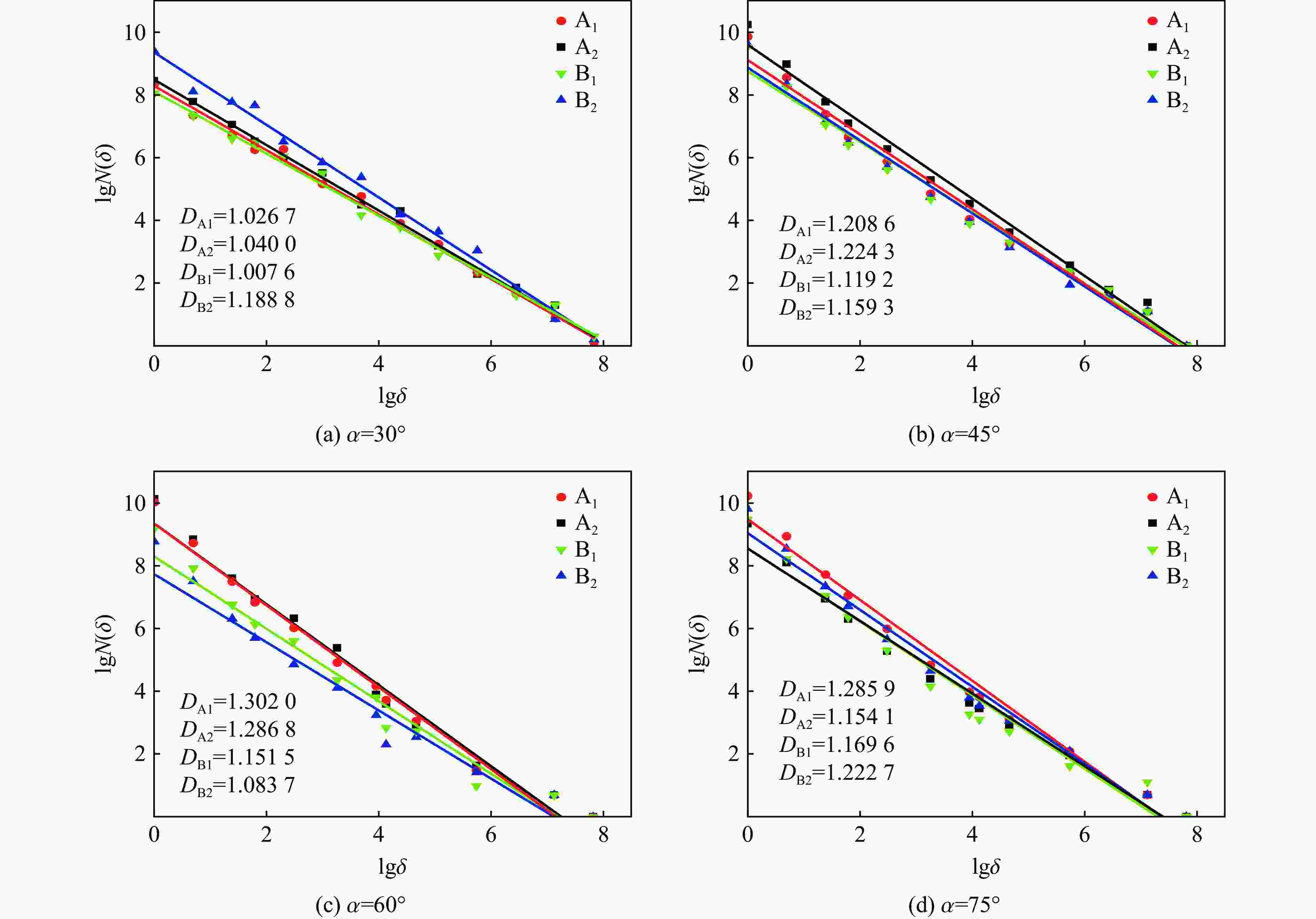
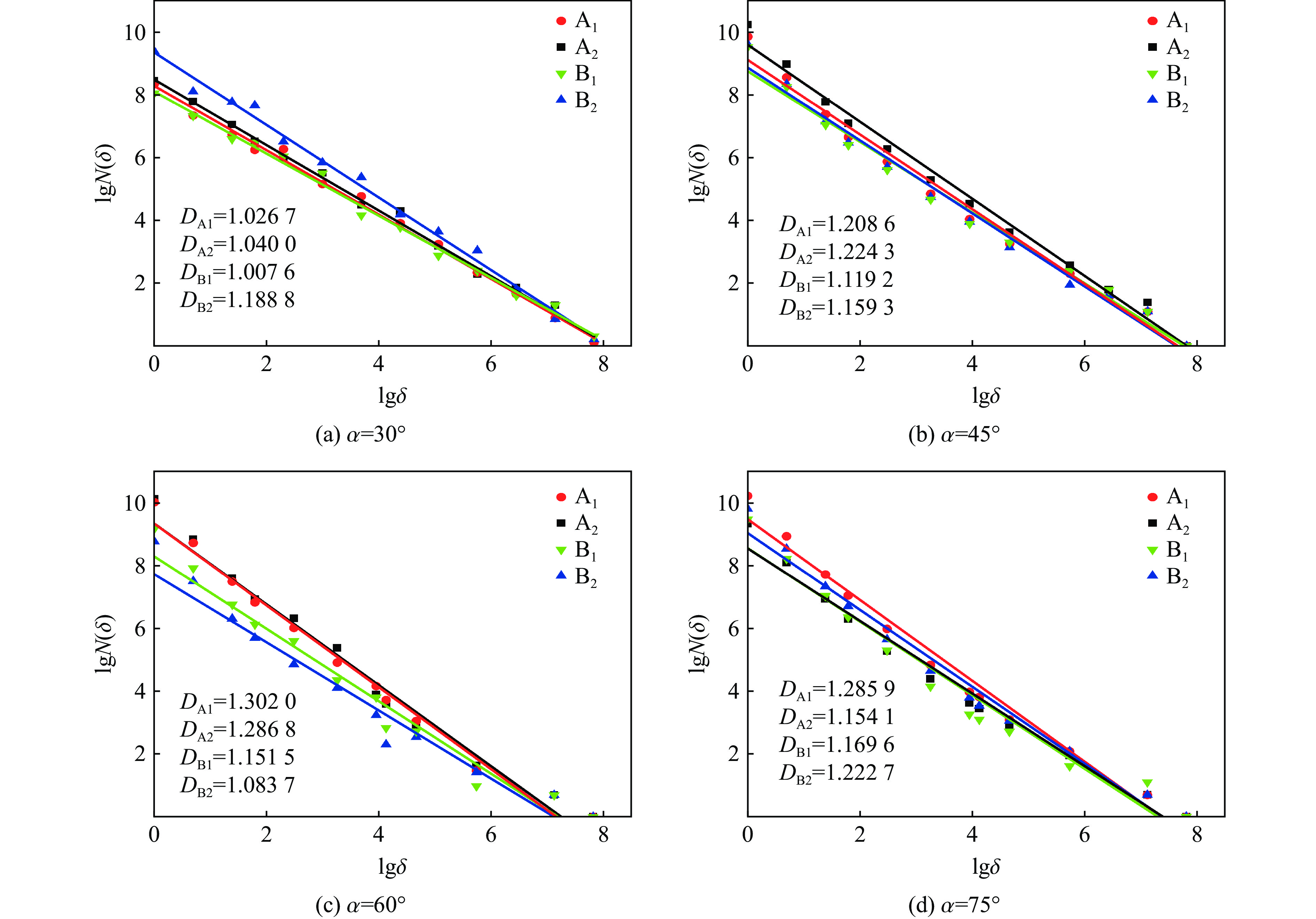
图 11 裂纹轨迹的计盒维数拟合曲线
Figure 11. Fitting curves of the box dimension of the crack trajectory
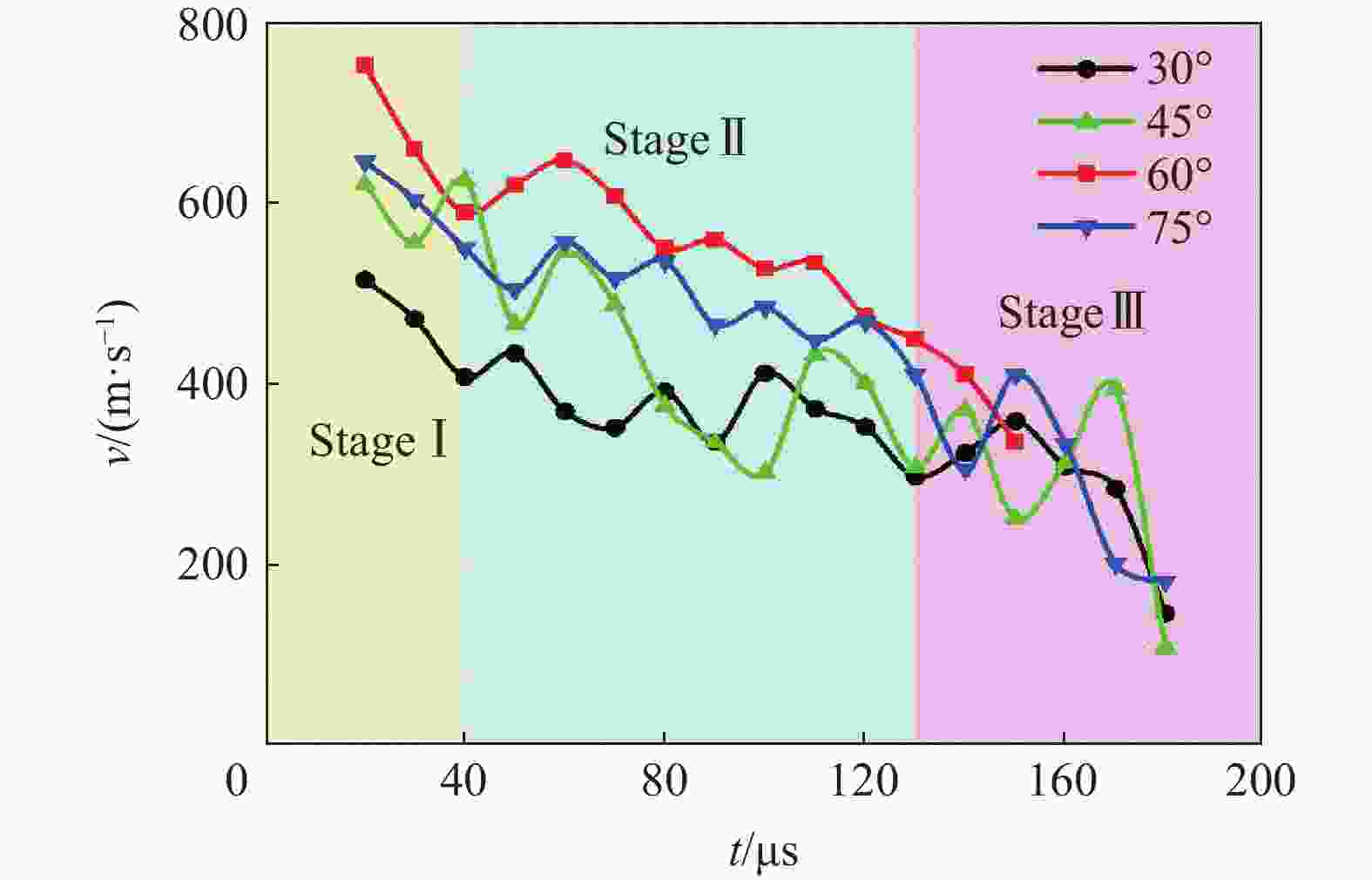
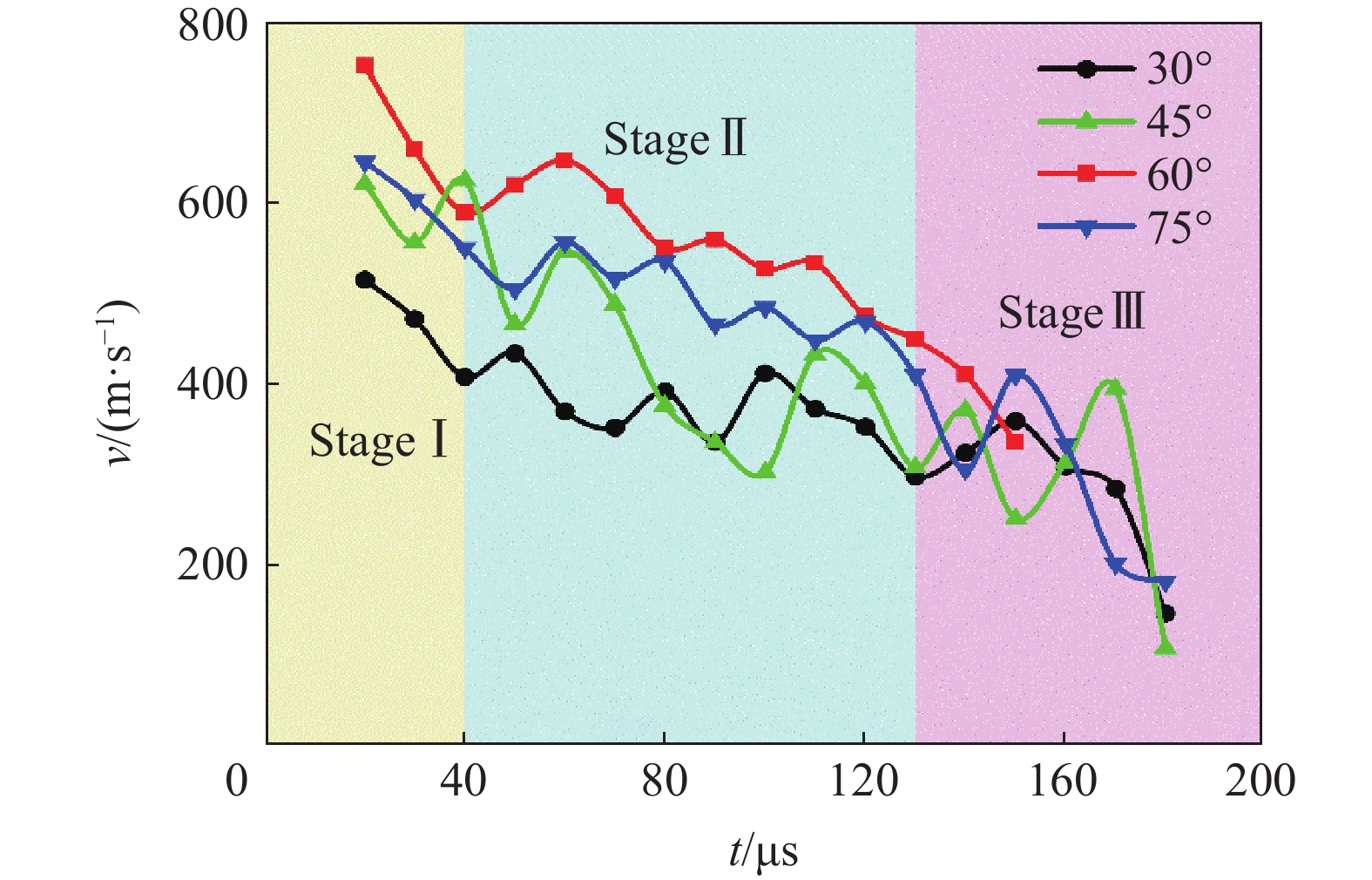
图 12 不同开口角度裂纹扩展速度-时间曲线
Figure 12. Velocity-time curves of crack propagation under different opening angles
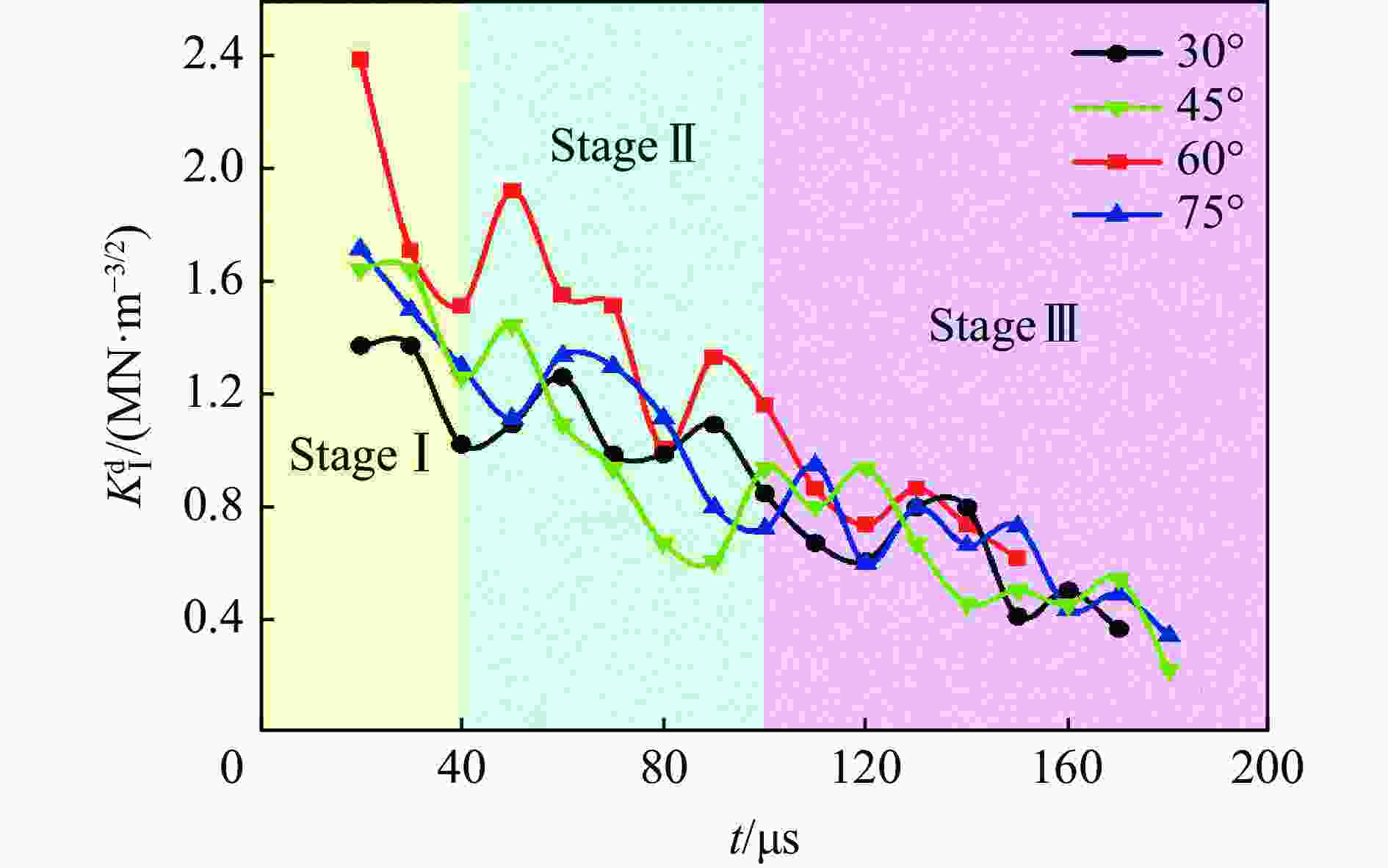
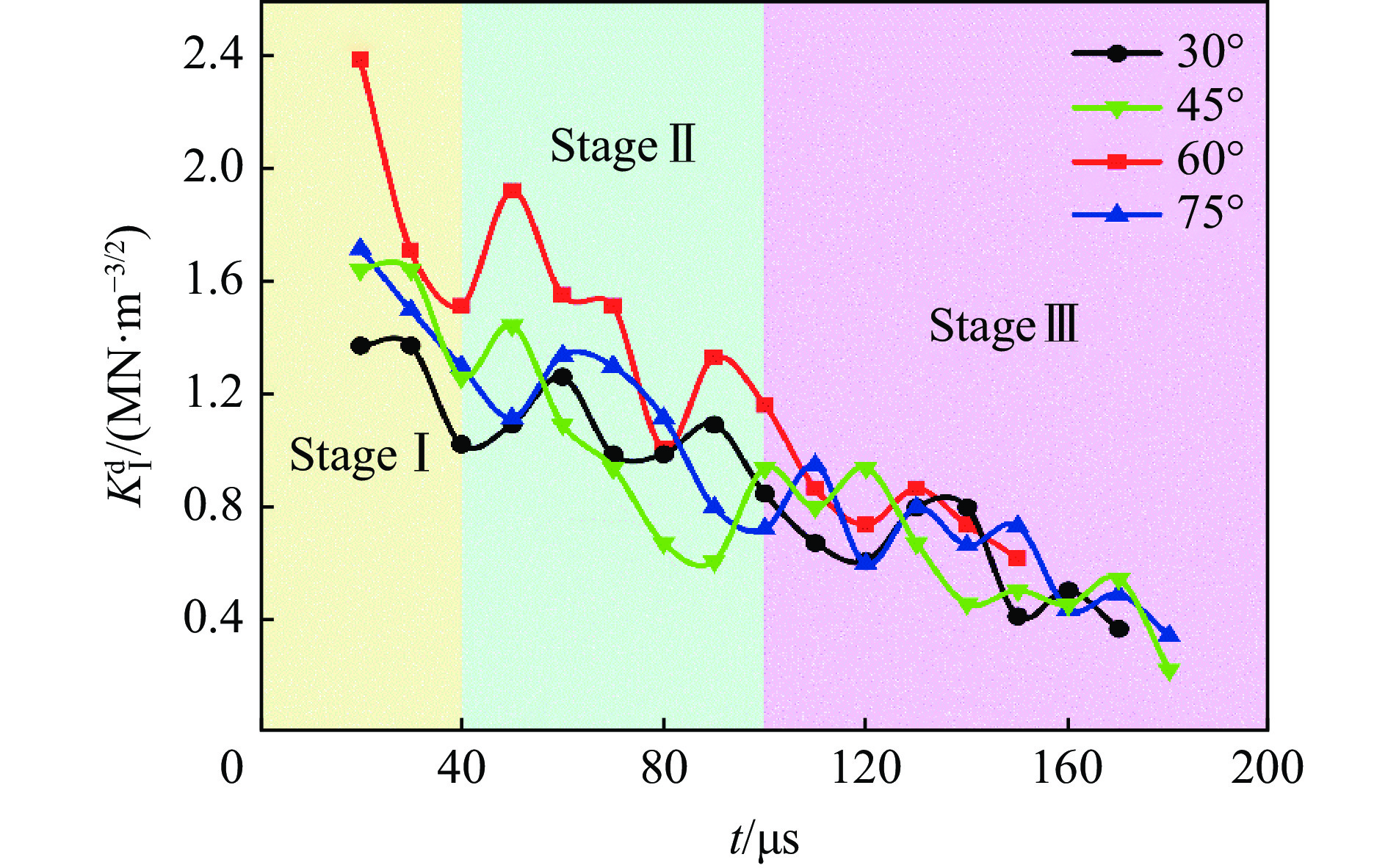
图 13 不同开口角度试件裂纹尖端的应力强度因子
Figure 13. Stress intensity factors at crack tips of specimens with varying opening angles
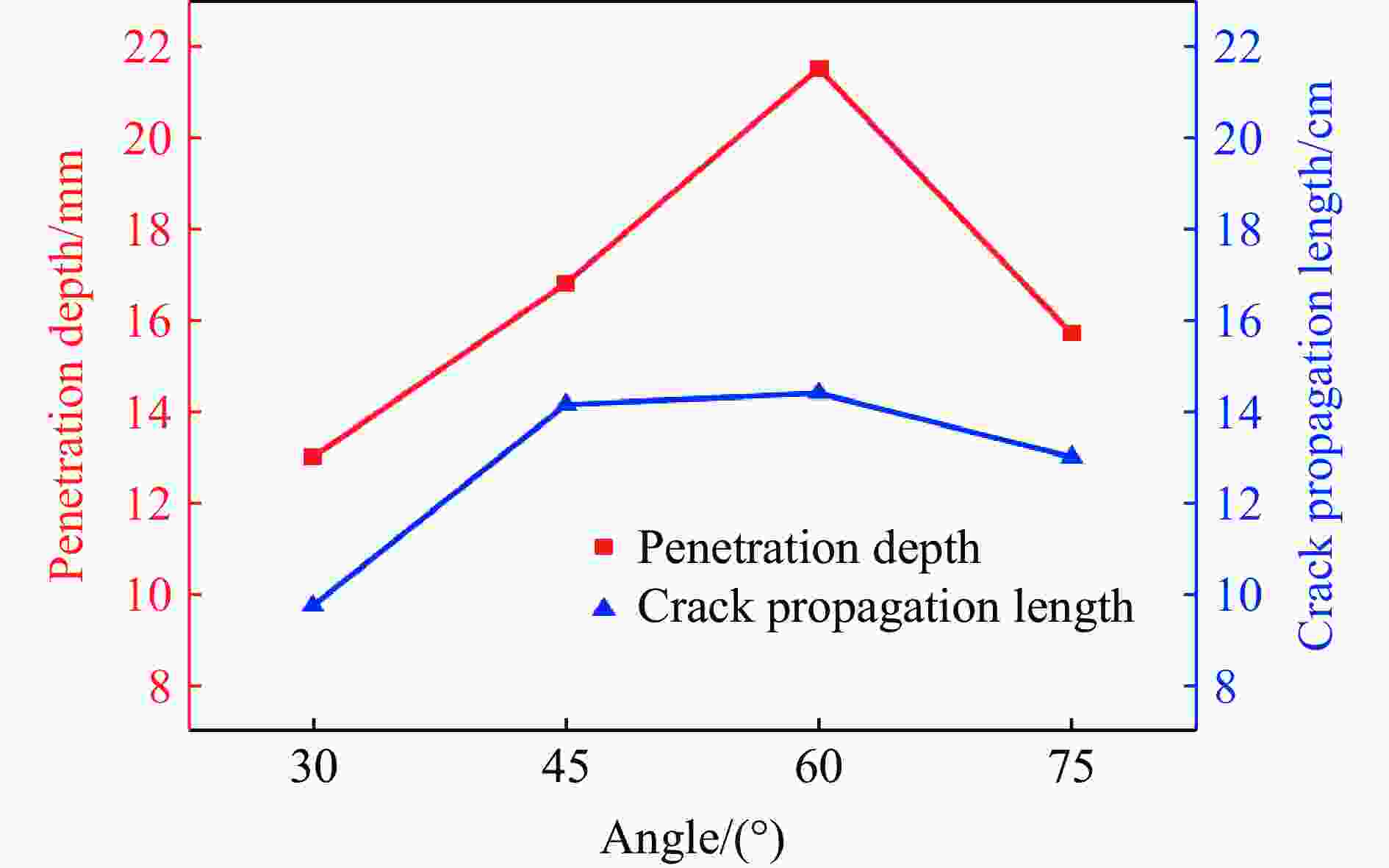
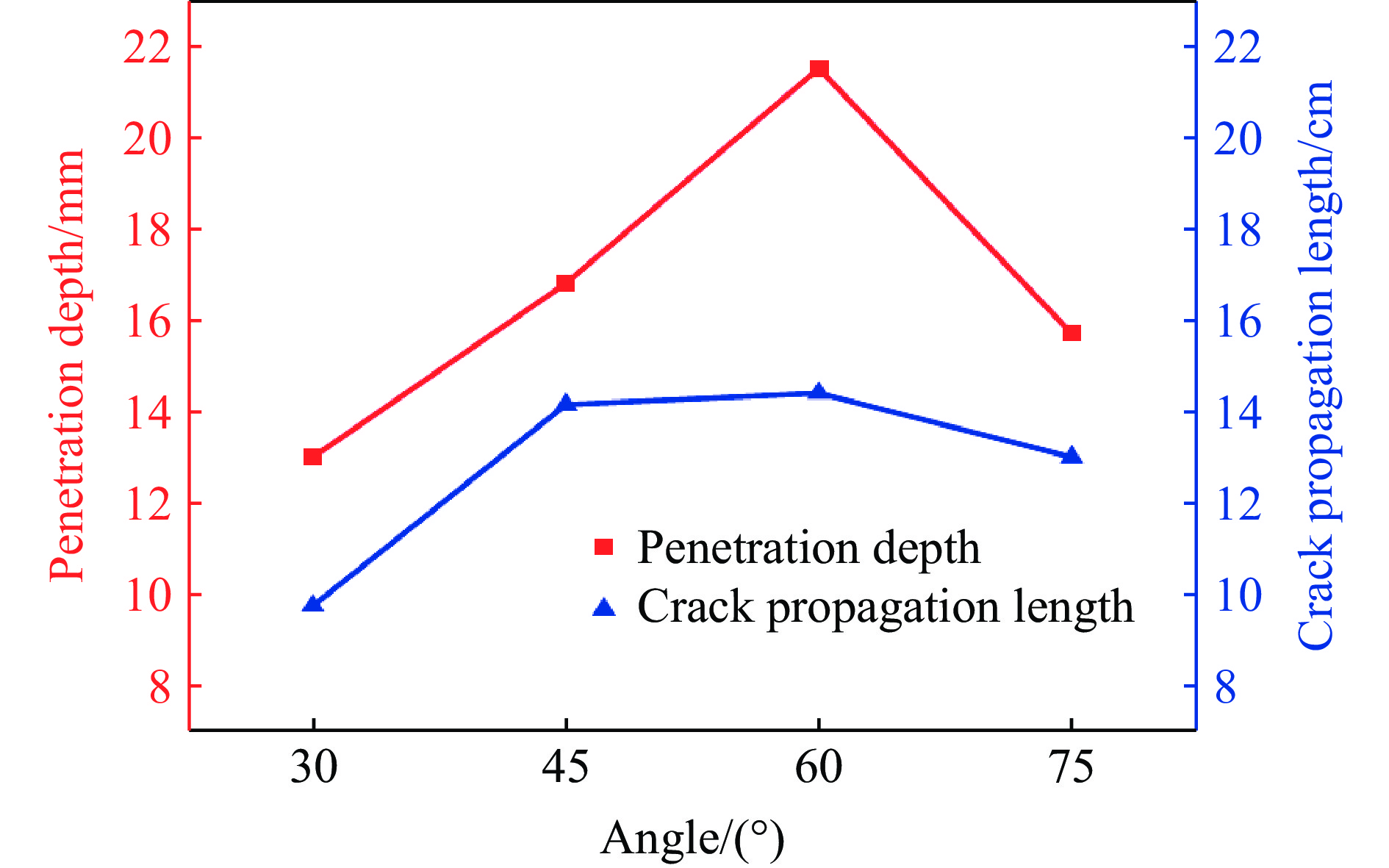
图 18 不同开口角条件下射流侵彻深度与裂纹扩展长度变化关系
Figure 18. Relationship of jet penetration depth and crack propagation length with different opening angles
动态弹性模量/GPa 动态泊松比 膨胀波波速/(m·s−1) 剪切波波速/(m·s−1) 光学常数/(m·N−1) 6.10 0.31 2320 1260 0.85×10⁻¹⁰  下载: 导出CSV
表 2 DDNP爆炸性能
Table 2. Explosion performance of DDNP
爆速/(m·s−1) 爆热/(kJ·kg−1) 爆容/(L·kg−1) 爆温/℃ 6600 5900 2320 4950
下载: 导出CSV
表 3 开口角度为60°时裂纹的扩展长度
Table 3. Extension lengths of cracks with the opening angle 60°
试验 裂纹扩展长度/cm A1 A2 B1 B2 S3-1 14.0 12.2 3.8 5.7 S3-2 14.5 14.3 4.2 4.4 S3-3 12.0 13.5 4.3 3.7
下载: 导出CSV
表 4 不同开口角度下裂纹的扩展长度
Table 4. Extension lengths of cracks with different opening angles
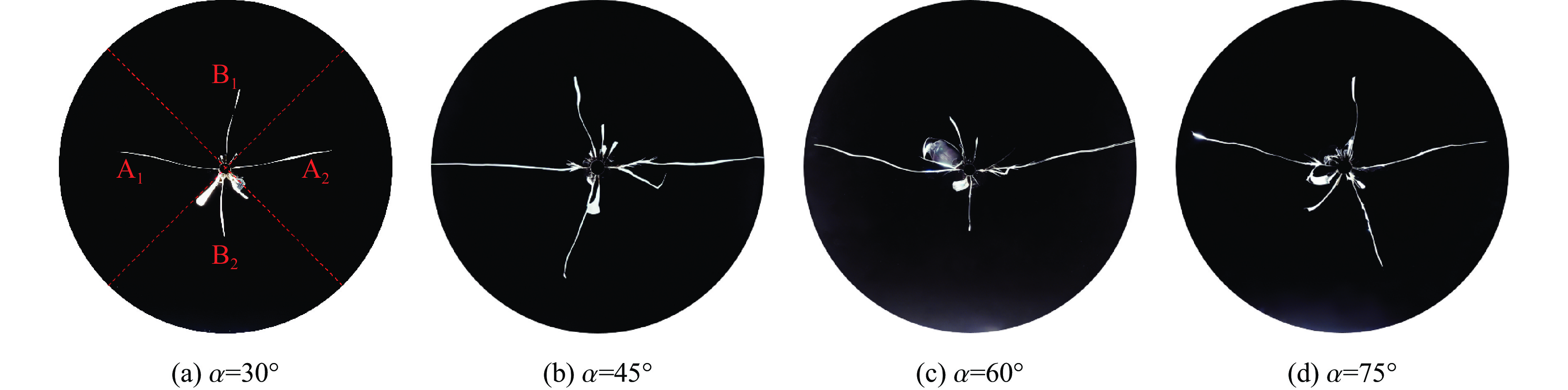
开口角度/(°) 裂纹扩展长度/cm A1 A2 B1 B2 30 9.8 9.7 6.6 4.5 45 14.3 14.0 7.5 9.3 60 14.5 14.3 4.2 4.4 75 12.9 13.1 7.5 8.7
下载: 导出CSV
表 5 分形维数计算结果
Table 5. Calculation results of fractal dimension
开口角度/(°) DA1 DA2 DA DB1 DB2 DB DA/DB 30 1.0267 1.0400 1.0334 1.0076 1.1888 1.0892 0.9488 45 1.2086 1.2243 1.2165 1.1192 1.1593 1.1393 1.0678 60 1.3020 1.2868 1.2944 1.1515 1.0837 1.1176 1.1582 75 1.2859 1.1541 1.2200 1.1696 1.2227 1.1962 1.0199
下载: 导出CSV
ρ/(kg·m−3) G/GPa σt/MPa σc/MPa 2400 21.9 2.2 35 注:ρ为密度;G为岩石剪切模量;σt为岩石抗拉强度;σc为岩石抗压强度。
下载: 导出CSV
表 7 铜药型罩材料参数及状态方程参数[34]
Table 7. Material parameters and state equation parameters of copper alloy hood[34]
ρ/(g·cm−3) E/GPa ν σy/MPa γ0 C1 S1 S2 8.93 117 0.35 70 1.99 3.94×10³ 1.489 0 注:ρ为密度;E为弹性模量;ν为泊松比;σy为屈服强度;γ0为Grüneisen系数;C1为材料声速;S1为Hugoniot 关系一阶系数;S2为Hugoniot关系二阶系数。
下载: 导出CSV
表 8 炸药的材料参数及JWL方程参数[36]
Table 8. Material parameters of explosives and parameters of JWL equation[36]
ρ/(kg·m−3) E0/GPa A/GPa B/GPa R1 R2 ω 1630 7.0 373.8 3.75 4.15 0.90 0.35
下载: 导出CSV
表 9 数值计算侵彻结果
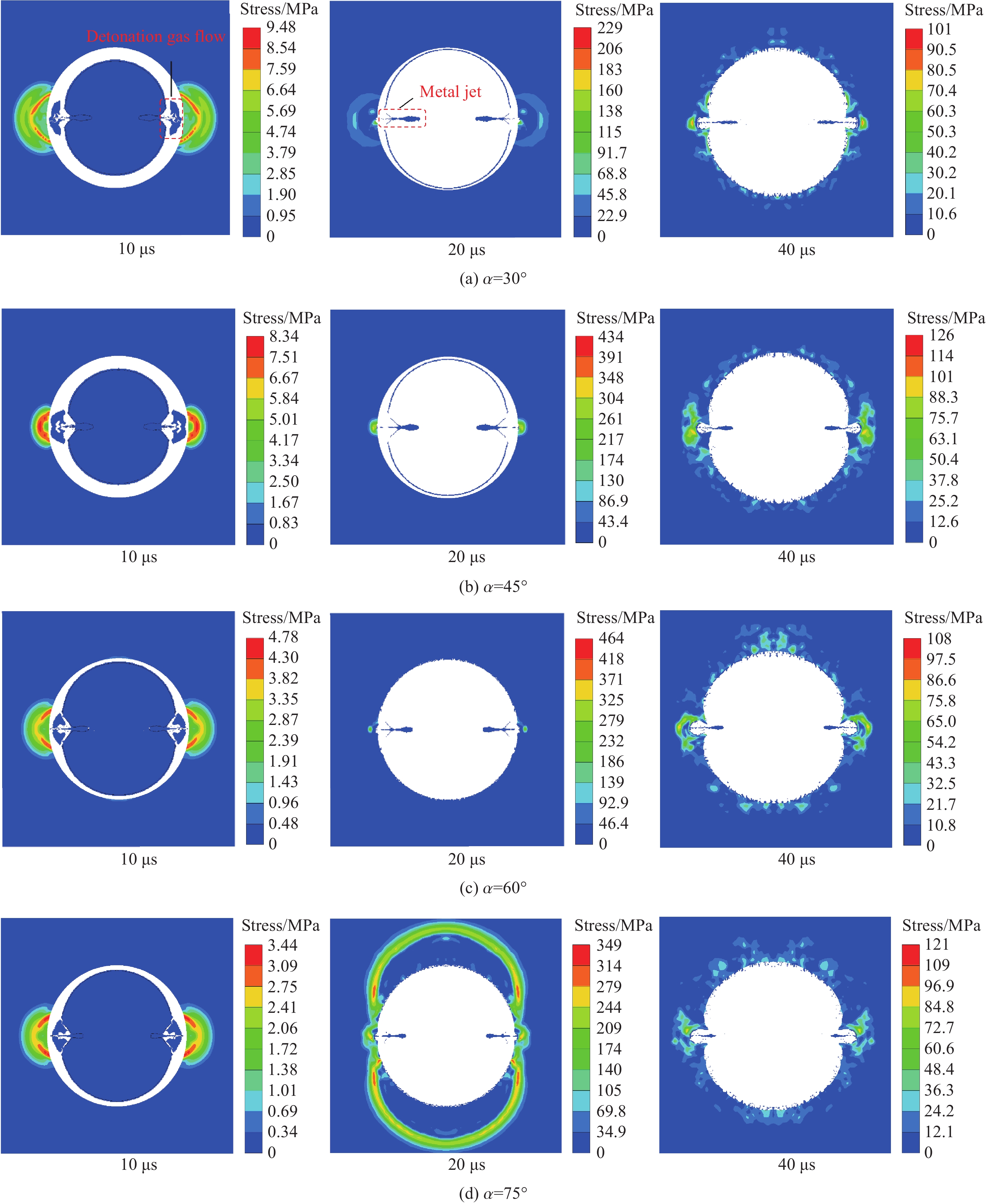
Table 9. Numerical calculation of piercing results
开口角度/(°) 侵彻深度/mm 入射孔径/cm 30 13.0 10.1 45 16.8 11.4 60 21.5 14.1 75 15.7 8.4
下载: 导出CSV
-
[1] LYU G P, ZHOU C B, JIANG N. Experimental and numerical study on tunnel blasting induced damage characteristics of grouted surrounding rock in fault zones [J]. Rock Mechanics and Rock Engineering, 2023, 56(1): 603–617. DOI: 10.1007/s00603-022-03055-8. [2] MAO X, MA T B, LIU J. Structure optimization of linear shaped charge based on different explosives [J]. Propellants, Explosives, Pyrotechnics, 2024, 49(5): e202300321. DOI: 10.1002/PREP.202300321. [3] 何满潮, 郭鹏飞, 张晓虎, 等. 基于双向聚能拉张爆破理论的巷道顶板定向预裂 [J]. 爆炸与冲击, 2018, 38(4): 795–803. DOI: 10.11883/bzycj-2016-0359.HE M C, GUO P F, ZHANG X H, et al. Directional pre-splitting of roadway roof based on the theory of bilateral cumulative tensile explosion [J]. Explosion and Shock Waves, 2018, 38(4): 795–803. DOI: 10.11883/bzycj-2016-0359. [4] 宋俊生, 王雁冰, 高祥涛, 等. 定向断裂控制爆破机理及应用 [J]. 矿业科学学报, 2016, 1(1): 16–28. DOI: 10.19606/j.cnki.jmst.2016.01.004.SONG J S, WANG Y B, GAO X T, et al. The mechanism of directional fracture controlled blasting and its application [J]. Journal of Mining Science and Technology, 2016, 1(1): 16–28. DOI: 10.19606/j.cnki.jmst.2016.01.004. [5] 杨仁树, 陈岗, 岳中文, 等. 切缝药包爆破中爆生气体作用的试验研究 [J]. 煤矿爆破, 2009(4): 1–3.YANG R S, CHEN G, YUE Z W, et al. Experimental study on the action of detonation gas under cutting seam cartridge blasting [J]. Coal Mine Blasting, 2009(4): 1–3. [6] 杨仁树, 王雁冰, 薛华俊, 等. 切缝药包爆破岩石爆生裂纹断面的SEM试验 [J]. 中国矿业大学学报, 2013, 42(3): 337–341. DOI: 10.13247/j.cnki.jcumt.2013.03.002.YANG R S, WANG Y B, XUE H J, et al. SEM experiment of rock crack cross section morphology after explosion fracturing with slotted cartridge [J]. Journal of China University of Mining & Technology, 2013, 42(3): 337–341. DOI: 10.13247/j.cnki.jcumt.2013.03.002. [7] XIAO C L, YANG R S, Li Q, et al. Experiment on blasting damage and dynamic caustics of jointed medium [J]. Engineering Fracture Mechanics, 2022, 259: 108143. DOI: 10.1016/J.ENGFRACMECH.2021.108143. [8] XIE H G, WANG Z X, LI C, et al. Directional fracture blasting experimental study [J]. Applied Mechanics and Materials, 2013, 341/342: 1477–1481. DOI: 10.4028/www.scientific.net/AMM.341-342.1477. [9] KANG Y Q, LI Y, XIAO C L, et al. Fractal damage and crack propagation of PMMA in multiple slit charge blasting [J]. Materials Today Communications, 2022, 31: 103249. DOI: 10.1016/J.mtcomm.2022.103249. [10] DING C X, YANG R S, XIAO C L, et al. Directional fracture behavior and stress evolution process of the multi-slit charge blasting [J]. Soil Dynamics and Earthquake Engineering, 2022, 152: 107037. DOI: 10.1016/J.SOILDYN.2021.107037. [11] YIN Y, SUN Q, ZOU B P, et al. Numerical study on an innovative shaped charge approach of rock blasting and the timing sequence effect in microsecond magnitude [J]. Rock Mechanics and Rock Engineering, 2021, 54(9): 4523–4542. DOI: 10.1007/s00603-021-02516-w. [12] WU B, XU S X, MENG G W, et al. Study on dynamic evolution law of blasting cracks in elliptical bipolar linear shaped charge blasting [J]. Shock and Vibration, 2021, 2021: 5272878. DOI: 10.1155/2021/5272878. [13] 申涛, 罗宁, 向俊庠, 等. 切缝药包爆炸作用机理数值模拟 [J]. 爆炸与冲击, 2018, 38(5): 1172–1180. DOI: 10.11883/bzycj-2017-0410.SHEN T, LUO N, XIANG J X, et al. Numerical simulation on explosion mechanism of split-tube charge holders [J]. Explosion and Shock Waves, 2018, 38(5): 1172–1180. DOI: 10.11883/bzycj-2017-0410. [14] GUO Y C, YANG R S, PENG S P, et al. Experimental study on decoupled charge blasting-induced crack propagation with parabolic shaped charge [J]. Engineering Fracture Mechanics, 2024, 304: 110178. DOI: 10.1016/j.engfracmech.2024.110178. [15] 岳中文, 郭洋, 许鹏, 等. 定向断裂控制爆破的空孔效应实验分析 [J]. 爆炸与冲击, 2015, 35(3): 304–311. DOI: 10.11883/1001-1455-(2015)03-0304-08.YUE Z W, GUO Y, XU P, et al. Analysis of empty hole effect in directional fracture controlled blasting [J]. Explosion and Shock Waves, 2015, 35(3): 304–311. DOI: 10.11883/1001-1455-(2015)03-0304-08. [16] 李清, 薛耀东, 于强, 等. 含预制裂纹的悬臂梁-柱试件冲击断裂实验 [J]. 矿业科学学报, 2018, 3(2): 139–147. DOI: 10.19606/j.cnki.jmst.2018.02.005.LI Q, XUE Y D, YU Q, et al. Experimental study on impact fracture of cantilever beam-column specimen with prefabricated crack [J]. Journal of Mining Science and Technology, 2018, 3(2): 139–147. DOI: 10.19606/j.cnki.jmst.2018.02.005. [17] 杨仁树, 丁晨曦, 王雁冰, 等. 爆炸应力波与爆生气体对被爆介质作用效应研究 [J]. 岩石力学与工程学报, 2016, 35(S2): 3501–3506. DOI: 10.13722/j.cnki.jrme.2016.0066.YANG R S, DING C X, WANG Y B, et al. Action-effect study of medium under loading of explosion stress wave and explosion gas [J]. Chinese Journal of Rock Mechanics and Engineering, 2016, 35(S2): 3501–3506. DOI: 10.13722/j.cnki.jrme.2016.0066. [18] 刘彩连, 陈朗, 刘丹阳, 等. 药型罩锥角和壁厚对聚能射流速度影响的分析 [J]. 北京理工大学学报, 2015, 35(S2): 86–89.LIU C L, CHEN L, LIU D Y, et al. Effects of cone angles or thicknesses of liner on shaped charge jet velocity [J]. Transactions of Beijing institute of Technology, 2015, 35(S2): 86–89. [19] LI X L, YAN S Q, WANG J G, et al. Influence of slot width in cartridge on crack propagation and energy concentration under explosion load [J]. Rock Mechanics and Rock Engineering, 2024, 58(2): 1707–1721. DOI: 10.1007/S00603-024-04199-5. [20] WANG L Z, MEHRMASHHADI J, BOBARU F. Interfaces in dynamic brittle fracture of PMMA: a peridynamic analysis [J]. International Journal of Fracture, 2023, 244(1/2): 217–245. DOI: 10.1007/S10704-023-00731-W. [21] FOURNIER V, GIRARDOT J, KOPP B J. Revisiting dynamic fracture in PMMA: the interplay between local and global methods [J]. International Journal of Fracture, 2025, 249(3): 47. DOI: 10.1007/S10704-025-00865-Z. [22] ROSSMANITH H P, DAEHNKE A, NASMILLNER R E K, et al. Fracture mechanics applications to drilling and blasting [J]. Fatigue & Fracture of Engineering Materials & Structures, 1997, 20(11): 1617–1636. DOI: 10.1111/j.1460-2695.1997.tb01515.x. [23] 谢和平, 陈至达. 分形(fractal)几何与岩石断裂 [J]. 力学学报, 1988, 20(3): 264–271. DOI: 10.3969/j.issn.1000-7598.2008.02.011.XIE H P, CHEN Z D. Fractal geometry and fracture of rock [J]. Acta Mechanica Sinica, 1988, 20(3): 264–271. DOI: 10.3969/j.issn.1000-7598.2008.02.011. [24] 杨仁树, 肖成龙, 李永亮, 等. 不耦合偏心装药结构爆破损伤破坏的分形研究 [J]. 振动与冲击, 2020, 39(12): 129–134. DOI: 10.13465/j.cnki.jvs.2020.12.017.YANG R S, XIAO C L, LI Y L, et al. A fractal study on blasting damage of an eccentric decouple charge structure [J]. Journal of Vibration and Shock, 2020, 39(12): 129–134. DOI: 10.13465/j.cnki.jvs.2020.12.017. [25] 杨仁树, 肖成龙, 陈程, 等. 基于分形理论不同装药量的爆破动焦散线实验研究 [J]. 振动与冲击, 2020, 39(14): 80–86,93. DOI: 10.13465/j.cnki.jvs.2020.14.012.YANG R S, XIAO C L, CHEN C, et al. Experimental study on the blasting dynamic caustics under different charge weight based on the fractal theory [J]. Journal of Vibration and Shock, 2020, 39(14): 80–86,93. DOI: 10.13465/j.cnki.jvs.2020.14.012. [26] FREUND L B. Dynamic fracture mechanics [M]. Cambridge: Cambridge University Press, 1998. [27] WALTERS W P, ZUKAS J A. Fundamentals of shaped charges[M]. New York: Wiley, 1989. [28] KAN J L, DOU L M, LI X W, et al. Effect of initiation pattern on rock damage and blasting seismic under multi-hole blasting [J]. Geomatics, Natural Hazards and Risk, 2023, 14(1): 2192334. DOI: 10.1080/19475705.2023.2192334. [29] WANG Z L, WANG H C, WANG J G, et al. Finite element analyses of constitutive models performance in the simulation of blast-induced rock cracks [J]. Computers and Geotechnics, 2021, 135: 104172. DOI: 10.1016/j.compgeo.2021.104172. [30] WEI S J, LI J J, WANG M, et al. Parameter determination and numerical simulation of the sandstone HJC constitutive model [J]. ACS Omega, 2025, 10(18): 18744–18752. DOI: 10.1021/ACSOMEGA.5C00300. [31] 方秦, 孔祥振, 吴昊, 等. 岩石Holmquist-Johnson-Cook模型参数的确定方法 [J]. 工程力学, 2014, 31(3): 197–204. DOI: 10.6052/j.issn.1000-4750.2012.10.0780.FANG Q, KONG X Z, WU H, et al. Determination of Holmquist-Johnson-Cook consitiutive model parameters of rock [J]. Engineering Mechanics, 2014, 31(3): 197–204. DOI: 10.6052/j.issn.1000-4750.2012.10.0780. [32] MARDALIZAD A, SAKSALA T, MANES A, et al. Numerical modeling of the tool-rock penetration process using FEM coupled with SPH technique [J]. Journal of Petroleum Science and Engineering, 2020, 189: 107008. DOI: 10.1016/j.petrol.2020.107008. [33] WANG J X, YIN Y, ESMAIELI K. Numerical simulations of rock blasting damage based on laboratory-scale experiments [J]. Journal of Geophysics and Engineering, 2018, 15(6): 2399–2417. DOI: 10.1088/1742-2140/aacf17. [34] FENG H, WU H, FANG Q, et al. Numerical simulations of shaped charge jet penetration into concrete-like targets [J]. International Journal of Protective Structures, 2017, 8(2): 237–259. DOI: 10.1177/2041419617706863. [35] 焦俊杰, 单锋, 王晗程, 等. 基于水下爆炸的爆轰产物JWL状态方程确定方法研究 [J]. 爆炸与冲击, 2025, 45(9): 093401. DOI: 10.11883/bzycj-2024-0203.JIAO J J, SHAN F, WANG H C, et al. Determination of JWL equation of state based on the detonation product from underwater explosion [J]. Explosion and Shock Waves, 2025, 45(9): 093401. DOI: 10.11883/bzycj-2024-0203. [36] BOGDANOV E N, VORONKOV R A, KNYAZEV V N. Determining the parameters of the Jones-Wilkins-Lee equation of state of explosives on the basis of data obtained by the barrier method [J]. Combustion, Explosion, and Shock Waves, 2023, 59(5): 576–581. DOI: 10.1134/S0010508223050064. -



计量
- 文章访问数: 238
- HTML全文浏览量: 82
- PDF下载量: 117
- 被引次数: 0