


Dynamic response and failure mechanism of current transformer pressure relief devices under explosive load
-
摘要: 电流互感器作为电力系统核心关键设施,长期服役于多物理场耦合环境中,其内部绝缘结构易在局部强电场作用下被击穿,引发油中电弧放电使绝缘油发生裂解并急剧膨胀,导致设备内部压力迅速升高,若压力无法及时释放,易诱发燃爆事故,因此,泄压装置在燃爆工况下的及时响应能力直接决定电流互感器的运行安全性。本文针对LVB-220型电流互感器的膨胀器-爆破片泄压装置,系统开展燃爆冲击载荷下的动态力学行为及失效机理研究。基于等效氢-空气预混气爆炸试验,重点分析压力波与火焰传播的时序特性、膨胀器波纹的变形规律及爆破片动态开启模式;结合ANSYS/LS-DYNA显式动力学仿真,采用Johnson-Cook动态本构模型,对试验中难以直接观测的力学响应全过程进行解析。研究结果表明,在燃爆初期,压力波先于火焰前锋抵达泄压口并触发爆破片开启;在高应变率作用下,爆破片的实际开启压力(0.72 MPa)高于静态标定值(0.2 MPa)。膨胀器变形呈现两端大、中部小的特征,反映出以低阶弯曲模态为主导的吸能机制;爆破片破裂过程中出现的非对称翻卷与应力波反射及高速泄流诱导的流固耦合作用密切相关。数值仿真与试验结果在关键动力学响应方面具有良好的一致性。本文提出的试验-仿真协同研究方法,可为互感器防爆结构的设计优化提供理论支撑与工程技术指导。Abstract: Current transformers are core components of power systems used for current measurement and relay protection. During long-term service under coupled multiphysical-field conditions, the internal insulation structure is susceptible to breakdown under locally intensified electric fields, triggering arc discharge in the insulating oil. The resulting oil cracking and rapid gas expansion produce a sharp rise in internal pressure. If this pressure is not relieved promptly, the resulting pressure surge may lead to combustion and explosion accidents. Therefore, the rapid-response capability of pressure relief devices under explosive loading is critical to the operational safety of current transformers. This study focuses on the expander–rupture disc pressure relief assembly of an LVB-220 current transformer and systematically investigates its dynamic mechanical behavior and failure mechanism under explosive impact loading. An equivalent hydrogen–air premixed-gas explosion test platform was constructed. The test system consisted of two stainless-steel flame-acceleration tubes with an inner diameter of 168.3 mm and a total length of
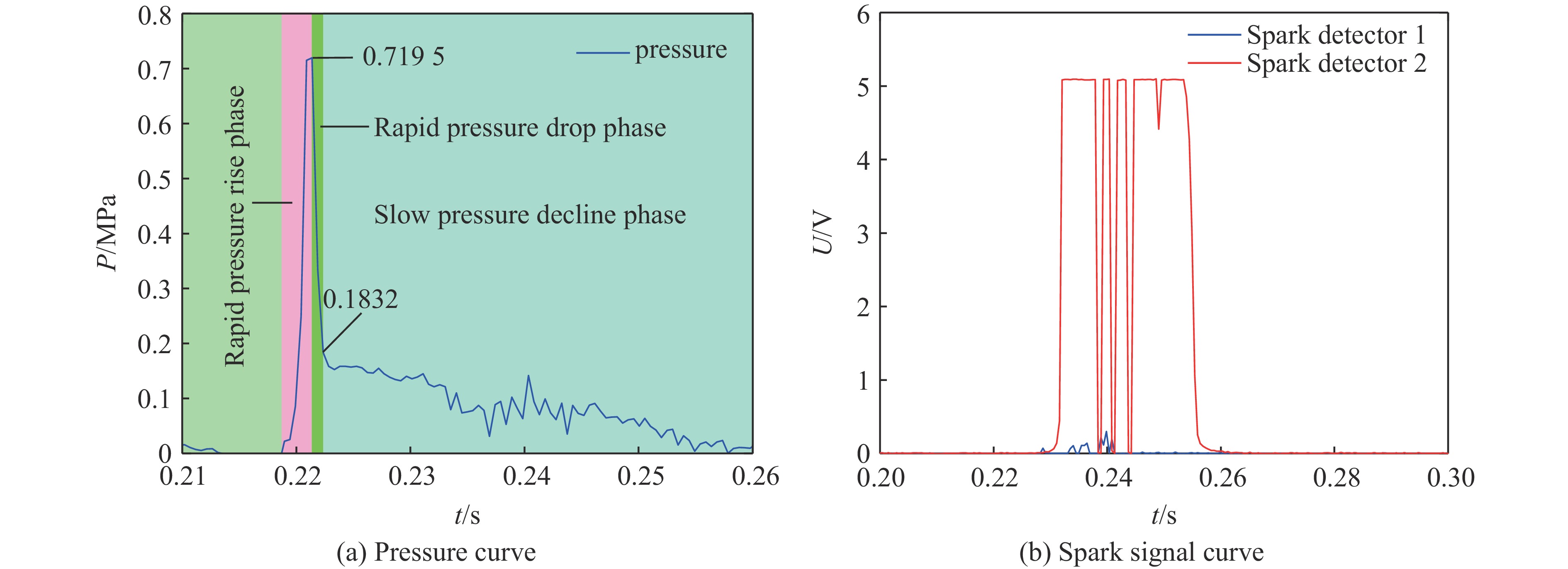
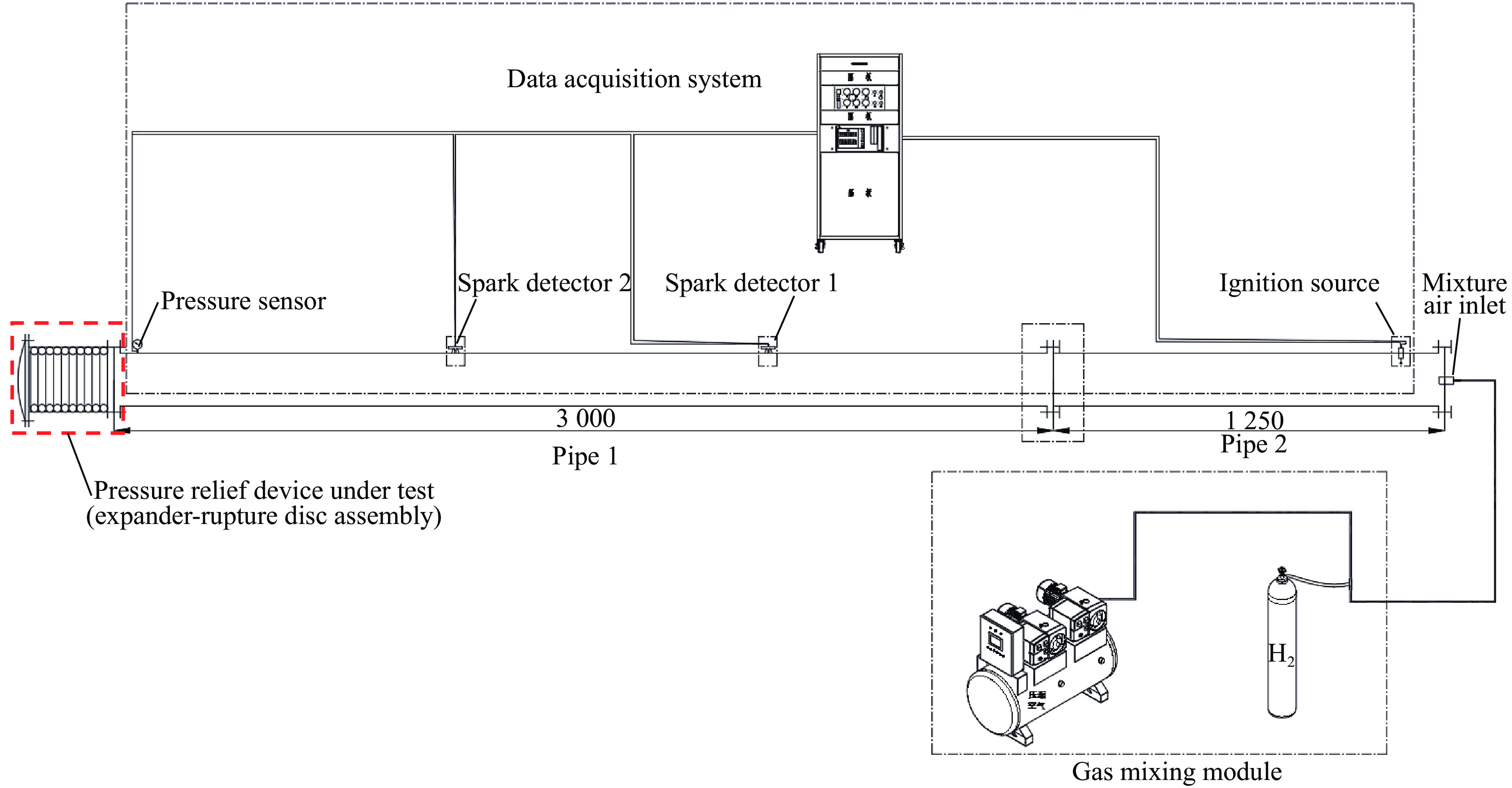
4250 mm, a gas-filling and mixing unit, an ignition device, and a high-speed data-acquisition system. A hydrogen-air mixture with a volume ratio of 27:75 was used as the combustible gas to reproduce the most severe explosion conditions caused by arc-generated cracking gas in transformer oil. Pressure and flame signals were recorded synchronously using a high-temperature pressure transducer and two flame detectors installed along the tube. The tested assembly consisted of a positive-arch, cross-scored rupture disc made of 316L stainless steel, with a static burst pressure of 0.2 MPa, and a nine-convolution expander. In addition, an explicit dynamic finite element model was developed using ANSYS/LS-DYNA. The Johnson-Cook constitutive model was adopted to describe the strain-rate-dependent behavior of 316L stainless steel. The cross-scored region of the rupture disc was finely meshed with a minimum element size of approximately 0.02 mm to accurately capture crack initiation and propagation. The measured pressure–time history was applied as the loading boundary condition. The model was validated by comparing the simulated opening pressure and expander deformation with the experimental results. The results show that, during the early stage of the explosion, the pressure wave reaches the relief port ahead of the flame front and triggers the opening of the rupture disc. The measured peak pressure before disc opening is 0.72 MPa, which is significantly higher than the static calibration value of 0.2 MPa because of strain-rate hardening, structural inertia, and the spatial nonuniformity of the pressure field under rapid loading. The expander exhibits limited plastic deformation, with the axial deformation of the nine convolutions ranging from 0.60 to 2.30 mm. The deformation distribution is characterized by larger values at both ends and smaller values in the middle, reflecting an energy-absorption mechanism dominated by low-order bending modes. The asymmetric curling of the rupture-disc petals is closely associated with stress-wave reflections and fluid–structure interaction induced by high-speed venting. The numerical simulation reproduces the crack-growth sequence, opening morphology, and stress distribution in good agreement with the experimental observations. The proposed integrated experimental-numerical approach provides a reliable mechanical basis and engineering guidance for optimizing the blast-resistant design of pressure relief devices for current transformers.-
Key words:
- current transformer /
- explosive load /
- pressure relief device /
- dynamic response /
- failure mechanism
-
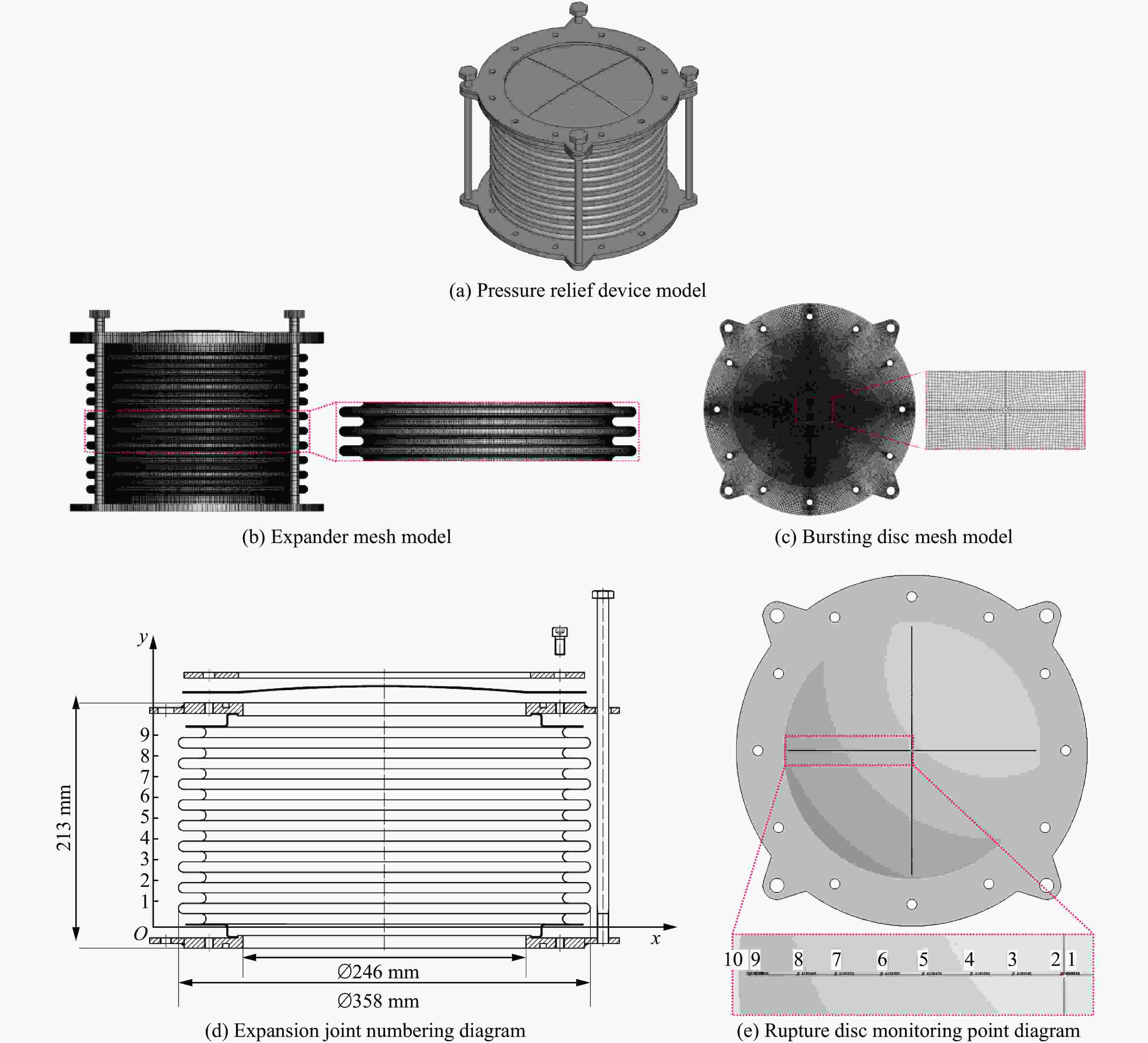
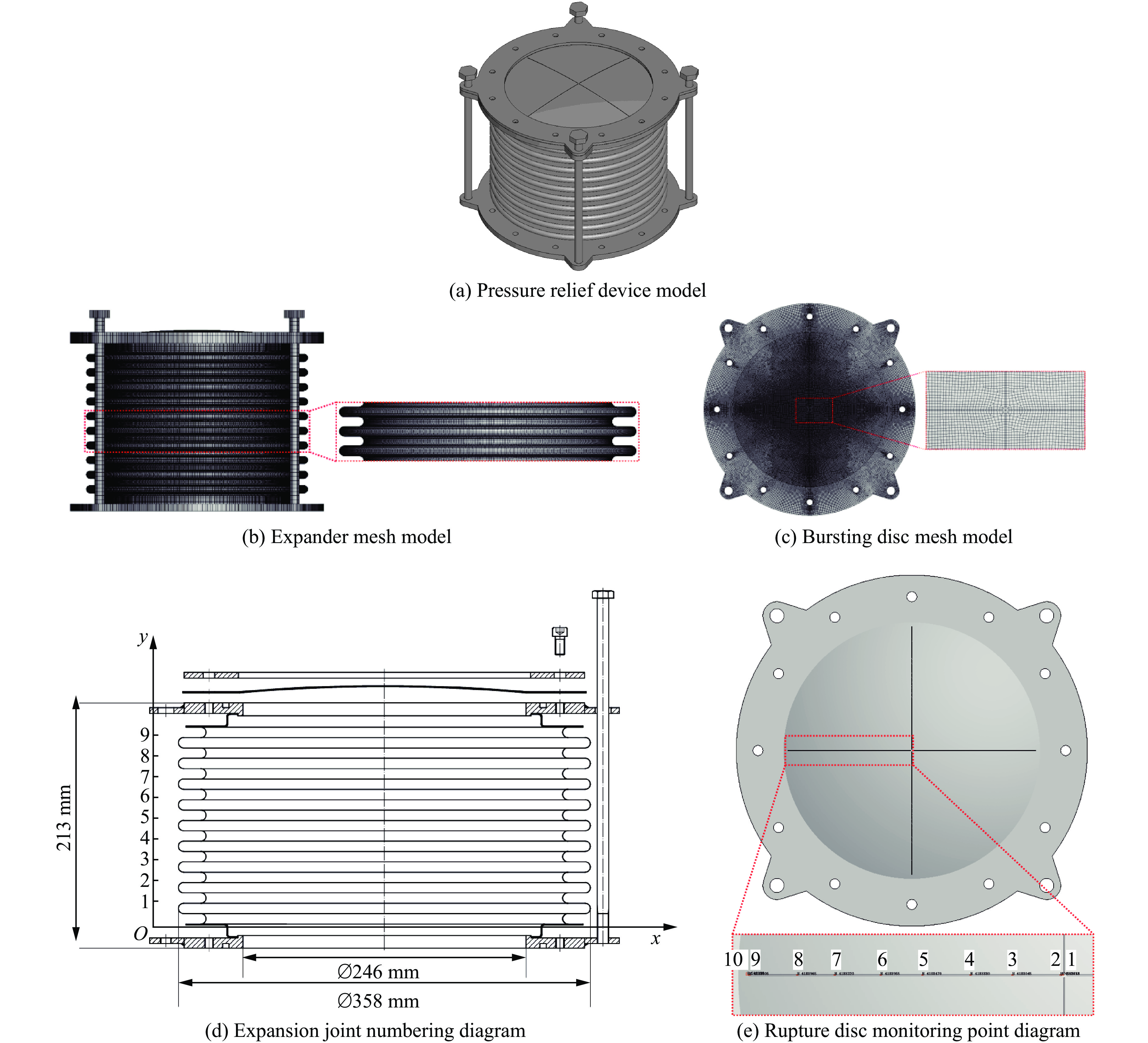
图 3 泄压装置仿真模型及监测点位图
Figure 3. Pressure relief device simulation model and monitoring point map
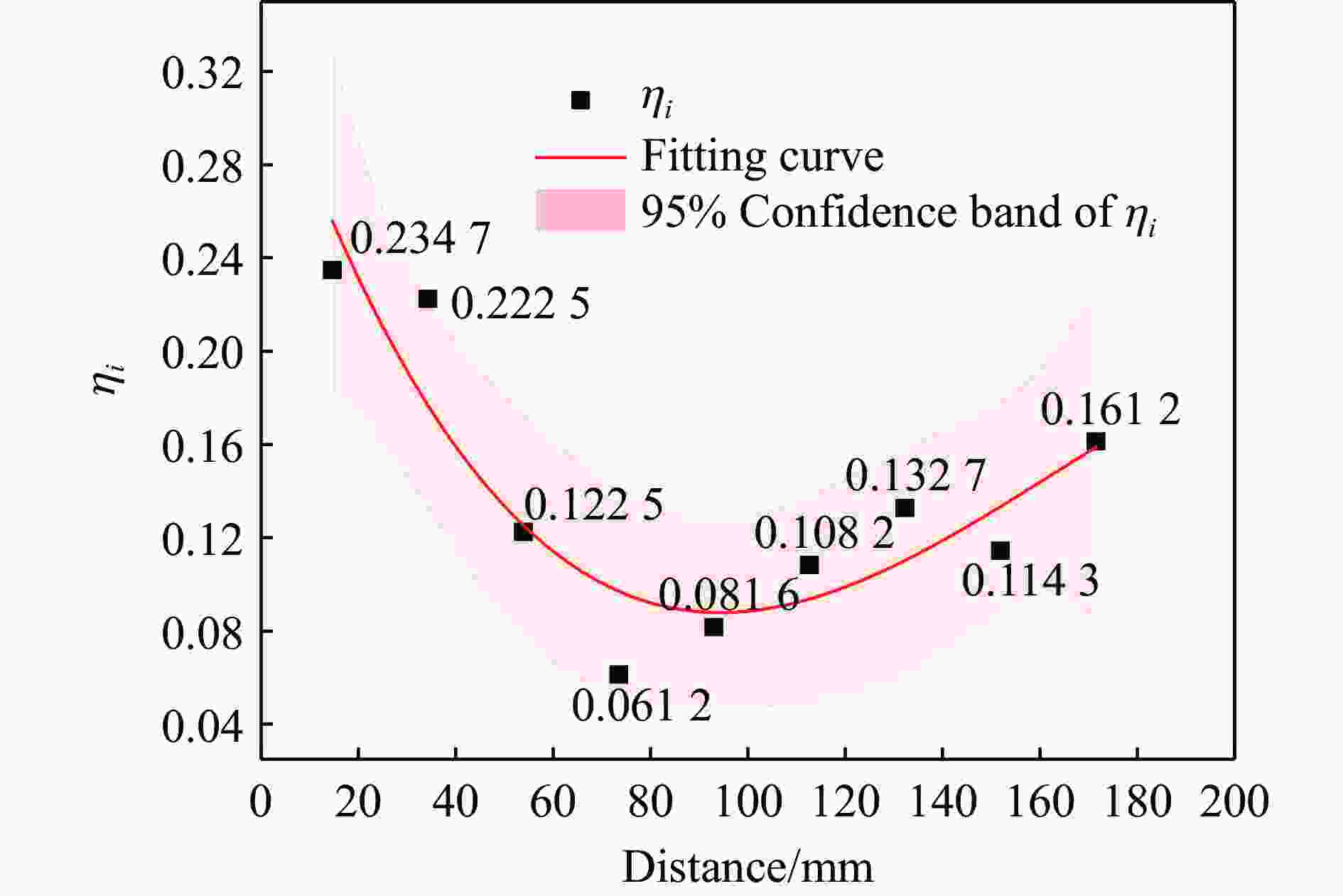
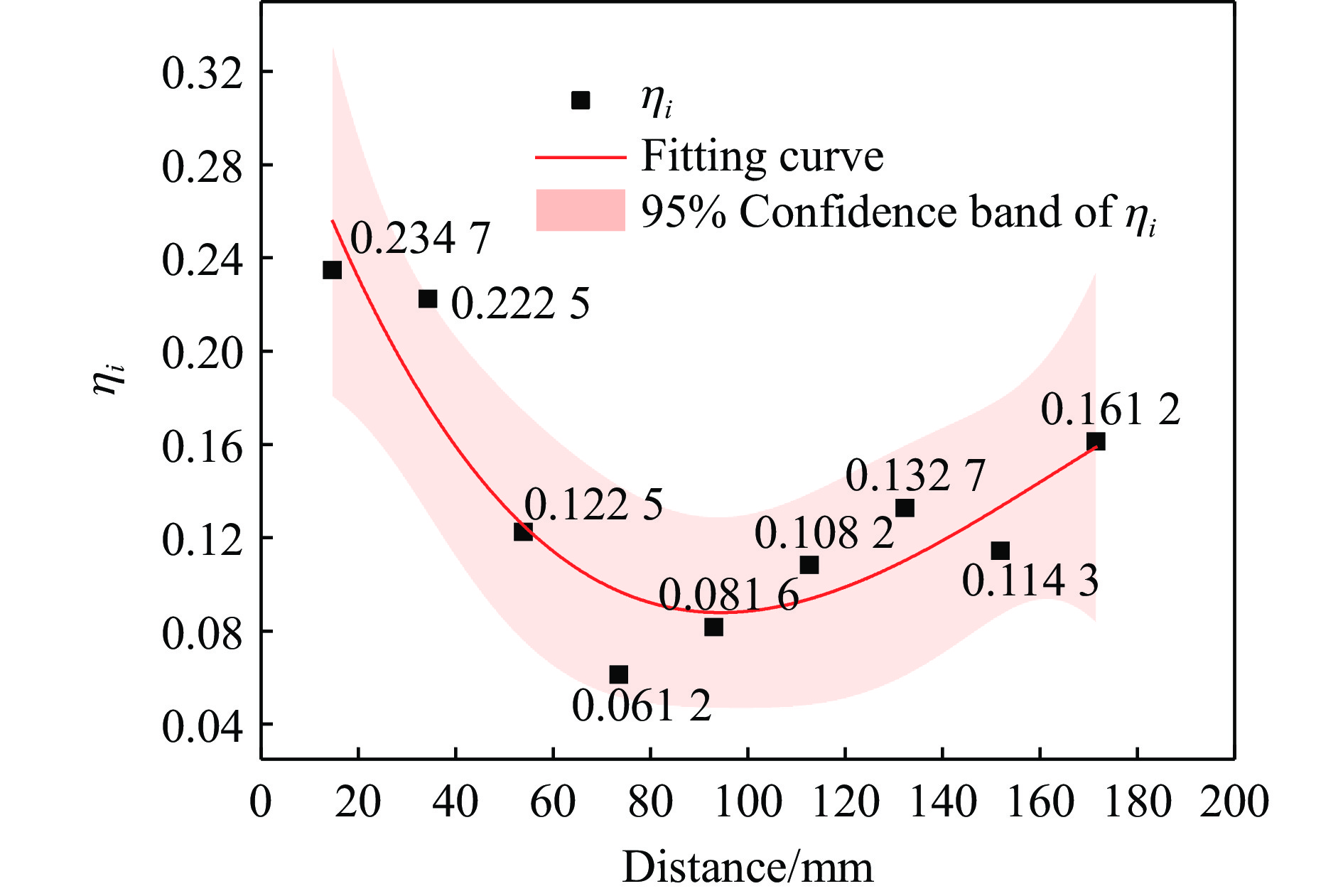
图 5 各膨胀节相对变形系数ηᵢ沿轴向分布拟合曲线
Figure 5. Axial distribution fitting curve of the relative deformation coefficient ηᵢ for each expansion joint
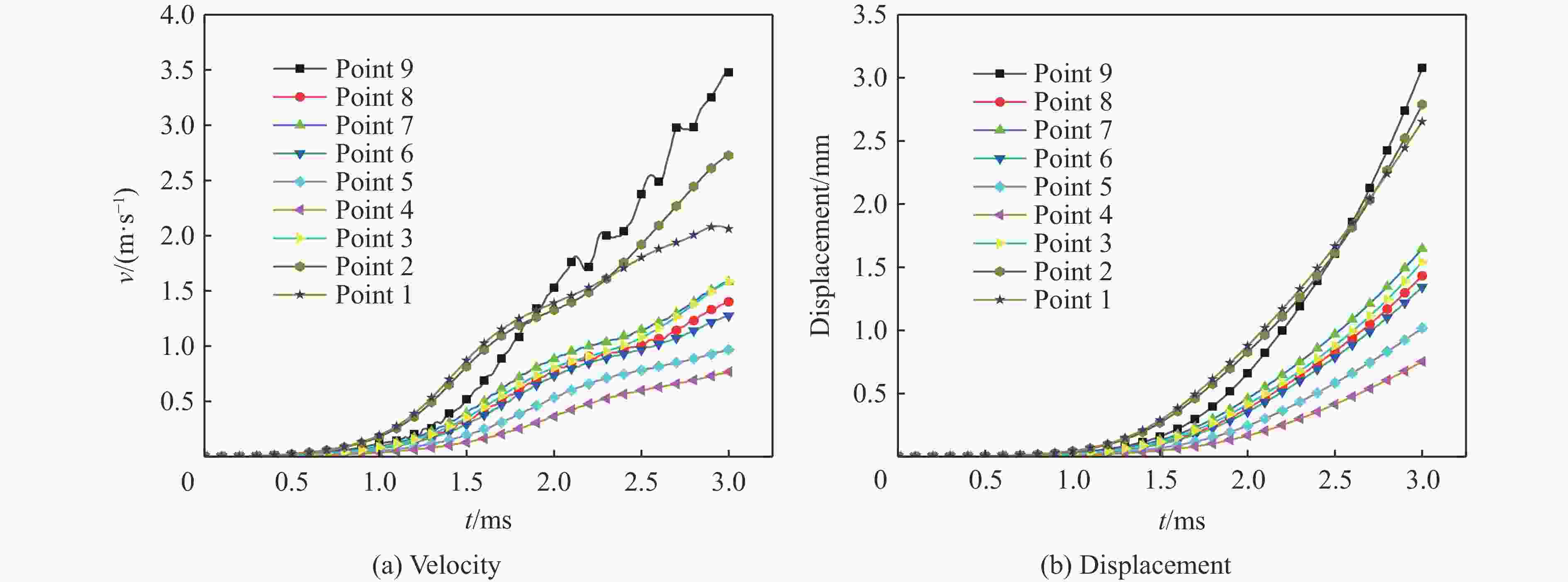
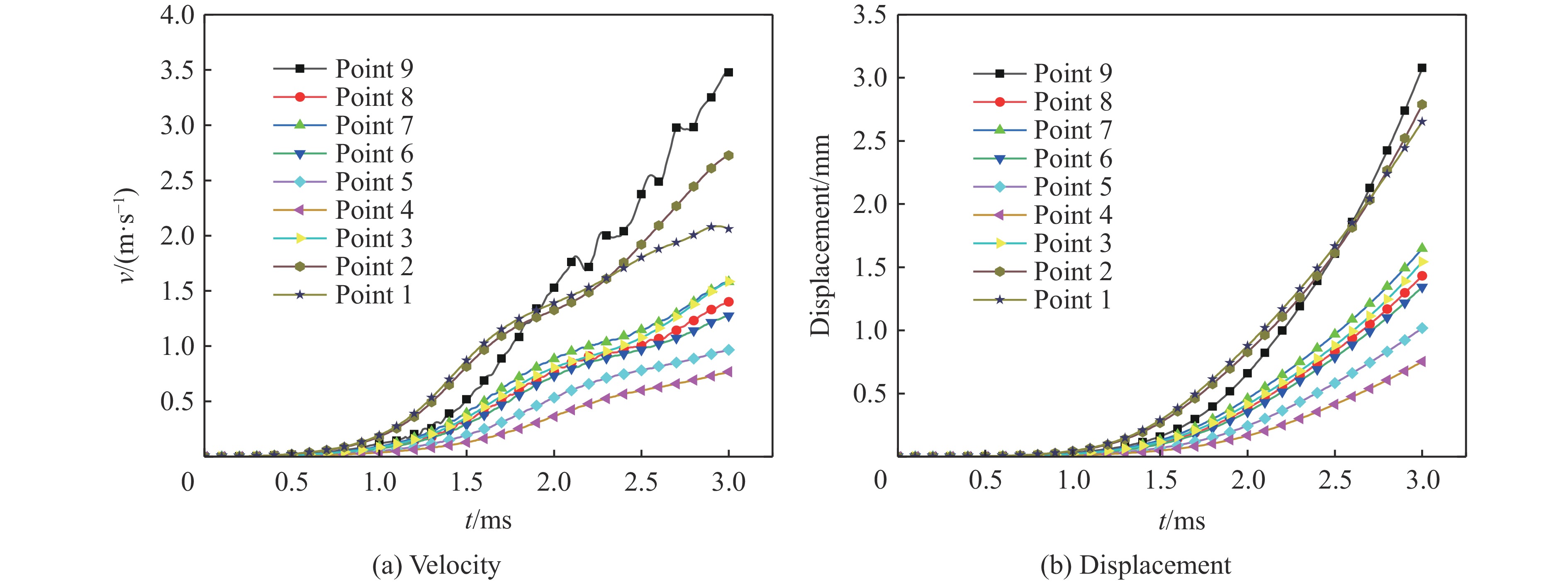
图 7 膨胀器监测点位的速度和位移曲线
Figure 7. Expander monitoring point velocity and displacement curves
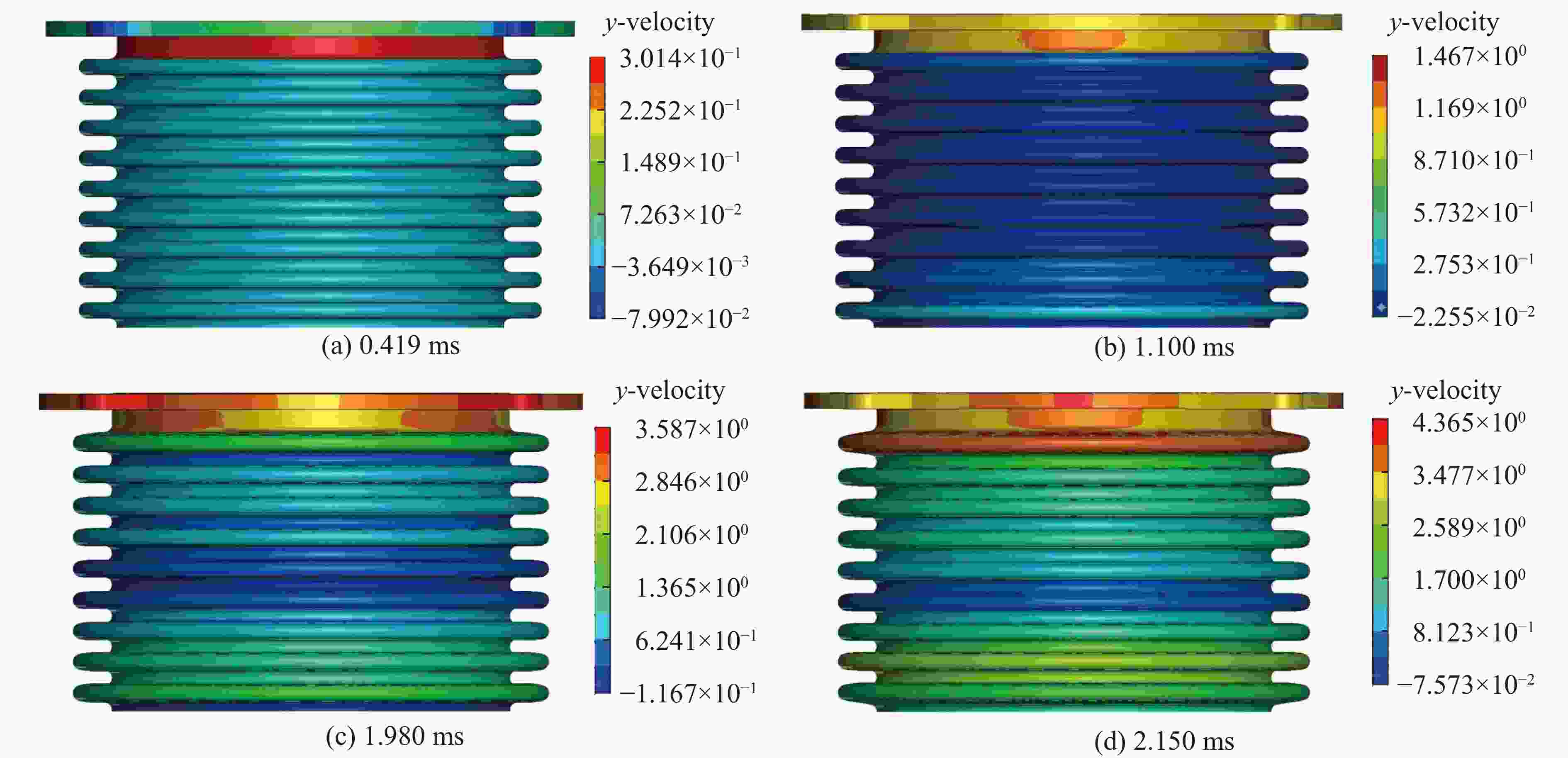
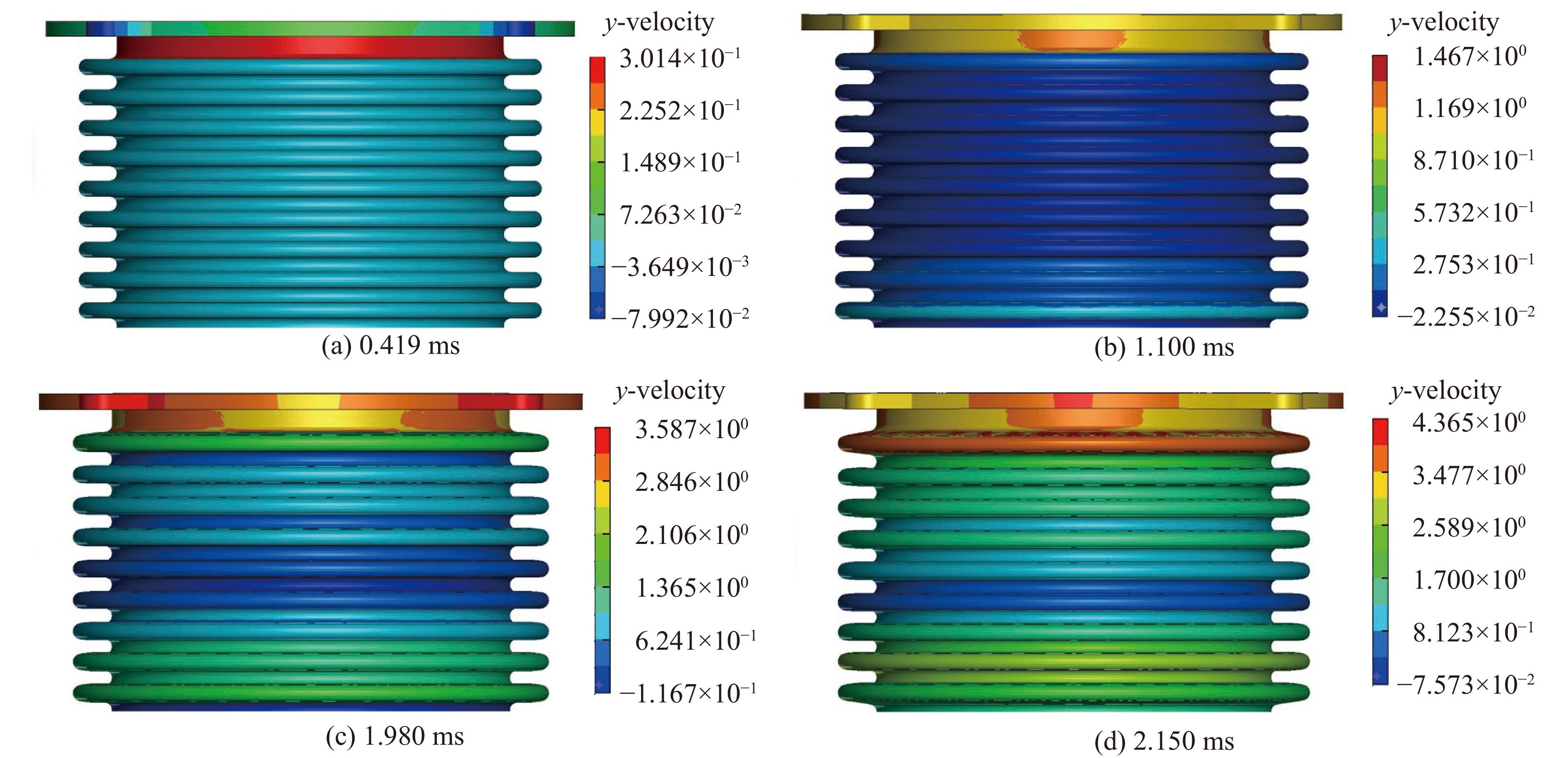
图 8 膨胀器变形过程的速度云图
Figure 8. Velocity contour map of the deformation process of an expander
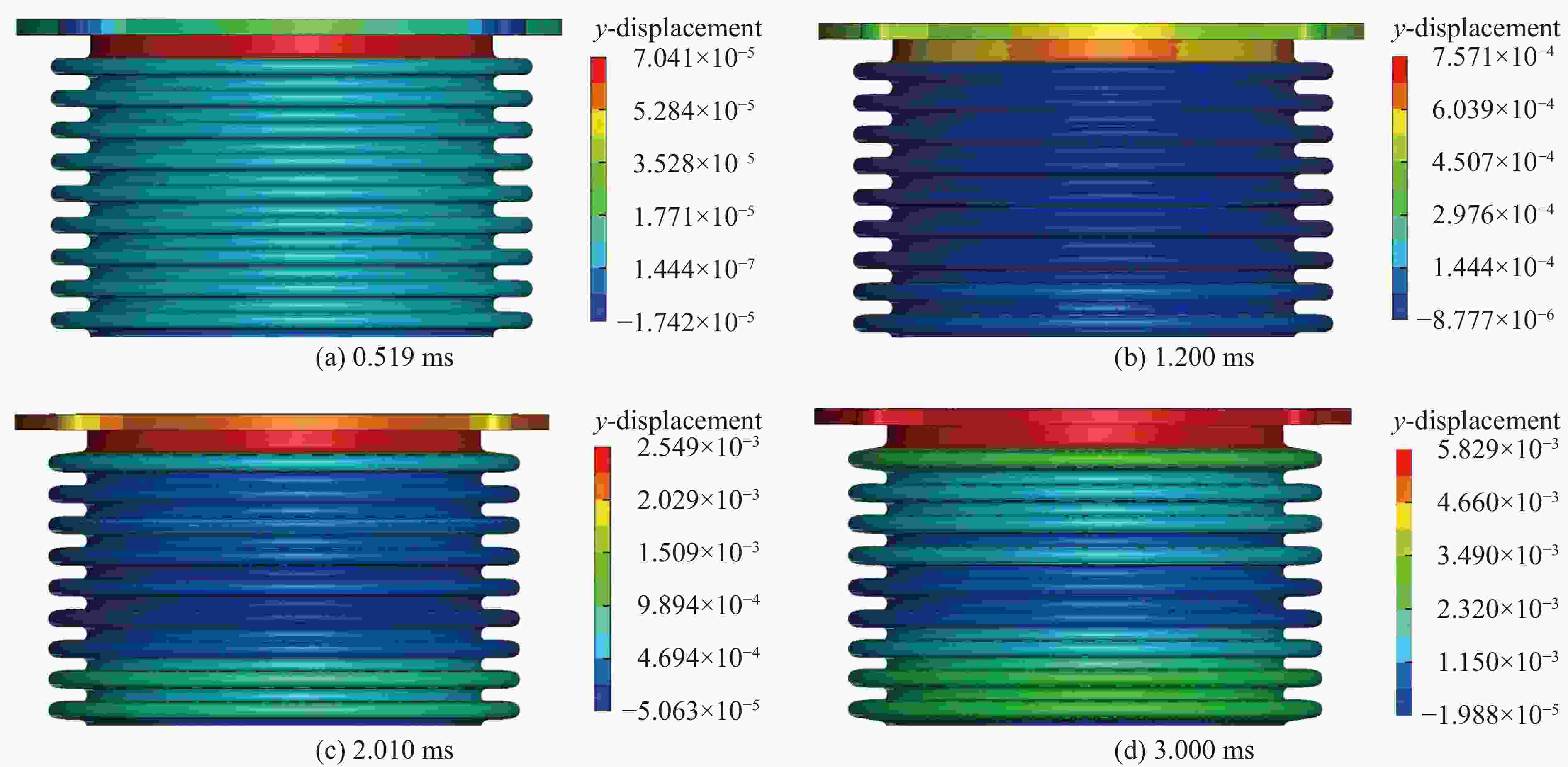
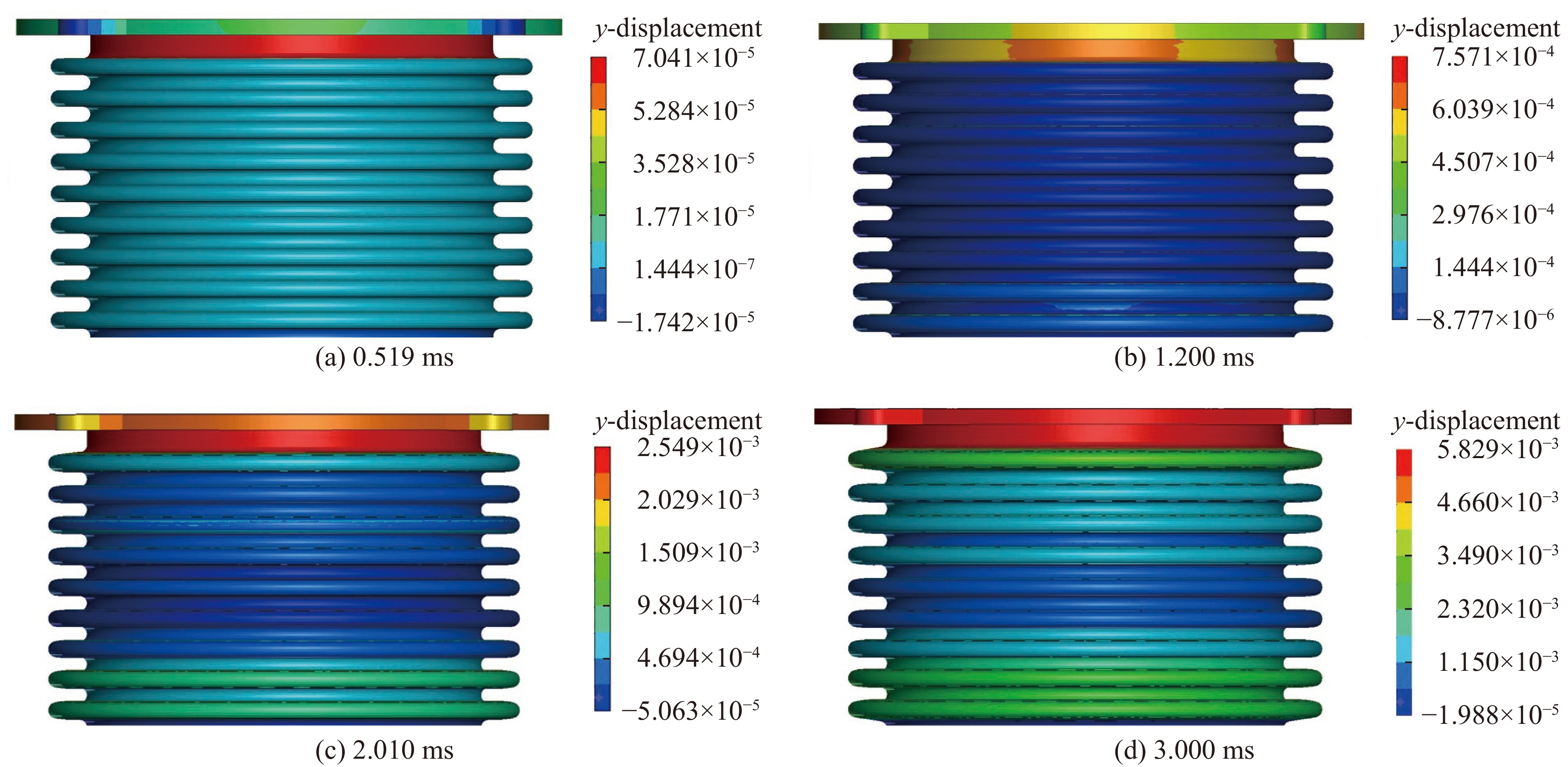
图 9 膨胀器监变形过程的位移云图
Figure 9. Displacement contour map monitoring deformation process of the expander
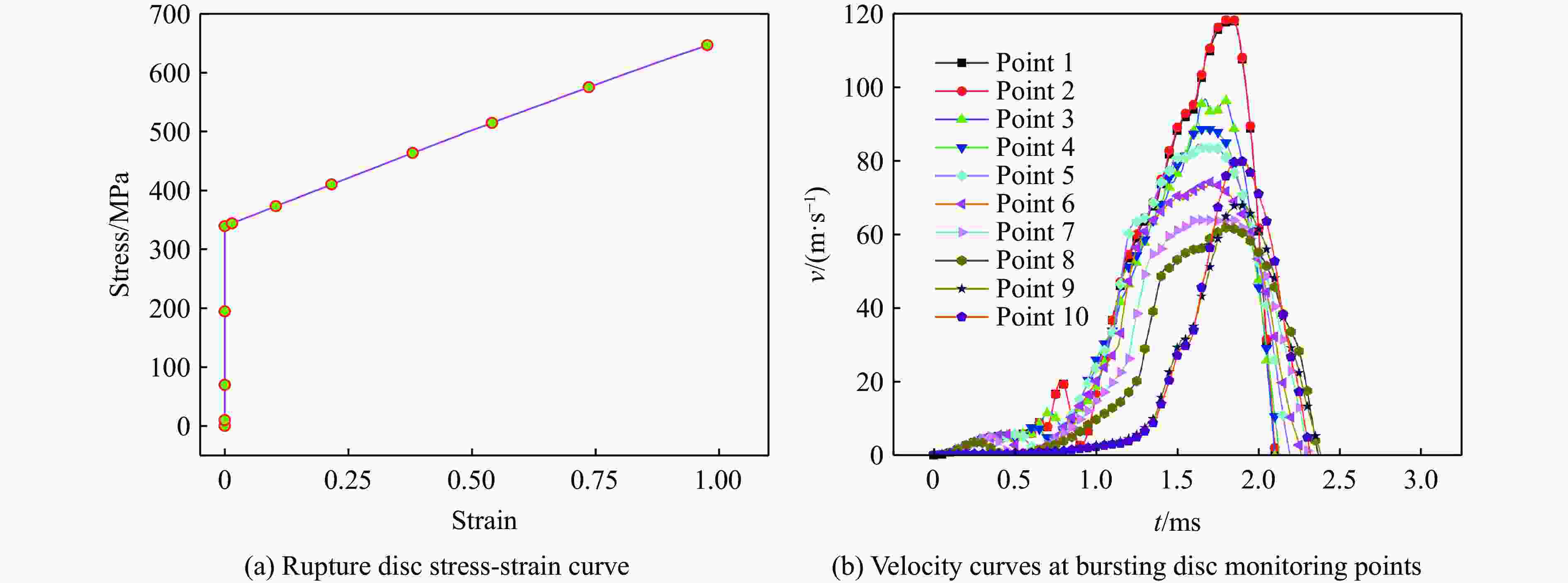
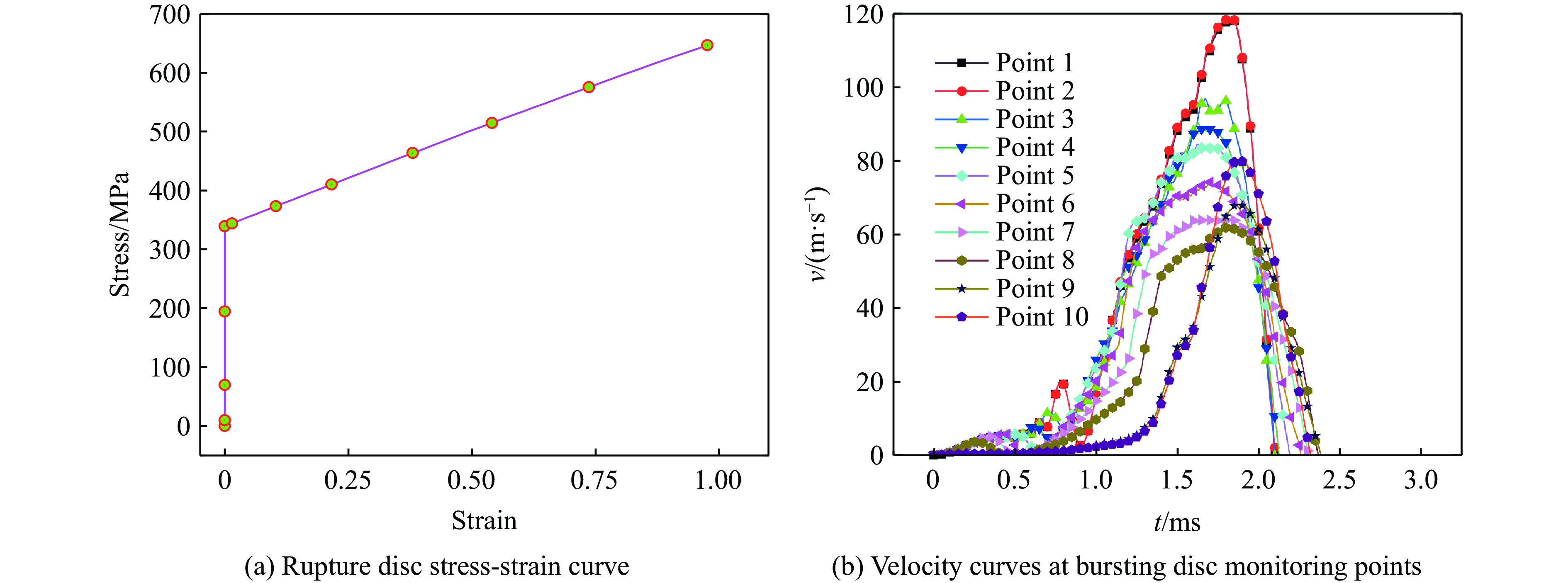
图 11 爆破片的应力-应变曲线与监测点的位速度曲线
Figure 11. Rupture disc stress-strain curve and monitoring point velocity curves
表 1 泄压装置材料316L成分的质量分数
Table 1. Mass fraction of 316L in pressure relief device material
w(C)/% w(Si)/% w(Mn)/% w(P)/% w(S)/% w(Ni)/% w(Cr)/% w(Mo)/% ≤0.08 ≤1.00 ≤2.00 ≤0.035 ≤0.035 10.00~14.00 16.00~18.00 2.00~3.00  下载: 导出CSV
表 2 爆破片技术参数
Table 2. Technical specifications of rupture discs
爆破压力/MPa 成型口径/mm 厚度/mm 成型压力/MPa 拱高/mm 0.2 254 0.2 0.18 8
下载: 导出CSV
表 3 泄压装置网格模型单元属性设置
Table 3. Setting the properties of a mesh element for a pressure relief device
单元类型 单元形状 节点总数 网格总数 C3D8R 六面体 1215765 750708
下载: 导出CSV
表 4 316L不锈钢Johnson-Cook本构模型参数表[15]
Table 4. 316L stainless steel Johnson-Cook constitutive model parameter table
A/MPa B/MPa n C 300.5 1156 0.603 0.01
下载: 导出CSV
表 5 膨胀器变形特性
Table 5. Deformation of Expanders
波纹节 1 2 3 4 5 6 7 8 9 变形/mm 2.30 2.18 1.20 0.60 0.80 1.06 1.30 1.12 1.58
下载: 导出CSV
表 6 破坏时间
Table 6. Failure Time
爆破点 1 2 3 4 5 6 7 8 9 10 破坏时间/ms 1.17 1.09 1.10 1.10 1.11 1.14 1.20 1.27 1.51 1.63
下载: 导出CSV
-
[1] 许志浩, 罗吕, 袁刚, 等. 基于热点位置分类的电流互感器发热故障判别方法 [J]. 激光与红外, 2021, 51(12): 1628–1634. DOI: 10.3969/j.issn.1001-5078.2021.12.013.XU Z H, LUO L, YUAN G, et al. Thermal fault identification method of current transformer based on hotspot position classification [J]. Laser & Infrared, 2021, 51(12): 1628–1634. DOI: 10.3969/j.issn.1001-5078.2021.12.013. [2] 朱梦梦, 束洪春, 罗强, 等. 换流站直流电流互感器现场测试的关键技术 [J]. 高电压技术, 2019, 45(8): 2522–2530. DOI: 10.13336/j.1003-6520.hve.20190731022.ZHU M M, SHU H C, LUO Q, et al. Key technology on field tests for DC current transformer of converter station [J]. High Voltage Engineering, 2019, 45(8): 2522–2530. DOI: 10.13336/j.1003-6520.hve.20190731022. [3] 李佳琪, 咸日常, 张宁, 等. 一起电流互感器绝缘故障引发停电事故的分析与处理 [J]. 变压器, 2022, 59(2): 51–55. DOI: 10.19487/j.cnki.1001-8425.2022.02.014.LI J Q, XIAN R C, ZHANG N, et al. Analysis and treatment of a power failure caused by insulation fault of current transformer [J]. Transformer, 2022, 59(2): 51–55. DOI: 10.19487/j.cnki.1001-8425.2022.02.014. [4] 陈珉, 陈胜科, 詹江杨, 等. 一起220kV电流互感器油色谱异常事故分析及研究 [J]. 变压器, 2018, 55(11): 78–81. DOI: 10.19487/j.cnki.1001-8425.2018.11.016.CHEN M, CHEN S K, ZHAN J Y, et al. Exploration and application of an incident about abnormal oil chromatography of 220kV current transformer [J]. Transformer, 2018, 55(11): 78–81. DOI: 10.19487/j.cnki.1001-8425.2018.11.016. [5] 马晓薇, 樊培培, 华超. 500 kV油浸倒立式电流互感器故障实例及分析 [J]. 电力电容器与无功补偿, 2018, 39(6): 91–94,98. DOI: 10.14044/j.1674-1757.pcrpc.2018.06.018.MA X W, FAN P P, HUA C. Failure example and analysis on 500 kV oil-immersed inverted current transformer [J]. Power Capacitor & Reactive Power Compensation, 2018, 39(6): 91–94,98. DOI: 10.14044/j.1674-1757.pcrpc.2018.06.018. [6] 钱心怡. 倒置式电流互感器二次绕组直流电阻异常故障分析 [J]. 电力安全技术, 2025, 27(9): 56–59. DOI: 10.3969/j.issn.1008-6226.2025.09.016.QIAN X Y. Fault analysis on secondary winding DC resistance anomalies in inverted current transformer [J]. Electric Safety Technology, 2025, 27(9): 56–59. DOI: 10.3969/j.issn.1008-6226.2025.09.016. [7] 沙玉洲, 潘婉玉, 王慧, 等. 关于某发电厂励磁变压器用电流互感器事故分析及改进意见 [J]. 变压器, 2022, 59(3): 61–65. DOI: 10.19487/j.cnki.1001-8425.2022.03.014.SHA Y Z, PAN W Y, WANG H, et al. Analysis and improvement opinions of current transformer for excitation transformer for a power plant [J]. Transformer, 2022, 59(3): 61–65. DOI: 10.19487/j.cnki.1001-8425.2022.03.014. [8] MAYYAS A, WEI M, LEVIS G. Hydrogen as a long-term, large-scale energy storage solution when coupled with renewable energy sources or grids with dynamic electricity pricing schemes [J]. International Journal of Hydrogen Energy, 2020, 45(33): 16311–16325. DOI: 10.1016/j.ijhydene.2020.04.163. [9] 滕予非, 吴杰, 张真源, 等. 基于离群点检测的高压并联电抗器本体电流互感器测量异常故障在线诊断 [J]. 电工技术学报, 2019, 34(11): 2405–2414. DOI: 10.19595/j.cnki.1000-6753.tces.180669.TENG Y F, WU J, ZHANG Z Y, et al. Online identification of measurement abnormality fault based on outlier detection for current transformer in high voltage shunt reactor [J]. Transactions of China Electrotechnical Society, 2019, 34(11): 2405–2414. DOI: 10.19595/j.cnki.1000-6753.tces.180669. [10] 汤德宝, 季虎, 马泰. 高压CT金属膨胀器在线监测装置的应用与性能分析 [J]. 中国设备工程, 2024(21): 177–179. DOI: 10.3969/j.issn.1671-0711.2024.21.075.TANG D B, JI H, MA T. Application and performance analysis of on-line monitoring device for metal expander of high voltage CT [J]. China Plant Engineering, 2024(21): 177–179. DOI: 10.3969/j.issn.1671-0711.2024.21.075. [11] SUN S D, CHEN P, ZHAI X, et al. Numerical study on the influence mechanism of different types of burst disc on high pressure hydrogen spontaneous combustion in tube [J]. Journal of Energy Storage, 2023, 67: 107626. DOI: 10.1016/j.est.2023.107626. [12] 汪可, 郑东阳, 王健一, 等. 变压器油过热故障产气特性及机理研究综述 [J]. 中国电机工程学报, 2025, 45(21): 8605–8621. DOI: 10.13334/j.0258-8013.pcsee.242361.WANG K, ZHENG D Y, WANG J Y, et al. Overview of gas generation mechanism of transformer oil under local overheating faults [J]. Proceedings of the CSEE, 2025, 45(21): 8605–8621. DOI: 10.13334/j.0258-8013.pcsee.242361. [13] NGUYEN N, HOSSEINI A. Direct calculation of Johnson-Cook constitutive material parameters for oblique cutting operations [J]. Journal of Manufacturing Processes, 2023, 92: 226–237. DOI: 10.1016/j.jmapro.2023.02.032. [14] CHOI H, YOON J W. A strain rate-dependent distortional hardening model for nonlinear strain paths [J]. International Journal of Plasticity, 2025, 184: 104197. DOI: 10.1016/j.ijplas.2024.104197. [15] YU Y L, GUO Y B, GAO G F, et al. Influence of stress triaxiality and strain-rate on fracture –a combined experiment-simulation approach employing 316 L stainless steel [J]. International Journal of Impact Engineering, 2026, 208: 105537. DOI: 10.1016/j.ijimpeng.2025.105537. [16] ZHANG P, ZSÉLY I G, PAPP M, et al. Comparison of methane combustion mechanisms using laminar burning velocity measurements [J]. Combustion and Flame, 2022, 238: 111867. DOI: 10.1016/j.combustflame.2021.111867. [17] VARMA A R, AHMED U, KLEIN M, et al. Effects of turbulent length scale on the bending effect of turbulent burning velocity in premixed turbulent combustion [J]. Combustion and Flame, 2021, 233: 111569. DOI: 10.1016/j.combustflame.2021.111569. [18] KIM W, SATO Y, JOHZAKI T, et al. Experimental study on self-acceleration in expanding spherical hydrogen-air flames [J]. International Journal of Hydrogen Energy, 2018, 43(27): 12556–12564. DOI: 10.1016/j.ijhydene.2018.04.153. [19] 贾天耀, 董洋硕, 陈超, 等. 临界流动状态下甲烷气体泄漏扩散特性 [J]. 化学工业与工程, 2025, 42(5): 92–98. DOI: 10.13353/j.issn.1004.9533.20240129.JIA T Y, DONG Y S, CHEN C, et al. Characteristics of leakage and dispersion of methane in critical flow [J]. Chemical Industry and Engineering, 2025, 42(5): 92–98. DOI: 10.13353/j.issn.1004.9533.20240129. [20] QIU T, SONG X, LEI Y, et al. Effect of back pressure on nozzle inner flow in fuel injector [J]. Fuel, 2016, 173: 79–89. DOI: 10.1016/j.fuel.2016.01.044. [21] JIA W L, BAN J Q, LIANG F J, et al. A new homogeneous non-equilibrium model to compute vapor-liquid two-phase critical pressure ratios of multicomponent hydrocarbon mixtures [J]. Journal of Loss Prevention in the Process Industries, 2020, 68: 104338. DOI: 10.1016/j.jlp.2020.104338. [22] JIN K Y, CAI X D, HONG R, et al. Numerical investigation on flow choking induced by local heat release and large-scale flow separation in a supersonic combustor [J]. Combustion and Flame, 2024, 268: 113627. DOI: 10.1016/j.combustflame.2024.113627. [23] LIVIERI P. Stress intensity factors from stress analysis of an equivalent hole [J]. Theoretical and Applied Fracture Mechanics, 2016, 84: 119–128. DOI: 10.1016/j.tafmec.2016.04.001. [24] LI D T, YANG W, JIANG J S, et al. Investigation into dynamic fracture toughness of rigid insulation tile materials ranging from 78 K to 1423 K [J]. International Journal of Impact Engineering, 2025, 206: 105451. DOI: 10.1016/j.ijimpeng.2025.105451. -

计量
- 文章访问数: 359
- HTML全文浏览量: 109
- PDF下载量: 73
- 被引次数: 0