


In-situ experiments on human dynamic response and perceived ECG changes under blasting vibration
-
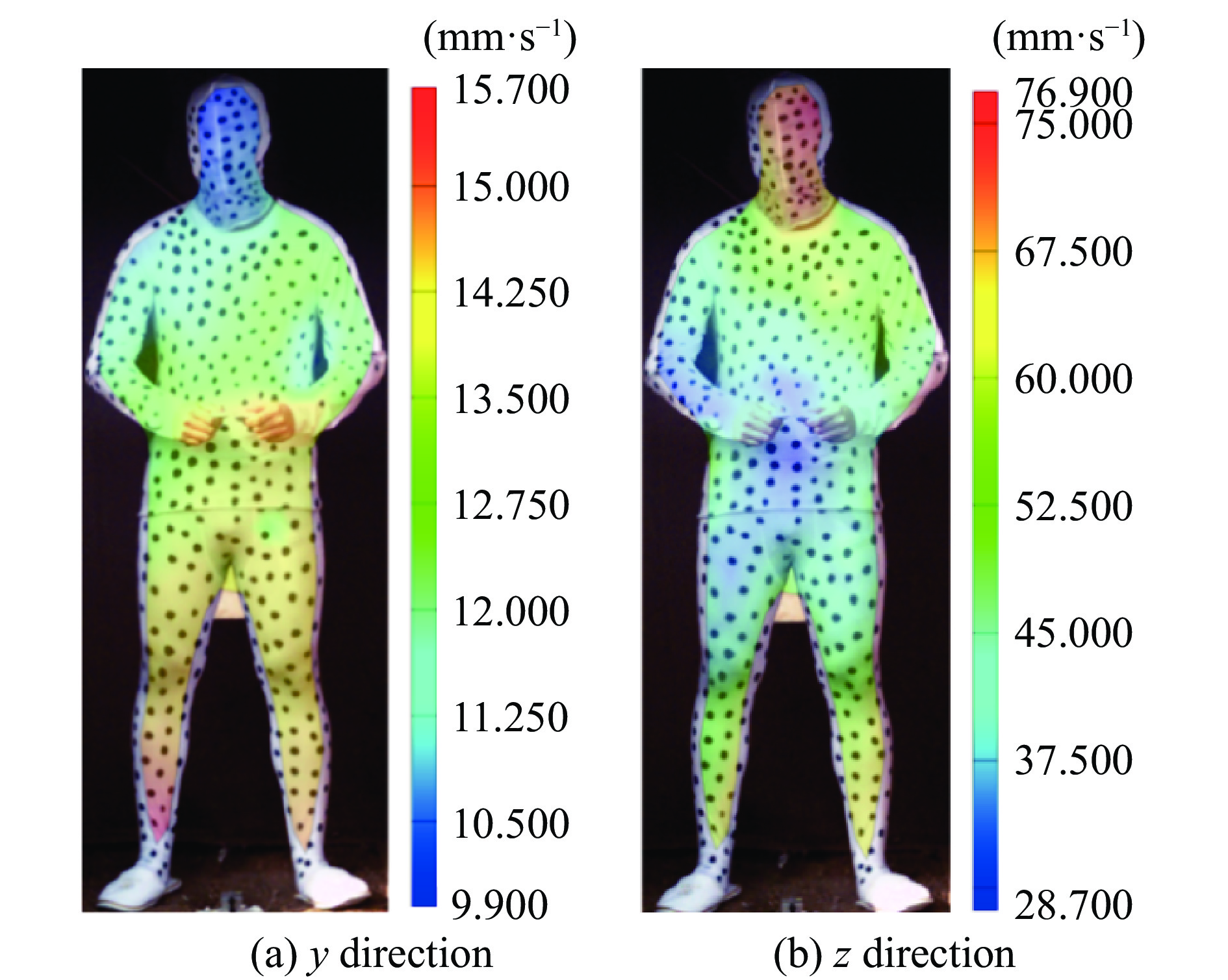
摘要: 为探索爆破振动作用下人体动态响应的量化评价方法,在严格安全控制条件下开展单受试者原位爆破试验,结合数字图像相关技术与心电变化同步测量系统,分析不同强度爆破振动作用下人体结构体表动态响应特征,并建立了本试验条件下考虑身高影响的人体分区(腰部以下、腰部以上)峰值振动速度拟合关系;鉴于原位爆破试验的安全性制约,进一步借助室内振动台试验,基于心率变异性评价指标的对比分析,论证振动台模拟爆破振动开展人体感知试验的可行性。研究结果表明:人体垂直振动速度显著高于水平振动速度,垂直方向为主振方向;垂直方向振动速度则呈现“腰部以下衰减、腰部以上放大”的特征,与地表振动速度相比,腰部以下区域衰减率为55.7%~65.9%,腰部以上区域振动速度放大1.25~1.74倍;水平向振动速度自脚部至头部呈衰减趋势,衰减率达52.6%~60%;原位试验与振动台试验所获心率变异性指标误差小于10%,证实了采用振动台模拟爆破振动研究人体感知的可行性。Abstract: In complex and sensitive environments, minimizing the disturbance of blasting vibration to surrounding residents is the primary concern during blasting construction. To explore a quantitative evaluation method for human dynamic response to blasting vibration, this study conducted single-subject in-situ blasting tests under strictly controlled safety conditions. By integrating digital image correlation (DIC) with a synchronous electrocardiogram (ECG) measurement system, the dynamic response characteristics of the human body surface under varying blasting vibration intensities were preliminarily analyzed. A height-dependent fitting relationship for peak particle velocity (PPV) was established under the present test conditions, with the body divided into two regions: below the waist and above the waist. Given the safety constraints of in-situ blasting tests, laboratory shake-table tests were also conducted. A comparative analysis using heart rate variability (HRV) evaluation indices was performed to preliminarily demonstrate the feasibility of using a shake table to simulate blasting vibration for human perception studies. The preliminary results indicate that under the present test conditions, the vertical vibration velocity of the human body is significantly higher than the horizontal velocity, with the vertical direction identified as the dominant vibration direction. The vertical vibration velocity exhibits a characteristic pattern of “attenuation below the waist and amplification above the waist”. Compared with the ground surface velocity, the attenuation rate in the lower body region ranges from 55.7% to 65.9%. The vibration velocity in the upper body region is amplified by a factor of 1.25 to 1.74. The horizontal vibration velocity decreases from the feet to the head, with an attenuation rate of 52.6% to 60%. The error in HRV indices obtained from the in-situ and shake-table tests is less than 10%, preliminarily confirming the feasibility of employing a shake table to simulate blasting vibration for human perception research. These exploratory in-situ tests provide a methodological reference for quantifying human vibration response and studying perceived ECG changes due to blasting vibrations.
-
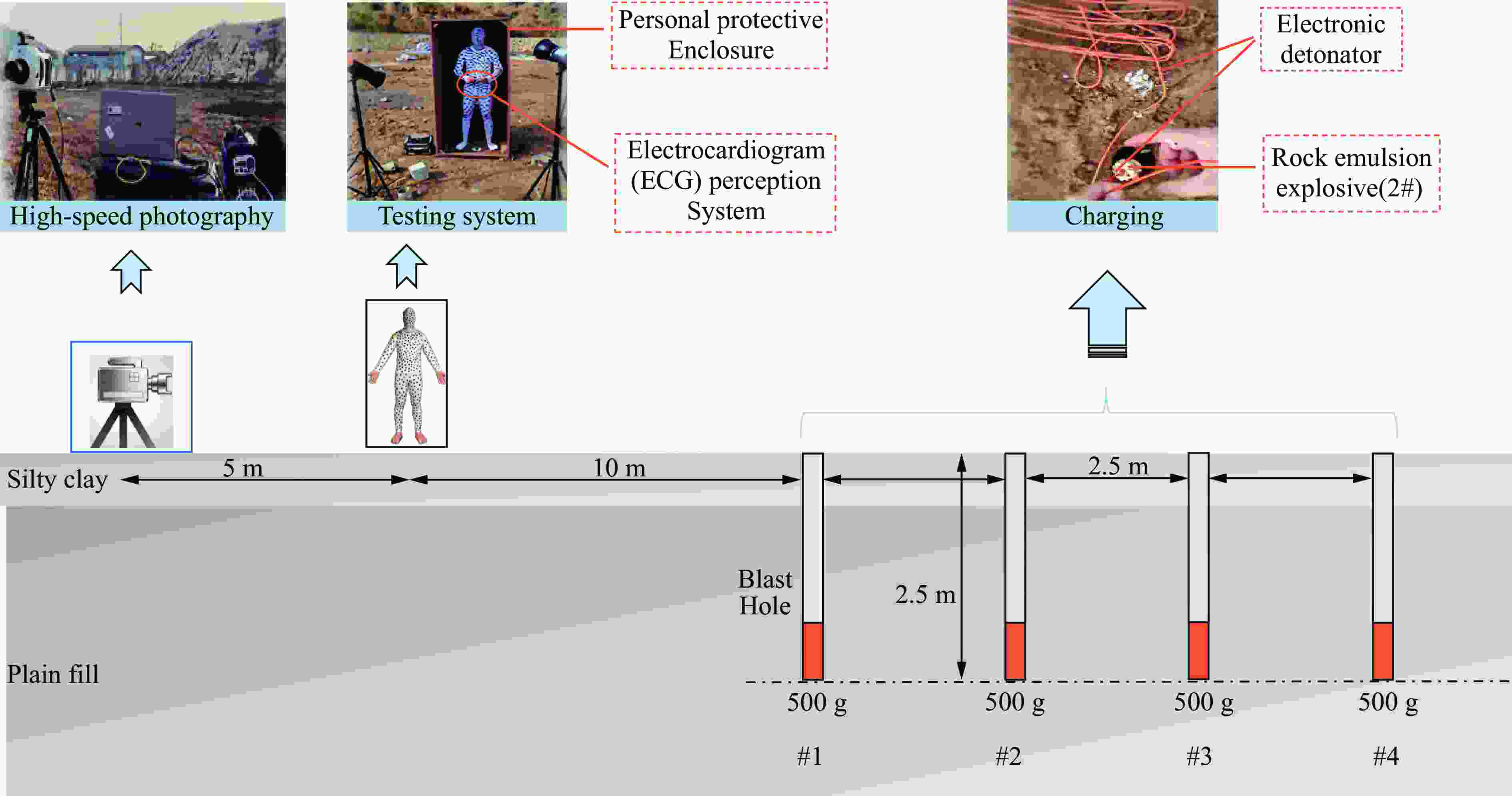
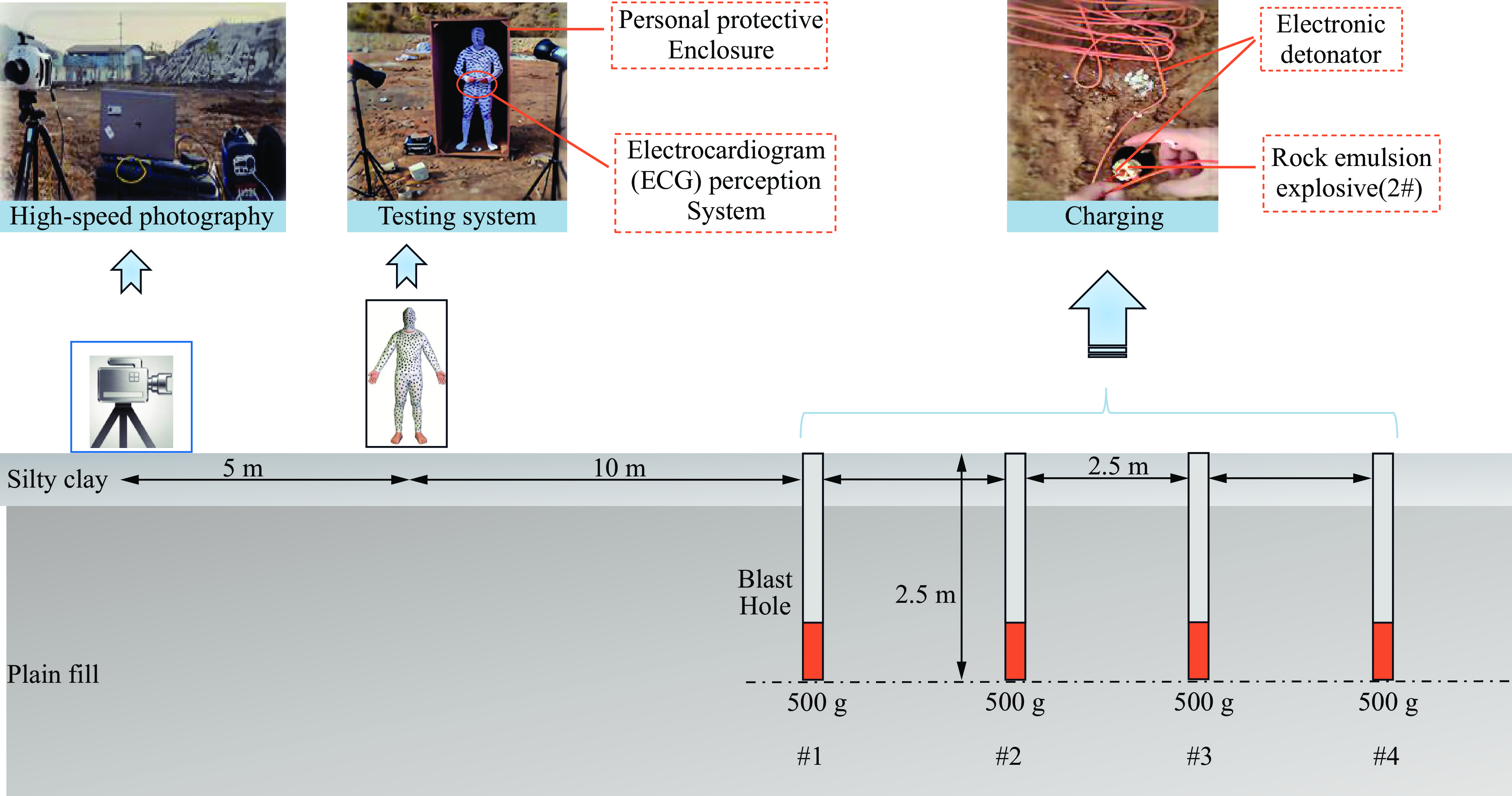
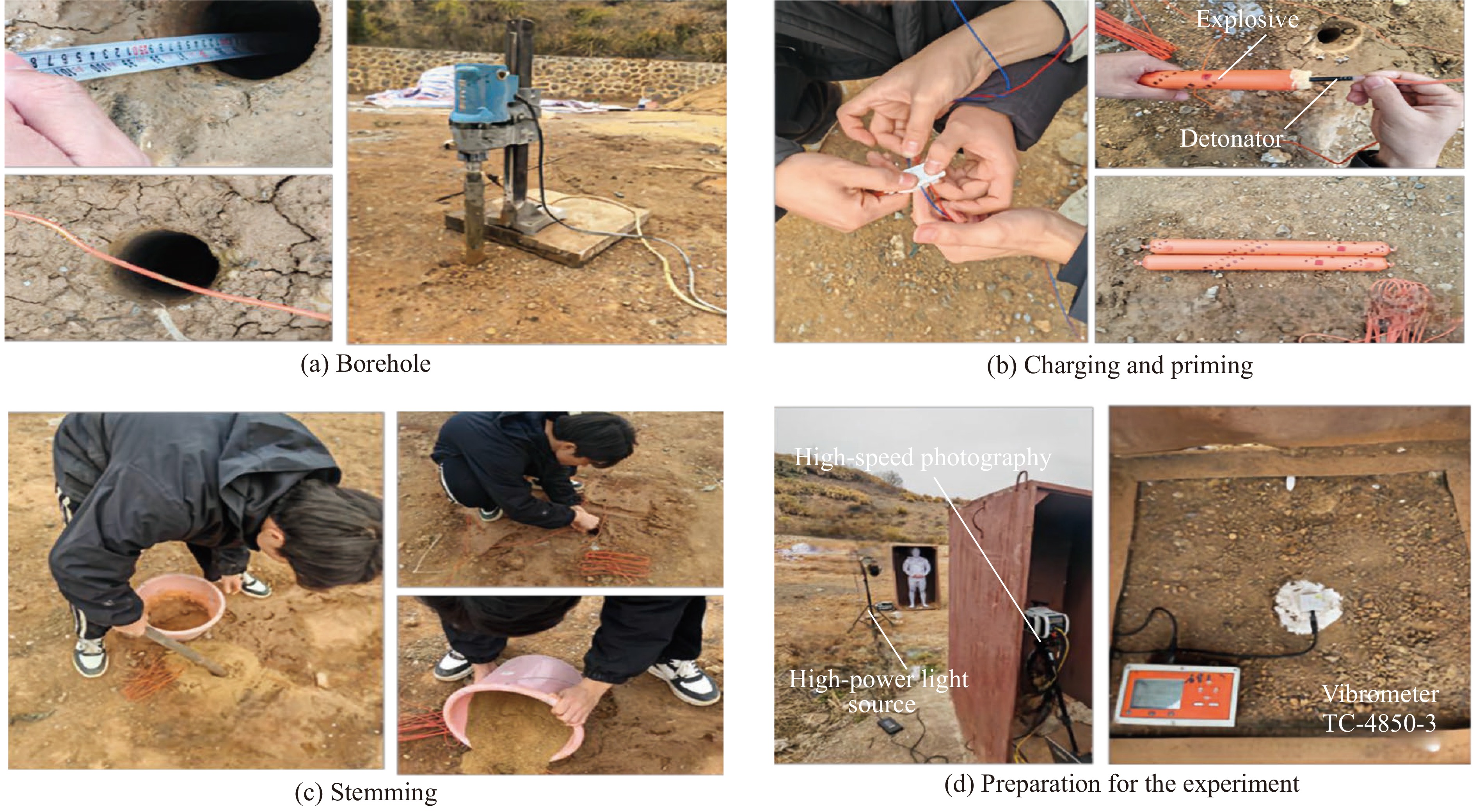
图 3 爆破振动人体感知原位试验布置示意图
Figure 3. Layout of in-situ test for human perception of blast-induced vibration
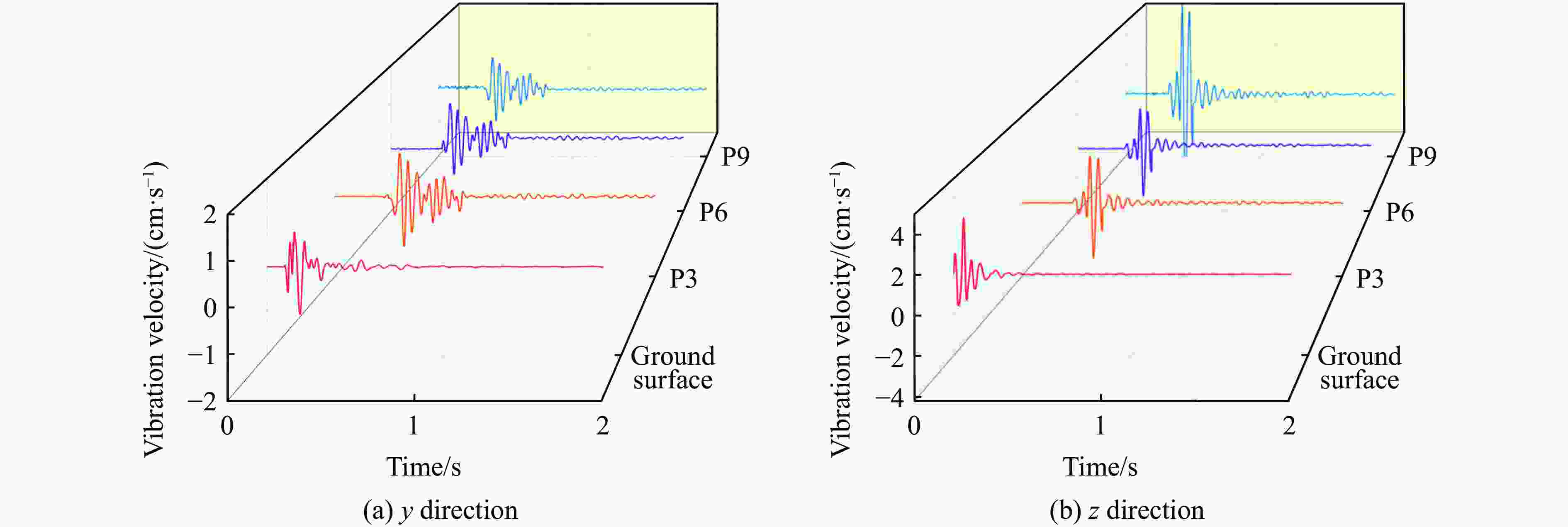
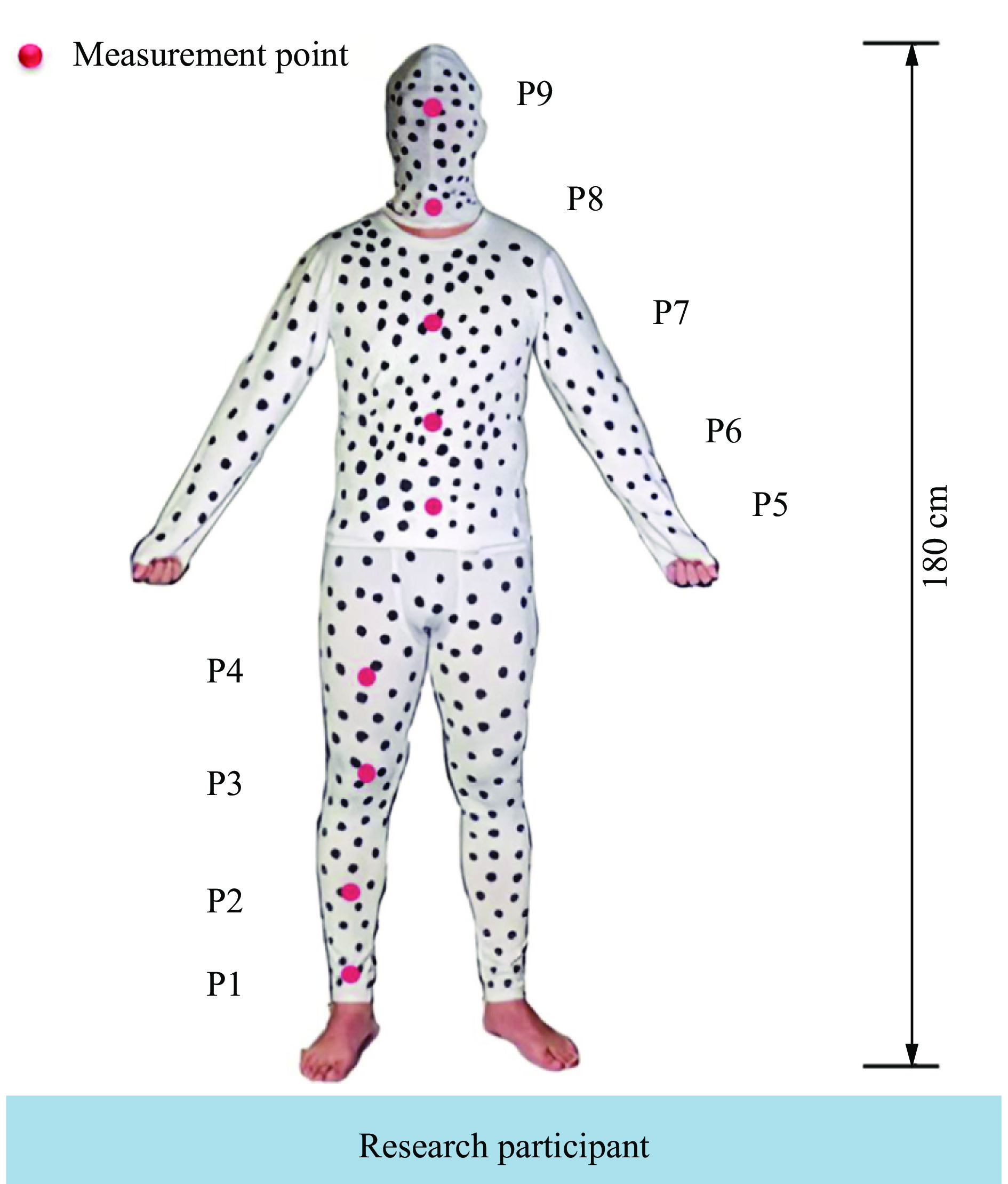
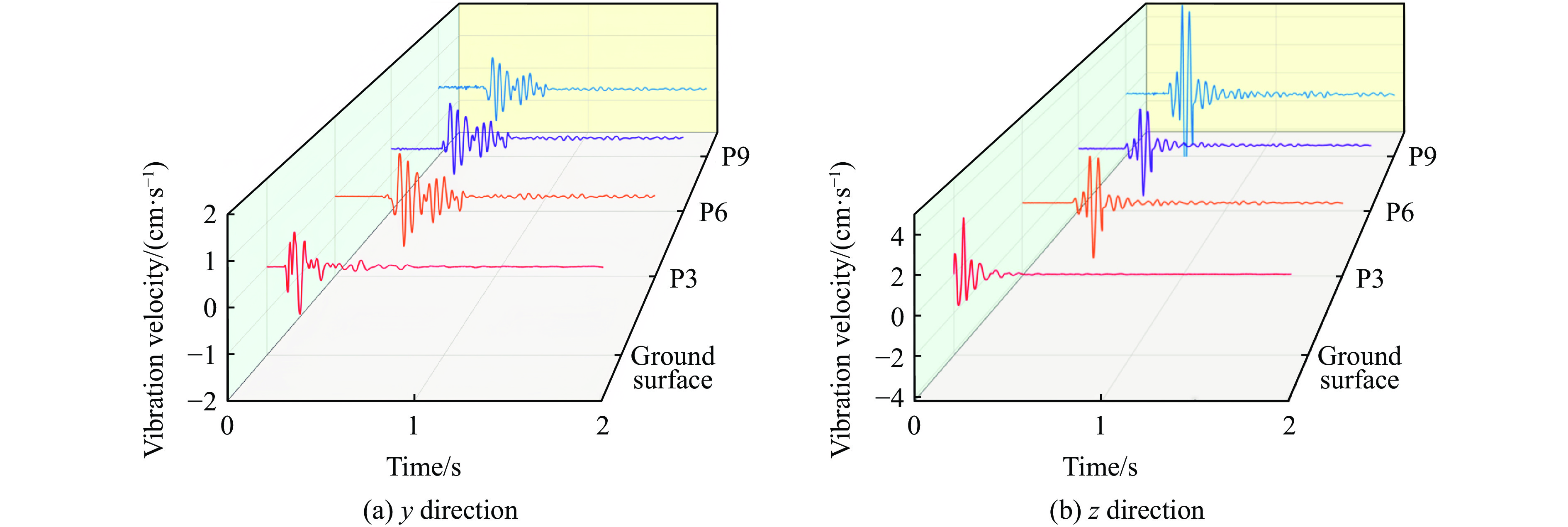
图 6 工况4下不同测点的振动速度时程曲线
Figure 6. Time history curves of vibration velocity at different observation points
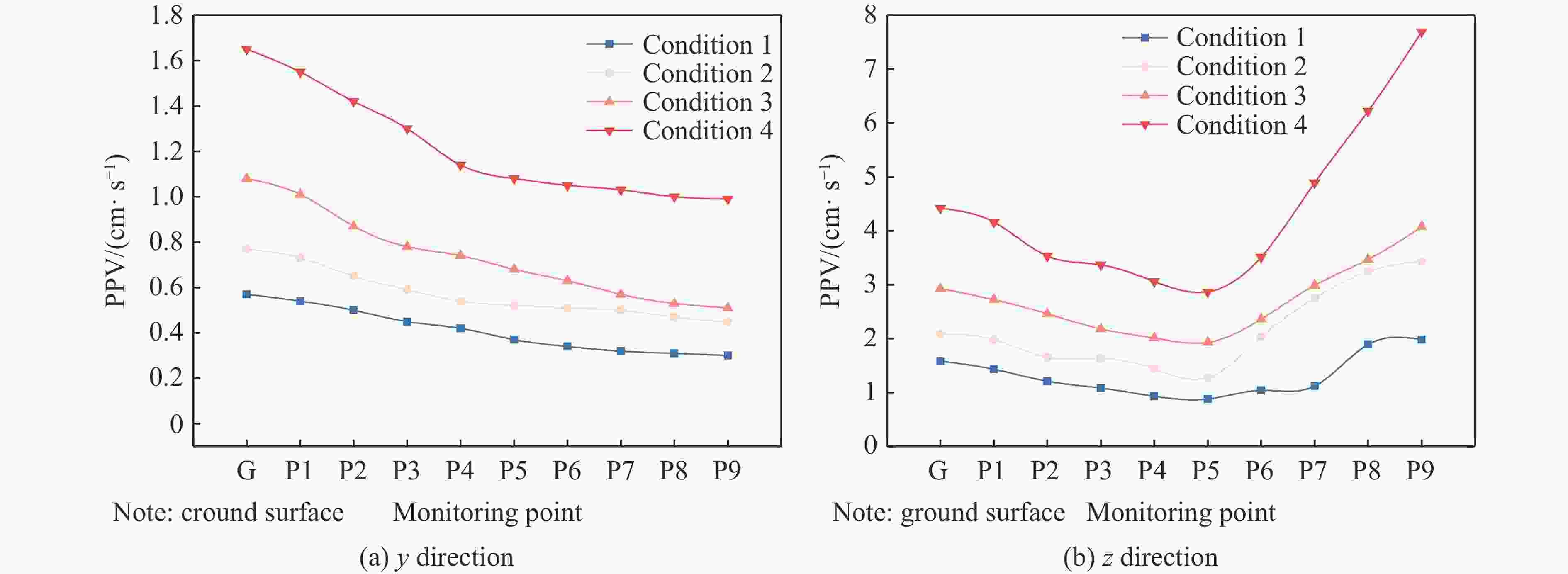
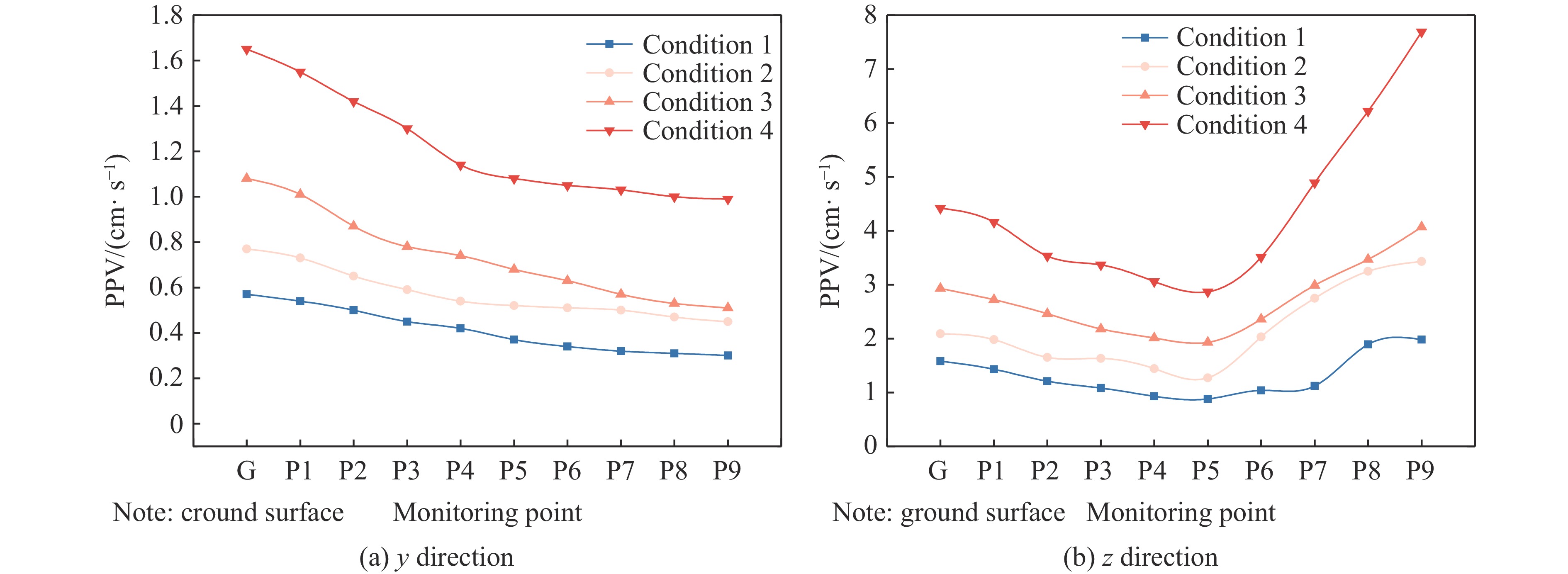
图 7 不同工况下各监测点PPV对比
Figure 7. Comparison of PPV at various monitoring points under different working conditions.
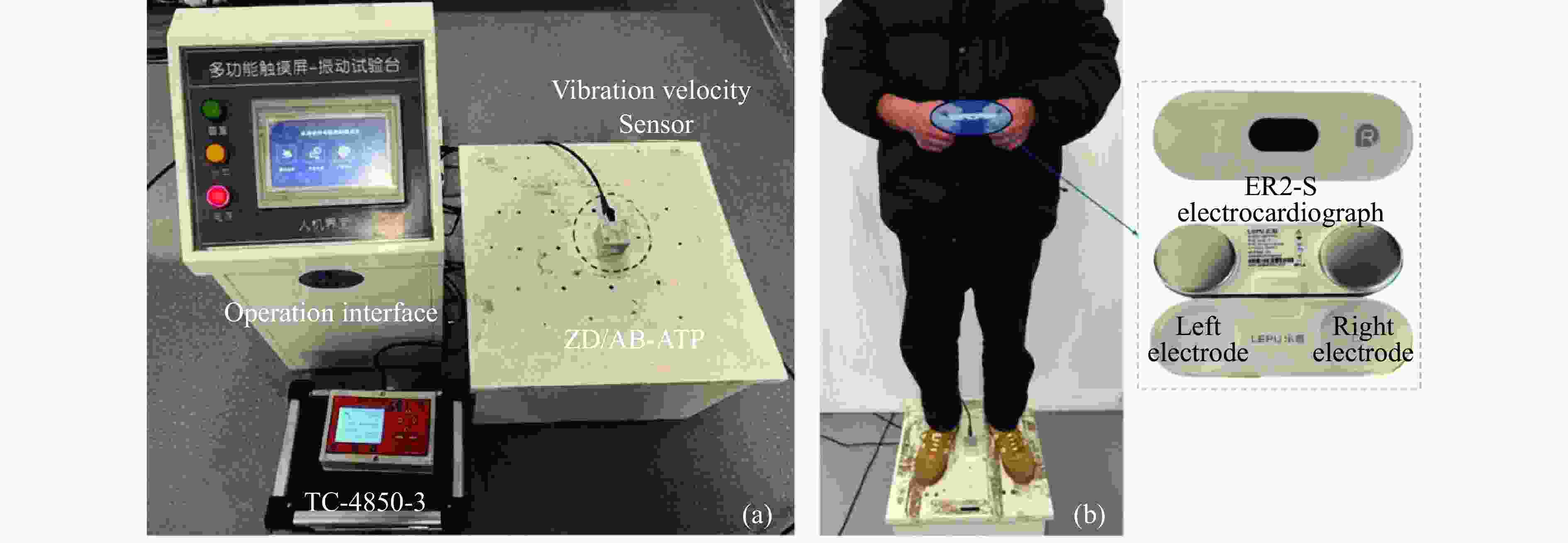
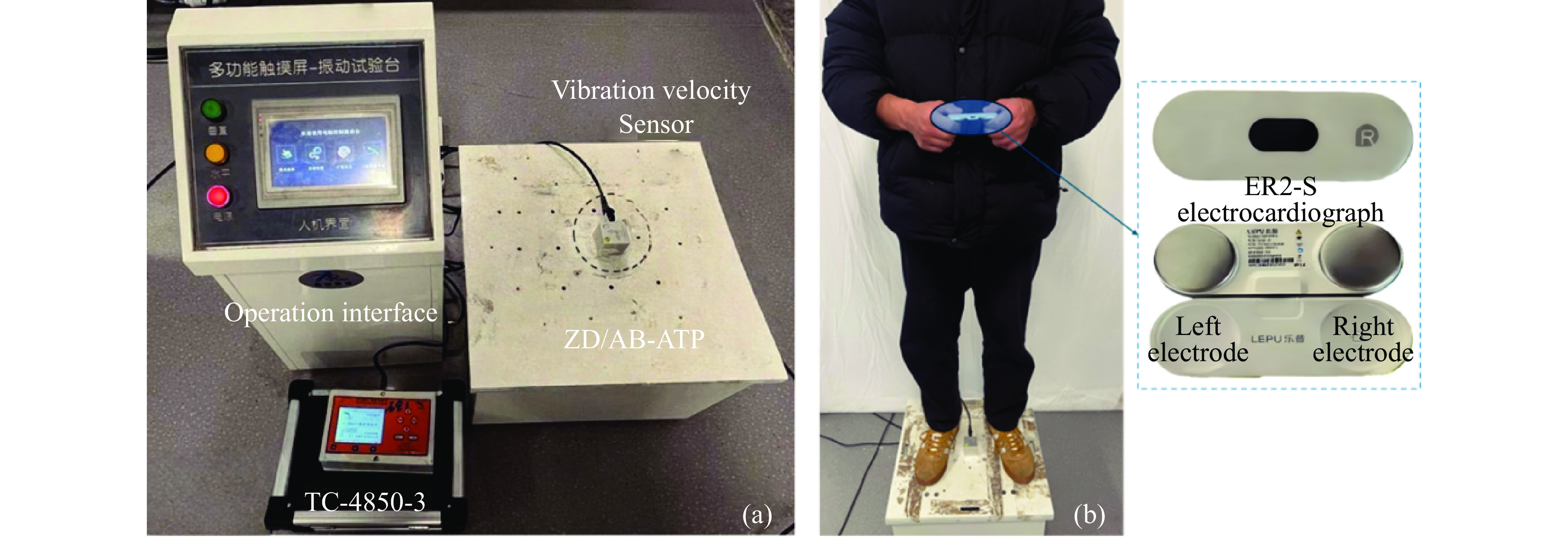
图 8 室内振动及心电采集系统
Figure 8. Laboratory vibration and electrocardiogram (ECG) acquisition system
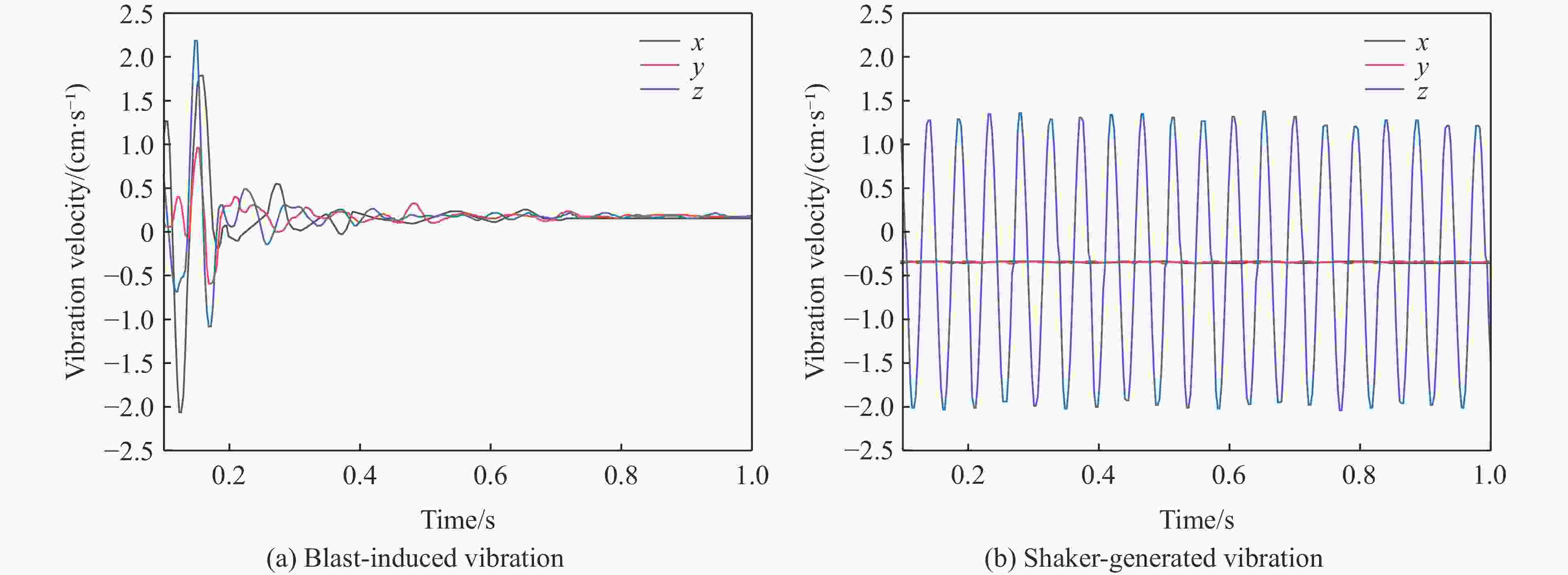
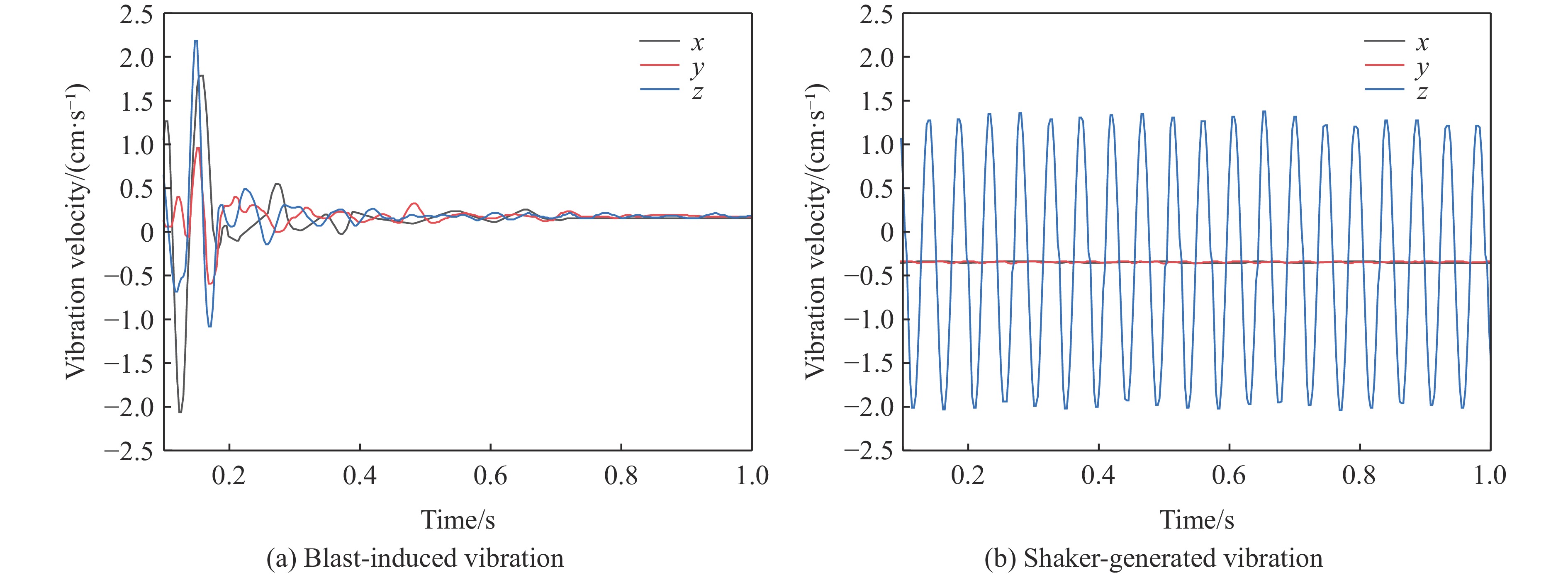
图 9 爆破振动与振动台振动时程曲线的对比
Figure 9. Comparison between blast-induced and shaker-generated vibration velocity-time curves
表 1 试验场地物理力学参数
Table 1. Geotechnical parameters
地层 厚度/m 泊松比 天然重度/
(kN·m−3)初始内聚力/
kPa初始内摩
擦角/(°)素填土 0~0.5 / 18.0 4 18 粉质黏土 0.5~3.5 0.3 19.0 34 13.8 粉砂 3.5~4.0 0.25 19.1 0 28  下载: 导出CSV
表 2 现场原位试验工况设置
Table 2. Geotechnical parameters
工况 爆破位置 爆心距/m 单段药量/kg 1 1# 17.5 0.5 2 2# 15.0 0.5 3 3# 12.5 0.5 4 4# 10.0 0.5
下载: 导出CSV
表 3 各工况下y向和z向的峰值振动速度
Table 3. Peak particle velocities in y- and z-directions under various test conditions
振动方向 监测点 PPV/(cm·s−1) 工况1 工况2 工况3 工况4 y向 地表 0.57 0.77 1.08 1.65 P1 0.54 0.73 1.01 1.55 P2 0.50 0.65 0.87 1.42 P3 0.45 0.59 0.78 1.30 P4 0.42 0.54 0.74 1.14 P5 0.37 0.52 0.68 1.08 P6 0.34 0.51 0.63 1.05 P7 0.32 0.50 0.57 1.03 P8 0.31 0.47 0.53 1.00 P9 0.30 0.45 0.51 0.99 z向 地表 1.58 2.09 2.93 4.42 P1 1.43 1.98 2.72 4.16 P2 1.21 1.65 2.46 3.53 z向 P3 1.08 1.63 2.18 3.37 P4 0.93 1.44 2.01 3.06 P5 0.88 1.27 1.93 2.87 P6 1.04 2.03 2.36 3.51 P7 1.12 2.75 2.99 4.89 P8 1.89 3.25 3.47 6.22 P9 1.98 3.43 4.07 7.69
下载: 导出CSV
表 4 现场原位试验爆破振动测试结果
Table 4. In-situ blasting vibration test results
爆破点 爆心距/m 单段药量/kg 峰值振动速度/(cm·s−1) x向 y向 z向 1# 17.5 0.5 1.60 0.57 1.58 2# 15.0 0.5 2.09 0.77 2.09 3# 12.5 0.5 3.28 1.08 2.93 4# 10, 0 0.5 4.63 1.65 4.42
下载: 导出CSV
表 5 原位试验与振动台试验心电变化对比
Table 5. Comparison of electrocardiographic changes between in-situ tests and shake table tests
工况 PLF/PHF 相对误差/% 原位试验 振动台试验 静息状态 1.28 1.28 0 1 1.45 1.56 7.6 2 1.52 1.61 5.9 3 1.58 1.65 4.4 4 1.70 1.80 5.9
下载: 导出CSV
-
[1] 夏宇磬, 蒋楠, 姚颖康, 等. 粉质黏土层预埋承插式混凝土管道对爆破振动的动力响应 [J]. 爆炸与冲击, 2020, 40(4): 043302. DOI: 10.11883/bzycj-2019-0207.XIA Y Q, JIANG N, YAO Y K, et al. Dynamic responses of a concrete pipeline with bell-and-spigot joints buried in a silty clay layer to blasting seismic waves [J]. Explosion and Shock Waves, 2020, 40(4): 043302. DOI: 10.11883/bzycj-2019-0207. [2] 刘义佳, 卢文波, 陈明, 等. 结构爆破振动响应的频率与持续时间依赖性分析 [J]. 爆炸与冲击, 2019, 39(8): 085203. DOI: 10.11883/bzycj-2019-0142.LIU Y J, LU W B, CHEN M, et al. Frequency and duration dependence analysis of structural blasting vibration response [J]. Explosion and Shock Waves, 2019, 39(8): 085203. DOI: 10.11883/bzycj-2019-0142. [3] 苏恒儒, 李志洋, 杜现平, 等. 爆炸冲击波致颅脑损伤数值模拟 [J]. 爆炸与冲击, 2025, 45(10): 102203. DOI: 10.11883/bzycj-2024-0298.SU H R, LI Z Y, DU X P, et al. Numerical simulation on traumatic brain injury by blast waves [J]. Explosion and Shock Waves, 2025, 45(10): 102203. DOI: 10.11883/bzycj-2024-0298. [4] 栗志杰, 由小川, 柳占立, 等. 爆炸冲击波作用下颅脑损伤机理的数值模拟研究 [J]. 爆炸与冲击, 2020, 40(1): 015901. DOI: 10.11883/bzycj-2018-0348.LI Z J, YOU X C, LIU Z L, et al. Numerical simulation of the mechanism of traumatic brain injury induced by blast shock waves [J]. Explosion and Shock Waves, 2020, 40(1): 015901. DOI: 10.11883/bzycj-2018-0348. [5] 卢壮旗, 姜辉, 董瑞春, 等. 竖直坐姿人体头部振动响应的有限元法研究 [J]. 应用力学学报, 2025, 42(5): 1191–1198. DOI: 10.11776/j.issn.1000-4939.2025.05.022.LU Z Q, JIANG H, DONG R C, et al. Finite element method study on the vibration response of the human head in an upright sitting position [J]. Chinese Journal of Applied Mechanics, 2025, 42(5): 1191–1198. DOI: 10.11776/j.issn.1000-4939.2025.05.022. [6] 陈兆玮, 李松松, 徐鸿, 等. 大型车辆段上盖建筑振动噪声特性及人体舒适度研究 [J]. 振动工程学报, 2025, 38(7): 1363–1377. DOI: 10.16385/j.cnki.issn.1004-4523.202308024.CHEN Z W, LI S S, XU H, et al. Research on vibration and noise characteristics and human comfort of the over-track building of large metro depot [J]. Journal of Vibration Engineering, 2025, 38(7): 1363–1377. DOI: 10.16385/j.cnki.issn.1004-4523.202308024. [7] 范威, 张驰, 张东祥, 等. 基于三维有限元模型的人体全腰椎振动特性研究 [J]. 中国生物医学工程学报, 2024, 43(2): 196–203. DOI: 10.3969/j.issn.0258-8021.2024.02.007.FAN W, ZHANG C, ZHANG D X, et al. A study of the vibration characteristics of human whole lumbar spine based on 3D finite element model [J]. Chinese Journal of Biomedical Engineering, 2024, 43(2): 196–203. DOI: 10.3969/j.issn.0258-8021.2024.02.007. [8] MOORE M, VATANDOOST H, YAO Y M, et al. Characterization of seat-to-head vibration transmissibility responses of a seated human body: the significance of the measurement location [J]. Measurement, 2026, 261: 119827. DOI: 10.1016/J.MEASUREMENT.2025.119827. [9] DONG R G, WELCOME D E, MCDOWELL T W, et al. Theoretical relationship between vibration transmissibility and driving-point response functions of the human body [J]. Journal of Sound and Vibration, 2013, 332(24): 6193–6202. DOI: 10.1016/j.jsv.2013.07.017. [10] ZHANG Z F, XIAO X B, XU H W, et al. Analysis of human body vibration response on high-speed trains under crosswinds [J]. Mechanical Systems and Signal Processing, 2025, 223: 111863. DOI: 10.1016/J.YMSSP.2024.111863. [11] JOHANNING E. Whole-body vibration-related health disorders in occupational medicine: an international comparison [J]. Ergonomics, 2015, 58(7): 1239–1252. DOI: 10.1080/00140139.2015.1005170. [12] SMITH M G, CROY I, ÖGREN M, et al. On the influence of freight trains on humans: a laboratory investigation of the impact of nocturnal low frequency vibration and noise on sleep and heart rate [J]. PLoS One, 2013, 8(2): e55829. DOI: 10.1371/journal.pone.0055829. [13] WADDINGTON D, WOODCOCK J, SMITH M G, et al. CargoVibes: human response to vibration due to freight rail traffic [J]. International Journal of Rail Transportation, 2015, 3(4): 233–248. DOI: 10.1080/23248378.2015.1076623. [14] 王俊龙, 马天, 关家乐, 等. 强冲击环境下人员颅脑损伤的评价方法 [J]. 爆炸与冲击, 2025, 45(10): 102204. DOI: 10.11883/bzycj-2024-0514.WANG J L, MA T, GUAN J L, et al. Evaluation method of human traumatic brain injury in environments of strong shockwave [J]. Explosion and Shock Waves, 2025, 45(10): 102204. DOI: 10.11883/bzycj-2024-0514. [15] 李桂兵, 李文博, 汪国胜, 等. 底部爆炸冲击下乘员脊柱的损伤行为和风险分析 [J]. 爆炸与冲击, 2024, 44(12): 121422. DOI: 10.11883/bzycj-2024-0211.LI G B, LI W B, WANG G S, et al. Analysis of occupant spinal injury behavior and risk induced by under-body blast impacts [J]. Explosion and Shock Waves, 2024, 44(12): 121422. DOI: 10.11883/bzycj-2024-0211. [16] ZHOU M, LIANG M Z, LIN Y L, et al. Directional effects of blast waves on human thorax: dynamic response and injury mechanisms[J/OL]. Defence Technology, 2025[2026-01-16]. https://doi.org/10.1016/j.dt.2025.12.011. [17] TANG F, GUO Z R, YUAN M Q, et al. Mechanical response of human torso under blast loading [J]. Safety Science, 2020, 131: 104936. DOI: 10.1016/j.ssci.2020.104936. [18] 吝曼卿, 卢祥龙, 夏元友, 等. 缓倾结构面岩体在梯度应力作用下的岩爆模型 [J]. 爆炸与冲击, 2025, 45(6): 061442. DOI: 10.11883/bzycj-2024-0466.LIN M Q, LU X L, XIA Y Y, et al. Model experimental investigation on the effects of rockburst on gently inclined structural planes under gradient stresses [J]. Explosion and Shock Waves, 2025, 45(6): 061442. DOI: 10.11883/bzycj-2024-0466. [19] 陈徐东, 王许阳, 季韬, 等. 基于DIC的冲击劈拉荷载作用下UHPC动态抗拉力学性能研究 [J]. 工程科学与技术, 2024, 56(6): 103–112. DOI: 10.12454/j.jsuese.202300153.CHEN X D, WANG X Y, JI T, et al. Dynamic tensile properties of ultra-high-performance concrete under impact splitting tensile load based on digital image correlation technology [J]. Advanced Engineering Sciences, 2024, 56(6): 103–112. DOI: 10.12454/j.jsuese.202300153. [20] GUO T F, LIU K W, WANG H Q, et al. Mechanical characteristics and fracturing behavior of rock-concrete composite specimens with two pre-existing parallel flaws under uniaxial compression based on AE and DIC systems [J]. Theoretical and Applied Fracture Mechanics, 2025, 136: 104866. DOI: 10.1016/J.TAFMEC.2025.104866. [21] JIANG N, ZHU B, ZHOU C B, et al. Safety criterion of gas pipeline buried in corrosive saturated soft soil subjected to blasting vibration in a coastal metro line [J]. Thin-Walled Structures, 2022, 180: 109860. DOI: 10.1016/J.TWS.2022.109860. [22] JIANG N, JIA Y S, YAO Y K, et al. Experimental investigation on the influence of tunnel crossing blast vibration on upper gas pipeline [J]. Engineering Failure Analysis, 2021, 127: 105490. DOI: 10.1016/J.ENGFAILANAL.2021.105490. [23] 唐海, 李海波. 反映高程放大效应的爆破振动公式研究 [J]. 岩土力学, 2011, 32(3): 820–824. DOI: 10.3969/j.issn.1000-7598.2011.03.030.TANG H, LI H B. Study of blasting vibration formula of reflecting amplification effect on elevation [J]. Rock and Soil Mechanics, 2011, 32(3): 820–824. DOI: 10.3969/j.issn.1000-7598.2011.03.030. [24] ZHAO F Z, CHEN M, WANG Y, et al. A new attenuation model for the surface blast vibration induced by underground blasting [J]. Tunnelling and Underground Space Technology, 2026, 167: 107076. DOI: 10.1016/J.TUST.2025.107076. [25] 张继奎, 蒋楠, 周传波, 等. 爆破振动影响下人体舒适度振动台试验及其评价体系构建 [J]. 工程科学学报, 2023, 45(2): 326–335. DOI: 10.13374/j.issn2095-9389.2022.04.20.001.ZHANG J K, JIANG N, ZHOU C B, et al. Vibrating table test of human comfort under blasting vibration and its evaluation system construction [J]. Chinese Journal of Engineering, 2023, 45(2): 326–335. DOI: 10.13374/j.issn2095-9389.2022.04.20.001. [26] DE YZAGUIRRE MAURA I, MORA J E I, MONACO M, et al. Physiological impact of the facial mask at rest (2): modification of cardiac variability (HRV) in young athletes [J]. Apunts Sports Medicine, 2025, 60(226): 100472. DOI: 10.1016/J.APUNSM.2024.100472. [27] CHAND K, CHANDRA S, DUTT V. A comprehensive evaluation of linear and non-linear HRV parameters between paced breathing and stressful mental state [J]. Heliyon, 2024, 10(11): e32195. DOI: 10.1016/J.HELIYON.2024.E32195. [28] ZHU H, WANG H Q, LIU Z Q, et al. Experimental study on the human thermal comfort based on the heart rate variability (HRV) analysis under different environments[J]. Science of the Total Environment, 2018, 616/617: 1124–1133. DOI: 10.1016/j.scitotenv.2017.10.208. [29] TAN Q Y, ZHOU M, YOU X J, et al. Association of ambient ozone exposure with early cardiovascular damage among general urban adults: a repeated-measures cohort study in China [J]. Science of the Total Environment, 2024, 957: 177380. DOI: 10.1016/J.SCITOTENV.2024.177380. -

计量
- 文章访问数: 512
- HTML全文浏览量: 121
- PDF下载量: 147
- 被引次数: 0