


Influence of shock waves on mechanical injury indicators of the human head and neck under different ambient pressure conditions
-
摘要: 为揭示低气压环境下爆炸冲击波作用于人员头颈时的运动学响应规律,采用集成超压传感器、加速度传感器、角速度传感器及六轴载荷传感器的高仿真物理假人模型,依托激波管测试系统,在4种不同环境气压下依次开展3种不同冲击波强度实验。结果表明:在54~101 kPa 的环境压力条件下,自由场冲击波峰值超压随环境气压降低整体呈下降趋势(相较101 kPa气压环境,当气压环境为54 kPa时峰值超压下降约16.03%),头部各测点峰值超压在低气压区间亦呈下降趋势。与此同时,头部质心x、z向加速度峰值与颈部x、z向力峰值整体随环境压力降低呈递减趋势,而头部质心y方向角速度峰值与颈部y方向扭矩峰值整体随环境压力降低递增趋势,表明在本研究工况下,低气压环境对头颈系统平动与转动响应的影响呈相反变化趋势。研究发现:基于常温常压条件建立的损伤量化评估方法在高原(低气压)环境下存在适用性偏差,其原因在于高原(低气压)环境可改变人体生理机能(如低氧、低温降低组织耐受性),相同冲击波加载工况下伤情往往较平原更重,该方法需在低气压工况下进行校准与验证。Abstract: In recent years, with the widespread application of various explosive weapons, the number of explosion-induced traumatic brain injury (TBI) cases has surged. Current research on explosive blast injuries predominantly focuses on plain environments, while studies on the injury mechanisms, trauma characteristics, and treatment strategies under the special physical and chemical environment of the plateau remain relatively scarce. To investigate the kinematic response of the human head–neck system subjected to blast loading under low-ambient-pressure conditions, this study employed a high-fidelity physical anthropomorphic surrogate instrumented with overpressure transducers, accelerometers, angular-rate sensors, and a six-axis load cell. Experiments were conducted using a shock-tube test system at four ambient-pressure levels, with three blast overpressure magnitudes applied sequentially for each pressure condition. The results show that, under ambient pressures ranging from 54 kPa to 101 kPa, the free-field peak overpressure decreases with decreasing ambient pressure (relative to 101 kPa, the peak overpressure at 54 kPa is reduced by approximately 16.03%). The peak overpressure measured at various locations on the head surface also shows a decreasing trend in the low-pressure range. Meanwhile, translational metrics—such as the peak head center-of-gravity accelerations in the x and z directions and the peak neck forces in the x and z directions—decrease overall with decreasing ambient pressure, whereas rotational metrics such as the peak head center-of-gravity angular velocity in the y direction and the peak neck torque in the y direction—increase overall with decreasing ambient pressure. These findings indicate that, under the present test conditions, low ambient pressure exerts opposite effects on the translational and rotational responses of the head-neck system. The study reveals that the injury quantification assessment method established under normothermic and normobaric conditions exhibits applicability bias in high-altitude (hypobaric) environments. This bias arises because high-altitude (hypobaric) conditions can alter human physiological functions (e.g., hypoxia and hypothermia reduce tissue tolerance). Under identical blast loading conditions, injuries tend to be more severe than those at plain levels. Therefore, the method requires calibration and validation under hypobaric conditions. In summary, this study provides a mechanics-based reference for blast-induced injury research and for evaluating the applicability of injury criteria in plateau (low-ambient-pressure) environments.
-
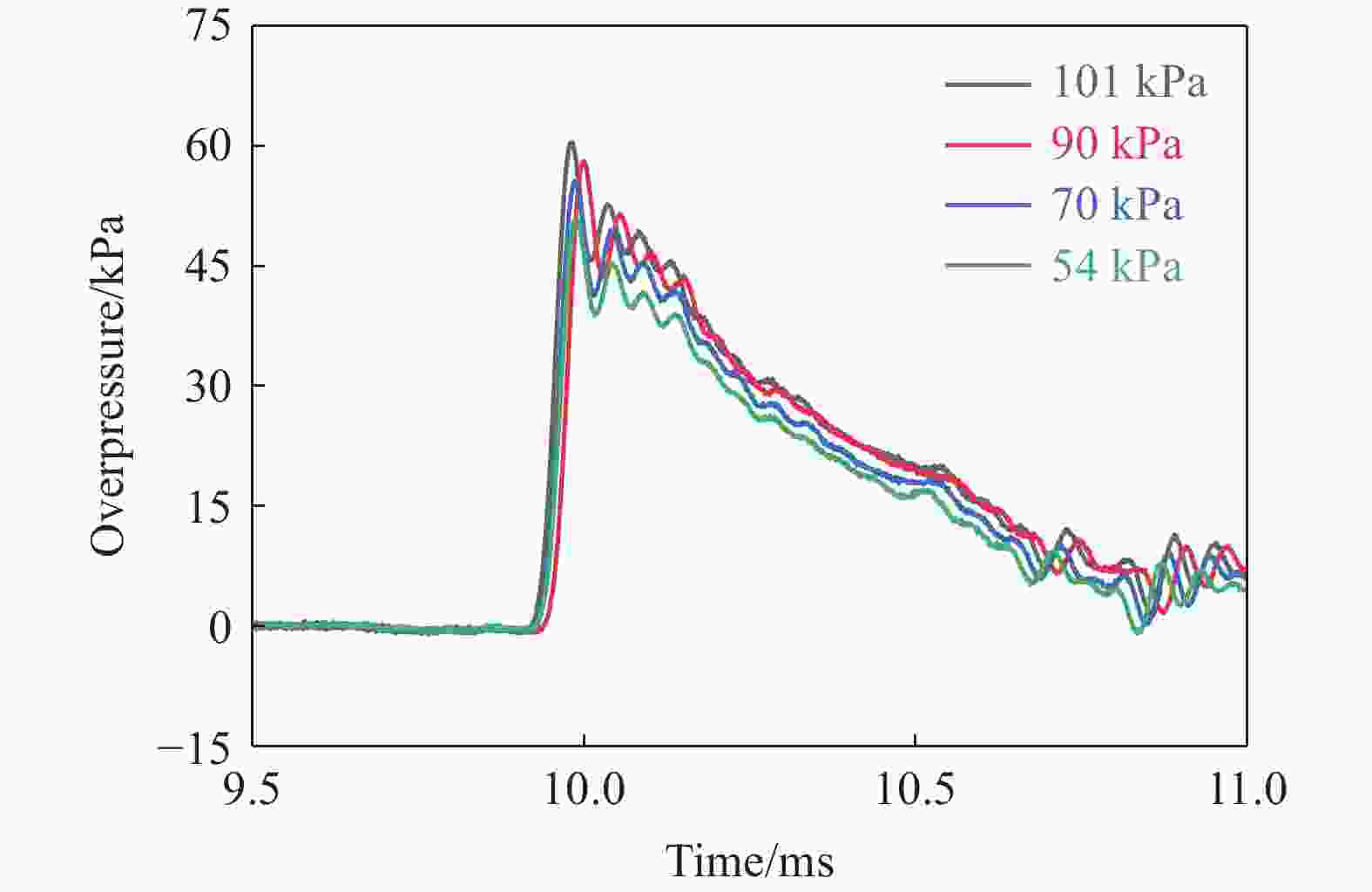
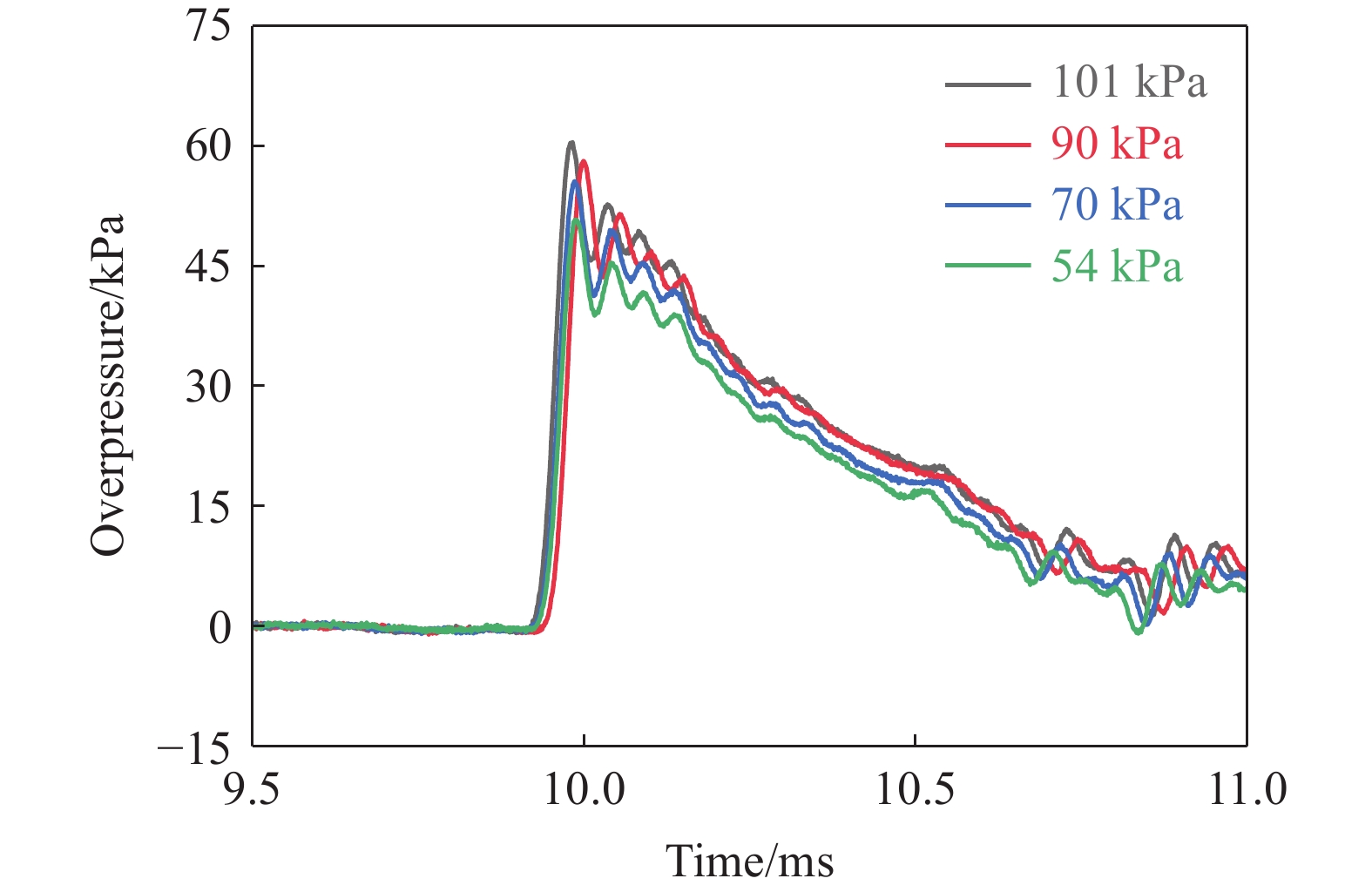
图 2 不同环境气压条件下实验段出口超压时程曲线
Figure 2. Shock wave overpressure time-history curves at the experimental section exit under different ambient pressure conditions
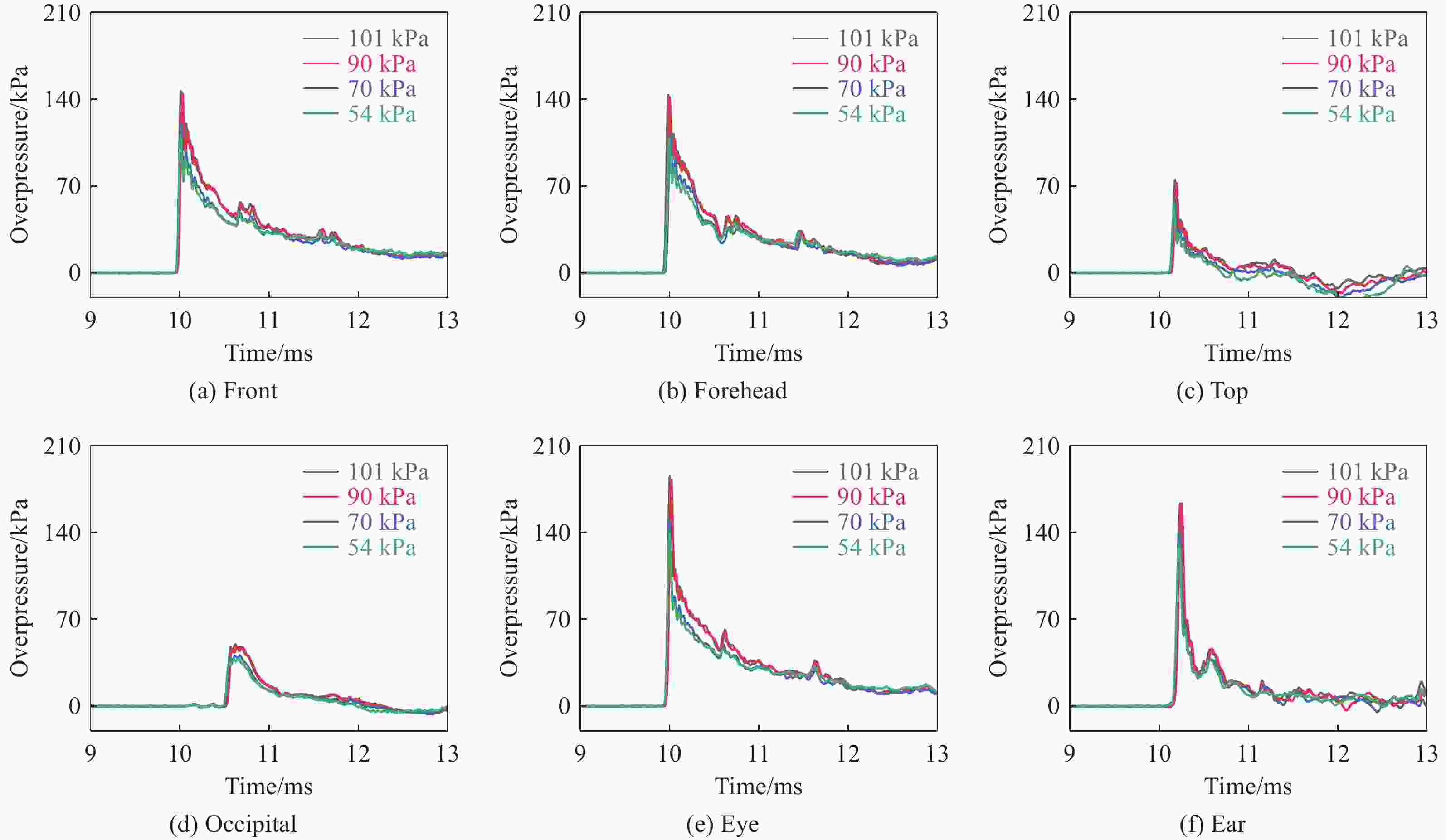
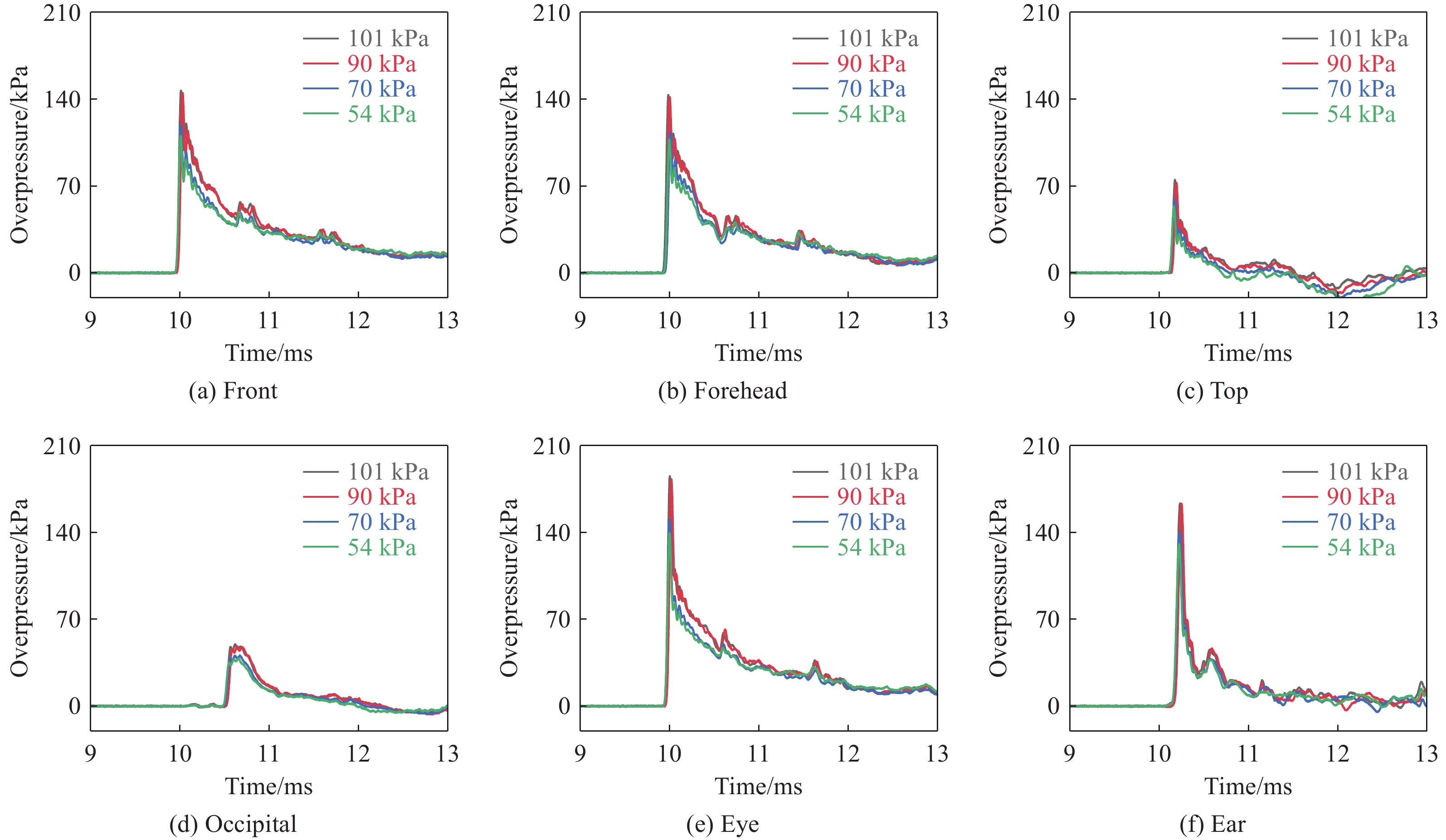
图 3 60 kPa冲击波工况下,不同环境气压下不同测点的冲击波超压时程曲线
Figure 3. Shock wave overpressure time-history curves at different measurement points under different ambient pressures in 60 kPa shock wave case
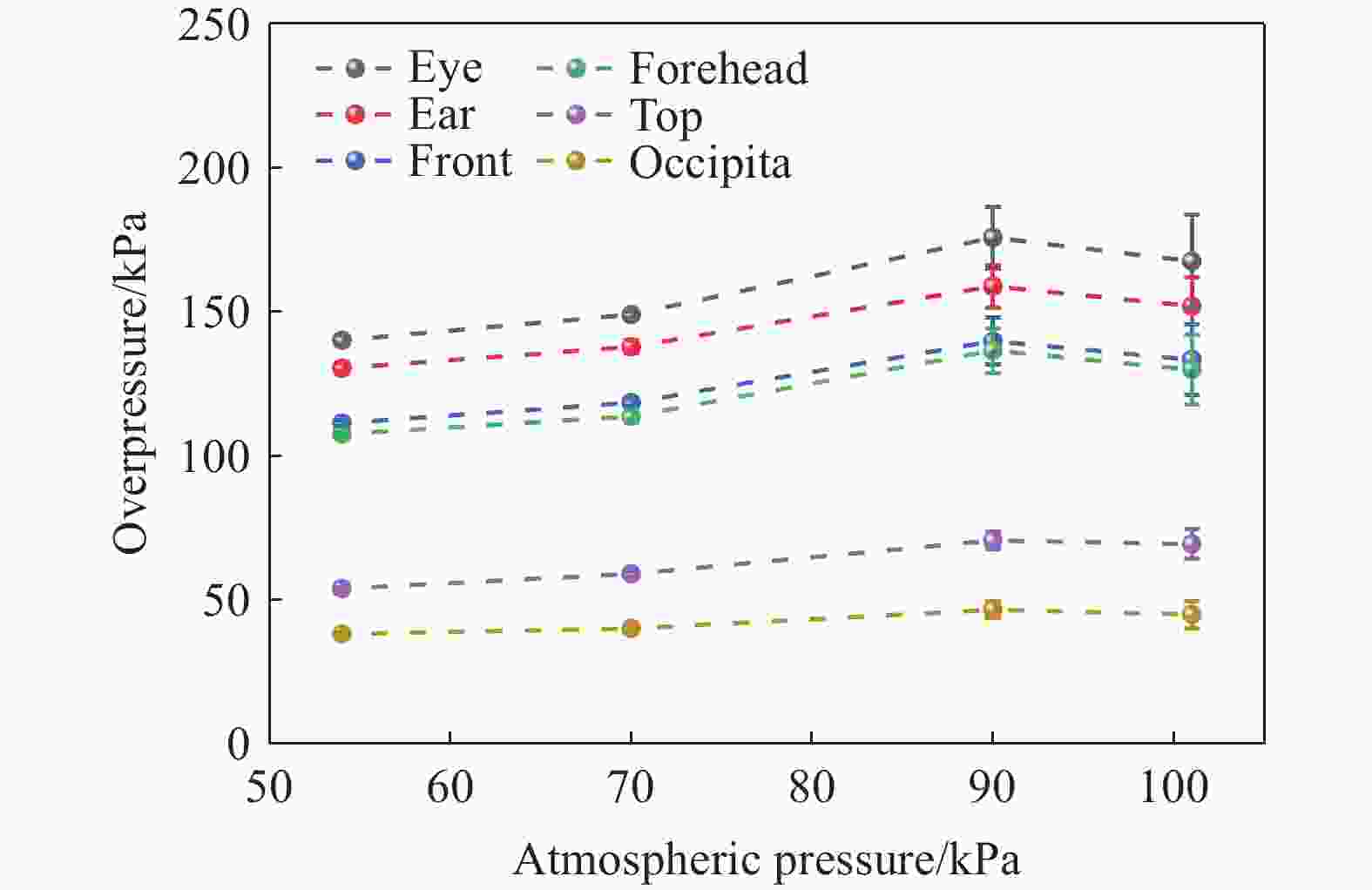
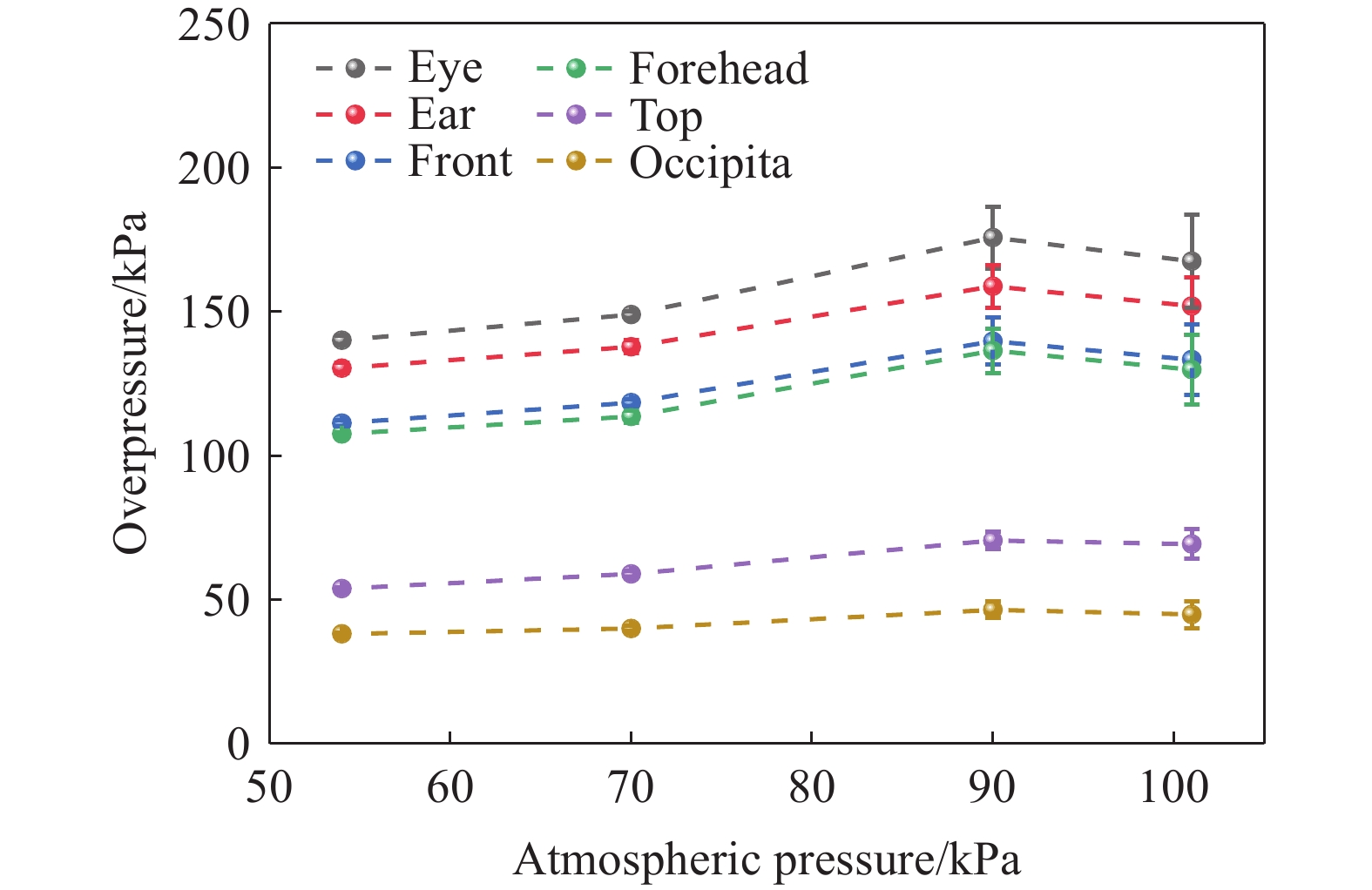
图 4 60 kPa冲击波工况下,不同环境气压下头部表面峰值超压
Figure 4. Peak overpressure on the head surface under different ambient pressures in 60 kPa shock wave case
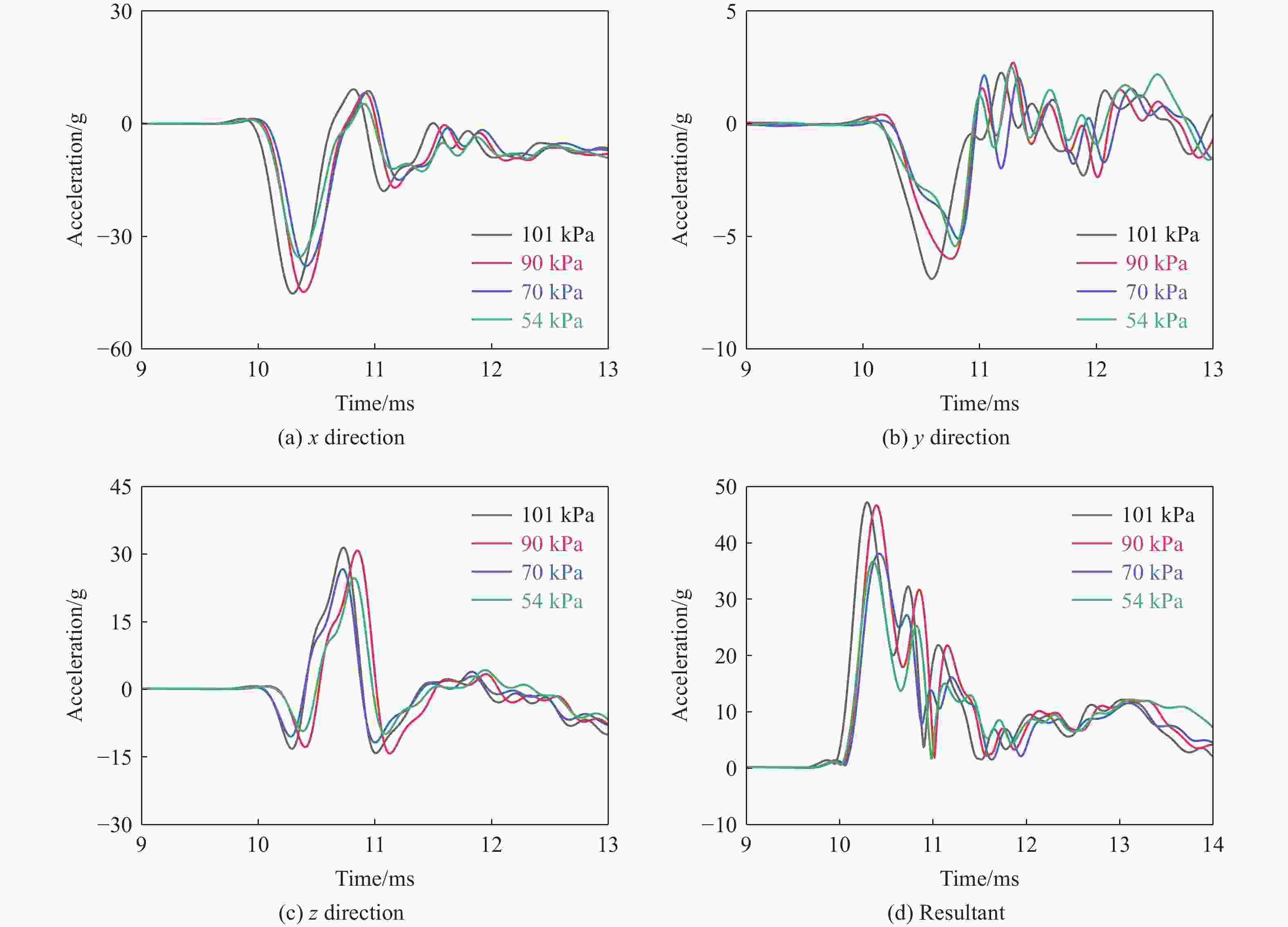
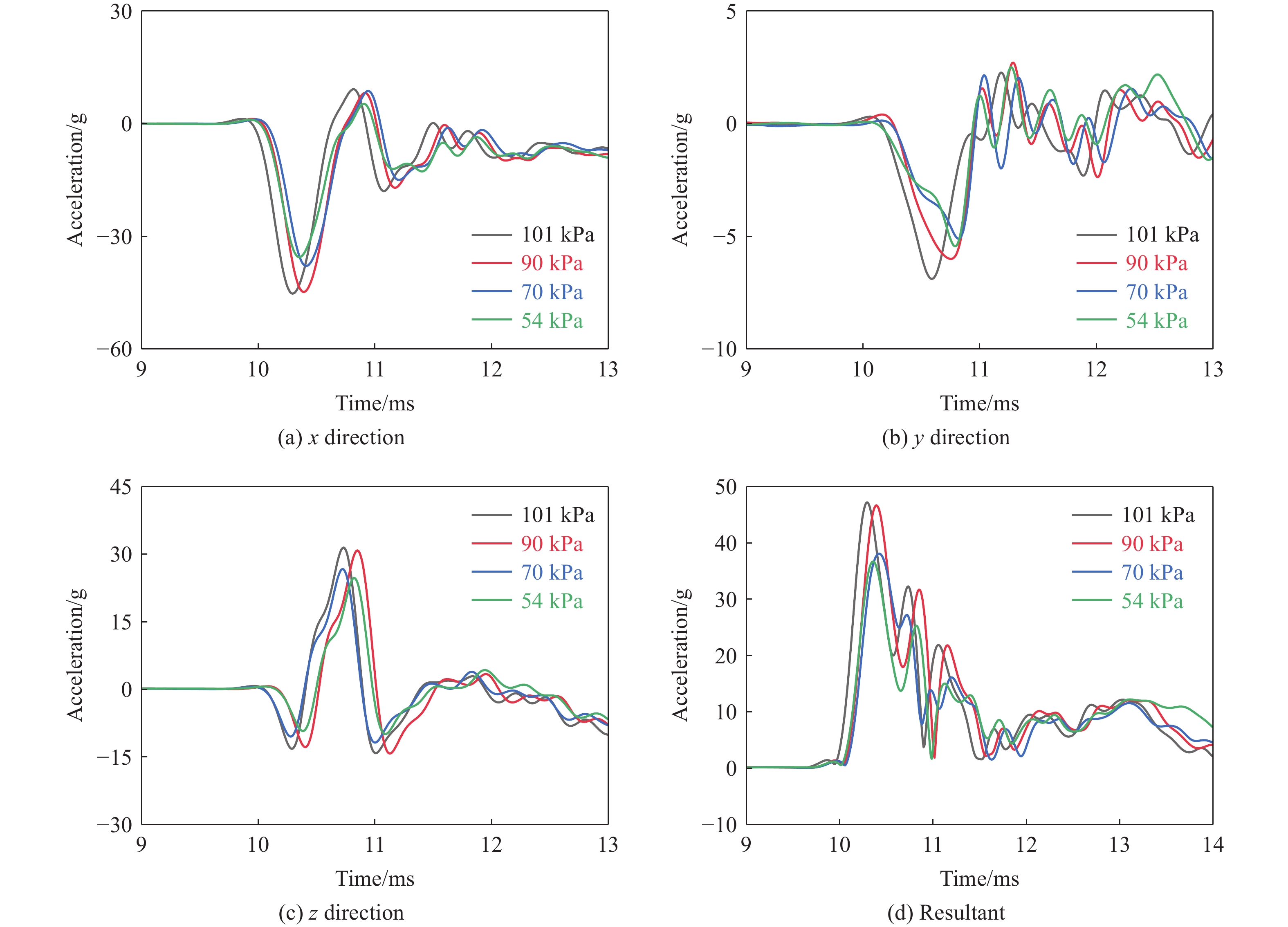
图 5 60 kPa冲击波工况下,不同环境气压条件下头部质心加速度时程曲线
Figure 5. Acceleration time-history curves of the center of mass of the head under different ambient pressure conditions in 60 kPa shock wave case
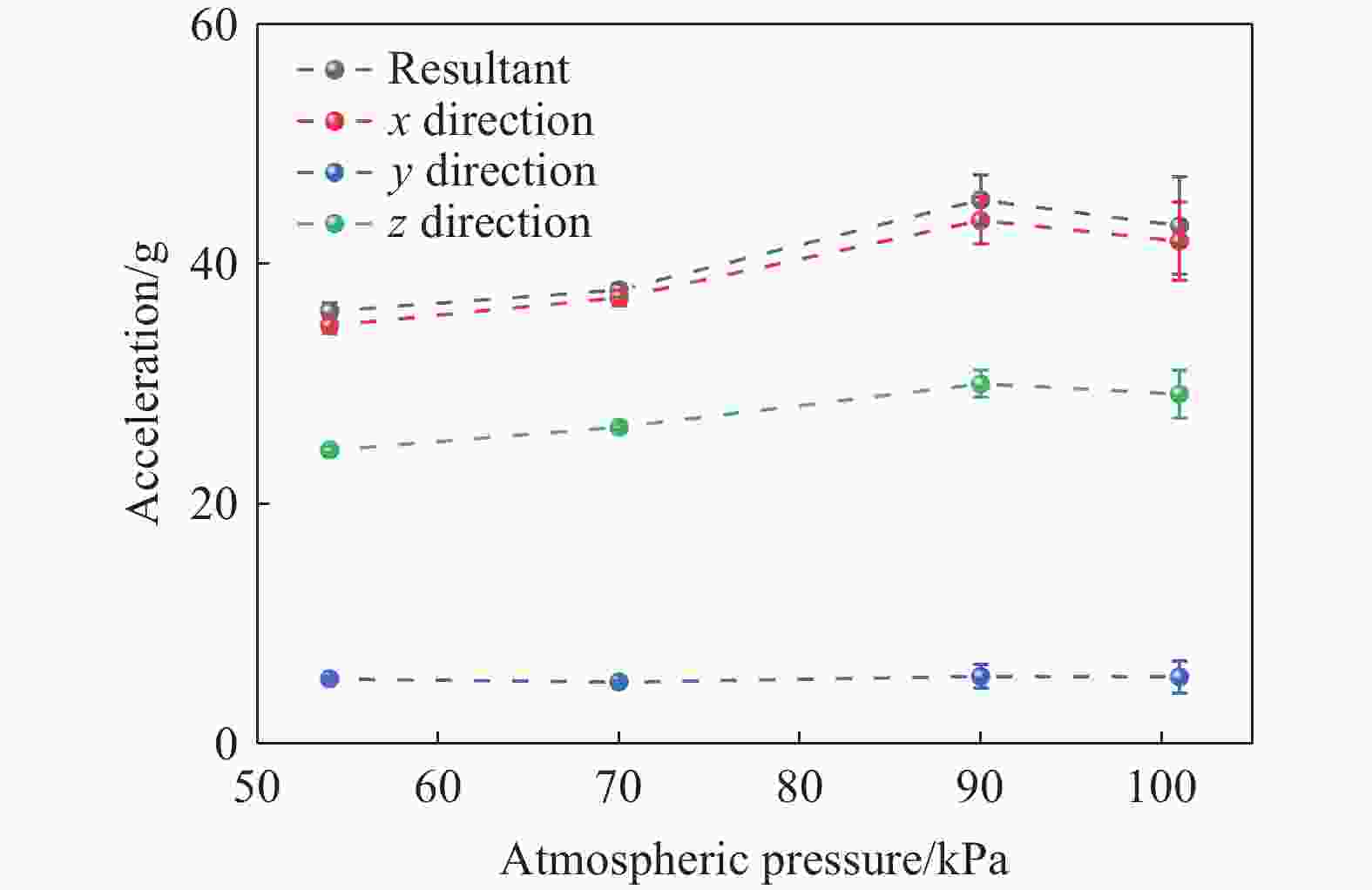
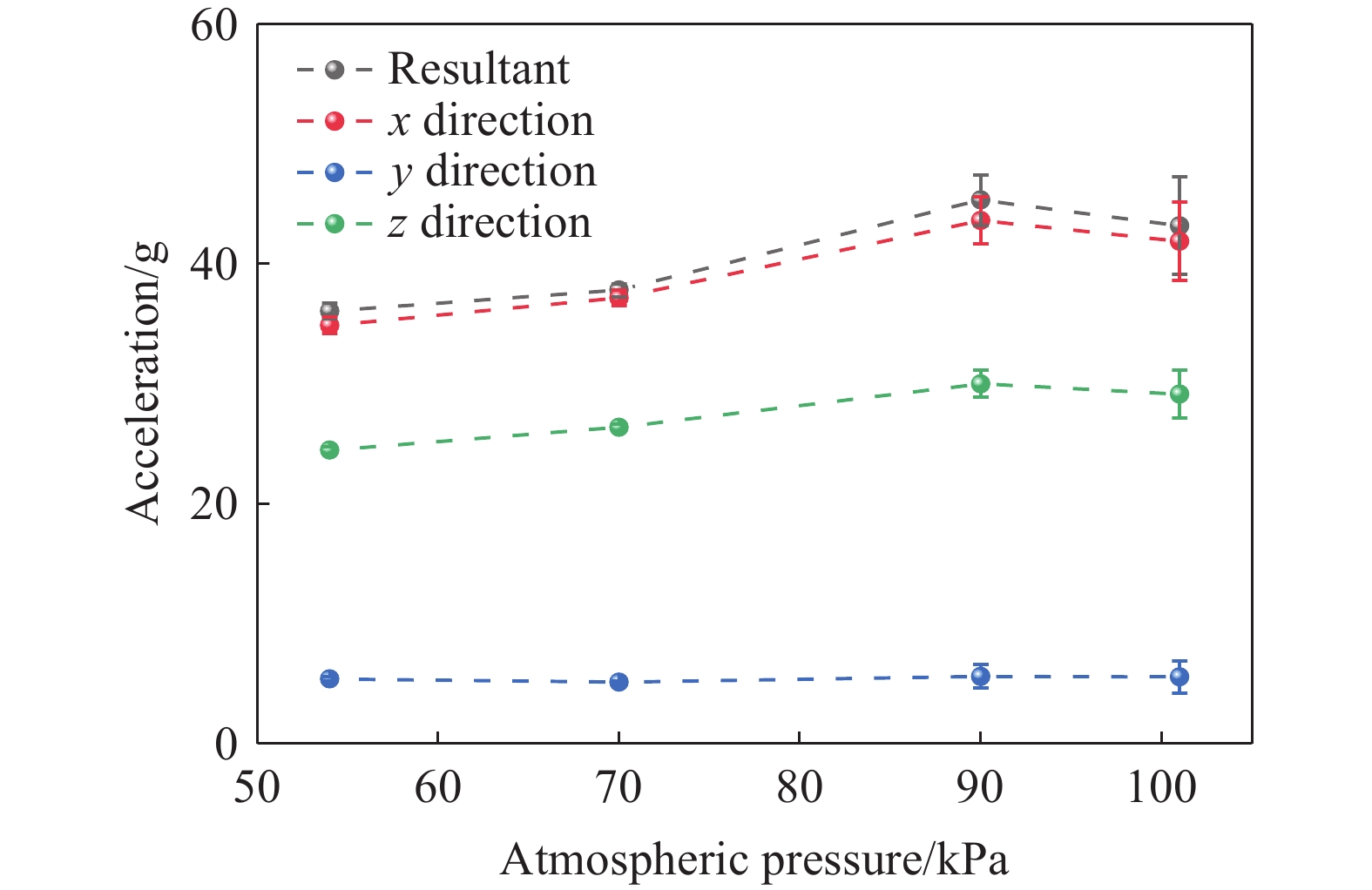
图 6 60 kPa冲击波工况下,不同环境气压下头部质心加速度峰值
Figure 6. Peak Accelerations of the center of mass of the head under different ambient pressure conditions in 60 kPa shock wave case
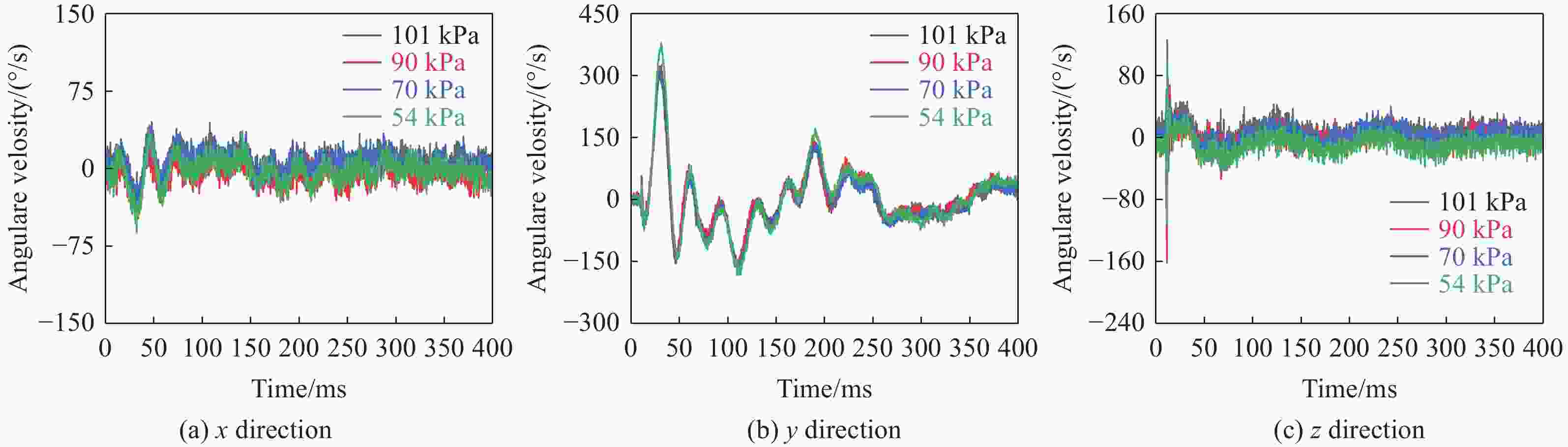
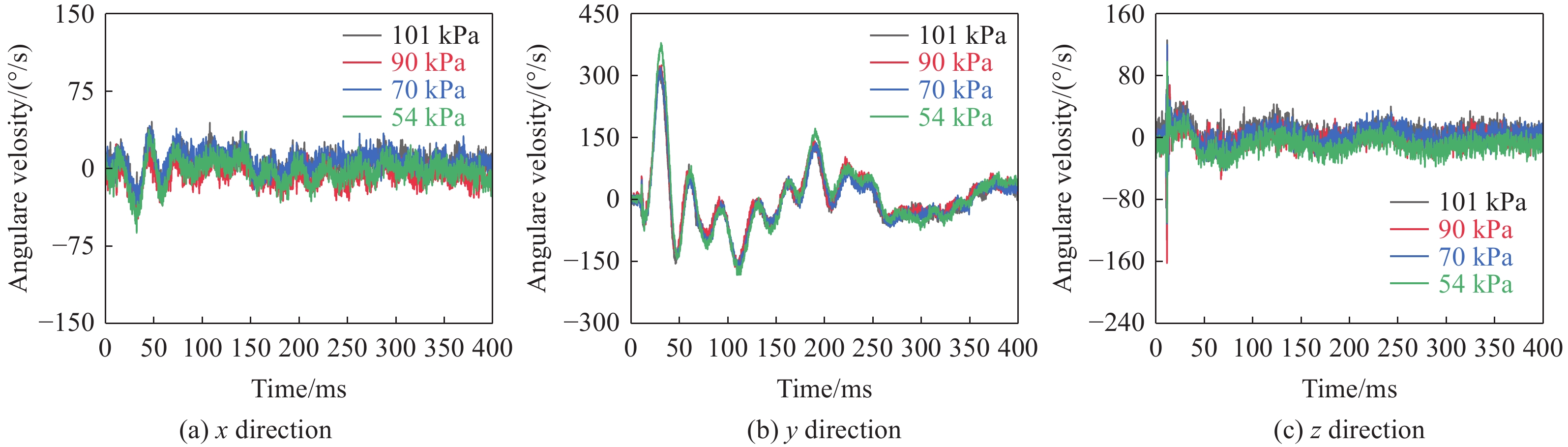
图 7 60 kPa冲击波工况下,不同环境气压条件下头部质心角速度时程曲线
Figure 7. Angular velocity time-history curves of the center of mass of the head under different ambient pressure conditions in 60 kPa shock wave case
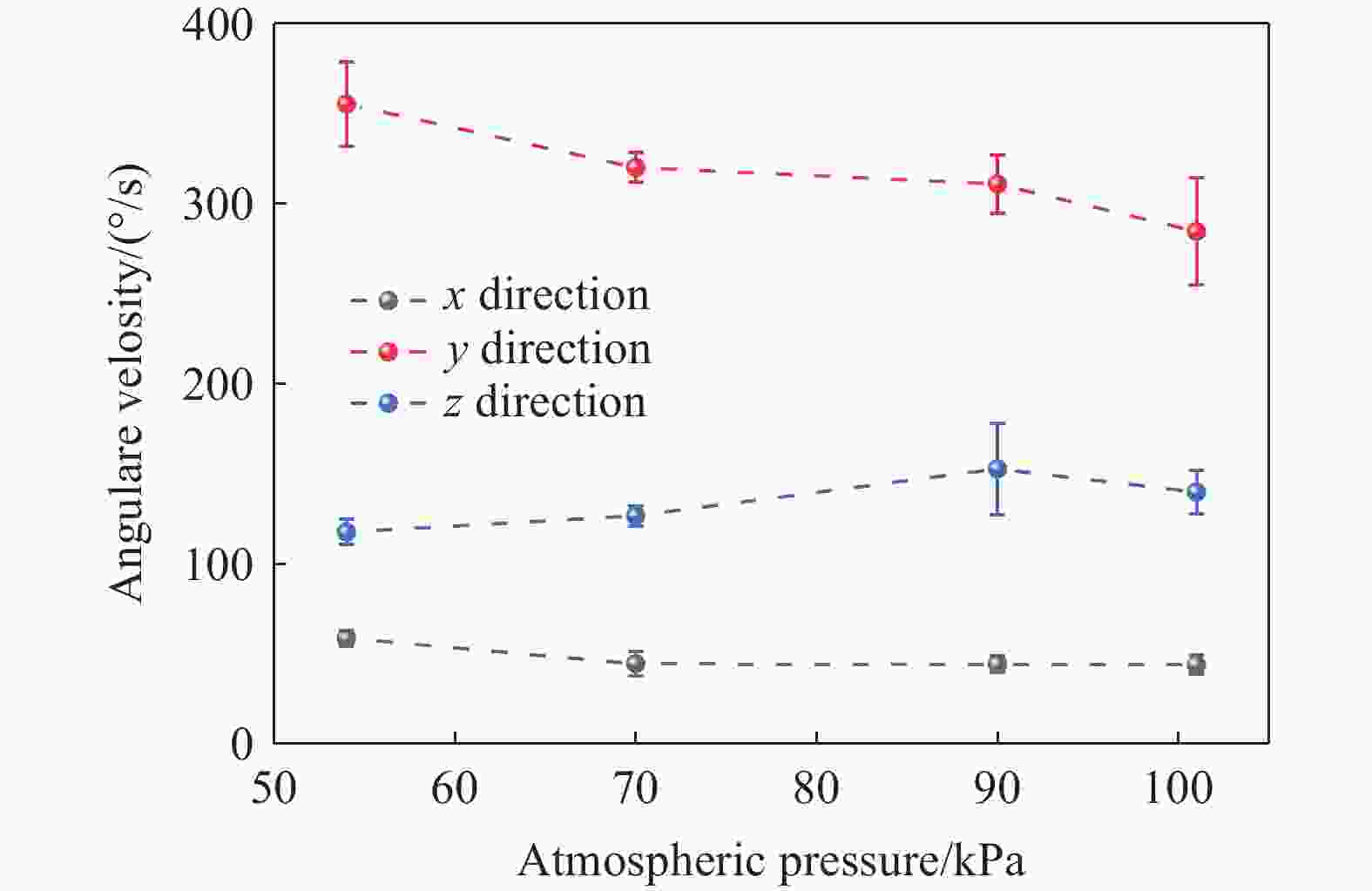
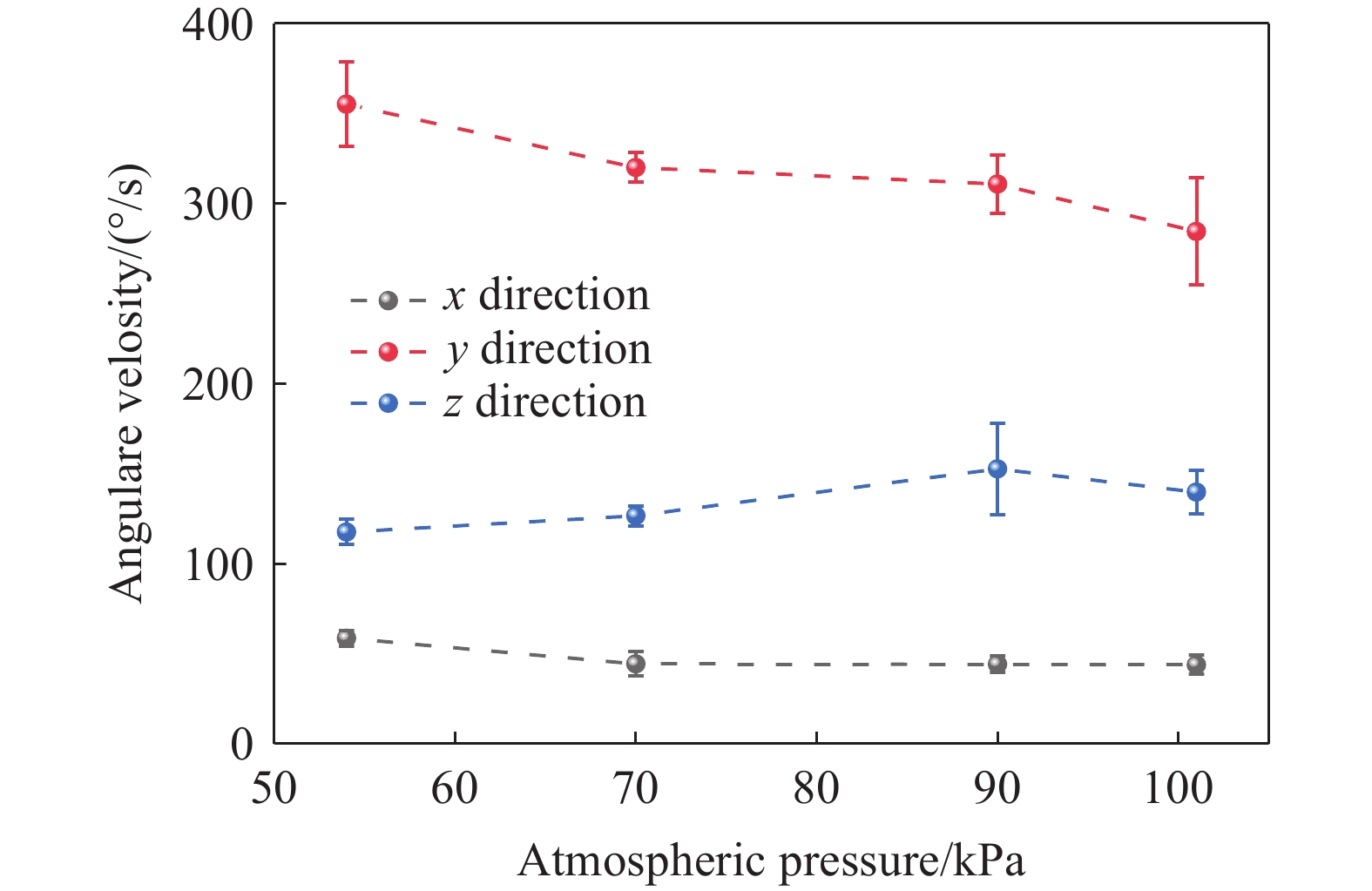
图 8 60 kPa冲击波工况下,不同环境气压下头部质心角速度峰值
Figure 8. Peak angular velocities of the center of mass of the head under different ambient pressure conditions in 60 kPa shock wave case
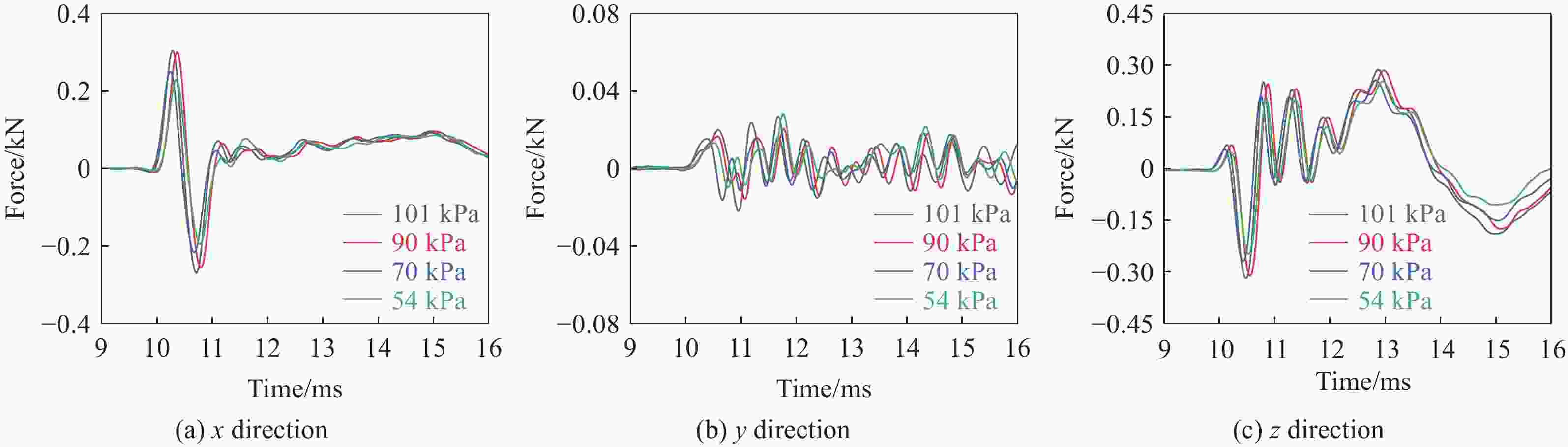
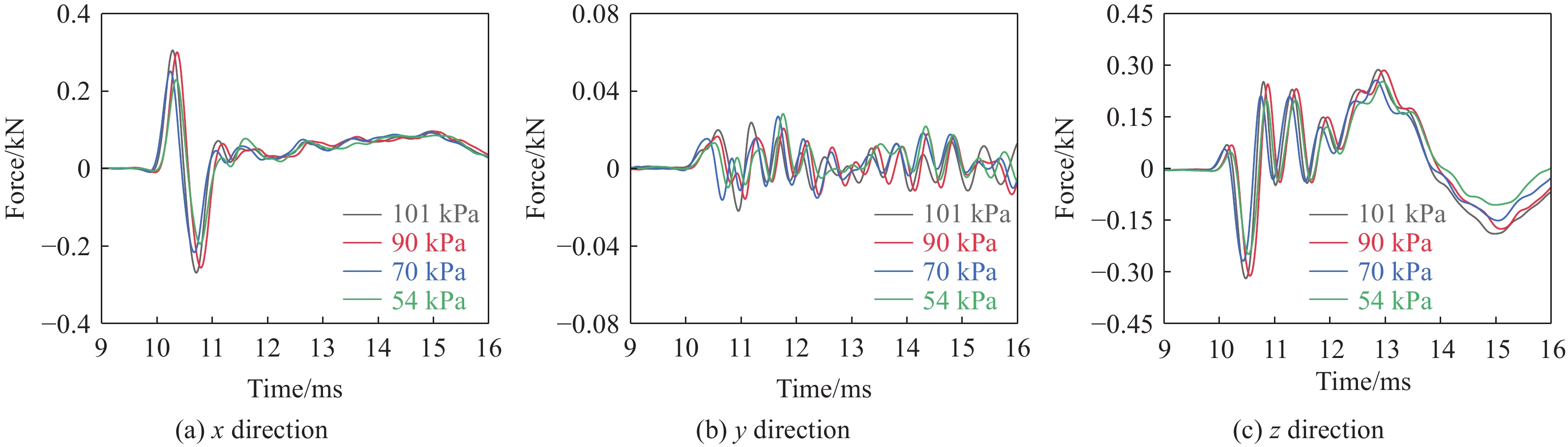
图 9 60 kPa冲击波工况下,不同环境气压条件下颈部力时程曲线
Figure 9. Neck force time-history curves under different ambient pressure conditions in 60 kPa shock wave case
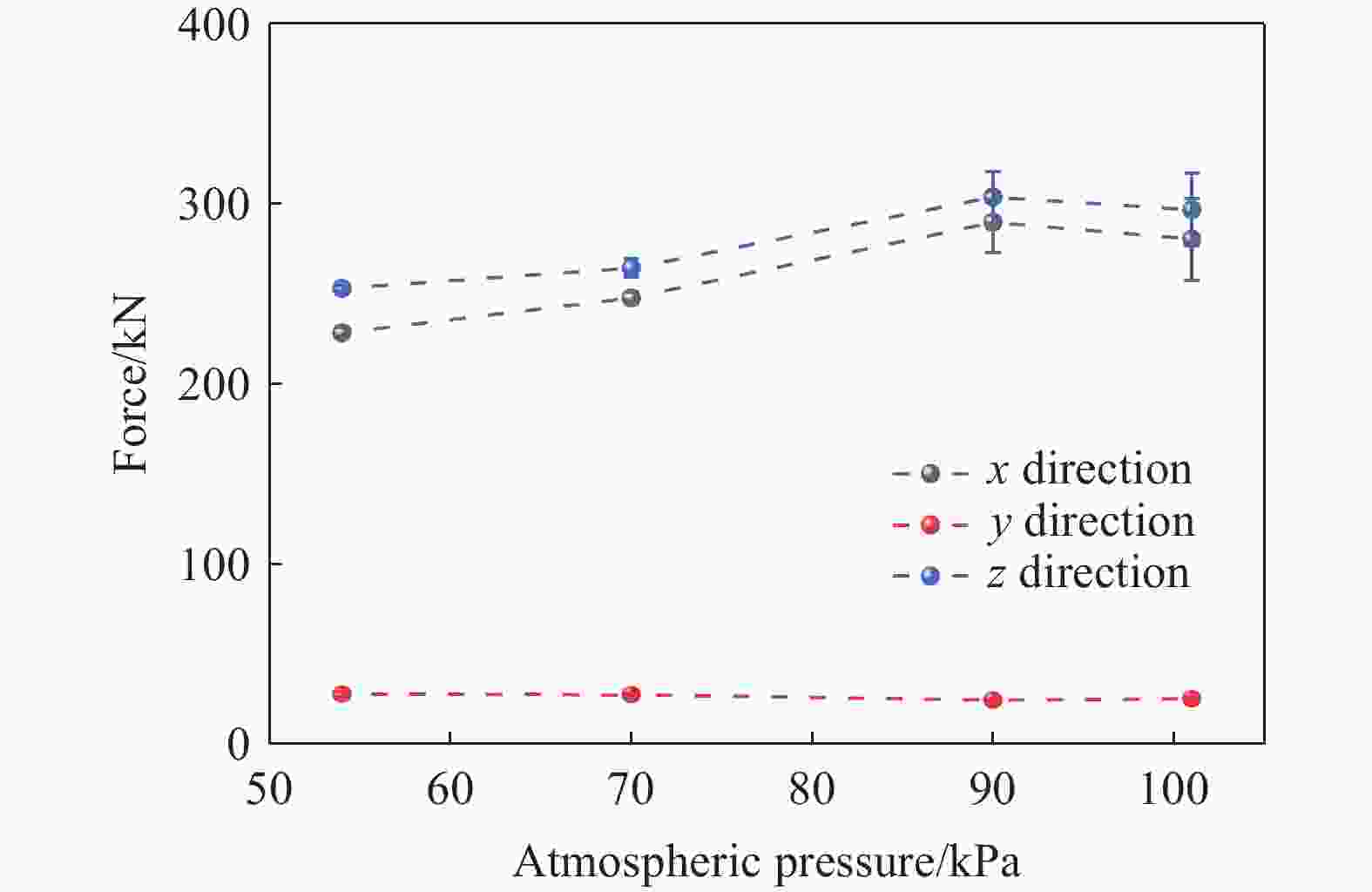
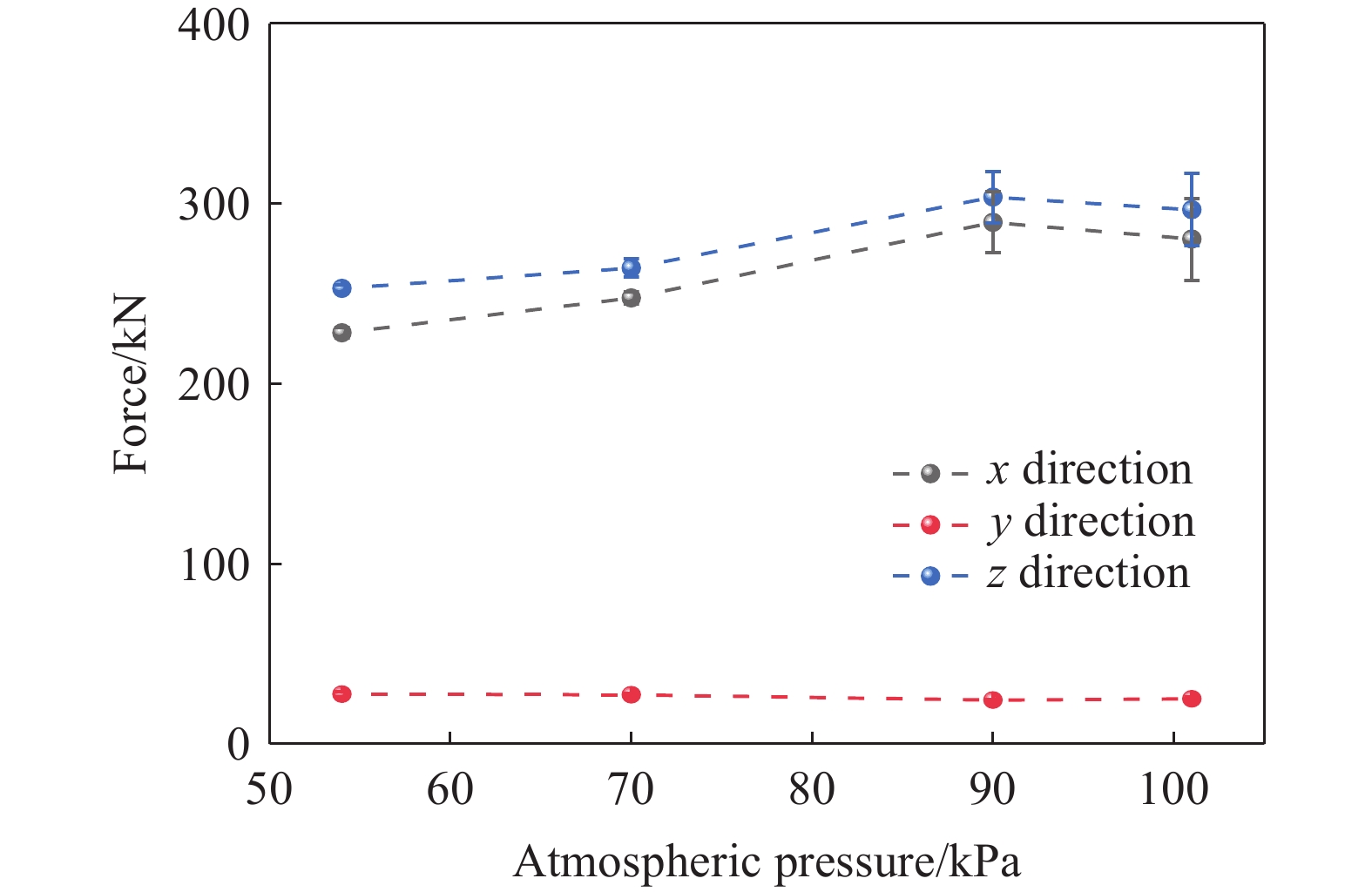
图 10 60 kPa冲击波工况下,不同环境气压条件下颈部力峰值
Figure 10. Peak neck forces under different ambient pressure conditions in 60 kPa shock wave case
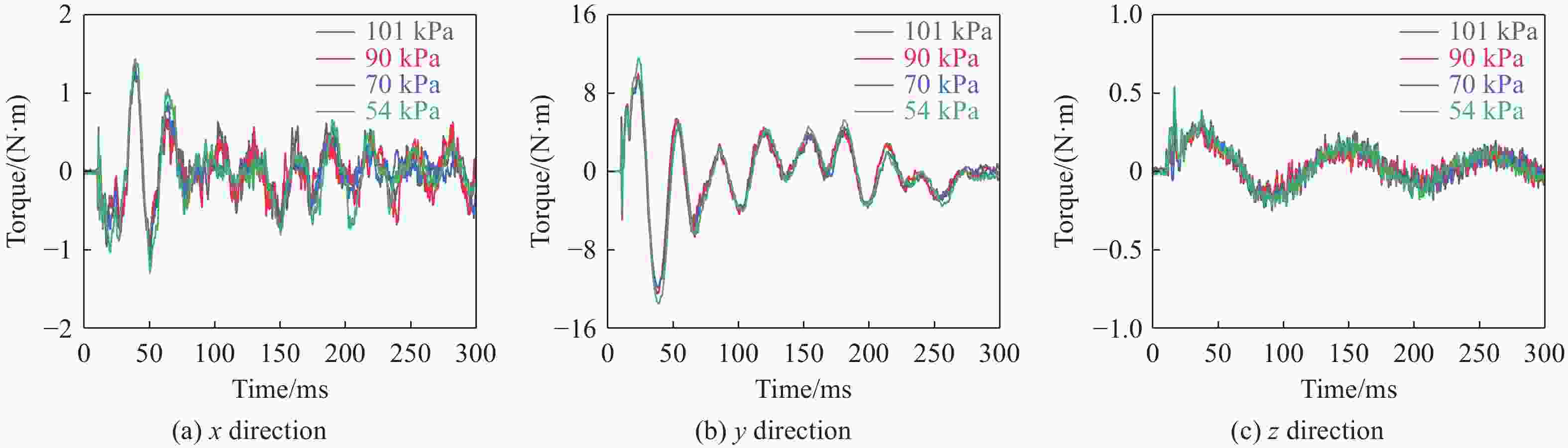
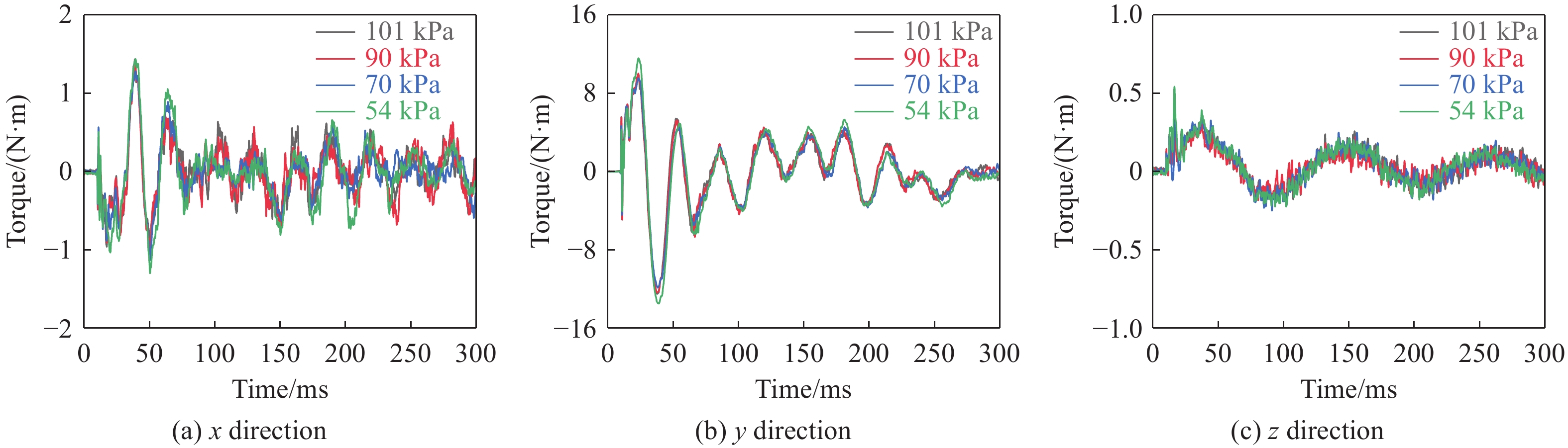
图 11 60 kPa冲击波工况下,不同环境气压条件下颈部扭矩时程曲线
Figure 11. Neck torque time-history curves under different ambient pressure conditions in 60 kPa shock wave case
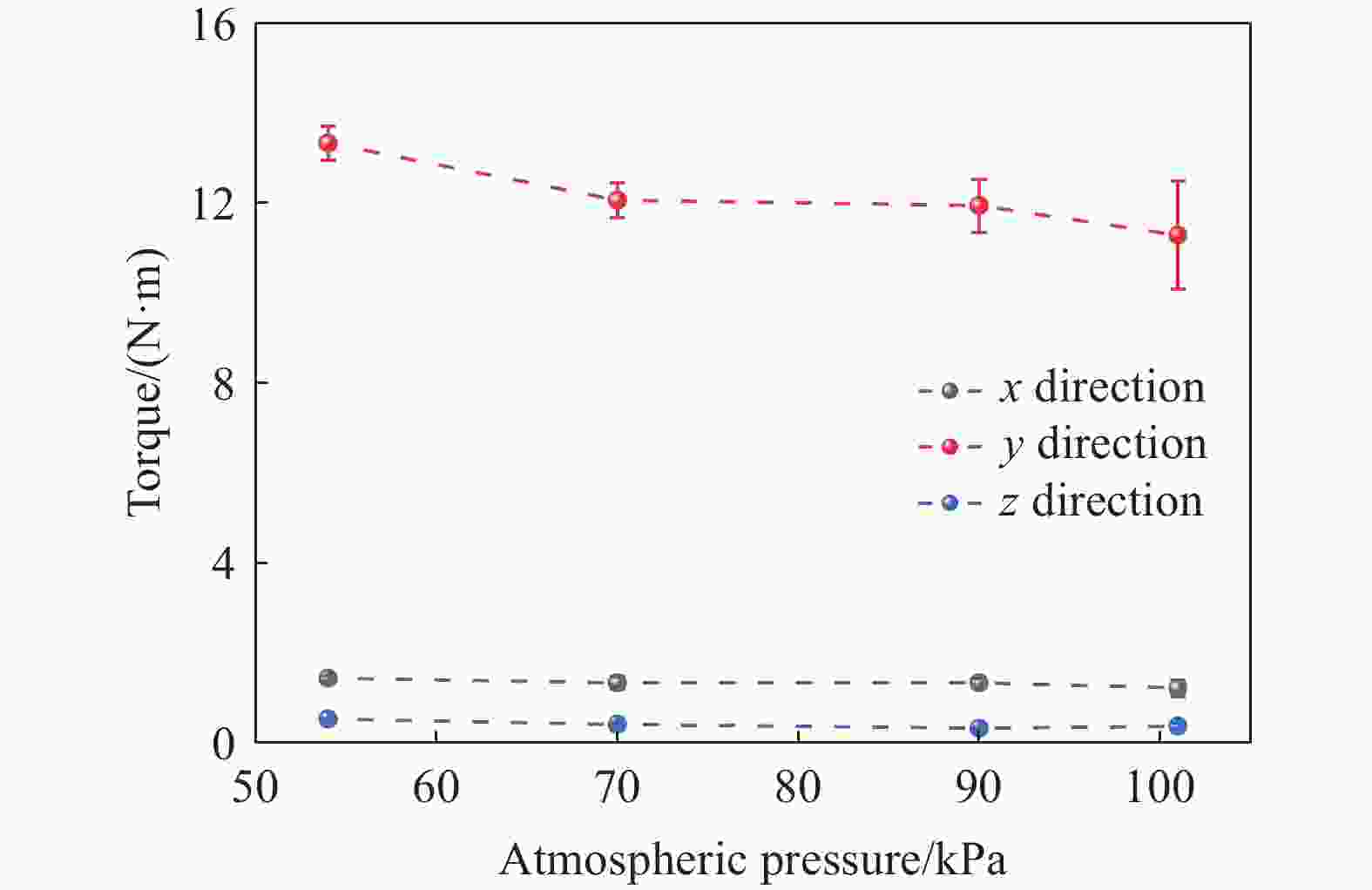
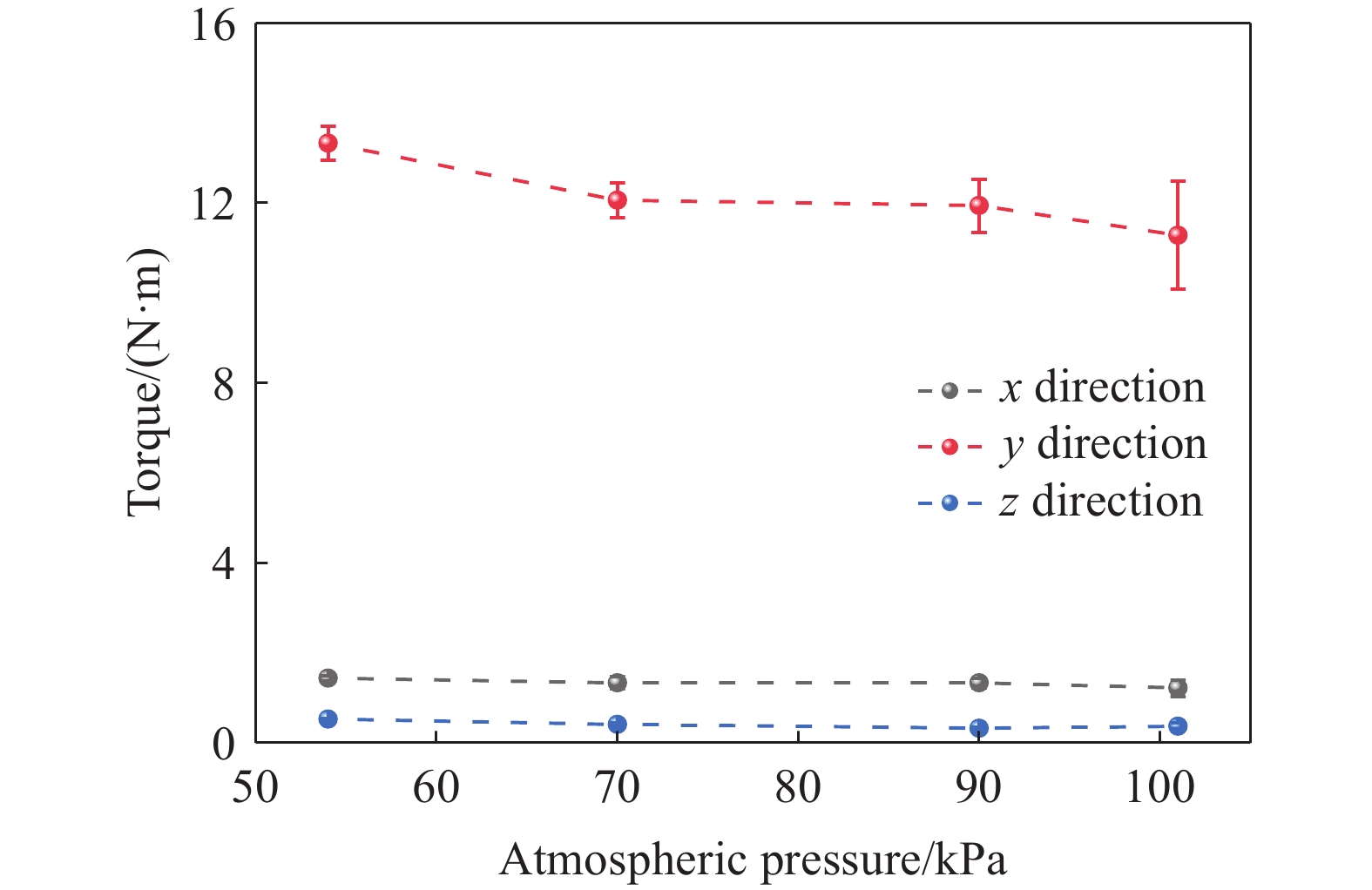
图 12 60 kPa冲击波工况下,不同环境气压条件下颈部扭矩峰值
Figure 12. Peak neck torques under different ambient pressure conditions in 60 kPa shock wave case
表 1 初始实验条件
Table 1. Initial experimental conditions
组别 $ {p}_{\text{d}} $/kPa $ {p}_{\text{t}} $/kPa $ {p}_{\text{e}} $/kPa 1 461 59.0 101 2 431 55.1 89 3 431 51.5 70 4 421 48.9 55  下载: 导出CSV
表 2 激波管实验段压力
Table 2. Pressures in the experimental section of the shock tube
$ {p}_{\text{e}} $/kPa $ {p}_{\text{t}} $/kPa 第1次 第2次 第3次 101 64.6 56.9 54.3 90 62.9 62.1 57.2 70 50.1 49.4 47.7 54 46.8 46.6 46.1
下载: 导出CSV
表 3 激波信息
Table 3. Shock wave information
pe/kPa pt/kPa D/(m·s−1) Ms Δp/kPa 101 59.0 417.4 1.23 59.63 90 55.1 417.4 1.23 52.39 70 51.5 427.4 1.26 47.15 54 48.9 440.9 1.30 43.58
下载: 导出CSV
-
[1] EPSHTEIN E, SHRAGA S, RADOMISLENSKY I, et al. Blast injury and chronic psychiatric disability in military personnel: exploring the association beyond posttraumatic stress disorder [J]. Journal of Psychiatric Research, 2025, 184: 515–521. DOI: 10.1016/j.jpsychires.2025.03.026. [2] 胡勇, 马天, 王俊龙, 等. 针对个体防护的冲击波检测评估技术 [J]. 爆炸与冲击, 2025, 45(4): 041101. DOI: 10.11883/bzycj-2024-0118.HU Y, MA T, WANG J L, et al. Shock wave detection and evaluation techniques for individual protection [J]. Explosion and Shock Waves, 2025, 45(4): 041101. DOI: 10.11883/bzycj-2024-0118. [3] WANG Z W, CHENG F, SHI X Y, et al. Advance on blast-induced traumatic brain injury [J]. World Neurosurgery, 2025, 199: 124115. DOI: 10.1016/j.wneu.2025.124115. [4] SACHDEVA T, GANPULE S G. Twenty years of blast-induced neurotrauma: current state of knowledge [J]. Neurotrauma Reports, 2024, 5(1): 243–253. DOI: 10.1089/neur.2024.0001. [5] 晁望舒, 费晓炜, 李伟萍, 等. 防护风镜对眼爆震伤诱导视网膜病理损伤和自噬变化的有效改善 [J]. 爆炸与冲击, 2024, 44(12): 121441. DOI: 10.11883/bzycj-2024-0257.CHAO W S, FEI X W, LI W P, et al. Effective improvement of retinal pathological injury and autophagy changes induced by explosive eye blast injury by protective goggles [J]. Explosion and Shock Waves, 2024, 44(12): 121441. DOI: 10.11883/bzycj-2024-0257. [6] 王俊龙, 马天, 关家乐, 等. 强冲击环境下人员颅脑损伤的评价方法 [J]. 爆炸与冲击, 2025, 45(10): 102204. DOI: 10.11883/bzycj-2024-0514.WANG J L, MA T, GUAN J L, et al. Evaluation method of human traumatic brain injury in environments of strong shockwave [J]. Explosion and Shock Waves, 2025, 45(10): 102204. DOI: 10.11883/bzycj-2024-0514. [7] 李志敏. 负压环境下炸药爆炸冲击波传播特性及有害效应研究 [D]. 淮南: 安徽理工大学, 2022. DOI: 10.26918/d.cnki.ghngc.2022.000007.LI Z M. Study on propagation characteristics of explosive blast wave and harmful effects of explosive explosion in negative pressure environment [D]. Huainan: Anhui University of Science and Technology, 2022. DOI: 10.26918/d.cnki.ghngc.2022.000007. [8] 谢雪腾. 高原环境爆炸冲击波传播特性的数值模拟与实验研究 [D]. 南京: 南京理工大学, 2017.XIE X T. Numerical simulation and experimental research on propagation characteristics of blast shock wave at plateau environment [D]. Nanjing: Nanjing University of Science & Technology, 2017. [9] 李子涵, 程扬帆, 王浩, 等. 负压环境对乳化炸药爆炸温度场和有害效应的影响 [J]. 爆炸与冲击, 2023, 43(8): 082301. DOI: 10.11883/bzycj-2023-0106.LI Z H, CHENG Y F, WANG H, et al. Influences of negative pressure conditions on the explosion temperature field and harmful effects of emulsion explosive [J]. Explosion and Shock Waves, 2023, 43(8): 082301. DOI: 10.11883/bzycj-2023-0106. [10] YANG H Y, JIANG C D, DING Y C, et al. Research on the influence of high-altitude tunnel environment on gas explosion characteristics and explosion limits [J]. Tunnelling and Underground Space Technology, 2025, 159: 106435. DOI: 10.1016/j.tust.2025.106435. [11] WANG L Q, KONG D R. Research on the distribution characteristics of explosive shock waves at different altitudes [J]. Defence Technology, 2023, 24: 340–348. DOI: 10.1016/j.dt.2022.03.002. [12] 庞春桥, 陶钢, 周佩杰, 等. 高原环境下爆炸冲击波参数的有效预测方法 [J]. 振动与冲击, 2018, 37(14): 221–226. DOI: 10.13465/j.cnki.jvs.2018.14.031.PANG C Q, TAO G, ZHOU P J, et al. Effective method for predicting the parameters of shock waves in plateau environment [J]. Journal of Vibration and Shock, 2018, 37(14): 221–226. DOI: 10.13465/j.cnki.jvs.2018.14.031. [13] 李福龙, 孔德仁, 王良全, 等. 海拔高度对化爆冲击波压力分布规律影响分析 [J]. 兵器装备工程学报, 2024, 45(2): 158–165. DOI: 10.11809/bqzbgcxb2024.02.020.LI F L, KONG D R, WANG L Q, et al. Analysis of the effect of altitude on the pressure distribution pattern of chemical explosion shock wave [J]. Journal of Ordnance Equipment Engineering, 2024, 45(2): 158–165. DOI: 10.11809/bqzbgcxb2024.02.020. [14] 陈龙明, 李志斌, 陈荣, 等. 高原环境爆炸冲击波传播特性的实验研究 [J]. 爆炸与冲击, 2022, 42(5): 053206. DOI: 10.11883/bzycj-2021-0279.CHEN L M, LI Z B, CHEN R, et al. An experimental study on propagation characteristics of blast waves under plateau environment [J]. Explosion and Shock Waves, 2022, 42(5): 053206. DOI: 10.11883/bzycj-2021-0279. [15] 李孝臣, 汪泉, 谢守冬, 等. 负压条件下球形爆炸容器内乳化炸药冲击波参数研究 [J]. 火炸药学报, 2023, 46(3): 252–259. DOI: 10.14077/j.issn.1007-7812.202207001.LI X C, WANG Q, XIE S D, et al. Study of shock wave parameters of emulsified explosives in spherical explosive containers under negative-pressure conditions [J]. Chinese Journal of Explosives & Propellants, 2023, 46(3): 252–259. DOI: 10.14077/j.issn.1007-7812.202207001. [16] WANG F Q, WANG Q, WANG Y J, et al. Propagation rules of shock waves in confined space under different initial pressure environments [J]. Scientific Reports, 2022, 12(1): 14352. DOI: 10.1038/s41598-022-18567-0. [17] VELDMAN R L, NANSTEEL M W, CHEN C C T, et al. The effect of ambient pressure on blast reflected impulse and overpressure [J]. Experimental Techniques, 2017, 41(3): 227–236. DOI: 10.1007/s40799-017-0171-8. [18] LIU C J, LI H J, WANG Z, et al. Experimental and numerical simulation of the attenuation effect of blast shock waves in tunnels at different altitudes [J]. Defence Technology, 2025, 43: 120–141. DOI: 10.1016/j.dt.2024.07.005. [19] 李志敏, 汪旭光, 汪泉, 等. 负压环境对炸药爆炸冲击波影响的实验研究 [J]. 火炸药学报, 2021, 44(1): 35–40. DOI: 10.14077/j.issn.1007-7812.202007025.LI Z M, WAGN X G, WANG Q, et al. Experimental study on the effect of negative pressure environment on explosion shock wave [J]. Chinese Journal of Explosives & Propellants, 2021, 44(1): 35–40. DOI: 10.14077/j.issn.1007-7812.202007025. [20] 李瑞, 李孝臣, 汪泉, 等. 低温和低压环境下炸药爆炸冲击波的传播特性 [J]. 爆炸与冲击, 2023, 43(2): 022301. DOI: 10.11883/bzycj-2022-0188.LI R, LI X C, WANG Q, et al. Propagation characteristics of blast wave in diminished ambient temperature and pressure environments [J]. Explosion and Shock Waves, 2023, 43(2): 022301. DOI: 10.11883/bzycj-2022-0188. [21] LI R, SUN R, HU M H, et al. Blast characteristics of center-initiated cylindrical charge in high-altitude environments [J]. AIP Advances, 2025, 15(3): 035352. DOI: 10.1063/5.0267319. [22] 李瑞, 杨耀勇, 汪泉, 等. 高海拔环境下运动装药的爆炸冲击波特性 [J]. 火炸药学报, 2024, 47(2): 159–171. DOI: 10.14077/j.issn.1007-7812.202305014.LI R, YANG Y Y, WANG Q, et al. Blast wave characteristics of moving charge at high-altitude environment [J]. Chinese Journal of Explosives & Propellants, 2024, 47(2): 159–171. DOI: 10.14077/j.issn.1007-7812.202305014. [23] CHEN L, LI Z, CHEN R, et al. Propagation characteristics of blast shock waves in low-pressure environment [J]. Shock Waves, 2023, 33(1): 61–74. DOI: 10.1007/s00193-022-01116-z. [24] 邓国强. 常规爆炸空气冲击波参数海拔高度影响分析 [J]. 防护工程, 2019, 41(3): 26–32.DENG G Q. Analysis on the altitude effects of air shock wave parameters of conventional explosion [J]. Protective Engineering, 2019, 41(3): 26–32. [25] 朱冠南. 高空环境下膛口流场研究 [D]. 南京: 南京理工大学, 2014.ZHU G N. Study on muzzle flow field in simulated low pressure environment [D]. Nanjing: Nanjing University of Science & Technology, 2014. [26] 朱冠南, 王争论, 马佳佳, 等. 低压环境下膛口冲击波实验研究 [J]. 兵工学报, 2014, 35(6): 808–813. DOI: 10.3969/j.issn.1000-1093.2014.06.009.ZHU G N, WANG Z L, MA J J, et al. Research on muzzle shock wave in low pressure environment [J]. Acta Armamentarii, 2014, 35(6): 808–813. DOI: 10.3969/j.issn.1000-1093.2014.06.009. [27] 康越, 马天, 王俊龙, 等. 不同海拔高度炮口冲击波动态演化特性数值模拟研究 [J]. 爆炸与冲击, 2024, 44(12): 121421. DOI: 10.11883/bzycj-2024-0108.KANG Y, MA T, WANG J L, et al. Numerical simulation study on the dynamic evolution characteristics of muzzle shock waves at different altitudes [J]. Explosion and Shock Waves, 2024, 44(12): 121421. DOI: 10.11883/bzycj-2024-0108. [28] 王峰, 杨志焕, 朱佩芳, 等. 高原冲击伤伤情特点的实验研究 [J]. 创伤外科杂志, 2008, 10(6): 549–551. DOI: 10.3969/j.issn.1009-4237.2008.06.026.WANG F, YANG Z H, ZHU P F, et al. Experimental study on characteristics of blast injury at high altitude [J]. Journal of Traumatic Surgery, 2008, 10(6): 549–551. DOI: 10.3969/j.issn.1009-4237.2008.06.026. [29] 王峰. 特殊环境冲击伤的伤情特点和治疗研究 [D]. 重庆: 第三军医大学, 2008.WANG F. The characteristics and interventions study of the blast injury at high altitude and under water [D]. Chongqing: Third Military Medical University, 2008. [30] 王俊龙, 康越, 关家乐, 等. 强冲击环境下头盔冲击波防护性能评估 [J]. 兵工学报, 2026, 47(3): 182–196. DOI: 10.12382/bgxb.2025.0444.WANG J L, KANG Y, GUAN J L, et al. Assessment of the blast wave protection performance of helmets in strong shock environments [J]. Acta Armamentarii, 2026, 47(3): 182–196. DOI: 10.12382/bgxb.2025.0444. [31] 颜凌波, 解文娜, 许伟, 等. 正面碰撞中基于中国人体尺寸的假人损伤响应研究 [J]. 汽车工程, 2019, 41(3): 289–297. DOI: 10.19562/j.chinasae.qcgc.2019.03.008.YAN L B, XIE W N, XU W, et al. Injury responses of the dummy based on Chinese anthropometric data in frontal crash [J]. Automotive Engineering, 2019, 41(3): 289–297. DOI: 10.19562/j.chinasae.qcgc.2019.03.008. [32] 汤骏. 基于中国人体尺寸假人头部仿真研究 [D]. 长沙: 湖南大学, 2016.TANG J. Simulation study on Chinese dummy head model [D]. Changsha: Hunan University, 2016. [33] 石波. 爆炸冲击工况下基于中国人体体征的乘员损伤研究 [D]. 长沙: 湖南大学, 2022. DOI: 10.27135/d.cnki.ghudu.2022.001036.SHI B. Study on occupant injury based on Chinese body signs under blast impact condition [D]. Changsha: Hunan University, 2022. DOI: 10.27135/d.cnki.ghudu.2022.001036. [34] WANG J L, KANG Y, GUAN J L, et al. Investigation of the uniformity of explosive shock wave fronts in variable cross-section shock tubes [C]//2024 4th International Conference on Electronic Information Engineering and Computer (EIECT). Shenzhen, China: IEEE, 2024: 880–883. DOI: 10.1109/EIECT64462.2024.10867126. [35] 张仕忠, 李进平, 康越, 等. 激波管模拟产生近场爆炸冲击波 [J]. 爆炸与冲击, 2024, 44(12): 121434. DOI: 10.11883/bzycj-2024-0204.ZHANG S Z, LI J P, KANG Y, et al. Generation of near-field blast wave by means of shock tube [J]. Explosion and Shock Waves, 2024, 44(12): 121434. DOI: 10.11883/bzycj-2024-0204. [36] AEP-55 VOL 2: 2011 Procedures for evaluating the protection level of armoured vehicles-volume 2: mine threat [S]. North Atlantic Treaty Organization, 2011. [37] 邓志龙. 高原冲击伤伤情特点和治疗研究 [D]. 重庆: 第三军医大学, 2004.DENG Z L. The characteristics and interventions study of the blast injury at high altitude [D]. Chongqing: Third Military Medical University, 2004. [38] GANPULE S, SALZAR R, PERRY B, et al. Role of helmets in blast mitigation: insights from experiments on PMHS surrogate [J]. International Journal of Experimental and Computational Biomechanics, 2016, 4(1): 13–31. DOI: 10.1504/ijecb.2016.081745. [39] 张文超, 王舒, 梁增友, 等. 爆炸冲击波致颅脑冲击伤数值模拟研究 [J]. 北京理工大学学报, 2022, 42(9): 881–890. DOI: 10.15918/j.tbit1001-0645.2021.191.ZHANG W C, WAGN S, LIANG Z Y, et al. Numerical simulation on traumatic brain injury induced by blast waves [J]. Transactions of Beijing Institute of Technology, 2022, 42(9): 881–890. DOI: 10.15918/j.tbit1001-0645.2021.191. [40] SKOTAK M, ALAY E, ZHENG J Q, et al. Effective testing of personal protective equipment in blast loading conditions in shock tube: comparison of three different testing locations [J]. PLoS One, 2018, 13(6): e0198968. DOI: 10.1371/journal.pone.0198968. [41] 高玉刚, 赵晓莉, 徐龙, 等. 高海拔压力环境对炸药猛度影响的实验研究 [J]. 火工品, 2013(5): 36–39. DOI: 10.3969/j.issn.1003-1480.2013.05.009.GAO Y G, ZHAO X L, XU L, et al. Experimental research on brisance of explosive in simulated high altitude environment [J]. Initiators & Pyrotechnics, 2013(5): 36–39. DOI: 10.3969/j.issn.1003-1480.2013.05.009. [42] 王正国, 蒋建新. 爆炸冲击伤原理与实践 [M]. 北京: 人民卫生出版社, 2020.WANG Z G, JIANG J X. Explosive blast injury principles and practices [M]. Beijing: People's Medical Publishing House, 2020. [43] 张雷廷, 余静, 王海燕, 等. 基于相同伤情的小鼠平原和高原严重冲击伤致伤参数研究 [J]. 中华危重病急救医学, 2022, 34(10): 1076–1081. DOI: 10.3760/cma.j.cn121430-20220907-00826.ZHANG L T, XU J, WANG H Y, et al. Study on injury parameters of severe blast injury in mice at plain and plateau based on equivalent trauma [J]. Chinese Critical Care Medicine, 2022, 34(10): 1076–1081. DOI: 10.3760/cma.j.cn121430-20220907-00826. -

计量
- 文章访问数: 583
- HTML全文浏览量: 165
- PDF下载量: 150
- 被引次数: 0